5 Types of Podcasts That Help Improve Your English
Exam Preparation
Your commute or evening walk already gives you listening time, and English podcasts turn it into real spoken English at your own level. Pearson, the company that runs PTE, named five podcasts on July 17, 2021, and a second set in its listening-skills article that same month. Below, those picks and additional shows are sorted by podcast types and by level.
The listings describe show formats and suggested practice. Level groupings are EasyEnglish guidance unless attributed to Pearson’s 2021 article, not assessed CEFR ratings. Check the publisher for current episodes, transcripts and access terms.
These five groupings offer different kinds of listening practice.
- Learner lesson podcasts teach clear English on purpose.
- Kids' explainer podcasts answer questions through stories and explanations; their language can still be challenging.
- True-crime and interview podcasts bring many accents into one show.
- Storytelling and culture podcasts give you long, natural stories.
- News, science and business podcasts build words for work and study.
Table of Contents
Does Listening to Podcasts Improve English?
Yes, podcasts improve your English, and Pearson calls them great practice for the PTE Academic Listening section, where you answer questions on audio clips and video clips. Conversational shows let you hear real-life English as people actually speak it. Pearson's advice is to set a daily goal of listening to authentic English, starting at a comfortable level. You can rewind anything you missed. Repeating and summarizing then turns conversational English into words you can use.
What Types of Podcasts Help You Learn English?
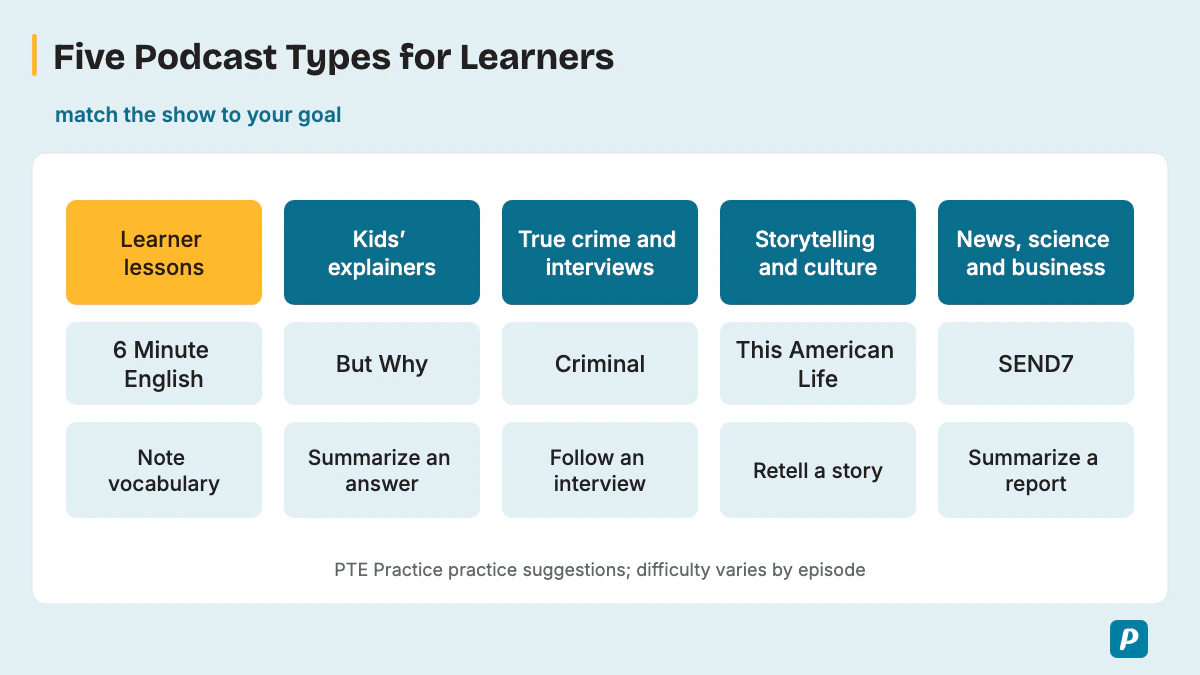
Five types to explore are: learner lesson podcasts, kids' explainer podcasts, true-crime and interview podcasts, storytelling and culture podcasts, and news, science and business podcasts. Learner podcasts slow down for you. True-crime podcasts, storytelling podcasts, news podcasts and science podcasts don't, and that real pace is why you need both. Each row pairs a type with example titles; current feeds and access terms can change.
| Podcast type | What you hear | Example shows | Best for |
|---|---|---|---|
| Learner lesson podcasts | Short episodes made for learners | 6 Minute English, Learning Easy English, Coffee Break English | Vocabulary and clear speech |
| Kids' explainer podcasts | Experts and storytellers answering children's questions | But Why, Tumble, The Past and The Curious | Intermediate listeners |
| True-crime and interview podcasts | Many interviewees with different accents | Criminal | Upper-intermediate and advanced |
| Storytelling and culture podcasts | Long themed true stories | This American Life, Stuff You Should Know | Advanced listeners |
| News, science and business podcasts | Current affairs, science and workplace English | Learning English from the News, Learning English For Work, SEND7, Global News Podcast, Science Quickly | Work and study words, lecture-style audio |
BBC’s titles include Learning English from the News and Learning English For Work. Use the publisher’s listings to find the current feeds; website series and podcast-feed names need not match.
Which Podcast Is Best for Improving English?
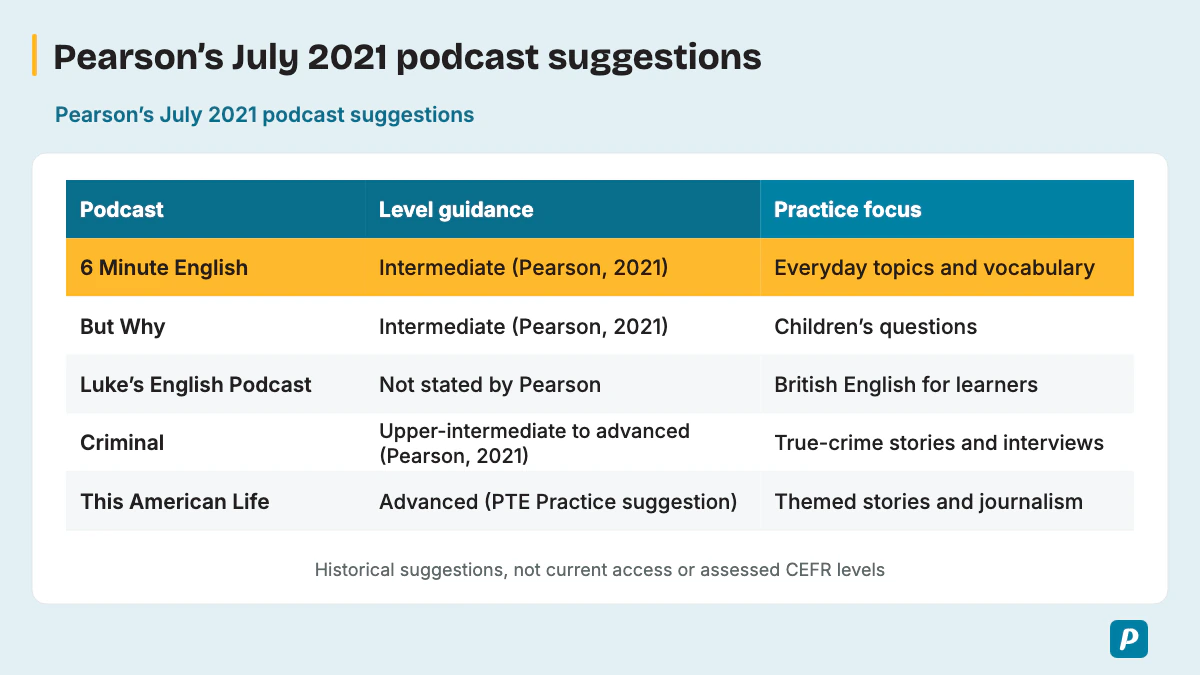
No single show suits everyone. Pearson's own five picks are 6 Minute English, But Why, Luke's English Podcast, Criminal and This American Life, and the best one is the show that matches your level and keeps you coming back. The table separates Pearson’s historical suggestions from EasyEnglish’s own level guidance; it does not state current episode lengths or access terms.
| Podcast | Level guidance | Practice focus |
|---|---|---|
| 6 Minute English | Intermediate (Pearson, 2021) | Everyday topics and vocabulary |
| But Why | Intermediate (Pearson, 2021) | Answers to children’s questions |
| Luke's English Podcast | Not stated by Pearson | British English for learners |
| Criminal | Upper-intermediate to advanced (Pearson, 2021) | True-crime stories and interviews |
| This American Life | Advanced (EasyEnglish suggestion) | Themed stories and journalism |
The five titles above come from Pearson’s article of 17 July 2021. Its popularity counts and publication details are historical and are not used here to rank the shows.
Pearson's listening-skills article (July 7, 2021) names a second set: BBC Learning English, Luke's English Podcast, EnglishClass101, Better at English, VOA Learning English, Culips Chatterbox and Aussie English Podcast. The following lists are suggestions to explore;check each publisher’s feed for current episodes, access and transcripts.
Which English Podcasts Are Best for Beginners?
Try a learner-focused show such as BBC Learning English’s Learning Easy English. Preview a short passage and use subtitles or a transcript when available. The seven suggestions below are a starting point, not a guarantee that every episode suits A1-A2 learners.
- Learning Easy English (BBC Learning English): learner conversations; its publisher listing includes Real Easy English episodes.
- Learning English Stories (BBC Learning English): short dramas and stories for English learners.
- Learning English Grammar (BBC Learning English): grammar explored through spoken English.
- Coffee Break English (Coffee Break Languages): English lessons with explanations; the publisher labels Level 1 Beginner A2.
- Podcasts in English: listening lessons grouped by level; start with the publisher’s beginner section.
- Espresso English: short English lessons; choose a vocabulary or grammar topic to review.
- EnglishClass101: audio and video lessons with explanations of words and phrases.
Move up to 6 Minute English once these feel easy, since Pearson rates it intermediate. The BBC homepage groups materials into Easy, Medium and Hard levels; check individual resources for their format and access.
Which Podcasts Suit Intermediate (B1-B2) Learners?
Pearson rates both 6 Minute English and But Why as intermediate-level podcasts, and at B1-B2 you can follow everyday topics at a natural but clear speed. The eleven suggestions below mix learner materials and general-audience shows. Preview an episode to judge its difficulty.
- 6 Minute English (BBC Learning English): discussions of everyday topics; Pearson’s 2021 article suggests it for intermediate learners.
- But Why (Vermont Public): a Vermont Public show answering children’s questions; Pearson’s 2021 article suggests it for intermediate learners.
- Learning English from the News (BBC Learning English): news topics and the language used to discuss them.
- SEND7 (Simple English News Daily): world news in simplified English; summarize one report in your own words.
- All Ears English: conversation-focused English for learners; note a phrase you could use in a conversation.
- Culips Everyday English Podcast: conversation-based English lessons; its feed includes Simplified Speech and Chatterbox.
- VOA Learning English (Voice of America): English-learning news and features; choose a recording from the publisher’s learning resources.
- Speak English with ESLPod.com: Jeff McQuillan presents dialogue, explains it and reviews it at natural speed.
- Speak English Now: Georgiana uses stories and questions that learners can answer aloud.
- Tumble Science Podcast for Kids: stories of scientific discovery, with companion blog resources on the publisher’s site.
- The Past and The Curious: history stories for children and families.
What If World turns children’s questions into imaginative stories, while Stories Podcast offers performed stories. Try a short passage before deciding whether either suits your listening level. SEND7 and Learning English from the News offer news-focused practice.
Which Podcasts Suit Upper-Intermediate to Advanced Learners?
Criminal and This American Life offer listening made for a general audience. Luke’s English Podcast and Aussie English are made for learners. This group mixes both formats for more challenging practice; B2-C1 is an editorial suggestion rather than a certified feed level.
- Criminal (Vox Media): true-crime stories and interviews; try summarizing one speaker’s account.
- This American Life: stories and journalism organized around a theme.
- Luke's English Podcast: Luke Thompson’s British English show for learners; consult individual episode pages for study materials.
- Aussie English: Australian English expressions, slang and culture.
- Global News Podcast (BBC World Service): international news reports and analysis.
- The Daily (The New York Times): news stories explored through reporting and discussion.
- Freakonomics Radio: questions about economics and everyday behavior.
- Stuff You Should Know: explanations of varied topics; summarize the main idea and two details.
- Science Quickly (Scientific American): science topics from Scientific American; note unfamiliar scientific terms.
- TED Talks Daily: TED talks in audio on varied subjects; identify a speaker’s main claim.
Science Quickly, Freakonomics Radio and TED Talks Daily offer science and ideas topics for additional listening practice; their formats do not reproduce PTE test audio. Take notes on the main point and two details while you listen, because that's the note-taking Summarize Spoken Text rewards. For structured study, consult the publisher’s current course listings.
What Podcasts Can Help You Improve Your Speaking Skills?
Any podcast with a transcript can train speaking skills. Pause and repeat after the host, which is Pearson's first podcast tip, and shows built around listen-and-repeat practice make this easier. Five drills turn a listening session into speaking practice.
- Pause and repeat after the host, line by line, with the transcript open.
- Try shadowing: speak along with the host on a short clip to copy rhythm, speed and pronunciation.
- Retell the episode aloud in one minute, without looking at the transcript.
- Record yourself, then play your version next to the original clip.
- Answer the host's questions out loud before they give the answer.
Four shows suit this kind of practice.
- Speak English Now: listen, repeat and answer questions aloud using a short story.
- Culips Everyday English Podcast: choose a short conversation to repeat aloud, matching the speaker’s rhythm.
- Learning English Conversations (BBC Learning English): its publisher listing includes The English We Speak; repeat an example phrase aloud.
- All Ears English: choose a short exchange and repeat each speaker’s lines.
Try this routine: take a 30-second clip from 6 Minute English and shadow it three times before you move on.
Can English Podcasts Help With Speaking Anxiety?
Yes, listen and repeat practice at home is a low-pressure way to get used to your own voice in English. Choose a familiar short passage to make the exercise manageable.
Repeat one short line from an episode until it feels easy, then record it and listen back, which builds confidence one sentence at a time. If nerves hit hardest on test day, our guide to PTE exam anxiety covers what to do before and during the test.
What Podcasts Can Help You Improve Your Vocabulary?
A vocabulary list or transcript can support this exercise. Pearson's tip is to note about 15 new words per episode, a suggested note-taking target rather than a guarantee of learning that many words. The following shows offer possible vocabulary practice.
- 6 Minute English: Pearson’s 2021 article describes accompanying vocabulary lists; check the selected episode.
- Learning English Vocabulary (BBC Learning English): vocabulary topics and English in a Minute episodes; use an example in a sentence of your own.
- The English We Speak (BBC Learning English): conversational words and phrases; its publisher listing uses the feed title Learning English Conversations.
- Culips vocabulary practice: look for expression-focused lessons in the Culips feed and practise an example.
- Espresso English: vocabulary and grammar lessons; practise a phrase from an episode.
- Aussie English: Australian slang and expressions, plus Australian history and culture.
How Do You Note New Vocabulary From Podcasts?
Write each new word inside the phrase you heard it in, with its meaning and one sentence of your own, because English words travel in fixed pairs. Here are four ordinary English expressions with EasyEnglish example sentences, set out as a notebook model; no particular episode is claimed as their source.
| Phrase you heard | Meaning | Your own sentence |
|---|---|---|
| Leave someone to their own devices | Let someone do what they want without help or supervision | My manager left me to my own devices on the new project. |
| Try someone's patience | Annoy someone until it is hard to stay patient | The slow website really tried my patience last night. |
| Sack something off | British informal: decide not to do something you planned | It was raining, so we sacked off the picnic. |
| In a tizzy | Nervous, excited and a bit confused | She was in a tizzy before her flight. |
Turn each row into one of your flashcards and review it a few days later, so the meaning sticks to the phrase. Our PTE collocations guide shows the word pairs that matter most in the test.
How Do You Learn English With Podcasts?
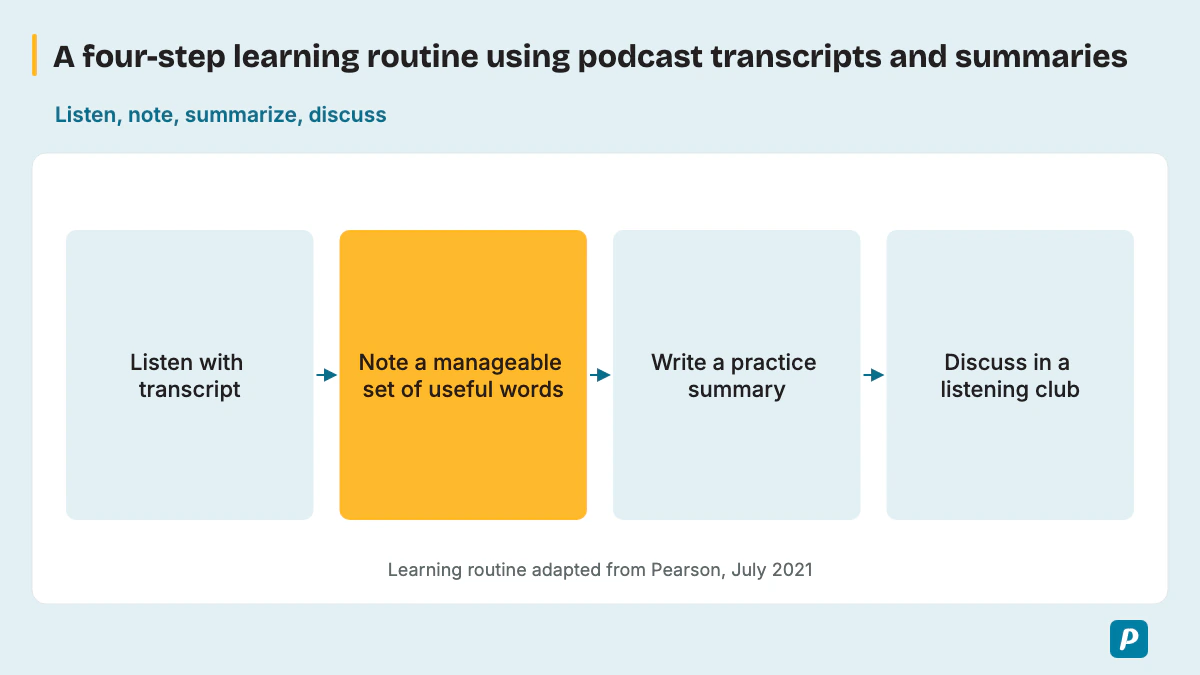
Pearson's method has four steps: listen with the transcript and repeat after the host, note interesting vocabulary, write a summary of each episode, and join a listening club. Each step works a different skill, and together they turn a show into a full lesson.
- Listen with the transcript open, pausing every few seconds to repeat after the host.
- Note interesting vocabulary, about 15 new words per episode, and look each one up after the show.
- Write a summary of each episode, from a single sentence on something new up to about 200 words.
- Join a listening club, where friends meet to discuss recent episodes, much like a book club.
Pearson's listening-skills article adds six habits that make each episode count.
- Set a daily listening goal, even if it's one short episode.
- If a clip is too hard, listen for the content words: nouns, adjectives and verbs.
- Listen as many times as you need, then again a few days later.
- Slow the audio down, but not so far that you translate in your head.
- Listen for stressed words, because speakers stress the most important ones.
- Keep a listening diary with each episode's title and your notes.
Two more habits help, though neither comes from Pearson's lists. Start each new episode with one gist listen for the main idea, then replay it with the transcript. If your app has a speed control, 0.75x is a sensible first step down. A 7-day plan puts all of this into 15-30 minutes a day.
| Day | Task | Time |
|---|---|---|
| Monday | Listen once for the gist, then replay with the transcript | 20 minutes |
| Tuesday | Note 15 new words in their phrases | 15 minutes |
| Wednesday | Shadow a 30-second clip three times | 15 minutes |
| Thursday | Write a 60-word summary of the episode | 20 minutes |
| Friday | Listen to a second episode in a different accent | 25 minutes |
| Saturday | Retell an episode aloud and record it | 15 minutes |
| Sunday | Review the week's words and listening diary | 15 minutes |
For PTE Academic, Summarize Written Text requires one complete sentence of 5–75 words. Summarize Spoken Text instead requires a 50–70 word summary and does not have a one-sentence limit. Use a podcast summary as an informal drill, then practise the exact test task under its own instructions. EasyEnglish practice scores are estimates.
How Do English Podcasts Help With PTE Listening?
PTE Academic Listening runs 31-39 minutes with 8 question types built on short audio clips, so regular podcast listening trains the same skill of catching the main idea and the details at natural speed. Each habit below maps to a task in our PTE Listening format guide, with clip lengths from Pearson.
| Podcast habit | PTE Listening task it trains |
|---|---|
| Write a 50-70 word episode summary | Summarize Spoken Text (60-90 second clip, 50-70 words) |
| Read along and spot words that differ from the transcript | Highlight Incorrect Words (15-50 second clip) |
| Type one short sentence you just heard | Write from Dictation (3-5 second sentence) |
| Fill gaps in a printed transcript | Fill in the Blanks (30-60 second clip) |
| Say the main idea in one sentence | Highlight Correct Summary (30-90 second clip) |
Which English Accents Should You Listen To?
Pearson advises listening to speakers from Britain, America, Canada, Australia and New Zealand, plus second-language speakers from India, China and Europe, because PTE Academic speakers have various accents. For British English, use Luke's English Podcast, SEND7 or 6 Minute English, and for American English, All Ears English, This American Life or Criminal. For Australian English, try Aussie English, which Pearson's listening article lists; host Pete Smissen teaches the slang and expressions of English spoken in Australia.
Global News Podcast carries reports and interviews from around the world, so you hear far more voices in one episode. Our guide to types of English accents covers each accent in detail.
Are There Free English Podcasts for Beginners?
Some publishers offer episodes or sample materials without charge. Check the publisher’s current listing before choosing a show: access to audio, transcripts, worksheets and archives may differ, and a free podcast app does not make every programme free. Coffee Break English’s publisher currently lists a free podcast option.
How Else Can You Improve Your English?
Pair podcast listening with reading, speaking and writing practice, and English movies add the visual context that audio alone cannot give. Pair one podcast a day with one short speaking or writing task, and your daily practice touches all four skills. Our guide on how to improve English sets out a full plan.
Written by
EasyEnglish Team
The team behind EasyEnglish's PTE practice and mock tests
We build the PTE practice tasks, mock tests and scoring on EasyEnglish, and we oversee every guide on this site. We consult official test-provider and government sources where relevant. Check the sources and review date for each guide; practice examples are authored learning material. EasyEnglish is not affiliated with Pearson.
Editorial review completed .