10 Best Tips to Improve Your English Every Day
Exam Preparation
A little focused practice every day keeps your English moving, even on busy days. These 10 tips help you improve your English through daily practice in the four skills (speaking, listening, reading and writing), each one small enough to fit into a normal day.
- Speak out loud every day.
- Read aloud.
- Shadow native speakers.
- Listen to podcasts, movies and news.
- Keep a vocabulary notebook.
- Learn collocations, not single words.
- Write a short summary daily.
- Learn grammar from real sentences.
- Read something in English daily.
- Test yourself and target your weakest skill.
Table of Contents
What Is the Fastest Way to Improve English?
The fastest way is a little practice every day across all four skills, aimed at your weakest one. According to Pearson, aiming your study time well matters more than piling on extra hours. How fast you move also depends on where you start. A one-minute recording or one timed practice item each day shows your weakest skill, and that skill gets the most of your daily practice. Promises such as "fluent in 30 days" have no source behind them, so use Pearson's realistic pace, given in the PTE section, as your target.
What Are the 4 Skills in English?
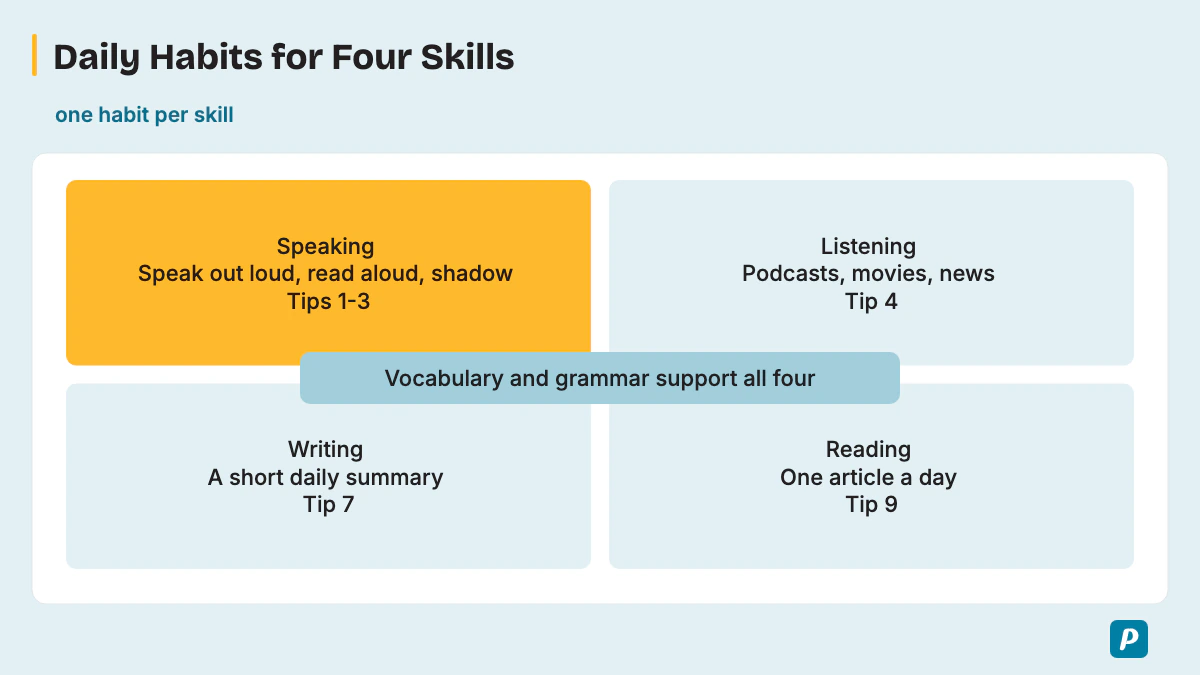
The four skills are listening, reading, speaking and writing. Tests such as PTE Academic score each one, and grammar and vocabulary support all four. Each skill gets one small daily habit, mapped to the numbered tips.
| Skill | Daily habit | Tip number |
|---|---|---|
| Speaking | Talk aloud for about 10 minutes | Tips 1-3 |
| Listening | One podcast episode or film scene | Tip 4 |
| Reading | One article | Tip 9 |
| Writing | A short summary | Tip 7 |
How Do You Improve English Speaking Skills?
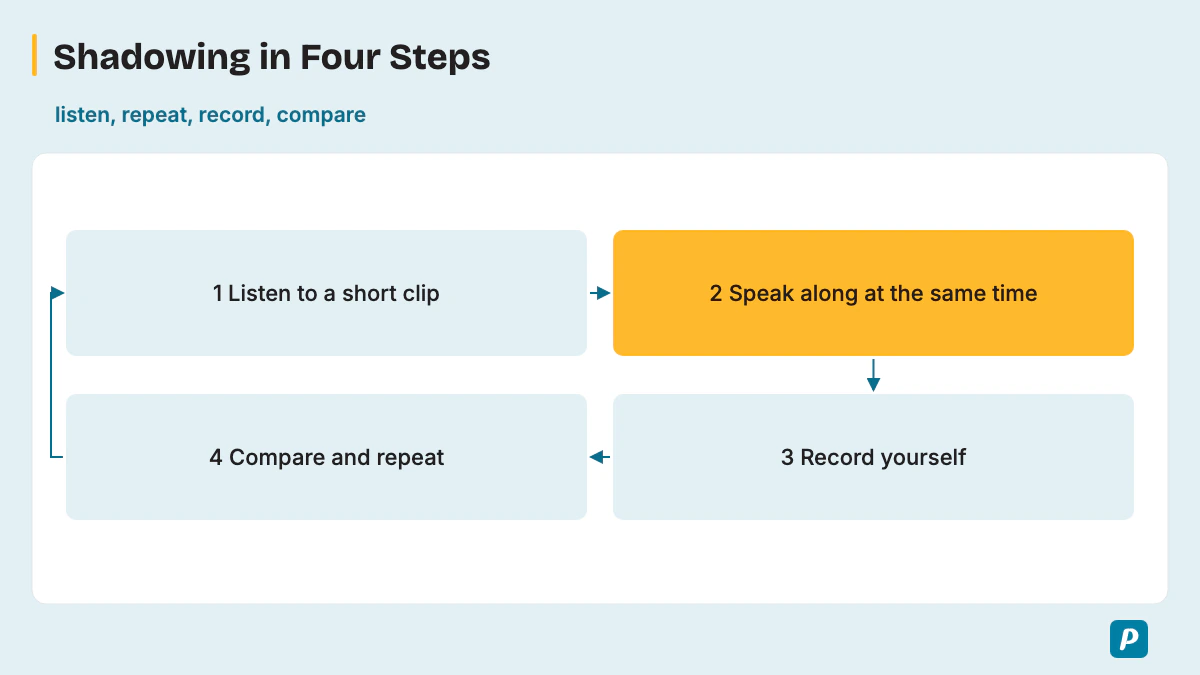
Speak out loud every day, read short texts aloud, and shadow native speakers by repeating a recording at the same time, so rhythm and pronunciation become automatic. The first three tips build fluency through your own voice.
- Speak out loud every day. Describe your day, talk yourself through a task, or find a conversation partner for a weekly chat.
- Read aloud. A news paragraph read aloud each morning trains your mouth on longer sentences and new words.
- Shadow native speakers. Play a short clip and speak along with it at the same time, a habit called shadowing, until your timing matches.
Pearson says PTE scores you on what you say, not on your accent, so aim for clear, natural speech rather than a copied accent. A simple check works well: record a one-minute description of your morning, then listen back and mark every long pause.
Real conversation matters as much as solo practice. Find a language-exchange partner who wants to learn your language. Join a club or hobby run in English, such as a book club or a cooking class, or debate a topic with friends once a week.
What Causes Poor Speaking Skills?
Poor speaking usually comes from too little speaking practice, translating in your head before you talk, and fear of mistakes, not from a lack of vocabulary alone. Translation slows every answer, and daily talk replaces it with the habit of thinking in English.
How Can Movies, News and Podcasts Improve Your English?
Movies, news and podcasts surround you with real English, and Pearson advises listening to speakers from Britain, America, Canada, Australia and New Zealand, plus second-language speakers from India, China and Europe (tip 4). That range of accents turns screen time into immersion when you use each source actively.
- Movies: watch with English subtitles, then replay one scene and repeat the lines.
- News: follow one short news story a day and retell it in two sentences.
- Podcasts: listen with the transcript and pause to repeat after the host.
- Songs and scripts: sing along with the lyrics on screen to copy word stress and rhythm, or act out a short TV scene aloud from its script.
Which Podcasts Help You Improve English?
Pearson's own picks include 6 Minute English for intermediate learners and Luke's English Podcast for British English, and Pearson advises listening with the transcript and repeating after the host. Pearson also suggests writing down 15 new words from each episode and meeting friends in a listening club to discuss what you heard. Our list of podcasts to improve English sets out more podcasts by type and level.
Which Movies Help You Improve English?
Films with clear speech and everyday dialogue work best at first, watched with English subtitles and replayed scene by scene. Each replay raises how much of the dialogue you catch without the subtitles. Our guide to English movies for learning offers English movies by level.
How Do You Improve English Vocabulary?
Keep a vocabulary notebook of useful words in the sentences you found them in, and learn words in pairs and phrases instead of alone (tips 5-6). Two habits make new words stick.
- Tip 5, keep a vocabulary notebook: write each word with its meaning and your own sentence, on paper or in an app. Check the meaning and an example in a learner's dictionary before you copy it down. If the dictionary has audio, say the word first, then play the recording to check, without leaning on it for every word.
- Tip 6, learn collocations, not single words: Pearson describes collocations as words that regularly occur together, so note word pairs such as the verb and noun you heard side by side. Review the pairs, not the single words, at the end of each week.
Should You Learn a New Word Every Day or a Collocation?
Learn the collocation: a new word sticks better with its usual partner, and Pearson describes collocations as pairs of words that occur regularly together whose natural use is a sign of general English proficiency. Our collocations guide explains the common word pairs and how to study them.
How Do You Remember New Words Once You Note Them?
Meet each word again on later days, and use it in your own speech or writing soon after you first see it. A vocabulary notebook is one method, and our list of techniques to remember new words adds flashcards, theme groups and a daily voice-note routine. In that routine you use 1 word 3 times in one day and record it in 1 voice note.
How Do You Improve English Writing Skills?
Write a short piece every day, such as a summary of something you read or heard, then check it for one problem at a time: grammar, spelling or organization (tip 7). Three habits build writing skills without long sessions.
- Daily summary: Pearson's podcast tip suggests writing a summary of each episode, and the same works for an article.
- Keep it short: give each paragraph one clear idea, which keeps your organization tidy.
- One review pass: reread for a single error type, such as spelling, before you check anything else.
Ask a teacher or an English-speaking friend to read one piece a week and mark what was unclear. Keep every daily piece in one file, so you can compare this week's writing with last month's.
How Do You Improve English Grammar?
Learn grammar from real sentences you read and hear, then reuse each pattern in your own writing and speech (tip 8). Memorizing rules without examples rarely carries over to speech.
Pick one of the common sentence patterns each week, such as the present perfect ("I have lived here since 2020") or a first conditional ("If it rains, we will stay in"). Later weeks can cover other tenses or articles. Notice each pattern in your reading, then write five sentences with it. That context learning ties each rule to a sentence you can use.
How Do You Improve English Reading?
Read something in English every day at a level slightly above comfortable, such as news, blogs or short books, and note the words and phrases you want to reuse (tip 9). Daily reading shows new words in context, which a bare word list can't. Read each text once for the main idea, then once more for detail. Reading aloud doubles as speaking practice, so one short article can cover two skills.
How Do You Improve Your English for the PTE Test?
Pearson's advice is to know the test experience, understand how responses are scored, and find where you can improve most, then spend your time on that skill (tip 10). Pearson says test familiarity reduces hesitation and lost time, so your responses come out more complete and continuous. Pearson also points out that part of a score gain is simply showing the English you already have more clearly, rather than new English.
In PTE Academic scoring, the same response can count toward more than one skill score, so clearer, more fluent answers can lift several scores at once. Pearson's official Scored Practice Tests give you a baseline score and show which tasks cost you marks, which points you to your weakest skill. EasyEnglish also offers mock tests for extra timed practice; its scores are estimates.
How Do You Improve English Quickly for a Test?
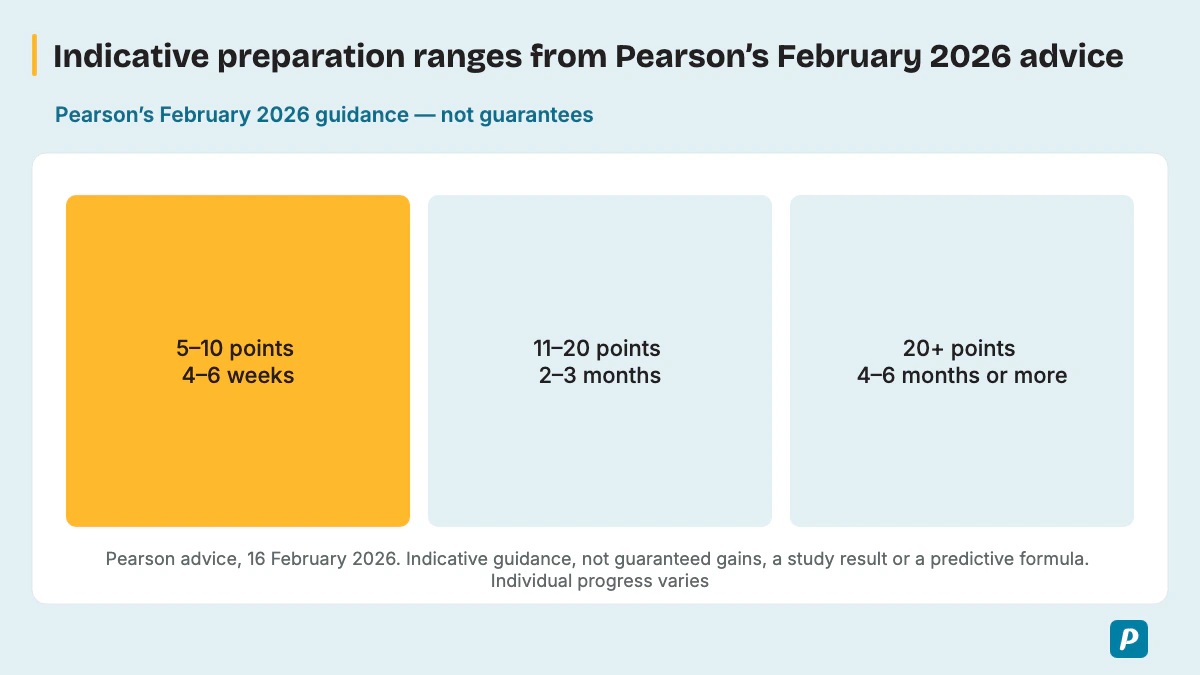
Pearson calls a realistic pace for most learners 5-10 PTE points in 4-6 weeks of consistent practice, 11-20 points in 2-3 months, and 20 points or more in 4-6 months or longer. In Pearson's example, a test taker whose target score is 65 but whose Listening is 45 spends study time on Listening, or adjusts the target or the timeline.
How Do You Improve Your English Speaking for PTE?
PTE Speaking gives partial credit across traits such as oral fluency and pronunciation, so daily read-aloud and shadowing practice feed straight into it. Our PTE speaking tips cover each speaking task.
How Do You Improve Your English Writing for PTE?
Pearson lists grammar, vocabulary, spelling and written organization among the traits that earn partial credit, so the daily-summary habit maps directly onto PTE Writing. Our PTE writing tips apply that habit to each writing task.
Written by
EasyEnglish Team
The team behind EasyEnglish's PTE practice and mock tests
We build the PTE practice tasks, mock tests and scoring on EasyEnglish, and we oversee every guide on this site. We consult official test-provider and government sources where relevant. Check the sources and review date for each guide; practice examples are authored learning material. EasyEnglish is not affiliated with Pearson.
Editorial review completed .