Types of English Accents You Need to Know for PTE Listening
Exam Preparation
English pronunciation varies between and within communities. This guide introduces 25 accent labels for listening practice; it is an editorial selection, not an official PTE accent roster or an exhaustive linguistic classification.
Focus on understanding the message rather than guessing a speaker’s nationality or copying an accent. A few sounds cannot reliably identify every speaker.
Table of Contents
What Is an English Accent?
An English accent is the way a group of speakers pronounces English, shaped by the region they live in, their history and the other languages around them. Cambridge Dictionary defines an accent as "the way in which people in a particular area, country, or social group pronounce words." Everyone speaks with an accent, native speakers included.
In its plain accent meaning, the word covers pronunciation only, so two speakers can share every word and still sound different. Cambridge gives tomato as /təˈmɑː.təʊ/ in UK English and /təˈmeɪ.t̬oʊ/ in US English.
What Is the Difference Between Accent and Dialect?
An accent is how words sound, while a dialect also changes the words and grammar people use. Cambridge Dictionary describes a dialect as a form of a language with "some words, grammar, or pronunciations" that differ from other areas or groups. British English says "flat" where US English says "apartment," a vocabulary difference that no change of accent explains.
For a test taker the split is practical: an accent changes the sound of words you know, while a dialect brings words you've never met.
Five dialect examples show how far vocabulary can move from region to region.
- divn't knaa: Geordie for "don't know," heard in Newcastle.
- bairns: "children," labeled Scottish or Northern English by Cambridge.
- wee: "small" or "little," a Scottish English word.
- apples and pears: Cockney rhyming slang for "stairs" in London.
- yous: a non-standard plural "you" for addressing a group.
What Are the Different Types of English Accents?
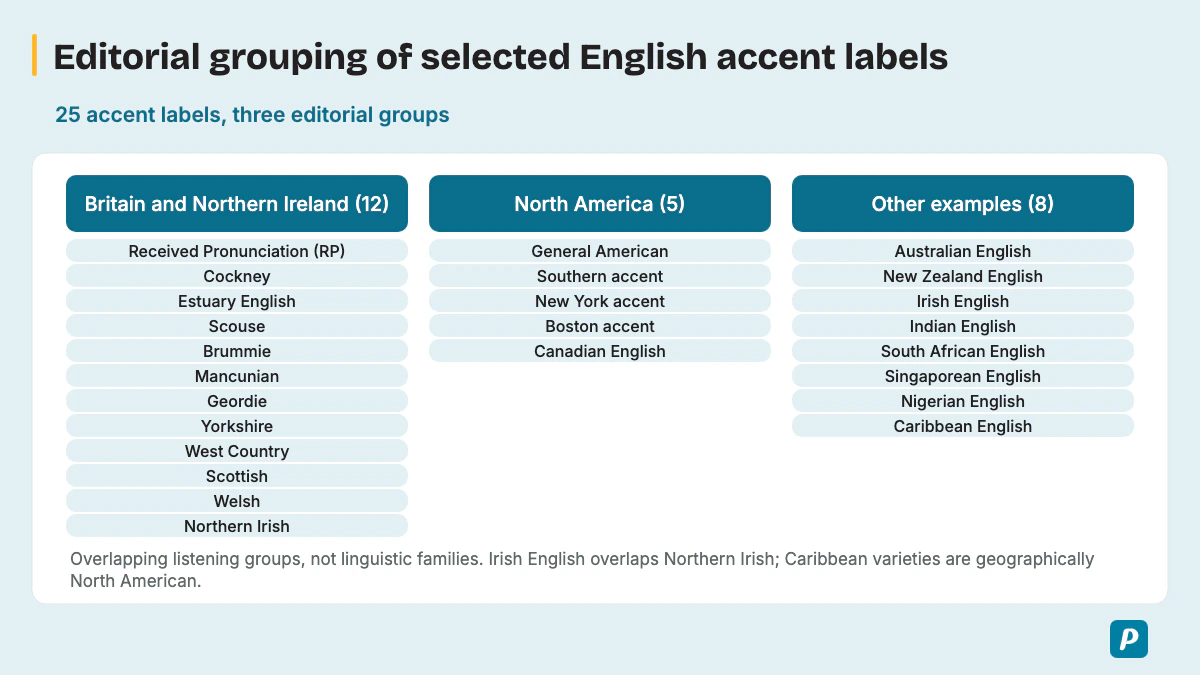
For convenience, the 25 labels below are grouped as Britain and Northern Ireland (12), North America (5), and other examples (8). These groups mix reference accents, cities, regions and national umbrella labels; they overlap and are not linguistic families.
- Britain and Northern Ireland: examples from England, Scotland, Wales and Northern Ireland.
- North America: the United States and Canada.
- Other examples: Australia, New Zealand, Ireland, India, South Africa, Singapore, Nigeria and the Caribbean. Ireland overlaps the Northern Irish entry, and Caribbean varieties are geographically North American.
What Are the British Accents?
For listening practice, the broad labels below cover traditional and modern varieties across Britain and Northern Ireland. Features vary by speaker, region, age and context;they are examples to notice, not diagnostic rules or an official PTE syllabus. Use a recording to check each example before practising it.
- Received Pronunciation (RP): A reference accent associated with England rather than a single town. It does not represent all English or British speakers.
- Cockney: Traditionally associated with working-class communities in East London. Contemporary London has many other accents as well.
- Estuary English: A broad label for some speech varieties associated with London and south-east England, with no single fixed boundary.
- Scouse: Associated with Liverpool and surrounding Merseyside communities in north-west England.
- Brummie: Associated with Birmingham in the West Midlands of England; neighbouring Black Country speech is a distinct regional label.
- Mancunian: Associated with Manchester in north-west England. Speech varies across the city and Greater Manchester.
- Geordie: Associated especially with Newcastle upon Tyne and Tyneside in north-east England; it is not a label for every north-eastern accent.
- Yorkshire: A group of regional accents associated with Yorkshire in northern England, with differences between areas and speakers.
- West Country: A broad regional label for south-west England. Its boundaries and the features included under it vary.
- Scottish: An umbrella label for English accents in Scotland. Scottish English and the Scots language should not be treated as interchangeable.
- Welsh: An umbrella label for English accents in Wales. Region and contact with the Welsh language contribute to variation.
- Northern Irish: An umbrella label for English accents in Northern Ireland. It does not describe one uniform pronunciation or all speech on the island of Ireland.
What Are the North American Accents?
These five labels offer examples from the United States and Canada. North America also includes Mexico, Central America and the Caribbean; this section is a selected listening list, not a complete geographic survey or promised test roster.
- General American: A broad reference label for US pronunciation, not a single local accent or the speech of every American.
- Southern accent: An umbrella label for varieties in the southern United States. Pronunciation differs across communities, generations and speaking styles.
- New York accent: Associated here with New York City, not all of New York State. Traditional descriptions do not fit every present-day resident.
- Boston accent: Associated with Boston in Massachusetts and some nearby eastern New England communities; speakers differ considerably.
- Canadian English: An umbrella label for English in Canada, including regional and community varieties; it is not one country-wide accent.
What Are the Global English Accents?
The next eight labels broaden the listening list. They are not a ranking of frequency or importance, and several overlap the earlier geographic groups.
- Australian English: An umbrella label for English in Australia, with regional, social and community variation.
- New Zealand English: An umbrella label for English in New Zealand, with variation across communities and individual speakers.
- Irish English: English varieties on the island of Ireland, including the Republic of Ireland and Northern Ireland. This label overlaps the Northern Irish entry; the catalogue is not a set of mutually exclusive categories.
- Indian English: An umbrella label for English varieties in India. Speakers have diverse linguistic backgrounds, so a single set of sound substitutions cannot describe them all.
- South African English: An umbrella label for English varieties in South Africa, shaped by different communities and language backgrounds.
- Singaporean English: English varieties in Singapore. Standard Singapore English and colloquial Singlish differ in register and other linguistic features; particles such as “lah” concern dialect and discourse, not pronunciation alone.
- Nigerian English: An umbrella label for English varieties in Nigeria, with regional and language-background variation. Nigerian English and Nigerian Pidgin should not be conflated.
- Caribbean English: A broad regional label covering English varieties in parts of the Caribbean, including Jamaica. Local English varieties and English-based creole languages should not be reduced to one accent.
English pronunciation varies considerably within countries and communities. The features above describe broad or traditional tendencies, not every speaker. Use real recordings and note what each individual says rather than inferring pronunciation from nationality.
Which English Accents Will You Hear in PTE Academic?
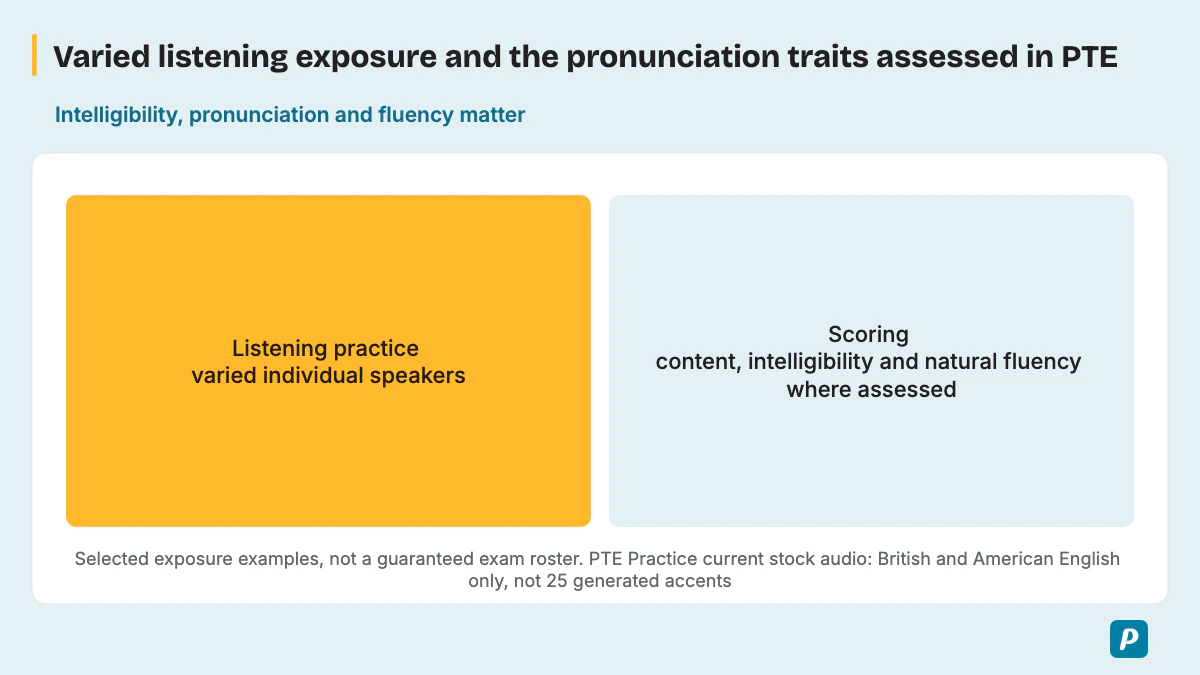
Pearson selects PTE Academic texts and settings from Australia, Canada, New Zealand, the UK and the USA, and the test also includes non-native English accents. Do not treat the catalogue above as a prediction of which speakers will appear.
Pearson's listening advice turns that into a training list: speakers from Britain, America, Canada, Australia and New Zealand, plus second-language speakers from India, China and Europe. Practise understanding varied speakers across the task formats rather than memorising a predicted accent roster.
Which English Accent Is Best?
No regional accent earns an automatic advantage in PTE. Work on intelligibility, word stress and a natural pace: pronunciation and fluency are assessed where applicable, alongside content. Pearson recognises regional and national varieties that are understandable to regular English speakers.
Questions about the "prettiest" or "hottest" accent are matters of opinion and don't affect any score.
Two misconceptions are worth dropping before you start practicing.
- "A British or American accent scores higher." Regional identity alone earns no extra points; content, pronunciation and fluency matter where assessed.
- "I must imitate a native accent." Forcing a borrowed accent can slow you down and cost fluency, so keep your own accent and make each sound clear.
How Do You Practice English Accents at Home?
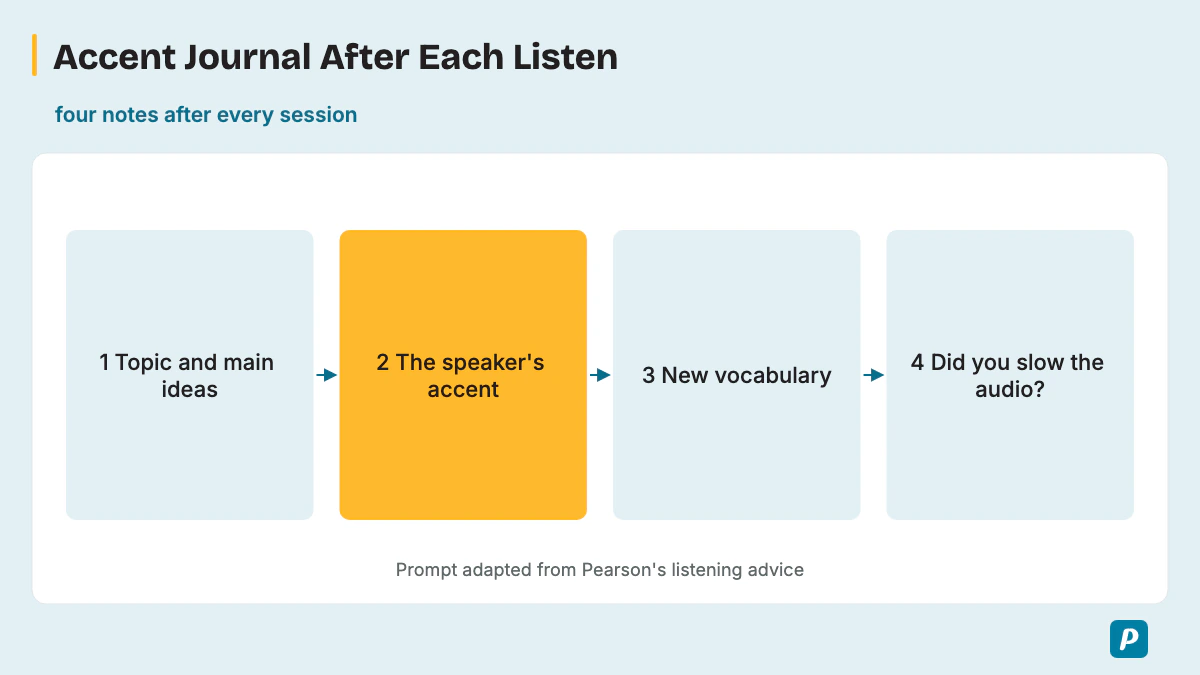
Listen every day to speakers from Britain, America, Canada, Australia and New Zealand, plus second-language speakers from India, China and Europe, and keep a short accent journal after each session. Pearson's journal prompt asks you to note the topic and main ideas, the speaker's accent, new vocabulary and whether you needed slowed audio.
For a short routine, choose a 3–5 minute recording from one of the communities above. Listen for meaning, then replay a sentence and note the sounds you actually hear. Record the speaker’s stated background only if known; do not infer it from a stereotype.
You can practise Listening tasks on EasyEnglish for test-style audio. Current stock voices use British and American English only; this 25-label catalogue does not mean our generated audio supplies 25 accents. Use outside recordings to broaden your exposure.
Which Words Show the Difference Between English Accents?
Words such as “car,” “butter” and “bath” can help you compare individual recordings. Listen for whether an r after a vowel is pronounced, how t is realised, and how vowel sounds differ. These observations are not nationality tests.
| Word | What to listen for | Where you hear it |
|---|---|---|
| car | Is r after the vowel audible? | Compare individual speakers; do not infer nationality. |
| butter | How is the middle consonant realised? | The result may vary with speaking style and context. |
| tomato | How does the stressed vowel sound? | Dictionary UK/US models are reference examples, not every speaker. |
| bath | How does the vowel compare with cat? | Record the actual contrast rather than applying a country rule. |
| cut / put | Are the two vowels similar or different? | Check both words from the same speaker. |
| about | How does the vowel change through the word? | Avoid exaggerated spelling imitations. |
| three | How is the initial consonant pronounced? | A single pronunciation does not identify a community. |
| vet / wet | Does this speaker distinguish the initial consonants? | Do not assume a merger from a speaker’s nationality. |
Where Can You Hear Different Accents in English Audio?
Pearson suggests podcasts such as the BBC's, Luke's English Podcast, English Class 101, Better at English, VOA Learning English, Culips Chatterbox and Aussie English Podcast. Our list of English podcasts for PTE covers each one, and these free channels let you pick one accent at a time.
- BBC Sounds: British voices across radio and podcasts.
- NPR podcasts: General American and regional US speakers.
- CBC Listen: Canadian English from Canada's public broadcaster.
- ABC Listen: Australian English from Australia's public broadcaster.
- RNZ: New Zealand English from New Zealand's public broadcaster.
- VOA Learning English: slower American English built for learners.
- International Dialects of English Archive: about 1,800 free recordings from 135 countries and territories.
For films, Pearson picks Brave for a Scottish accent and Love Actually for a range of British and Irish accents.
How Do You Improve Your English Accent?
For PTE you don't need a new accent: work on clear pronunciation and steady pace, because intelligibility and fluency matter where assessed. Record one sentence from a speaking practice item, then play it back against the model. Check that stressed words stand out and final consonants such as t, d and s are audible. Our PTE pronunciation guide covers the speaking side in depth.
How Many Accents Are There in English?
There is no fixed number: accents change from region to region and even town to town, so any count such as "20 accents" is a choice of the list maker. A list can stop at national varieties or go down to single cities, and that choice about regional variation sets the number of accents it ends up with.
For a sense of scale, the International Dialects of English Archive collects recordings from many countries and territories. You don't need to hear them all, and a few English movies with mixed accents are a free way to meet several at once.
Written by
EasyEnglish Team
The team behind EasyEnglish's PTE practice and mock tests
We build the PTE practice tasks, mock tests and scoring on EasyEnglish, and we oversee every guide on this site. We consult official test-provider and government sources where relevant. Check the sources and review date for each guide; practice examples are authored learning material. EasyEnglish is not affiliated with Pearson.
Editorial review completed .