32 English Movies for Learning English, by Goal
Exam Preparation
A film you enjoy gives you extended listening practice, so the right choice of English movies depends on your level and your goal. Pearson's list of its top ten films for learning English, picked for language clarity and cultural insights, forms the core here. Twenty-two more picks from 1989 to 2023 join them, grouped by suggested practice goal, for 32 films in total.
- Forrest Gump, Home Alone, Brave and five animated or family films for beginners.
- Harry Potter, Love Actually and four narrated or mixed-accent films for listening.
- The King's Speech plus four dialogue-heavy films for speaking.
- Pride and Prejudice, Inception and six more films for vocabulary, plus three office films for workplace English.
Table of Contents
Can I Learn English by Watching Movies?
Yes, as practice: movies train your ear for natural speed, accents and everyday phrases, and Pearson picked its own top-ten list for language clarity and cultural insights. Films help you learn English, but they don't replace lessons or practice with real test questions. Pearson's listening advice is to hear speakers from Britain, America, Canada, Australia and New Zealand, plus second-language speakers from India, China and Europe. Films can expose you to varied accents;access may require a legal rental, subscription or purchase.
The genre groupings below are suggested practice goals, not measured learning outcomes.
- Animated and family films: simple plots and clear, everyday phrases suit beginners.
- Teen films and films with a narrator: a narrator tells you what is happening, which makes the story easier to follow by ear.
- Comedies and romantic comedies: casual, natural conversation about ordinary topics gives you lines to copy when speaking.
- Science fiction, historical and period films: specialist and old-fashioned words build advanced vocabulary.
- Workplace dramas: meetings, deadlines and office small talk teach professional English.
What Are the Best Movies for English Language Learners?
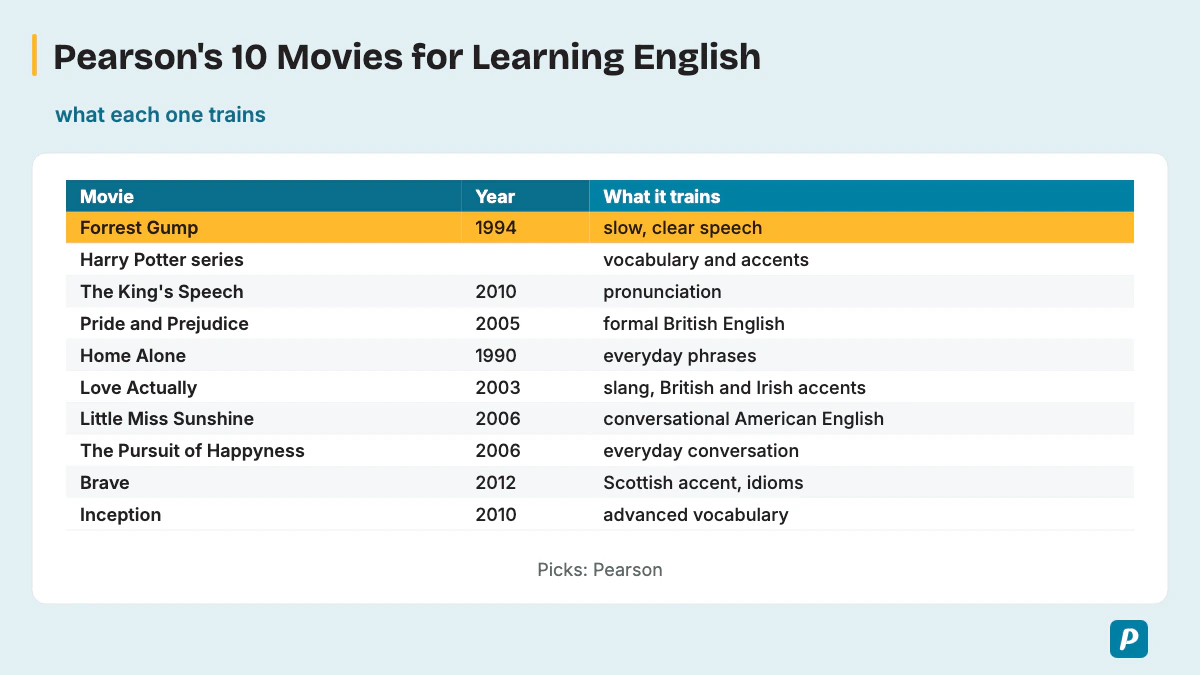
Pearson's top ten are Forrest Gump, the Harry Potter series, The King's Speech, Pride and Prejudice, Home Alone, Love Actually, Little Miss Sunshine, The Pursuit of Happyness, Brave and Inception.
Pearson published these ten on July 6, 2021, and each row uses Pearson's own reason.
| Movie | Year | Best for | What it trains (Pearson's reason) |
|---|---|---|---|
| Forrest Gump | 1994 | Beginners | Slow speech, a trip through American history |
| Harry Potter series | Several films | All levels | Rich vocabulary, characters' accents |
| The King's Speech | 2010 | Speaking | Pronunciation |
| Pride and Prejudice | 2005 | Vocabulary | Historical British English, formal language |
| Home Alone | 1990 | Beginners | Day-to-day phrases at a slower pace |
| Love Actually | 2003 | Listening | Informal phrases, slang, British and Irish accents |
| Little Miss Sunshine | 2006 | Speaking | Conversational American English |
| The Pursuit of Happyness | 2006 | Speaking | Everyday conversation in contemporary America |
| Brave | 2012 | Beginners | Scottish accent, everyday phrases and idioms |
| Inception | 2010 | Advanced vocabulary | Complex language and plot |
Pearson's page lists Love Actually as 2010, but the film came out in 2003.
Which English Movies Are Best for Beginners?
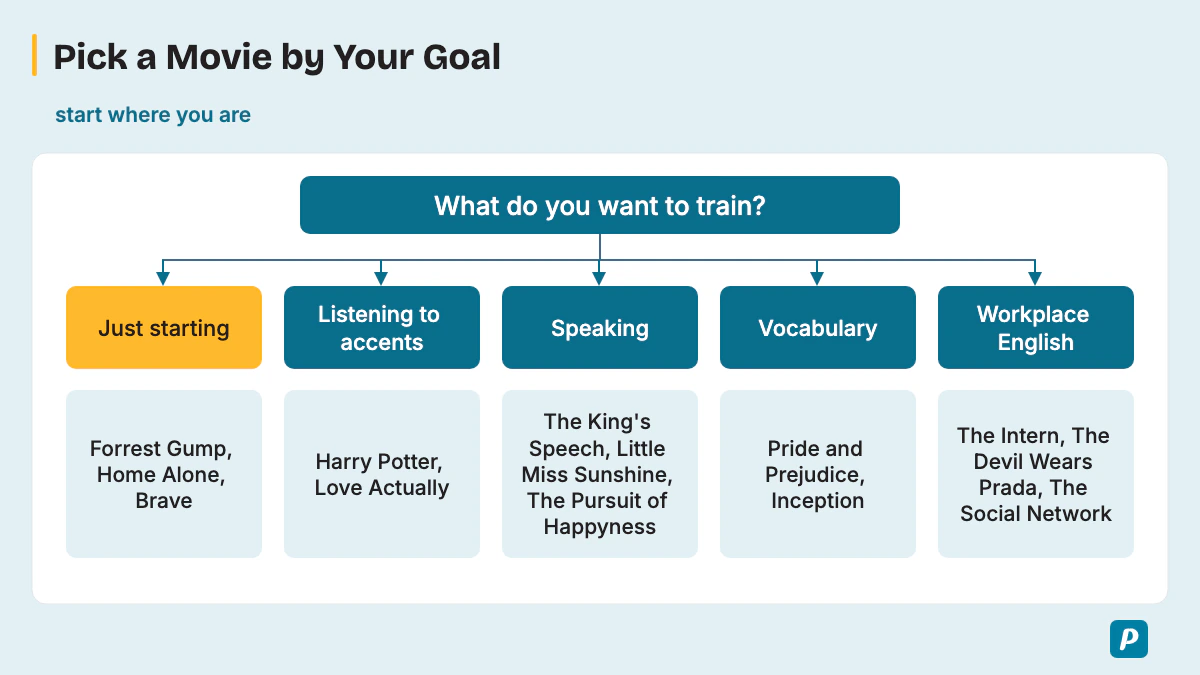
Pearson names Forrest Gump, Home Alone and Brave as beginner-friendly. Forrest speaks slowly throughout, Home Alone uses day-to-day phrases at a slower pace, and Brave is an animated film full of everyday phrases. The five additional animated and family films below are EasyEnglish suggestions. Try a short scene with subtitles first; a family film is not necessarily easy to understand.
- Forrest Gump (1994): listen for how Forrest's slow speech lets you hear every word in a sentence.
- Home Alone (1990): write down the short day-to-day phrases you could use at home yourself.
- Brave (2012): catch the everyday idioms and notice how the Scottish accent changes familiar words.
- Finding Nemo (2003): follow Marlin the clownfish searching for his son, and note each simple question the characters ask.
- Toy Story (1995): the toys argue, joke and make plans in short lines, so pause and repeat one exchange per scene.
- Up (2009): Carl travels in a house lifted by balloons, with young Russell along for the adventure; choose a short exchange to repeat.
- Frozen (2013): sing along with the songs in this animated musical to practice rhythm and linking sounds.
- Paddington (2014): a polite bear from Peru moves in with the Brown family in London, so listen for polite British requests and thanks.
Pearson suggests watching with subtitles if you're not feeling confident, so turn them on for your first viewing.
Which English Movies Improve Listening Skills?
The Harry Potter series and Love Actually train your ear for different accents. Pearson says the Harry Potter films let you learn characters' accents and ways of communicating. Love Actually (2003) mixes British accents and Irish accents with informal phrases and slang. Four more picks use narration or accent contrast to build listening skills.
- Harry Potter series: after each film, note which character's accent was hardest to follow and rewatch one of their scenes.
- Love Actually (2003): pick one storyline and write down three slang phrases you hear, then check their meaning.
- Mean Girls (2004): Cady Heron's narration helps introduce her school experiences; summarize a short narrated passage, using subtitles if needed.
- How to Train Your Dragon (2010): Hiccup narrates parts of his story; write a one-line summary of the opening.
- Four Weddings and a Funeral (1994): this British romantic comedy has an American lead, Carrie, so compare her American accent with the British speakers around her.
- The Imitation Game (2014): the story portrays Alan Turing and wartime codebreaking; transcribe a short exchange, replaying it as needed.
Narration helps because the narrator tells you what is happening and who is who, and you can't lean on watching the speaker's mouth, so you follow the story by ear alone. Forrest Gump works the same way, since Forrest tells his life story to strangers on a bus-stop bench. Pearson's PTE listening advice is to hear speakers with various accents, so a film with mixed accents builds test listening too.
Which English Movies Improve Speaking?
The King's Speech puts pronunciation at the center of the story, while Little Miss Sunshine and The Pursuit of Happyness are full of everyday conversational American English you can repeat aloud. Four more dialogue-heavy films, two of them romantic comedies, give you real lines to practice speaking.
- The King's Speech (2010): pause after a short line and repeat it with the same rhythm and stress.
- Little Miss Sunshine (2006): copy one short family conversation line by line, matching the speed of the speakers.
- The Pursuit of Happyness (2006): repeat short everyday exchanges aloud until they come out without a pause.
- Crazy Rich Asians (2018): Rachel, a Chinese American professor, visits Singapore with her boyfriend Nick; practice the polite small talk at family meals.
- When Harry Met Sally... (1989): the film opens with a long conversation on a drive from Chicago to New York, so act out both roles.
- Juno (2007): the dialogue is quick and witty, so slow one exchange down, then build it back to full speed.
- Marriage Story (2019): a couple goes through a bi-coastal divorce, and their long arguments let you practice stress and emotion.
Use one shadowing routine for every film. Shadow one scene a day by speaking along with the actors, record yourself, then play your recording next to the film and fix one sound at a time.
Which English Movies Improve Vocabulary?
Pride and Prejudice teaches formal historical British English set in early 19th-century England, and Inception, which Pearson recommends for advanced learners, brings complex language and advanced vocabulary. Six more films add scientific, academic, literary and old-fashioned vocabulary.
- Pride and Prejudice (2005): note five formal English words on each viewing and use each one in a sentence of your own.
- Inception (2010): pause after dense dialogue, write down new vocabulary and use each word in a sentence.
- The Martian (2015): Mark Watney keeps a video diary on Mars, so collect scientific vocabulary such as the names of tools and processes.
- Oppenheimer (2023): the film follows the theoretical physicist who led the first nuclear weapons project, so list academic vocabulary from the lecture and hearing scenes.
- Enola Holmes (2020): Sherlock Holmes's teenage sister speaks in the Victorian era, so record old-fashioned expressions next to a modern equivalent.
- Dead Poets Society (1989): English teacher John Keating teaches at a 1959 boarding school; copy one line of literary language and explain it in plain English.
- Little Women (2019): Greta Gerwig’s adaptation follows the March sisters; compare a scene with a passage from Louisa May Alcott’s novel.
- The Great Gatsby (2013): Nick Carraway narrates a story set in the 1920s; note unfamiliar expressions and check whether they are still used today.
Which English Movies Teach Workplace English?
The Intern, The Devil Wears Prada and The Social Network show English at work: office small talk, meetings, deadlines and business vocabulary. These are dramatized workplaces. Discuss how you might phrase a request more appropriately in a real workplace.
- The Intern (2015): a 70-year-old widower becomes a senior intern at a fashion website, so note how he introduces himself and offers help.
- The Devil Wears Prada (2006): an aspiring journalist works at a fashion magazine; list the phrases her boss uses to give orders.
- The Social Network (2010): the film covers the founding of Facebook, with fast office dialogue written by Aaron Sorkin, so pick out business vocabulary from the meeting scenes.
What Are the Tips for Learning English With Movies?
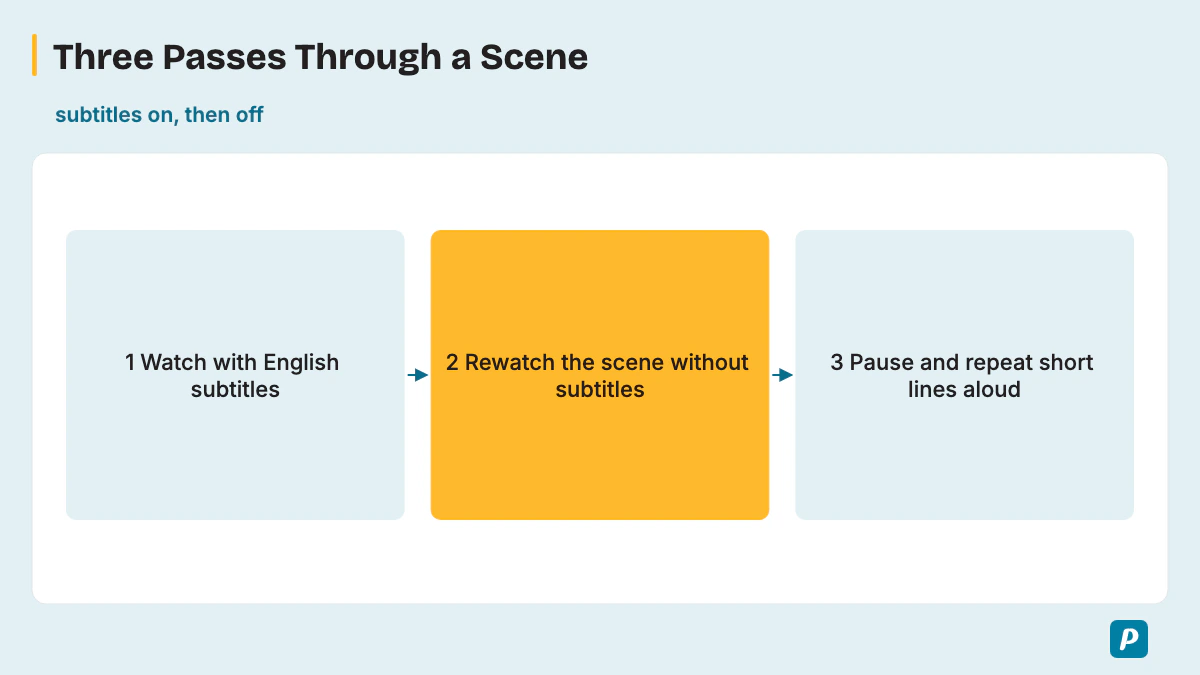
Start with English subtitles, rewatch key scenes without them, and pause to repeat short lines aloud. Pearson's stated method is to watch with subtitles when you're not confident; the other eight tips are EasyEnglish’s suggested active-watching exercises. You can also practice PTE Listening tasks on EasyEnglish when you want test-style audio.
- Match the film to your goal: choose from the beginner, listening, speaking or vocabulary picks above.
- Start with English subtitles: read the words as you hear them on the first viewing.
- Rewatch key scenes: turn the subtitles off and check how much you catch.
- Pause and repeat: stop after a short line and say it aloud with the same rhythm.
- Keep a vocabulary notebook: write each new word or phrase with the line it came from.
- Guess from context: use what you see on screen and the rest of the scene to work out a word's meaning instead of pausing for every word.
- Keep sessions short: choose shorter films or split a long one into parts so you finish it.
- Summarize a clip: after a one-minute clip, say aloud what happened in your own words.
- Talk and switch genres: discuss the film with other learners, then try a different genre next time.
Should You Watch English Movies With Subtitles?
Yes at first: Pearson says to watch with subtitles if you're not feeling confident, then switch them off on a second viewing to test your ear. Pick English subtitles over subtitles in your first language, so you read the same words you hear. Move through three stages: English subtitles on a first viewing, no subtitles on a rewatch, then new films without subtitles once you follow most lines.
With English subtitles on, note any word you meet twice, then use these techniques to remember new English words.
How Often Should You Watch Movies to Learn English?
Watch a little often: split a film into short sessions spread across your week rather than one long film once a month. Rewatch a favorite film too, because each viewing offers lines you missed the first time. End each session with a one-minute spoken summary of what you watched as active recall.
On days with no time for a film, an episode from our list of English podcasts for learners keeps the listening habit going.
What Are the Best Movies to Learn English for Indian Learners?
Start with the slow, clear beginner picks, then add films with British, American and other accents, because Pearson's listening advice is to hear many accents, including second-language speakers from India. For Indian learners, Crazy Rich Asians adds speakers of English from Asia, which offers accent variety beyond British and American voices. Our guide to types of English accents explains the main accent families.
How Do English Movies Help With PTE Listening?
Movies train the same skill PTE Listening tests, following real speakers at natural speed, and Pearson says PTE Academic speakers have various accents. Pearson selects PTE Academic texts from Australia, Canada, New Zealand, the UK and the USA, and the test also includes non-native accents.
Pearson's listening diary works for a film scene too: note the topic and main ideas, the speaker's accent, the vocabulary you learned and whether you needed to slow it down. Movies don't replace practice with real question types, which our PTE Listening guide covers in full.
How Do You Improve English Quickly?
Build movies into a daily routine with reading, speaking and review, because no film makes you fluent on its own. Our guide on how to improve English covers the full routine to improve English week by week.
Written by
EasyEnglish Team
The team behind EasyEnglish's PTE practice and mock tests
We build the PTE practice tasks, mock tests and scoring on EasyEnglish, and we oversee every guide on this site. We consult official test-provider and government sources where relevant. Check the sources and review date for each guide; practice examples are authored learning material. EasyEnglish is not affiliated with Pearson.
Editorial review completed .