100 New English Words With Meaning and Example Sentences
Exam Preparation
Dictionaries add hundreds of new English words every year, and in September 2026 Merriam-Webster alone added 1,400 words and definitions, from vibe coding to parasocial. Learners, though, mostly want words that are new to them and useful this week. The newest dictionary words below are dated and tied to the dictionary that recorded them, while Pearson's 2021 list is presented as a dated historical source.
The main vocabulary list holds100 useful words in four groups: slang, workplace, daily use and students. Meanings and sentences are learner explanations and authored examples; they are not all newly coined words or an official PTE list. Use a current learner’s dictionary to check register and pronunciation.
Table of Contents
What Are the Newly Added Words in English?
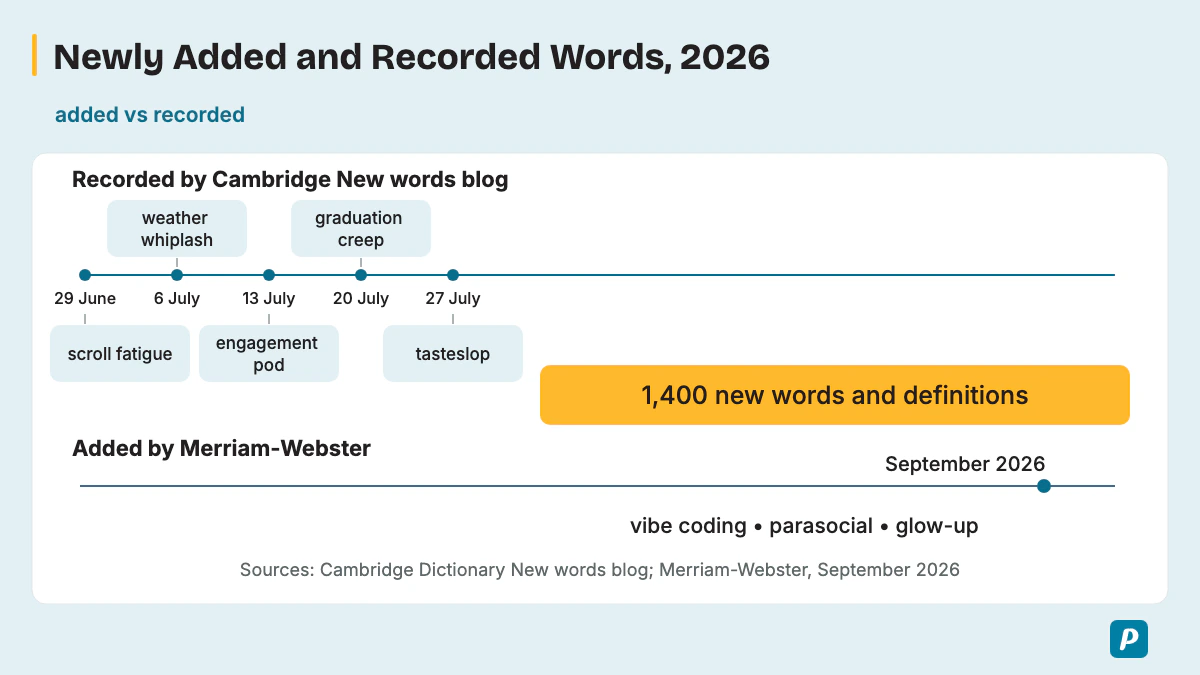
In September 2026 Merriam-Webster added 1,400 new words and definitions, including vibe coding, parasocial, glow-up, looksmaxxing, AGI and Mandela Effect. Cambridge Dictionary's New words blog recorded words such as tasteslop, vibe hacking and dead internet theory on 27 July 2026. Merriam-Webster says its new entries reflect words and meanings that have shown widespread use over time.
Here are 22 of Merriam-Webster's September 2026 additions, with meanings based on its own entries.
| Word | Part of speech | Meaning |
|---|---|---|
| glow-up | noun | A dramatic improvement, especially in appearance |
| looksmaxxing | noun | Trying, sometimes in extreme ways, to look as attractive as possible |
| parasocial | adjective | Describing a one-sided bond with someone you don't know, such as a celebrity |
| Rickroll | verb | To trick someone into hearing Rick Astley's "Never Gonna Give You Up" |
| meme coin | noun | A cryptocurrency associated with an internet meme, joke or online community |
| promposal | noun | A creative, often elaborate request to be someone's prom date |
| compute | noun | Computing resources, such as memory and processing power |
| vibe coding | noun | Using an AI system to generate computer code |
| AGI | abbreviation | Artificial general intelligence: a proposed AI capability to perform a broad range of intellectual tasks at human level |
| uncanny valley | noun | Unease caused by something almost, but not quite, human |
| superfood | noun | A marketing term for a food promoted as especially nutritious |
| cake pop | noun | A ball of cake and icing on a stick, dipped in a coating |
| shishito | noun | A slender, usually mild East Asian chili pepper |
| bao | noun | A soft steamed bun with a sweet or savory filling |
| chili crisp | noun | A spicy, crunchy condiment of oil and fried chili peppers |
| cuffing season | noun | Colder months when single people look for a short-term partner |
| Sunday scaries | plural noun | Anxiety or sadness on Sunday as the weekend ends |
| crashout | noun | A dramatic failure; also an emotional breakdown or outburst |
| whack-a-mole | noun | A situation where a new problem appears as soon as one is solved |
| yacht rock | noun | A style of soft rock from the 1970s and 1980s |
| copium | noun | Denial or playing down of a bad situation, imagined as a drug |
| Mandela Effect | noun | Many people sharing the same false memory |
Cambridge's New words blog works differently: it shows words the Cambridge Dictionary team is watching, so these 15 are recorded, not yet added as full entries.
| Word | Meaning (from Cambridge's post) | Recorded on |
|---|---|---|
| tasteslop | AI-made "tasteful" content that is bland and unoriginal | 27 July 2026 |
| vibe hacking | Cybercrime done with AI, using plain-language instructions | 27 July 2026 |
| dead internet theory | The theory that bots and AI now create much of the internet | 27 July 2026 |
| graduation creep | Graduation ceremonies spreading to lower school levels | 20 July 2026 |
| fall curriculum | Adults choosing subjects to study during the autumn months | 20 July 2026 |
| rejection cake | A cake shared online after a university rejection | 20 July 2026 |
| engagement pod | A group that likes and shares each other's posts to boost them | 13 July 2026 |
| dopamine site | A fake shopping site for the pleasure of browsing without paying | 13 July 2026 |
| clipping economy | Earning money by making and sharing short video clips | 13 July 2026 |
| omega block | A stuck weather pattern that keeps the same conditions for days | 6 July 2026 |
| weather whiplash | A quick swing from one weather extreme to another | 6 July 2026 |
| global weirding | Climate change making weather more extreme and unpredictable | 6 July 2026 |
| scroll fatigue | Mental exhaustion from scrolling too long | 29 June 2026 |
| ultraprocessed time | Time spent on content built to keep you watching | 29 June 2026 |
| Slow Social Era | A period of using social media less often and more carefully | 29 June 2026 |
Some words that circulated in2025, such as broligarchy, tradwife, skibidi and delulu, may be familiar from dictionary coverage. A wordwatch post and a full dictionary entry are different records. Check the exact current entry before describing any term as newly admitted or absent.
How Are New English Words Discovered and Added?
Dictionary editors read widely, collect real examples of a word in use, and add it once it shows frequent, widespread and meaningful use, the three criteria Merriam-Webster names. A word usually starts with one speaker, spreads as others pick it up, and gets noticed by lexicographers as its use grows. Dictionary editors collect examples of real usage and review the evidence before adding an entry.
Editors evaluate evidence of usage before publishing dictionary entries; procedures differ between publishers. Cambridge's New words posts show the stage before a new entry, giving each word a part of speech, pronunciation, definition and a dated real citation.
- Frequent use: the word keeps appearing over time, so a flash-in-the-pan trend stays out.
- Widespread use: people across regions and industries use it, so an average adult may meet it.
- Meaningful use: people use the word to mean something, not just as a curiosity.
How Are New English Words Formed?
Most new words are built from material English already has, and Cambridge defines a neologism as a new word or expression, or a new meaning for an existing word. Six word-building processes produce nearly every example in the lists below.
| Process | How it works | Example |
|---|---|---|
| Blending | Two words merge into one | glamping (glamorous + camping), broligarchy (bro + oligarchy) |
| Compounding | Two whole words join | oat milk, screen time, side hustle |
| Borrowing | A word comes from another language | hygge, from Danish |
| Abbreviation | Initials stand for a phrase | FOMO, WFH, GOAT, LOL (laughing out loud) |
| Shortening | A long word is cut down | inspo (inspiration), delulu (delusional) |
| New sense | An old word gains a new meaning | thirsty, cloud, mouse, tablet |
Are All New English Words Actually New?
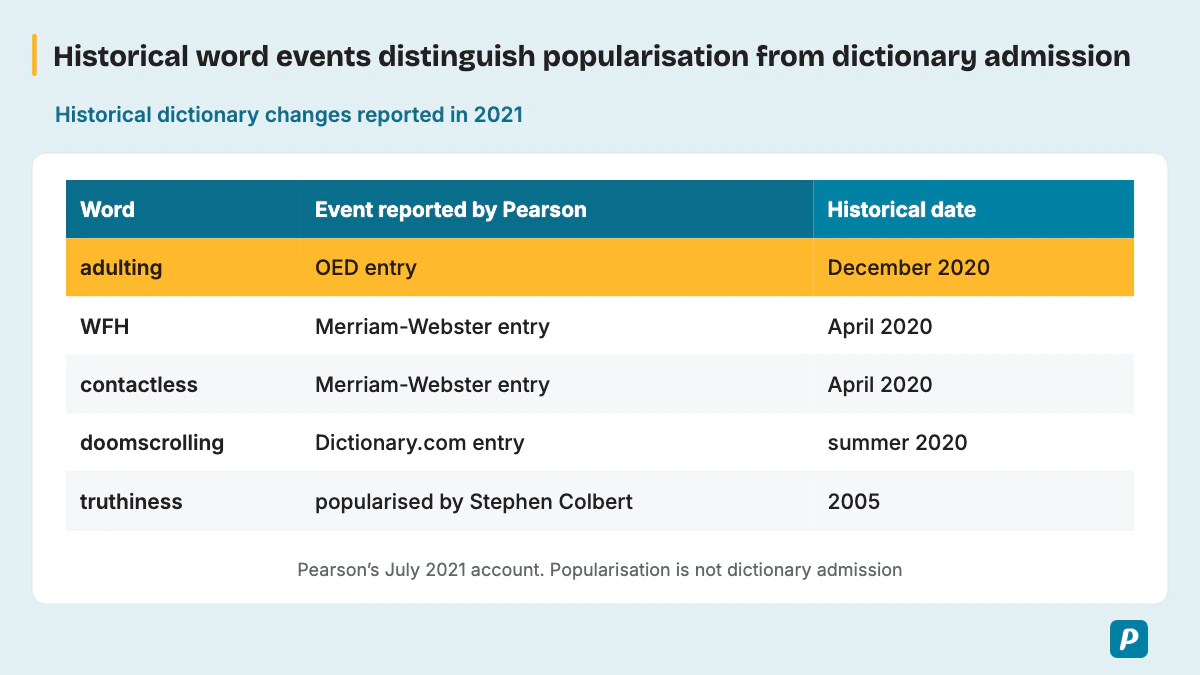
No, many "new" words are new senses of old words or older coinages that reached dictionaries later. Mouse and cookie gained computer meanings, and existing words can gain specialist meanings before dictionaries record them. Pearson's list of ten, published on 7 July 2021, names the dictionary that added each word. Read it as a snapshot of pandemic-era English rather than this year's additions.
| Word | Meaning (per Pearson) | What happened (per Pearson, 2021) |
|---|---|---|
| adulting | Behaving the way a grown-up does | Oxford English Dictionary entry, December 2020 |
| awe walk | A walk spent noticing the things around you | Term created by researchers in a psychology study on older adults; observed by Cambridge, not added |
| contactless | Not touching people, or paying by short-range technology | Merriam-Webster entry, April 2020 |
| doomscrolling | Constantly reading depressing news, especially on a phone | Added by Dictionary.com in summer 2020; popularized by journalist Karen Ho |
| PPE | Short for personal protective equipment | Merriam-Webster entry, April 2020 |
| quarenteen | Someone who was a teen through the COVID-19 pandemic | Observed by Cambridge, not added |
| thirsty | Wanting attention or approval | New sense added by Merriam-Webster in 2020 |
| truthiness | A feeling of truth with no evidence behind it | Popularized by Stephen Colbert on The Colbert Report in 2005; now in Merriam-Webster |
| unconscious bias | Bias you hold, without noticing, toward a race, gender or group | Oxford English Dictionary entry, 2020 |
| WFH | Doing your job from home | Merriam-Webster entry, April 2020 |
Pearson’s table records what its2021 article said at the time. It does not establish whether awe walk, quarenteen or any other term has a dictionary entry today. Treat its dates as historical source attributions.
Which Social Media and Modern Slang Words Should You Know?
The following25 items are informal vocabulary examples. Their meanings depend on context, and inclusion here does not certify an entry in both Cambridge and Merriam-Webster. Keep slang for suitable informal exchanges rather than inserting it into an academic essay.
| Word | Part of speech | Meaning | Example sentence |
|---|---|---|---|
| doomscrolling | noun | Spending a long time reading bad news online | I stopped doomscrolling at midnight and finally slept. |
| thirsty | adjective | Wanting attention or approval | Posting three selfies in an hour looks a bit thirsty. |
| rizz | noun | Charm that attracts people, often romantically | My cousin has enough rizz to chat with anyone at a wedding. |
| delulu | adjective | Having unrealistic hopes or beliefs; informal and often humorous | I'm delulu if I think I'll finish this book tonight. |
| aura | noun | An admired, cool personal style | Staying calm during my presentation gave me real aura. |
| situationship | noun | A romance that isn't yet a clear relationship | They've been in a situationship since the summer. |
| beige flag | noun | A habit that is neither good nor bad, just a bit odd | His beige flag is ordering the same pizza every time. |
| brain rot | noun | An informal, often humorous term for feeling mentally dulled by trivial content | Two hours of short videos left me with brain rot. |
| touch grass | phrase | To go outside and spend time in the real world | After a weekend of gaming, I need to touch grass. |
| cooked | adjective | In serious trouble and unlikely to recover | If I miss this bus, I'm cooked. |
| canon event | noun | An experience that shapes who you become | Failing my first driving test was a canon event. |
| sus | adjective | Suspicious | That message asking for my password looks sus. |
| slay | verb | To do something extremely well | You slayed that solo at the school concert. |
| mid | adjective | Neither very good nor very bad | The new café is fine, but the coffee is mid. |
| GOAT | noun | Greatest of all time | My grandmother is the GOAT of homemade biryani. |
| ghosting | noun | Ending a relationship by suddenly cutting all contact | After two dates, his ghosting felt rude. |
| FOMO | noun | Worry that you're missing something others enjoy | FOMO made me join the trip at the last minute. |
| cringe | adjective | Very embarrassing because it's bad or silly | My old dance video is so cringe. |
| low-key | adverb | Slightly; used to soften an opinion | I'm low-key excited about the new semester. |
| stan | verb | To admire a famous person to an unusual degree | My sister has stanned that band since school. |
| cancel culture | noun | Dropping support for someone who has offended people | We debated cancel culture in our media class. |
| clapback | noun | A quick, clever reply to criticism | Her clapback to the rude comment made everyone laugh. |
| no cap | phrase | Used to stress that you're telling the truth | That was the best mango I've ever had, no cap. |
| ick | noun | A sudden dislike for someone because of something they do | Loud chewing on our first date gave me the ick. |
| rage bait | noun | Online content made to anger people so they reply | I scrolled past the rage bait instead of commenting. |
Several of these replace an older, plainer word. Charismatic becomes rizz, doomed becomes cooked, average becomes mid, and suspicious becomes sus. Two related entries are worth knowing too: thirsty gave English thirst trap (a photo or post shared to attract attention), and Cambridge now lists aura farming (doing things to show off an admired, cool personality). Slang suits chats and social posts, not formal writing or an exam essay.
Which Workplace and Professional Vocabulary Words Are New?
Work vocabulary changed fast after 2020: WFH, contactless and unconscious bias all reached major dictionaries in 2020, according to Pearson. The workplace list below includes newer expressions and established vocabulary; check a current dictionary for the sense and register you need. These 25 words of workplace vocabulary cover the professional English of meetings, job ads and team chats.
| Word | Part of speech | Meaning | Example sentence |
|---|---|---|---|
| WFH | abbreviation | Working from home | I'm WFH on Fridays this month. |
| contactless | adjective | Paying or delivering without physical contact | The canteen only takes contactless payments now. |
| unconscious bias | noun | Unfair judgment of people that you aren't aware of | Our hiring workshop covered unconscious bias. |
| hybrid working | noun | Splitting work time between the office and home | Hybrid working lets me skip the commute twice a week. |
| upskill | verb | To learn, or teach staff, new skills | I'm upskilling in spreadsheets before my review. |
| reskill | verb | To learn new skills to do a different job | I reskilled as a web designer after five years in sales. |
| quiet quitting | noun | Doing only the work your job requires | Quiet quitting won't get me the promotion I want. |
| burnout | noun | Exhaustion from working too hard for too long | I took a week off to avoid burnout. |
| onboarding | noun | Helping new staff learn what they need for the job | My onboarding lasted three days. |
| side hustle | noun | Paid work done alongside your main job | My side hustle is editing videos on weekends. |
| gig economy | noun | Work made of temporary jobs or separately paid tasks | My brother earns extra money in the gig economy. |
| hallucination | noun | False information produced by an AI system | I found a hallucination in the chatbot's list of dates. |
| mouse jiggler | noun | A device or software program that keeps the cursor moving so the computer doesn't go into sleep mode | Our IT team blocks mouse jigglers on work laptops. |
| asynchronous | adjective | Not happening at the same time | We share asynchronous updates, so nobody needs a daily call. |
| bandwidth | noun | The time or energy to deal with something | I don't have the bandwidth for another project this week. |
| greenwashing | noun | Making a company look greener than it really is | Our marketing class spotted greenwashing in a bottled-water ad. |
| digital detox | noun | A break from phones and computers | I'm planning a digital detox for the long weekend. |
| hot-desking | noun | Using any free desk instead of your own | With hot-desking, I sit somewhere new every day. |
| deepfake | noun | A fake video or voice recording that seems real | My manager warned us about deepfake calls asking for payments. |
| cybersecurity | noun | Protecting computers and data from attacks | I took a short cybersecurity course at work. |
| layoff | noun | A company ending someone's job, often for lack of work | My friend found a new job two weeks after her layoff. |
| co-working | noun | Working in shared space with independent workers or people from different organizations | I rent a co-working desk near the station. |
| soft skills | plural noun | The ability to communicate and work well with others | Group projects build soft skills such as listening. |
| presenteeism | noun | Working while ill or staying late to look committed | Coming in with a fever is presenteeism, not dedication. |
| vibe coding | noun | Writing software by giving an AI plain-language instructions | I built a simple budget app through vibe coding. |
Which New Words With Meaning Are Useful for Daily Use?
Useful daily words are the ones you can say today in an ordinary conversation, such as adulting, staycation, hangry and binge-watch. Pick words you can use about your own day; these 25 everyday words for daily use each come with a meaning and an example sentence.
| Word | Part of speech | Meaning | Example sentence |
|---|---|---|---|
| adulting | noun | Doing the everyday tasks of a responsible adult | Paying my own bills feels like serious adulting. |
| staycation | noun | A holiday spent at or near home | We had a staycation and explored our own city. |
| hangry | adjective | Angry because you're hungry | I get hangry if lunch is late. |
| photobomb | verb | To jump into someone's photo as a joke | My brother photobombed our group picture. |
| selfie | noun | A photo you take of yourself, usually with a phone | I took a selfie at the station. |
| unfriend | verb | To remove someone from your friends list online | I unfriended an old classmate who only posted ads. |
| screen time | noun | Time spent looking at a phone, computer or TV | I cut my screen time to two hours a day. |
| self-care | noun | Activities intended to support your physical or mental well-being | A walk after work is my self-care. |
| plant-based | adjective | Made completely or mainly from plants | I tried a plant-based burger at lunch. |
| carpool | verb | To share a car for a regular trip, such as to work | We carpool to the office on Mondays. |
| power nap | noun | A brief daytime sleep taken to rest or recharge | A power nap helps me study in the evening. |
| binge-watch | verb | To watch many episodes one after another | We binge-watched a whole series over the weekend. |
| athleisure | noun | Sporty clothes stylish enough for everyday wear | I wear athleisure on long train journeys. |
| hygge | noun | A cozy, content feeling from simple comforts | Tea, candles and a book are my idea of hygge. |
| oat milk | noun | A milk substitute made from oats and water | I order my coffee with oat milk. |
| e-bike | noun | A bicycle with an electric motor | My e-bike makes the hill on my way to work easy. |
| glamping | noun | Camping with comfort and luxury | We went glamping, so the tent had a real bed. |
| dupe | noun | A cheaper copy of an expensive product | My sneakers are a dupe of a famous brand. |
| nomophobia | noun | Anxiety at the thought of having no working phone | I felt real nomophobia when my phone died on the trip. |
| bed rotting | noun | Spending long periods in bed during the day | Sunday was pure bed rotting with a podcast. |
| single-use | adjective | Designed to be used once rather than repeatedly | I carry a bottle so I can skip single-use cups. |
| brunch | noun | A late-morning meal that combines breakfast and lunch | We met for brunch at eleven. |
| emoji | noun | A small image in a message that shows a feeling | She replied with a laughing emoji. |
| podcast | noun | A digital audio show you download or stream | I listen to an English podcast on my commute. |
| biohacking | noun | Personal techniques or experiments intended to change bodily performance or well-being | My friend's biohacking includes cold showers and sleep tracking. |
What Are New Words in English With Meaning for Students?
For students, "new words" usually means useful words new to them rather than new to English, such as resilient, ubiquitous, mitigate and meticulous, which help in essays and presentations. These 25 academic words carry precise meanings, so one of them often replaces a whole phrase.
| Word | Part of speech | Meaning | Example sentence |
|---|---|---|---|
| serendipity | noun | Finding something valuable by chance | Meeting my mentor at the library was pure serendipity. |
| ephemeral | adjective | Lasting only a short time | My interest in that app was ephemeral. |
| resilient | adjective | Able to recover after something difficult | I stayed resilient after a low mock score and kept practicing. |
| ubiquitous | adjective | Seeming to be everywhere | Phone chargers are ubiquitous in our library. |
| eloquent | adjective | Expressing ideas clearly and with strong effect | Her eloquent closing won the class debate. |
| candid | adjective | Honest, especially about something difficult | My tutor gave candid feedback on my essay. |
| tenacious | adjective | Unwilling to give up | I was tenacious and rewrote the essay four times. |
| mitigate | verb | To make something less harmful or bad | I mitigate exam stress with a short walk before each test. |
| vindicate | verb | To prove someone right after others doubted them | My final grade vindicated my new study plan. |
| zealous | adjective | Enthusiastic and eager | The zealous volunteers arrived an hour early. |
| altruistic | adjective | Helping others even at a cost to yourself | Tutoring younger students for free felt altruistic. |
| pristine | adjective | In an original, exceptionally clean or unspoiled condition | My secondhand textbook was still pristine. |
| sagacious | adjective | Showing understanding and good judgment | My sagacious advisor told me to start the project early. |
| meticulous | adjective | Very careful about every detail | I keep meticulous notes in every lecture. |
| pragmatic | adjective | Solving problems sensibly, based on real conditions | A pragmatic study plan fits around my part-time job. |
| ambiguous | adjective | Having more than one possible meaning | The essay question was ambiguous, so I asked my teacher. |
| diligent | adjective | Careful and hard-working | A diligent review every evening keeps me on track. |
| empathy | noun | The ability to understand or share another person's feelings | Empathy helped me support a stressed classmate. |
| lucid | adjective | Expressed so clearly that it's simple to follow | The lecturer's lucid notes turned a hard topic into a simple one for me. |
| obsolete | adjective | No longer used because something newer replaced it | My old calculator is obsolete now. |
| paradox | noun | A statement or situation that appears contradictory but may reveal a truth | It's a paradox that resting more helped me study more. |
| scrutinize | verb | To examine very carefully | I scrutinize every sentence before I submit. |
| facilitate | verb | To make something possible or easier | Clear headings facilitate a quick read of my report. |
| elucidate | verb | To explain or make clear | Could you elucidate the second step of the method? |
| juxtapose | verb | To place different things side by side | My essay juxtaposes city life with village life. |
How Do You Use New English Words in a Sentence?
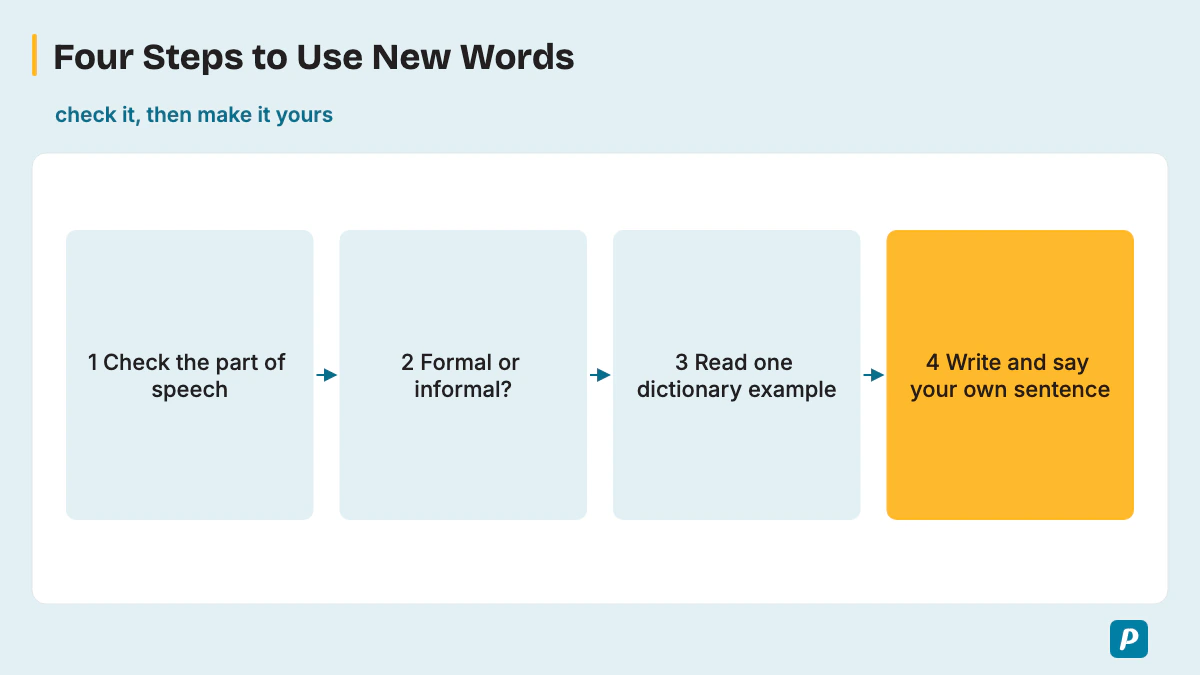
Check the word's part of speech and register first, read one real example in a learner's dictionary, then write your own sentence about your own life and say it aloud. Pearson's 2021 word list follows the same pattern, pairing each definition with a "How to use it" sentence.
- Check the part of speech, so you know whether the word is a noun, verb or adjective.
- Check the register, because slang belongs in chats while academic words fit essays.
- Read one usage example in Cambridge or Merriam-Webster as your model example sentence.
- Write your own sentence about your life, then say it aloud.
Three worked examples show how register changes the sentence. With "mitigate" (verb, formal), write "My essay discusses measures to mitigate flood damage" about your own study plan, then reuse it in a speaking practice the same day.
"Cooked" is a slang adjective. "If I don't revise tonight, I'm cooked" works in a chat. An essay needs "Without revision, I would be in serious trouble." With "bandwidth" (noun, workplace sense), "I don't have the bandwidth to lead two projects this term" suits an email to your manager.
What Are the Tips for Learning New Words in English?
Learn a few words at a time in context, review them on later days, and use each one in your own speech or writing soon after you meet it. Pearson recommends keeping up with the new words dictionaries add through the year. Each of the learning tips below gives you one more meeting with a word, and that repeat contact is what helps you remember words.
Which Techniques Help You Remember New Words?
Pick two or three techniques and use them every day, because each one makes you meet or use the word again.
- Make flashcards with the word on one side and its meaning plus your own sentence on the other.
- Keep a personal word notebook and add the date you first met each word.
- Read articles and watch shows with English subtitles, and note any word you meet twice.
- Group words by theme, the way the four tables above split slang, work, daily life and study.
- Teach a new word to a friend, then ask them to use it back to you.
- Play word games and quizzes such as crosswords and anagrams.
- Follow the 1-3-1 routine: 1 word, used 3 times in one day, recorded in 1 voice note.
- Keep a dictionary app open while you read, and check the part of speech every time.
For technique 3, our list of movies for English learners groups films by level and by the skill they train.
How Do You Remember New Words in English With Collocations?
Learn each new word with the word it usually travels with, because Pearson describes collocations as pairs that occur regularly together and says natural use shows general English proficiency. Word partners such as "mitigate the risk", "take a power nap" and "scrutinize the data" help you remember the word and use it correctly at once. Our guide to collocations sets out the common patterns.
How Many New Words Are Added to the Dictionary Each Year?
Pearson puts the count at hundreds of new dictionary words each year, and a single update can be larger: Merriam-Webster added 1,400 new words and definitions in September 2026. No one publishes a yearly total across all dictionaries, because each publisher sets its own update schedule.
Can You Use New English Words in the PTE Test?
You can use any correct, well-chosen English word in PTE Speaking and Writing; slang and very recent coinages are risky in an academic task, so prefer words a learner's dictionary lists as standard. Standard new words such as cybersecurity, deepfake or hybrid working fit the academic register of PTE Writing, while slang such as rizz, cooked or no cap doesn't.
Pearson, which owns PTE, scores Write Essay on traits that include Vocabulary range and Spelling, and it accepts US, UK, Australian and Canadian spelling if you keep to one convention in a response. Our PTE vocabulary guide covers the words worth learning for the test.
Written by
EasyEnglish Team
The team behind EasyEnglish's PTE practice and mock tests
We build the PTE practice tasks, mock tests and scoring on EasyEnglish, and we oversee every guide on this site. We consult official test-provider and government sources where relevant. Check the sources and review date for each guide; practice examples are authored learning material. EasyEnglish is not affiliated with Pearson.
Editorial review completed .