PTE Collocation List: Types, Examples and How to Learn Them
Exam Preparation
You know the words, yet your sentences still sound slightly off to a fluent reader. Collocations fix that, because words that regularly travel together make academic English sound natural, and Pearson collected the academic ones in its free Academic Collocation List. That list holds 2,469 collocations, which are word pairs, not 2,469 single words. Any "top 100" or "96 most common" list is a publisher's own pick, not a Pearson number.
The pairs below are selected learning examples. The meanings, sentences and task suggestions are authored teaching material, not official PTE questions. Use Pearson’s current ACL to confirm exact list membership;good English collocations need not appear on that particular list.
Table of Contents
What Is a Collocation?
A collocation is a pair of words that occur regularly together, and Pearson says knowing and using them naturally is a sign of general English proficiency. Fluent speakers order "fast food", never "quick food", and academic writers "conduct research" rather than "make research". These word pairs are what separate natural English from correct-but-odd English. A learner who knows every single word can still sound unnatural, because the words are right but the partners are wrong.
A collocation keeps its literal meaning, so "take responsibility" is exactly what it sounds like. An idiom does not, since "break the ice" has nothing to do with ice. Collocations come first for PTE, but idioms aren't irrelevant. Pearson's Write Essay scoring guide covers them too: under Vocabulary range it says "synonyms, idiomatic expressions and academic terms are also assessed if appropriate."
What Is the PTE Academic Collocation List?
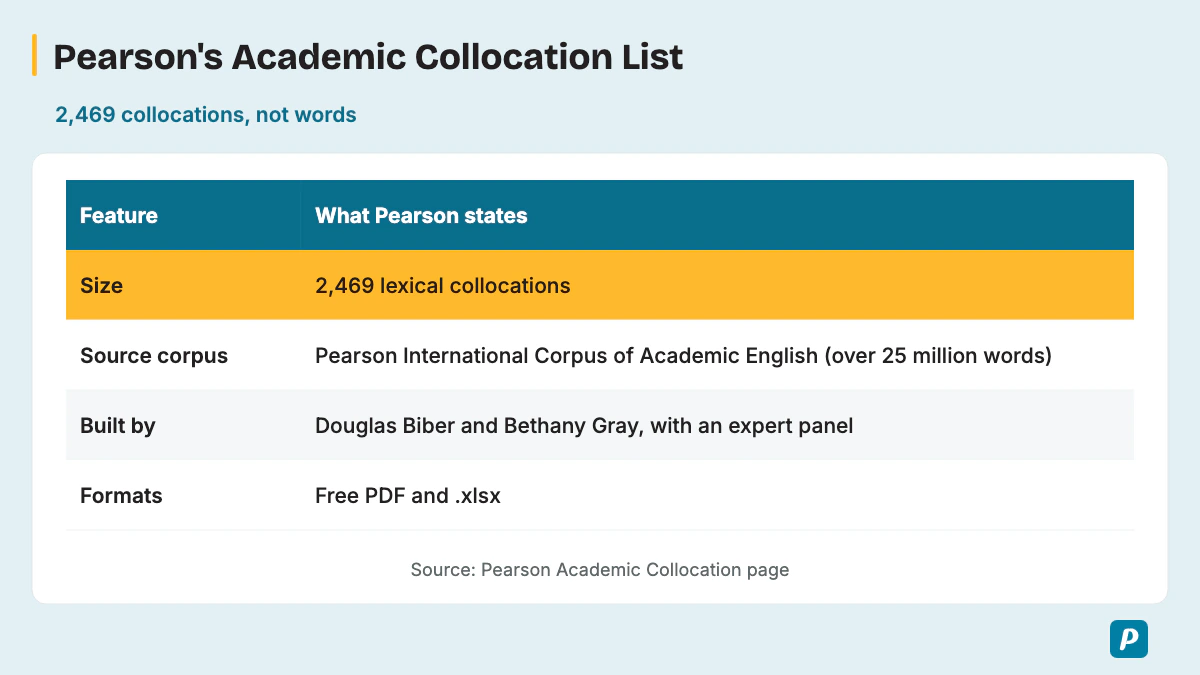
Pearson's Academic Collocation List (ACL) holds 2,469 of the most frequent and teachable lexical collocations in written academic English. Pearson compiled it from the written curricular part of the Pearson International Corpus of Academic English, which covers over 25 million words.
The table pulls together what Pearson's Academic Collocation page and the spreadsheet itself say about the list.
| Feature | What Pearson states |
|---|---|
| Size | 2,469 lexical collocations |
| Source corpus | Pearson International Corpus of Academic English, written curricular part, over 25 million words |
| Purpose | Cross-disciplinary collocations for academic English and teachers' lesson planning; the spreadsheet adds "to support PTE preparation" |
| Computational analysis | Douglas Biber and Bethany Gray |
| Tagging and validation | Andrew Roberts, computational linguist, tagged the first list and ran the validation study |
| Expert panel | David Crystal, Geoffrey Leech, Diane Schmitt, Della Summers and Randolph Quirk |
| Format | Free PDF download and a linked .xlsx spreadsheet;check the current version |
Each row of the spreadsheet gives Component I and Component II with a part-of-speech tag, and it shows a usual preposition in brackets, as in "draw attention (to)". Some prep sites still quote "2,469 words" or "over 2,500"; Pearson's current page says 2,469 collocations, and each one is a word pair.
What Are the Common Types of Collocations?
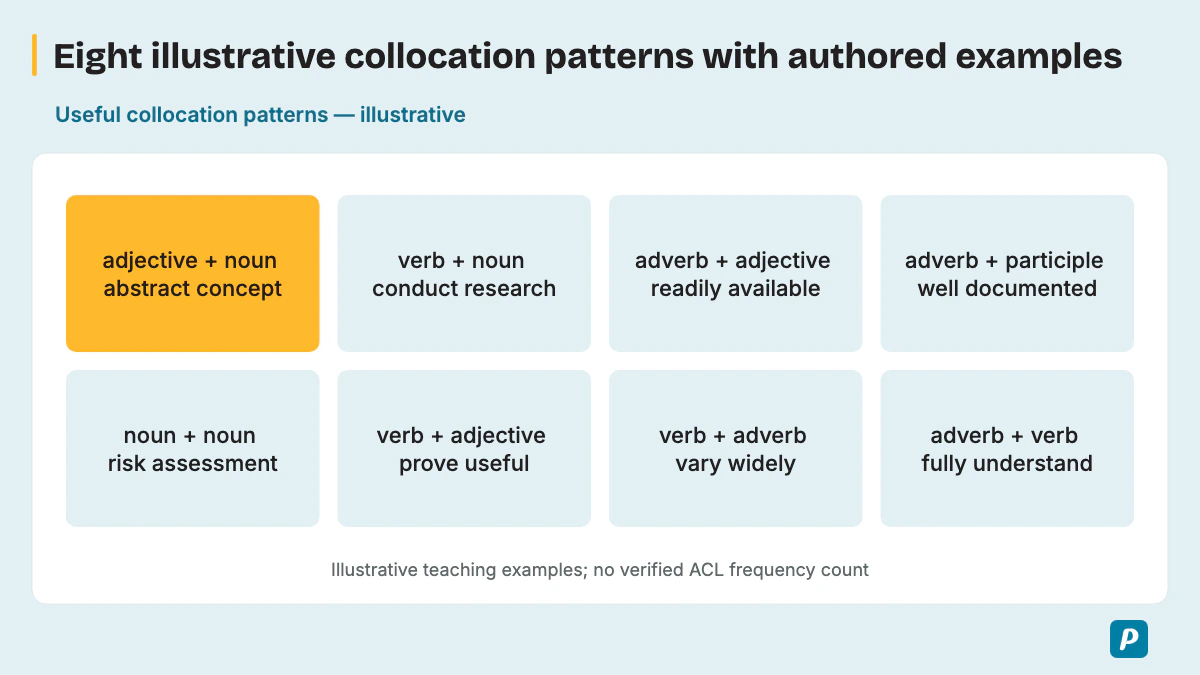
Teachers group collocations by the word classes they join. Guides usually list seven patterns: verb + noun, adjective + noun, noun + noun, adverb + adjective, verb + adverb, verb + preposition and adjective + preposition, with noun + verb as a common variant. Pearson's list itself uses eight word-class combinations, and adjective + noun pairs make up most of it.
The table shows eight useful lexical patterns for organising your own examples. It does not reproduce a verified statistical count of the ACL.
| Pattern | Teaching examples |
|---|---|
| Adjective + noun | abstract concept, informed consent |
| Verb + noun | conduct research, meet expectations |
| Adverb + adjective | readily available, mutually exclusive |
| Adverb + past participle | densely populated, well documented |
| Noun + noun | risk assessment, target audience |
| Verb + adjective | prove useful, seem unlikely |
| Verb + adverb | vary widely, communicate effectively |
| Adverb + verb | fully understand, greatly enhance |
Verb + preposition and adjective + preposition pairs are grammatical collocations, because one partner is a function word. The ACL doesn't list them as separate entries; it shows the usual preposition in brackets instead, as in play a role (in), directly responsible (for) and rely heavily (on). Common grammatical pairs worth knowing are depend on, consist of, result in, responsible for, consistent with and interested in.
Noun + verb pairs such as "prices rise" and "evidence suggests" are lexical collocations, like verb + noun, because both partners are content words. The Oxford Collocations Dictionary lists them as their own pattern: its entry for the noun "rate" has a "rate + verb" group with partners such as rise, soar, fall and plummet. Pearson's ACL has no noun + verb entries, so learn these from reading and a collocation dictionary.
Which Are the Most Important Collocations for PTE?
Pearson publishes no "most important" ranking; the official list is the 2,469-item Academic Collocation List, and any "top 96" or "top 100" list is a publisher's own selection from it or from elsewhere. When you hunt for the most important collocations, treat publisher picks as a starting set and check each pair against the official list.
The132 pairs in the eleven topic groups below are our learning selection. Each row gives a meaning, an authored scenario and a suggested practice task. Dates, figures and study claims inside example sentences are illustrative, not reports of real events or evidence about official exam content.
Research and evidence
| Pair | Meaning | Sentence in context | Most useful for |
|---|---|---|---|
| conduct research | carry out a formal study | Two city hospitals will conduct research on night-shift fatigue. | Write Essay |
| carry out research | the same as conduct research | Engineering students carry out research in the wind tunnel each spring. | Retell Lecture |
| empirical evidence | evidence from observation or experiment | Supporters of the herbal remedy offer no empirical evidence for it. | Write Essay |
| strong evidence | evidence that clearly supports a claim | Brain scans gave strong evidence that the training changed memory. | Summarize Written Text |
| compelling evidence | evidence that is hard to doubt | Old shipping records provide compelling evidence of the trade route. | Summarize Written Text |
| anecdotal evidence | evidence from personal stories, not data | Parents' stories are anecdotal evidence, not proof that the toy is unsafe. | Write Essay |
| recent research | studies published lately | According to recent research, bilingual children switch tasks faster. | Retell Lecture |
| previous research | earlier studies on the topic | Unlike previous research, this project followed workers over 60. | Summarize Spoken Text |
| extensive research | a large body of careful study | The museum's new exhibit rests on extensive research in local archives. | Read Aloud |
| pilot study | a small trial run before a full study | Before the national rollout, a pilot study ran in three villages. | Read Aloud |
| longitudinal study | a study that follows people over years | In a longitudinal study, nurses recorded patients' weight every year. | Summarize Spoken Text |
| research findings | the results of a study | The lab shared its research findings with the farmers first. | Retell Lecture |
Data, analysis and results
| Pair | Meaning | Sentence in context | Most useful for |
|---|---|---|---|
| collect data | record information for a study | Weather stations collect data on rainfall every ten minutes. | Retell Lecture |
| gather data | bring information together | Field teams gather data by interviewing shop owners. | Read Aloud |
| interpret data | explain what figures mean | Economists interpret data differently when inflation is high. | Describe Image |
| raw data | figures before any processing | Nobody could check the claim because the raw data was lost. | Reading Fill in the Blanks |
| statistical analysis | testing numbers with statistics | After statistical analysis, the link between coffee and stress disappeared. | Summarize Written Text |
| quantitative analysis | measuring and counting to answer a question | Her thesis combines interviews with quantitative analysis of exam marks. | Summarize Written Text |
| qualitative data | descriptive, non-numerical information | Open-ended survey answers produce qualitative data that is hard to count. | Summarize Spoken Text |
| random sample | a group chosen by chance | Inspectors checked a random sample of 80 restaurants. | Read Aloud |
| statistically significant | meeting a specified statistical test threshold under its assumptions | Only the morning group showed a statistically significant gain. | Summarize Spoken Text |
| significant difference | a meaningful gap between results | Boys and girls showed no significant difference in reading speed. | Describe Image |
| preliminary findings | early results that may change | The preliminary findings will be confirmed after a second round of tests. | Retell Lecture |
| strongly correlated (with) | closely linked in measurement | Hours of daylight are strongly correlated with mood in winter. | Summarize Spoken Text |
Change and trends (Describe Image)
| Pair | Meaning | Sentence in context | Most useful for |
|---|---|---|---|
| significant increase | a rise big enough to matter | Bike rentals show a significant increase between April and June. | Describe Image |
| dramatic increase | a sudden, very large rise | The graph shows a dramatic increase in smartphone use among seniors. | Describe Image |
| significant growth | a large expansion over time | Solar installations saw significant growth across the five years shown. | Describe Image |
| reach a peak | arrive at the highest point | Hospital admissions reach a peak in the coldest week of January. | Describe Image |
| remain stable | stay at about the same level | Coffee prices remain stable from 2018 to 2020 in the chart. | Describe Image |
| remain constant | not change at all | Water use per person remains constant throughout the period. | Describe Image |
| increase dramatically | rise very sharply | Flights to the island increased dramatically once the airport expanded. | Describe Image |
| grow rapidly | expand fast | Online grocery orders grew rapidly during the lockdown months. | Retell Lecture |
| significant reduction | a large, meaningful fall | The new filter brought a significant reduction in factory smoke. | Describe Image |
| slightly higher | a little above another figure | The pass rate in 2023 was slightly higher than in 2022. | Describe Image |
| significantly higher | clearly above another figure | Heating bills were significantly higher in the northern region. | Describe Image |
| relatively stable | changing little by comparison | Bus use stayed relatively stable while train use fell. | Describe Image |
Cause, effect and impact
| Pair | Meaning | Sentence in context | Most useful for |
|---|---|---|---|
| major cause | a main reason something happens | Poor drainage is a major cause of flooding in the old town. | Write Essay |
| underlying cause | the hidden reason a problem starts | Doctors treated the fever but missed its underlying cause. | Summarize Written Text |
| unintended consequences | results nobody planned | Free parking had unintended consequences for traffic downtown. | Write Essay |
| serious consequences | results that cause real harm | Skipping the safety check can lead to serious consequences. | Write Essay |
| adverse effect | an unwanted, damaging outcome | The trial found that bright screens had an adverse effect on sleep. | Summarize Spoken Text |
| profound effect | a deep, lasting result | Moving abroad had a profound effect on his career choices. | Write Essay |
| significant impact | a large effect | A four-day week had a significant impact on staff turnover. | Write Essay |
| negative impact | a harmful effect | Constant notifications have a negative impact on deep work. | Write Essay |
| make an impact | cause a noticeable effect | A single volunteer can make an impact on a small library. | Retell Lecture |
| adversely affect | harm or damage | Delays at the port adversely affect fresh food prices. | Summarize Written Text |
| directly affect | change something without a middle step | Changes to visa rules directly affect overseas nurses. | Read Aloud |
| contribute significantly | add a great deal to a result | Migrant workers contribute significantly to the harvest each year. | Summarize Spoken Text |
Importance and emphasis
| Pair | Meaning | Sentence in context | Most useful for |
|---|---|---|---|
| key factor | a deciding element | Location was the key factor when the company chose its new office. | Write Essay |
| crucial role | an essential function | In the Lee family, grandparents fill a crucial role in childcare. | Write Essay |
| vital role | a necessary function | Mangrove forests have a vital role in protecting the coast. | Retell Lecture |
| central role | the main function within something | The river had a central role in the city's early trade. | Summarize Written Text |
| play a role (in) | take part in a process | Genetics may play a role in how fast people age. | Write Essay |
| place emphasis (on) | give special importance to | Modern zoos place emphasis on conservation rather than display. | Read Aloud |
| high priority | something to deal with first | Fixing the leaking roof is a high priority this summer. | Write Essay |
| give priority (to) | treat something as most important | Some cities give priority to buses at traffic lights. | Summarize Spoken Text |
| take precedence (over) | matter more than something else | For the jury, facts must take precedence over feelings. | Write Essay |
| considerable attention | a lot of interest or focus | The rare bird attracted considerable attention from photographers. | Read Aloud |
| critical importance | extreme importance | Accurate dosing is of critical importance for young children. | Write Essay |
| particularly useful | especially helpful | A timer is particularly useful during essay practice. | Read Aloud |
Argument and discussion
| Pair | Meaning | Sentence in context | Most useful for |
|---|---|---|---|
| draw a conclusion | reach a judgment from evidence | With only ten replies, the club could not draw a conclusion. | Write Essay |
| support an argument | give reasons that back a claim | Use one statistic to support an argument in each body paragraph. | Write Essay |
| valid argument | a sound, logical case | Opponents of the dam raised a valid argument about fish stocks. | Write Essay |
| compelling argument | a very convincing case | The author builds a compelling argument for shorter school days. | Summarize Written Text |
| raise a question | make people ask something | The missing invoices raise a question about the budget. | Retell Lecture |
| address an issue | deal with a problem | The new timetable does not address the issue of overcrowded trains. | Write Essay |
| controversial issue | a topic people disagree on | Whether homework helps young pupils is a controversial issue. | Write Essay |
| heated debate | an angry or intense discussion | The plan to close the library led to heated debate at the meeting. | Summarize Spoken Text |
| plausible explanation | a reason that seems likely | A faulty sensor is a plausible explanation for the strange readings. | Summarize Written Text |
| widely accepted | agreed by most people | The theory is now widely accepted among geologists. | Write Essay |
| strongly agree | agree completely | I strongly agree that cities should plant more trees. | Write Essay |
| critically evaluate | judge strengths and weaknesses | In this essay, critically evaluate both proposals before choosing one. | Read Aloud |
Society, government and policy
| Pair | Meaning | Sentence in context | Most useful for |
|---|---|---|---|
| government policy | an official plan of action | A change in government policy made solar panels cheaper. | Write Essay |
| government intervention | action by the state in a market | Housing prices kept rising despite government intervention. | Summarize Written Text |
| introduce legislation | bring in a new law | Lawmakers plan to introduce legislation on food labels next year. | Retell Lecture |
| proposed legislation | a law not yet passed | Under the proposed legislation, drones would need a license. | Summarize Spoken Text |
| local authority | the council that runs an area | Each local authority sets its own recycling schedule. | Read Aloud |
| raise awareness | make more people know about something | Posters in clinics raise awareness of hearing loss. | Write Essay |
| public awareness | how much the public knows | Public awareness of microplastics has grown since the documentary aired. | Summarize Written Text |
| public perception | how the public sees something | Good reviews changed public perception of the electric scooter. | Write Essay |
| social inequality | unequal access to wealth or chances | Unequal internet access deepens social inequality in rural towns. | Write Essay |
| gender equality | equal rights for women and men | The football league adopted new rules on gender equality in pay. | Write Essay |
| cultural diversity | a mix of many cultures | The festival celebrates the cultural diversity of the neighborhood. | Write Essay |
| vulnerable group | people at higher risk of harm | Children with asthma are a vulnerable group during wildfire season. | Summarize Spoken Text |
Economy, business and work
| Pair | Meaning | Sentence in context | Most useful for |
|---|---|---|---|
| economic growth | a rise in a country's output | Cheap electricity helped economic growth in the coastal provinces. | Describe Image |
| economic crisis | a severe economic downturn | During the economic crisis, families cut spending on travel. | Retell Lecture |
| global economy | the world's economy as one system | A drought in one region can ripple through the global economy. | Write Essay |
| private sector | businesses not run by the state | The private sector built most of the new stadium. | Summarize Written Text |
| public sector | services run by the state | Teachers and firefighters both work in the public sector. | Read Aloud |
| foreign investment | money put in by other countries | Tax breaks drew foreign investment into the textile industry. | Summarize Spoken Text |
| disposable income | income remaining after direct taxes, before ordinary household spending | Lower fuel costs left drivers with more disposable income. | Write Essay |
| minimum wage | the lowest legal pay rate | A higher minimum wage helped part-time cleaners most. | Read Aloud |
| paid employment | a job that earns a salary | After graduating, she moved straight into paid employment. | Write Essay |
| employment opportunities | available jobs | The new factory brought employment opportunities to the valley. | Write Essay |
| skilled worker | a worker with special training | A skilled worker can repair the machine in an hour. | Summarize Spoken Text |
| allocate resources | decide where money or staff go | Hospitals allocate resources based on patient numbers. | Write Essay |
Education and learning
| Pair | Meaning | Sentence in context | Most useful for |
|---|---|---|---|
| higher education | study at college or university | In the province, free tuition widened access to higher education. | Write Essay |
| primary education | the first years of school, roughly ages 5 to 11 | Music lessons are part of primary education in that region. | Write Essay |
| academic performance | results in study | The survey linked regular breakfast to better academic performance. | Summarize Written Text |
| learning environment | the setting where people learn | Natural light makes for a calmer learning environment. | Write Essay |
| learning outcome | what a learner should achieve | The main learning outcome is writing a clear lab report. | Read Aloud |
| lifelong learning | learning throughout life | Public libraries encourage lifelong learning for retirees. | Write Essay |
| prior knowledge | what you already know | The workshop needs no prior knowledge of photography. | Retell Lecture |
| acquire knowledge | gain knowledge | Apprentices acquire knowledge by working beside experts. | Write Essay |
| cognitive skills | thinking abilities such as memory | Chess may sharpen cognitive skills such as planning. | Summarize Spoken Text |
| transferable skill | a skill useful in many jobs | Public speaking is a transferable skill in almost any job. | Write Essay |
| critical thinking | careful, reasoned judgment | Debate clubs train critical thinking through argument. | Write Essay |
| professional development | training during a career | The firm pays for professional development courses online. | Read Aloud |
Environment, science and technology
| Pair | Meaning | Sentence in context | Most useful for |
|---|---|---|---|
| climate change | long-term change in global climate | Farmers are shifting planting dates because of climate change. | Write Essay |
| environmental damage | harm to nature | The oil spill caused environmental damage along 40 kilometers of shore. | Summarize Written Text |
| environmental protection | keeping nature safe from harm | The park ranger's job focuses on environmental protection. | Retell Lecture |
| renewable energy | power from wind, sun and water that will not run out | The island runs mostly on renewable energy from wind turbines. | Describe Image |
| solar power | electricity from sunlight | Solar power runs the pumps on the farm. | Read Aloud |
| natural resources | materials from nature, such as water | Timber and copper are the province's main natural resources. | Write Essay |
| reduce emissions | cut the amount of harmful gas released | Electric buses help the city reduce emissions downtown. | Write Essay |
| natural disaster | an event such as a flood or earthquake | After the natural disaster, schools reopened as shelters. | Retell Lecture |
| scientific method | the process of testing ideas | Students follow the scientific method in every lab session. | Read Aloud |
| scientific community | scientists as a group | The scientific community questioned the small sample size. | Summarize Spoken Text |
| artificial intelligence | computer systems that learn tasks | Artificial intelligence helps translators draft subtitles. | Write Essay |
| technological advances | new progress in technology | Technological advances made home DNA kits affordable. | Summarize Written Text |
Pairs with a fixed preposition
| Pair | Meaning | Sentence in context | Most useful for |
|---|---|---|---|
| gain access (to) | manage to reach or use | Villagers gained access to clean water after the well was dug. | Reading Fill in the Blanks |
| draw attention (to) | make people notice | The protest drew attention to rising bus fares. | Summarize Written Text |
| directly responsible (for) | the main cause of or in charge of | The site manager is directly responsible for worker safety. | Reading Fill in the Blanks |
| closely related (to) | strongly connected | Spanish and Portuguese are closely related to each other. | Summarize Spoken Text |
| rely heavily (on) | depend a great deal on | Small farms rely heavily on seasonal rain. | Write Essay |
| cast doubt (on) | make something seem less certain | A second test cast doubt on the first result. | Retell Lecture |
| offer insight (into) | help people understand | Old diaries offer insight into wartime food shortages. | Summarize Written Text |
| come into contact (with) | meet or touch | Lab staff come into contact with chemicals daily. | Read Aloud |
| become involved (in) | start taking part | Local teenagers became involved in cleaning the beach. | Write Essay |
| largely based (on) | built mostly on | The new course is largely based on student feedback. | Retell Lecture |
| specifically designed (for) | made for one purpose | These gloves are specifically designed for cold storage work. | Read Aloud |
| heavily influenced (by) | shaped a great deal by | The architect's early work was heavily influenced by Japanese temples. | Summarize Spoken Text |
The alternatives below illustrate natural English combinations. They are not interchangeable in every context, and this table does not certify whether a phrase is present or absent in Pearson’s current ACL.
| Natural pair | Another useful expression |
|---|---|
| make a decision | reach a decision |
| reach a conclusion | draw a conclusion |
| have an impact | make an impact |
| sharp decline | significant reduction |
| steady rise | gradual increase |
| rapid growth | rapid expansion |
| solve a problem | address a problem |
| main reason | primary reason |
| achieve results | obtain results |
| take into account | take into consideration |
Where Do Collocations Show Up in PTE Tasks?
Pearson's Reading section, 23-30 minutes with 5 question types, includes Fill in the Blanks (Dropdown) and Fill in the Blanks (Drag and Drop). In both, the skill being tested is choosing the word that naturally fits its partner. Pearson's own Drag and Drop tip names collocation directly, using "the general public" as its example. Its ACL spreadsheet also tells teachers to have learners use the list to find the most appropriate collocation for each gap in both task types.
Collocations help across other PTE tasks too, though Pearson publishes no separate collocation score for any of them.
| PTE task | How collocations help | What Pearson states |
|---|---|---|
| Fill in the Blanks (Dropdown) | Pick the option that fits its partner and the grammar | Match meaning (gain access) and grammar (access to) |
| Fill in the Blanks (Drag and Drop) | Spot the familiar pair among the extra words | Think of words you often see or hear together, such as "the general public" |
| Write Essay | Precise pairs show range in a 200-300 word essay | Vocabulary range rewards varied words that suit an academic environment |
| Summarize Written Text | Two-word pairs pack an idea into one sentence | One sentence, no more than 75 words |
| Summarize Spoken Text | Pairs compress the lecture's main points | A 50-70 word summary in 10 minutes |
| Describe Image | Trend pairs describe charts quickly | The ACL spreadsheet's example uses "significant growth" and "reach (a) peak" |
| Retell Lecture | Pairs heard in the audio are easy to reuse | No collocation guidance published |
| Fill in the Blanks (Type In), Select Missing Word, Highlight Incorrect Words | Knowing the partner helps you predict the word you hear | One point per correct word, spelled correctly, in Fill in the Blanks (Type In) |
| Read Aloud and Repeat Sentence | A known pair is read or held as one unit | No collocation guidance published |
Pearson's spreadsheet also encourages learners to use collocations in PTE speaking and writing answers to improve "range and precision". Treat the dropdown blanks and drag-and-drop blanks as the place where a missing pair costs you most directly.
How Do You Identify a Collocation?
A word pair is a collocation when swapping one word for a synonym makes it sound wrong to a fluent speaker, and when the pair keeps appearing together in what you read. Five checks settle the question before a pair goes into your notes.
- Run a synonym swap: "conduct research" is natural, while "make research" sounds wrong even though both verbs can mean "do".
- Watch the frequency: a pair you meet again and again in academic reading is almost always a collocation.
- Search the ACL spreadsheet with Ctrl+F on the headword; the brackets show the usual preposition, as in "rely heavily (on)".
- Look the headword up in a collocation dictionary such as the Oxford Collocations Dictionary, which Oxford Learner's Dictionaries says covers 250,000 word combinations for 9,000 nouns, verbs and adjectives, with full access through a paid code. Two free options are SKELL from Sketch Engine, which shows a word's collocations and example sentences, and the Longman Dictionary of Contemporary English online, which offers short collocation quizzes.
- Check the headword's other ACL partners, the way Pearson's spreadsheet suggests: after "prime example", look up "prime" and find "prime time".
How Do You Learn PTE Collocations Without Memorizing Blindly?
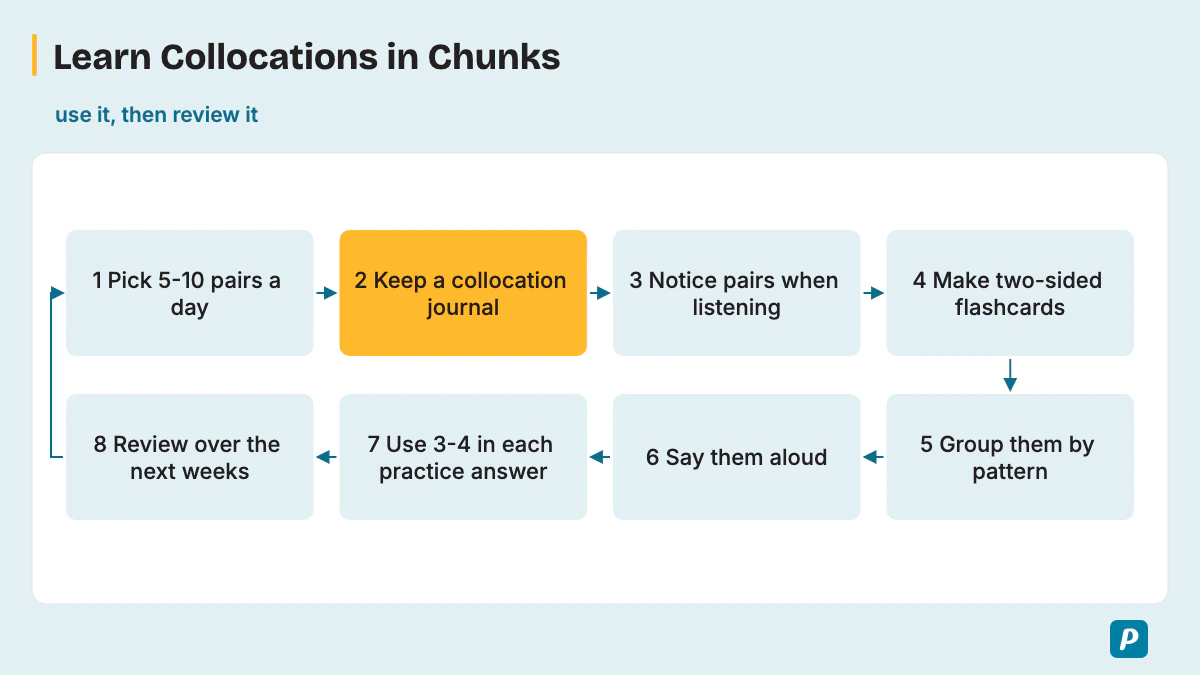
Learn collocations as chunks inside sentences you can use, grouped by pattern and topic, and review them on a spaced schedule instead of reading the full list end to end. Eight steps turn a list of pairs into language you can produce under time pressure.
- Pick 5-10 pairs a day from one topic group rather than a whole page of the ACL.
- Keep a collocation journal with three columns: the pair, a real sentence where you met it, and your own sentence.
- Notice pairs in listening as well as reading, such as lectures, podcasts and documentaries, and add them to the journal.
- Make two-sided flashcards with the pair on the front and your own sentence plus a gap version on the back.
- Sort the pairs into pattern groups, such as verb + noun or adverb + adjective, so you learn the shape as well as the words.
- Say each sentence aloud until the pair comes out as one unit, which helps in Read Aloud and Describe Image.
- Put 3-4 new pairs into every practice essay or summary, and when you meet an ACL pair in an academic text, reuse it in a practice answer the same day.
- Return to the same pairs over the following days and weeks as spaced review, testing yourself before you look at the answer.
Pearson's spreadsheet adds a classroom version of step 5: learners match verbs to nouns (take responsibility, make arrangements, become aware), then search the list for more nouns that go with each verb.
What Common Mistakes Should You Avoid With Collocations?
The most common mistakes are the wrong verb in a verb + noun pair, the wrong preposition after a verb or adjective, and forcing rare pairs into writing just to sound advanced. Six errors cover most of what goes wrong, and each one has a direct fix.
- Wrong verb: "make research" becomes "conduct research" or "carry out research".
- Wrong preposition: "responsible of the project" becomes "responsible for the project". Note that "discuss about" is a verb-pattern error, not a collocation error, so fix it as plain "discuss".
- Wrong adjective: "big evidence" becomes "strong evidence" or "compelling evidence".
- Forced vocabulary: "Learning English is statistically significant for my career" misuses a research pair, so write "Learning English is of considerable importance for my career".
- Overusing one pair: "significant impact" three times in one essay reads as padding, so vary it with "profound effect" and "major influence".
- Direct translation: "make a photo", copied word for word from some languages, becomes "take a photo" in English.
A pair can also be correct but wrong for the context. "Raw data" means figures before processing, so it can't describe uncooked food; check the example sentence before you reuse a pair.
Where Can You Get the PTE Collocation List?
Pearson offers the Academic Collocation List free on its Academic Collocation page in the Teacher Hub, as a PDF download and as a viewable .xlsx spreadsheet. The spreadsheet is easier to search and filter than the PDF. Check the version and introductory notes on the current download before reusing it. Third-party "PTE collocation list PDF" files are selections, so check any pair against Pearson's own list before you learn it.
How Do You Practice and Test Your Collocation Knowledge?
Test yourself by filling gaps in academic sentences, by rewriting a paragraph with stronger pairs, and by timed practice on Reading Fill in the Blanks, where the right partner word decides the answer. Gap-fill practice shows whether you recall the partner, and rewriting shows whether you can use it. You can create a free account on EasyEnglish when you want timed sets of Reading blanks.
Which Collocations Help in PTE Reading Fill in the Blanks?
Verb + noun and adjective + noun pairs help most, because each blank asks for the word that naturally fits the words around it. Pearson's own example works this way: only "access" fits "gained ___ to technologies", because the pair is "gain access" and the grammar is "access to".
Expect wrong options that fit the grammar of the sentence but not its partner word, so test each option against the pair before you choose. Two worked items show the same skill in Reading blanks.
- "Scholarship candidates who fail to ___ the criteria are not interviewed" (reach / do / meet / achieve): the answer is "meet", the best collocation with "criteria" among these options.
- "One vivid example can ___ an impact on the reader" (do / make / give / take): the answer is "make", because "make an impact" is on the ACL and the other three verbs don't pair with "impact".
Our guide to PTE Reading Fill in the Blanks walks through the full task and its scoring.
How Do You Practice With the PTE Collocation List?
Practice the list with gap-fills, matching and rewriting, then check every answer against Pearson's spreadsheet. These are authored practice items;choose the best standard collocation in context. They are not official PTE questions or a certified extract from the ACL.
Gap-fill: choose the word that completes the pair.
- The charity will ___ a survey of food banks in March. (conduct / raise / pose)
- From a sample of six people, you can't ___ a conclusion. (draw / pull / take)
- Every October, pink ribbons ___ awareness of breast cancer. (lift / raise / climb)
- Invasive beetles ___ a threat to the pine forests. (pose / put / give)
- Only flats that ___ the criteria qualify for the grant. (reach / meet / do)
- Nurses learn to ___ data from heart monitors. (interpret / translate / speak)
- The board met to ___ resources for the new clinic. (allocate / deliver / place)
- Electricity demand will ___ a peak at around 7 p.m. (reach / make / arrive)
- Fingerprints on the glass were ___ evidence against him. (strong / heavy / large)
- Old wiring was a ___ cause of the fires last winter. (major / heavy / wide)
- The cream had an ___ effect, so the rash got worse. (adverse / adversely / against)
- Membership numbers ___ stable after the fee rise. (remained / stopped / sat)
- Weather conditions ___ a role in the crash. (played / did / made)
- With a library card, members ___ access to e-books. (gain / take / make)
- Rents in the student district ___ dramatically last year. (increased / enlarged / extended)
- Homeless people are a ___ group in a cold snap. (vulnerable / weak / fragile)
- The bakery relies ___ on morning commuters. (heavily / hardly / highly)
- Missing pages cast ___ on the diary's value. (doubt / question / worry)
- Beginners with no ___ knowledge can join the class. (prior / earlier / before)
- Was the drop in errors ___ significant, or just luck? (statistically / numerically / mathematically)
Matching exercise: use each verb once. Verbs: conduct, draw, raise, pose, meet, reach, allocate, gain, take, make. Nouns: a consensus, access, research, responsibility, a threat, arrangements, the criteria, awareness, resources, a conclusion.
Rewrite: replace the weak pairs. Weak version: "Some experts did a study about the river and found big evidence that factories make a bad effect on the fish. The council should do something about it." Stronger version: "Biologists carried out research on the river and found strong evidence that factory waste has an adverse effect on fish stocks. The local authority should address the issue and allocate resources to cleaning the water."
Answer key. Gap-fill: 1 conduct, 2 draw, 3 raise, 4 pose, 5 meet, 6 interpret, 7 allocate, 8 reach, 9 strong, 10 major, 11 adverse, 12 remained, 13 played, 14 gain, 15 increased, 16 vulnerable, 17 heavily, 18 doubt, 19 prior, 20 statistically. Matching: conduct research, draw a conclusion, raise awareness, pose a threat, meet the criteria, reach a consensus, allocate resources, gain access, take responsibility, make arrangements.
Copy every pair you missed into your journal with a new sentence of your own. For timed sets on the full task, see PTE Reading & Writing Fill in the Blanks.
How Do Collocations Affect Your PTE Academic Score?
Pearson says natural use of collocations indicates general English proficiency, so they support your answers across tasks, but Pearson publishes no separate collocation score. In Write Essay, Pearson judges Vocabulary range by how varied your words are and how well they suit an academic environment, which is where precise pairs count toward your PTE Academic score.
PTE Core differs in register. Pearson says its content focuses on everyday situations rather than academic settings, so academic pairs appear less often. Core still has Reading & Writing: Fill in the Blanks and Fill in the Blanks, which test the same partner-word skill. Our PTE vocabulary guide covers wider word study.
How Many Collocations Should You Learn for PTE?
You don't need all 2,469; a working set of about 100-150 pairs you can produce in your own sentences is a realistic collocation target, built at a daily set of 5-10. "Learned" means you can write the pair in a sentence without looking, which is what Write Essay and Summarize Written Text ask of you. Our PTE Write Essay guide shows where to put that working set to use.
What Is Another Word for Collocation?
Teachers also call collocations word partnerships or word combinations, and longer fixed groups are often called chunks. Pearson's list covers the chunk "take into consideration", which behaves like a two-word pair, so learn it the same way.
Can You Give Me 10 Examples of Collocation?
These 10 examples are academic pairs from Pearson's list, two for each of five patterns, and the topic tables above hold 132 more.
- Verb + noun: reach a consensus, pose a threat, as in "the jury took two days to reach a consensus".
- Adjective + noun: detailed analysis, key issue, as in "parking is the key issue for residents".
- Noun + noun: data set, survey data, as in "the survey data came from 300 cafés".
- Adverb + adjective: highly effective, widely available, as in "free maps are widely available at the station".
- Verb + adverb: expand rapidly, occur naturally, as in "the town expanded rapidly after the railway arrived".
Written by
EasyEnglish Team
The team behind EasyEnglish's PTE practice and mock tests
We build the PTE practice tasks, mock tests and scoring on EasyEnglish, and we oversee every guide on this site. We consult official test-provider and government sources where relevant. Check the sources and review date for each guide; practice examples are authored learning material. EasyEnglish is not affiliated with Pearson.
Editorial review completed .