How to Manage PTE Exam Fear and Overcome Anxiety?
Exam Preparation
On test day, exam fear blanks your recall in the first items, rushes your speech and makes the timer feel louder than the task. Familiar practice and a calm routine may help, though anxiety varies and can persist. Every test-day rule here, from arrival time and ID to the booth, the people around you, the warm-up item and retakes, is Pearson's own rule for PTE Academic. The calming methods are general wellbeing habits, not medical advice.
Table of Contents
What Is PTE Exam Anxiety?
PTE exam anxiety is the nervousness you can feel before and during a high-stakes test whose score may be one requirement for study or a visa. It shows up as racing thoughts, a blank mind on the first item or speech that runs faster than you planned. Pearson's own advice treats nerves as normal and suggests turning them into positive energy.
Familiar practice takes most of the surprise out of the test. If anxiety feels severe or lasting, it's worth talking it through with a qualified professional.
Other everyday signs are easy to spot once you name them:
- a fast heartbeat or sweaty hands when you sit down to a timed practice test;
- trouble sleeping in the nights before the test;
- putting off practice because a low result would feel bad;
- comparing your practice scores with friends' scores;
- negative self-talk such as "I always freeze on speaking".
Why Do You Panic Before the PTE Exam?
Panic before PTE usually comes from fear of missing the score a visa or university needs, not knowing what happens on test day and worry about the speaking setup. Each of these four causes has a practical answer.
- Fear of failing: the score feels final, but a retake is open as soon as your scores arrive.
- Feeling underprepared: learning the format facts removes most surprises.
- Time pressure: a study timeline with timed practice makes the clock feel normal.
- The speaking setup: talking to a computer with others nearby feels odd until you know your microphone won't pick them up.
How Do You Master the PTE Format Before Test Day?
Learn the three parts and every question type, then take timed, scored practice tests until nothing on screen surprises you. Pearson itself suggests taking a Scored Practice Test before test day. Knowing the test format turns each item into something you've already done. These format facts matter most for nerves.
- The test lasts about two hours for PTE Academic, PTE Academic UKVI and PTE Core.
- The Personal Introduction is an unscored warm-up, with 25 seconds to prepare and 30 seconds to record.
- In Answer Short Question, waiting more than three seconds or stopping for three seconds ends the recording.
- Pearson adds that the same rule applies to Read Aloud, Repeat Sentence, Describe Image and Re-tell Lecture.
- You type on a QWERTY keyboard, so practice on one if you normally use another layout.
Pearson does not name Summarize Group Discussion or Respond to a Situation in that 3-second note, so practice starting every speaking task promptly and keeping your voice going without long pauses.
Why Should You Arrive Early on PTE Test Day?
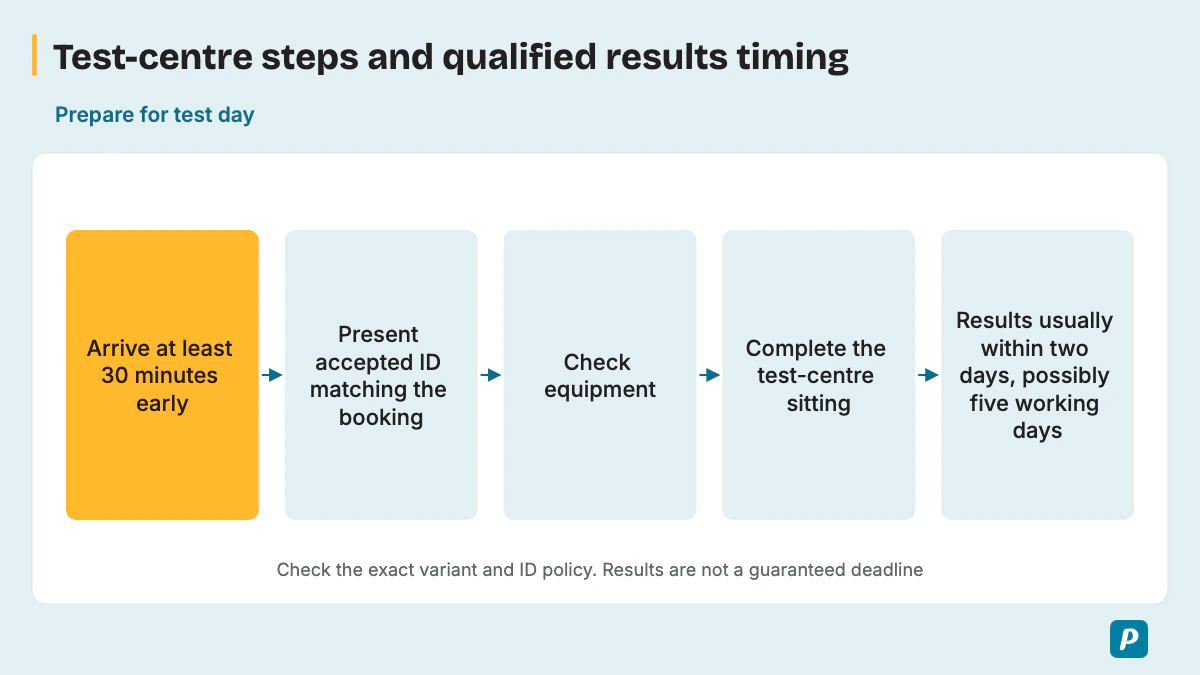
Pearson asks you to arrive at least 30 minutes before your test, and late arrivals aren't allowed to test and lose the fee. That half hour covers check-in, so the rush never reaches your first item. The table sets out what to expect once you're through the door.
| What to expect | Pearson's rule |
|---|---|
| Arrival | Late arrivals cannot test and the fee is lost. |
| ID | Bring the ID you chose at booking, normally a valid passport, physical, unexpired and issued no more than 10 years ago. |
| Check-in | Staff match your ID to your booking, then take a digital photo, signature and palm scan. |
| Your booth | A partitioned booth holds a computer, keyboard, audio headset, notepad and pencil. |
| The room | Around 10-15 people test together; you may hear them, but your microphone won't pick up their voices. |
| Test length | The test runs for two hours. |
PTE Academic UKVI and PTE Home accept a wider ID list, such as a UK eVisa share code or a BRP, so check Pearson's identification policy for your test. The day before, travel your route at the same hour and time it, so the morning holds no unknowns.
What Happens on PTE Exam Day?
Exam day runs from check-in and ID checks to a two-hour test in a partitioned booth, and knowing each step in order takes the guesswork out of the morning. You store personal items in a locker before you go in. Our PTE exam day guide walks through each step.
How Do You Calm Your Body and Mind Before the Exam?
The simple answer is to sleep well, eat a normal meal, take a short walk and use a few minutes of slow breathing in the waiting area. These everyday habits help you feel steadier, and none of them is a PTE rule.
- Sleep: aim for a normal night's sleep rather than late revision.
- A familiar meal: eat what you usually eat, skip anything heavy or new, and drink some water.
- Light movement: a short walk before you go in loosens tension.
- Slow breathing: breathe in gently and let the out-breath run a little longer.
- A grounding exercise: in the waiting area, name things you can see, then things you can hear.
Rehearse the breathing and grounding routine before and after study sessions in the weeks before the test, so on the day it runs without thought. You don't need a named technique or exact counts: any slow, comfortable rhythm works.
If these habits don't ease things over time, a qualified professional can help. If a doctor has diagnosed a long-term condition, Pearson's accommodations route may apply. Flag it when you create your myPTE account, then send the request form with a medical letter at least six weeks before the test.
How Do You Stay Calm During the PTE Exam?
Staying calm during the test means using the unscored warm-up, checking your headset and focusing on one item at a time. Five habits keep you steady from the first item to the last.
- Run the headset check carefully and adjust the fit before the first item.
- Use the Personal Introduction as a warm-up to find a calm speaking pace.
- Keep notes on the notepad short, a few words per idea.
- Move on after a weak item and give the next one your full attention; single-item focus keeps one slip from spreading.
- Ignore neighbors' voices, because Pearson says your microphone won't pick them up.
How Do You Set a Study Timeline That Reduces PTE Stress?
A study timeline that reduces stress starts with booking the test date, then counts back the weeks you need. Spread practice so the last few days are for review, with no cramming of new content. Five stages make up the timeline.
| Stage | What to do |
|---|---|
| Start early | Learn every task type and its rules. |
| Practice under test conditions | Work timed, on a keyboard, with background noise. |
| Take a scored practice test | Use the result to pick your weakest tasks. |
| Final days | Review mistakes and add no new material. |
| The day before | Handle logistics only: ID, route, sleep. |
Build stamina as well as skill. Sit at least a few full-length two-hour mock tests in one go, with no pauses, and schedule one at a time of day when you usually feel tired. Practice with background noise on purpose, since test rooms hold about 10-15 people and you may hear them.
How Do You Shift Your Mindset About the PTE Score?
A healthier mindset starts here: see the test as one attempt, not a verdict. Pearson accepts intelligible regional and national pronunciation; content, pronunciation and fluency are assessed where applicable. Work on clarity rather than trying to erase your accent.
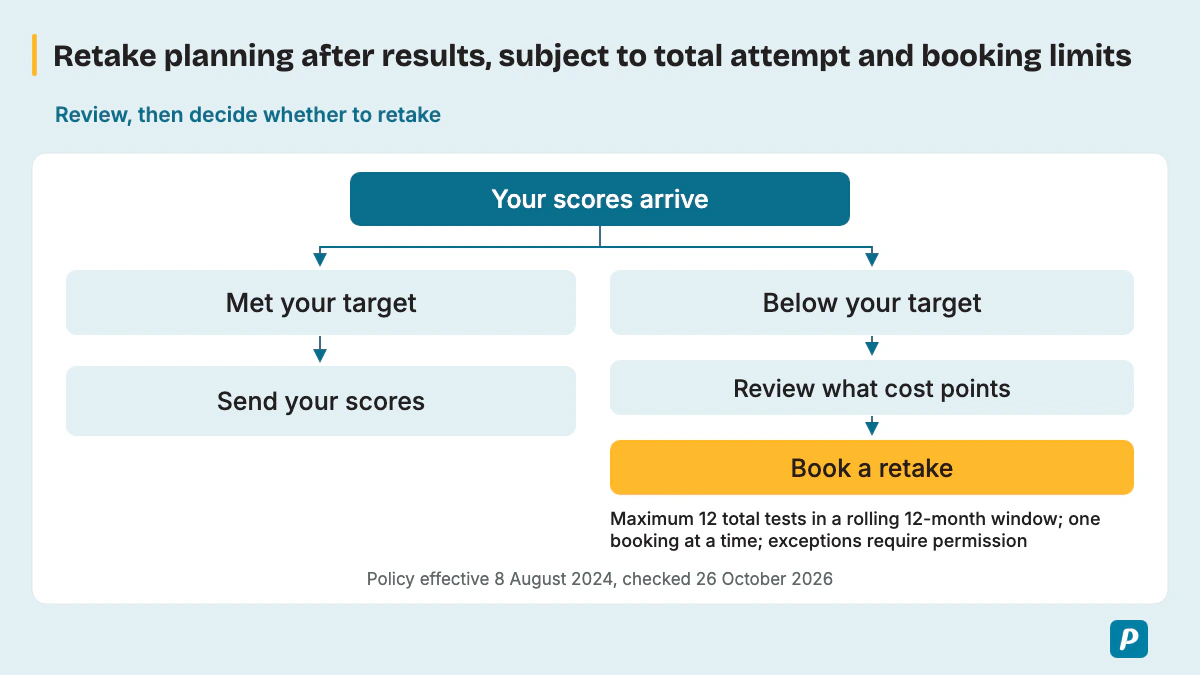
Results are usually available within two days but may take up to five working days. Once your scores arrive you can book a retake, subject to a limit of 12 total tests in a 12-month window; some prep sites say there's no limit, but Pearson's policy sets that cap. Comparison with other test takers tells you nothing about your own score, so keep your attention on your own tasks.
Negative self-talk is easier to change when you have the replacement sentence ready.
| Instead of saying | Say this |
|---|---|
| "If I miss this score, everything is over." | "This is one attempt, and I can book another once my scores arrive." |
| "My accent will pull my score down." | "Pearson scores what I say, not my accent." |
| "Everyone else is better at this." | "My only job is the item on my screen." |
| "I froze on that item, so the test is ruined." | "That item is finished; the next one is a fresh start." |
After the test, let go of what you can no longer change. Open your score report when you are ready, then read the skill scores for the next step.
How Do You Overcome PTE Exam Fear for the Long Term?
Long-term confidence comes from a steady routine of timed practice and honest review, plus a backup plan in the form of a retake date. Progress tracking means confidence rests on evidence, not hope: log each practice score by task, so you can see which tasks are moving.
Try a write-it-down exercise once a week. List every specific fear about the test, such as "my mind will go blank in Read Aloud". Next to each one, write the action or Pearson rule that answers it, such as "read the passage silently during the preparation time, then speak as soon as the microphone opens".
How Do You Overcome PTE Exam Stress While Preparing?
Plan short, timed practice blocks with breaks, and measure progress by tasks you can now do rather than by hours studied. A short break between blocks lets you review mistakes with a fresh eye. Our PTE preparation guide helps you plan the blocks.
How Can Motivation Help You Beat PTE Exam Fear?
Motivation steadies fear when it is tied to a concrete goal, such as the score your university or visa needs, written where you study. A target score turns a vague worry into a number you can work toward. Our PTE tips help you plan the steps to it.
Can You Retake PTE If the Exam Goes Wrong?
Yes, you can book a retake as soon as you receive your scores, subject to a limit of 12 total tests in a 12-month window under Pearson's retake policy. The next retake can fall within the same month. See our PTE retake page for the booking steps.
Practice PTE Online on EasyEnglish
Try Speaking, Writing, Reading and Listening tasks in a timed, computer-based format.
Practice scores are EasyEnglish estimates, not official Pearson scores. You can try speaking scoring without signing up.
Written by
EasyEnglish Team
The team behind EasyEnglish's PTE practice and mock tests
We build the PTE practice tasks, mock tests and scoring on EasyEnglish, and we oversee every guide on this site. We consult official test-provider and government sources where relevant. Check the sources and review date for each guide; practice examples are authored learning material. EasyEnglish is not affiliated with Pearson.
Editorial review completed .