PTE Vocabulary: Top Words and Best Strategies
Exam Preparation
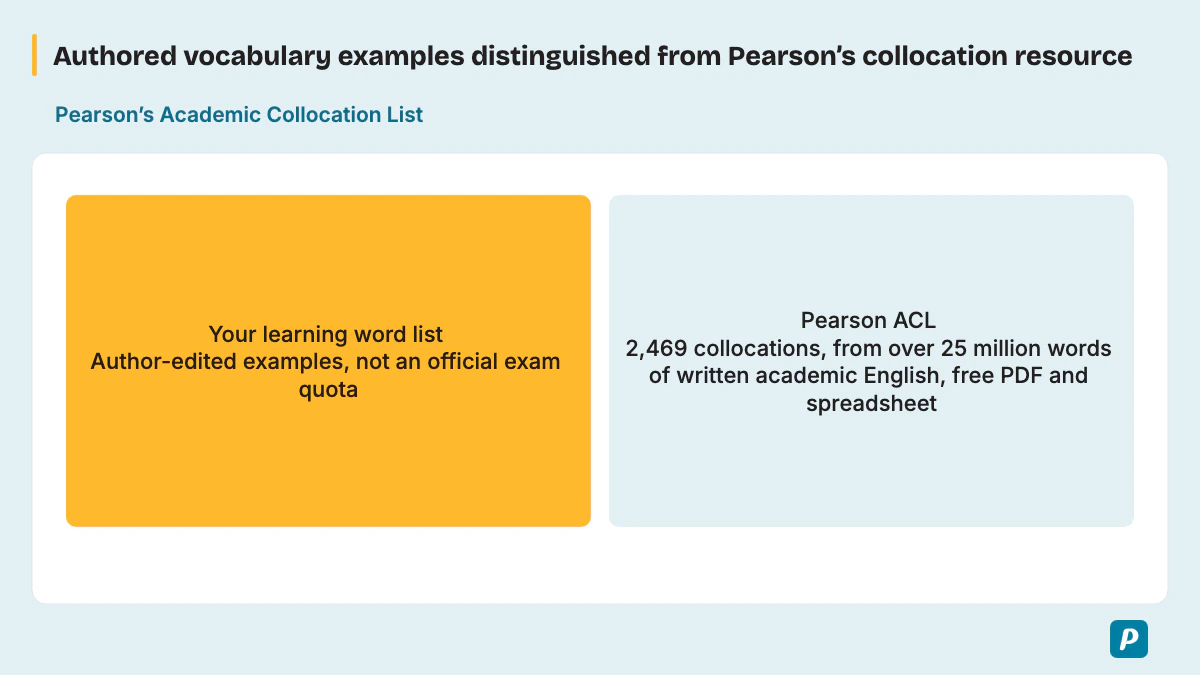
A long downloaded word list won't lift your score by itself. Pearson scores PTE vocabulary through the range and precision of the words you write and say, and through word pairs and word forms in the Reading Fill in the Blanks tasks. Pearson publishes no word list for PTE Academic or PTE Core. Its official word resource is the Academic Collocation List.
The words below are our authored example set of academic, topic and lecture vocabulary, with meanings, parts of speech and model sentences. The scenarios, dates, figures and research statements in those sentences are invented for language practice, not reports of real studies or official PTE questions. Linking words, data words, collocations and formal alternatives accompany30 practice items with answers.
Table of Contents
What Is Vocabulary in PTE?
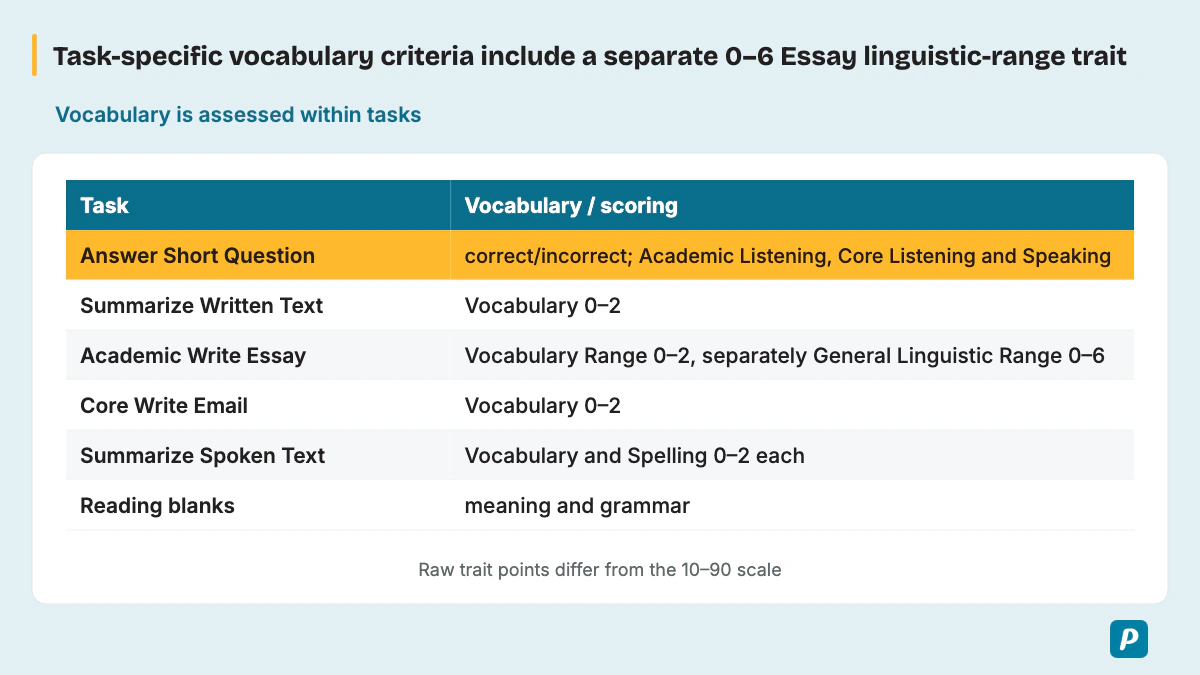
In PTE, vocabulary is a scored quality inside tasks, not a separate vocabulary section. Pearson scores it as the Vocabulary trait in Summarize Written Text and Summarize Spoken Text, as Vocabulary range and General linguistic range in Write Essay, and as word choice in Answer Short Question. Older guides use "enabling skills" such as written discourse, but Pearson's Score Guide uses these trait names, though its Write Essay page still lists written discourse. Answer Short Question counts toward listening only in PTE Academic, while PTE Core says it also affects speaking and vocabulary.
Pearson's Score Guides for PTE Academic (2025) and PTE Core (2026) publish the scale for each vocabulary criterion, summarized in this table.
| Task | Test | Vocabulary criterion | Score scale |
|---|---|---|---|
| Answer Short Question | Academic and Core | Vocabulary (word choice) | 1 = appropriate word choice, 0 = inappropriate |
| Summarize Written Text | Academic and Core | Vocabulary | 0-2 (2 = appropriate choice of words) |
| Write Essay | Academic | Vocabulary Range; separately, General Linguistic Range | Vocabulary Range 0-2; General Linguistic Range 0-6 |
| Write Email | Core | Vocabulary | 0-2 (2 = good command of lexis appropriate to the situation) |
| Summarize Spoken Text | Academic and Core | Vocabulary and Spelling | 0-2 each |
| Reading Fill in the Blanks | Academic and Core | No vocabulary trait | Each blank needs the right word in meaning and grammar |
Is There an Official PTE Vocabulary List?
No, Pearson publishes no official word list for PTE Academic or PTE Core. Its official word resource is the Academic Collocation List: 2,469 collocations common in written academic English, free as a PDF and spreadsheet on pearsonpte.com. The Pearson vocabulary PDF that turns up in searches belongs to PTE Young Learners, a different test, so it isn't a PTE Academic list. Publisher lists of "200+ words" are editorial picks, and that includes the 230-plus words in our tables.
They're useful for practice, but none of them is official.
What Type of Vocabulary Do You Need for PTE?
Five kinds of words do the most work in PTE: academic words, topic-based vocabulary, linking words, descriptive and data words, and collocations. Each one pays off in a different set of tasks.
- Academic words lift Write Essay, Summarize Written Text and your spoken summaries.
- Topic-based vocabulary helps you follow passages and lectures on subjects like health or the economy.
- Linking words hold essays, summaries and spoken answers together.
- Data words describe trends, highs and lows in Describe Image.
- Collocations help in both Reading Fill in the Blanks tasks, alongside meaning and part of speech.
Pearson says PTE Academic isn't very strict about using only academic vocabulary, and you lose no points for personal pronouns such as "I" or "we". You do score more for higher-level academic words used correctly, so accuracy comes before rarity. "The figures plummeted marginally" misuses a dramatic verb, while "the figures fell slightly" says the same thing correctly.
Which Academic Words Help in PTE?
Academic words help when you use them correctly: Pearson says correct use of academic words earns higher vocabulary points, and the Write Essay Vocabulary range trait rewards precise terms and variety. The 70 words in these three tables are an example set we chose from common academic English, not a Pearson list.
Start with the academic verbs, since a precise verb carries most of the meaning in a summary sentence.
| Word | Part of speech | Meaning | Example sentence |
|---|---|---|---|
| acquire | verb | gain or get something | Children acquire a second language faster when they hear it daily. |
| adapt | verb | change to suit new conditions | Small firms adapted quickly to online ordering. |
| allocate | verb | give a share of something for a purpose | The council allocated more funds to public libraries. |
| analyze | verb | examine something in detail | The team analyzed ten years of rainfall records. |
| assess | verb | judge the quality or value of something | Doctors assess each patient before surgery. |
| attribute | verb | say something is caused by something | The author attributes the decline to rising rents. |
| clarify | verb | make something easier to understand | The lecturer clarified the difference between weather and climate. |
| compile | verb | collect information into one list or report | Researchers compiled data from 40 hospitals. |
| constitute | verb | form or make up something | Volunteers constitute most of the festival's staff. |
| contribute | verb | help to cause something | Long working hours contribute to stress. |
| demonstrate | verb | show clearly with evidence | The trial demonstrated that the drug was safe. |
| derive | verb | get something from a source | Many English words derive from Latin. |
| emphasize | verb | give special importance to something | The report emphasizes the need for early testing. |
| enhance | verb | improve the quality of something | Good lighting enhances the look of a room. |
| evaluate | verb | judge how good or useful something is | Students evaluate two sources before writing. |
| facilitate | verb | make a process easier | Shared offices facilitate contact between teams. |
| illustrate | verb | explain by giving an example | The chart illustrates how prices changed. |
| imply | verb | suggest without saying directly | His tone implied that he disagreed. |
| indicate | verb | show or point to something | The results indicate a link between diet and mood. |
| interpret | verb | explain what something means | Economists interpret the same data in different ways. |
| justify | verb | give good reasons for something | The minister justified the new tax in parliament. |
| modify | verb | change something slightly | Engineers modified the design to cut costs. |
| obtain | verb | get something, often with effort | Applicants must obtain a work permit first. |
| reinforce | verb | make something stronger | Regular quizzes reinforce what students learn. |
| undermine | verb | gradually weaken something | Constant noise undermines concentration. |
Academic nouns name the ideas you summarize, so these 25 cover concepts found across many academic passages.
| Word | Part of speech | Meaning | Example sentence |
|---|---|---|---|
| approach | noun | a way of dealing with something | The school took a new approach to homework. |
| aspect | noun | one part or feature of something | Cost is only one aspect of the decision. |
| assumption | noun | something accepted as true without proof | The plan rests on the assumption that prices stay low. |
| capacity | noun | the amount something can hold or do | The stadium has a capacity of 60,000 people. |
| component | noun | one part of a larger system | Batteries are the most expensive component of an electric car. |
| concept | noun | a general idea | The concept of free trade is easy to explain. |
| consequence | noun | a result of an action | One consequence of the drought was higher food prices. |
| constraint | noun | a limit on what is possible | Time is the main constraint on the project. |
| criterion | noun | a standard used to judge something | Price was the first criterion for choosing a supplier. |
| decline | noun | a fall in amount or quality | The decline in bee numbers worries farmers. |
| emphasis | noun | special importance given to something | The course puts emphasis on speaking skills. |
| evidence | noun | facts that support a claim | There is strong evidence that exercise improves mood. |
| factor | noun | one cause among several | Location is a key factor in house prices. |
| framework | noun | a basic structure of ideas or rules | The law gives a framework for online privacy. |
| impact | noun | a strong effect | Social media has a clear impact on news habits. |
| implication | noun | a likely result or effect | The findings have implications for teacher training. |
| initiative | noun | a new plan to solve a problem | The city launched an initiative to plant trees. |
| outcome | noun | the final result | Nobody could predict the outcome of the vote. |
| perspective | noun | a way of thinking about something | The novel tells the story from a child's perspective. |
| phenomenon | noun | a fact or event that can be observed | Migration of birds is a seasonal phenomenon. |
| priority | noun | something treated as most important | Safety is the airline's first priority. |
| proportion | noun | a part compared with the whole | A large proportion of students work part time. |
| significance | noun | importance | Few people saw the significance of the discovery at first. |
| strategy | noun | a plan to reach a goal | The company changed its marketing strategy. |
| trend | noun | a general direction of change | There is a trend toward smaller families. |
Adjectives and adverbs sharpen a claim, and the adverbs in this third table also work as linking words.
| Word | Part of speech | Meaning | Example sentence |
|---|---|---|---|
| accurate | adjective | correct in every detail | Accurate records helped the nurses track each dose. |
| adequate | adjective | good or large enough | The flat has adequate space for two people. |
| alternative | adjective | offering another choice | Cycling is an alternative way to get to work. |
| apparent | adjective | clear or obvious | The benefits became apparent after a month. |
| beneficial | adjective | having a good effect | Fresh air is beneficial for young children. |
| comparable | adjective | similar enough to compare | Salaries in the two cities are comparable. |
| considerable | adjective | large in size or amount | The repairs cost a considerable sum. |
| crucial | adjective | extremely important | Early diagnosis is crucial for treatment. |
| distinct | adjective | clearly different | The two species have distinct songs. |
| efficient | adjective | working well without waste | LED bulbs are more efficient than old bulbs. |
| inevitable | adjective | certain to happen | Some delays are inevitable in large projects. |
| relevant | adjective | connected to the subject | Only include relevant details in your summary. |
| significant | adjective | large or important enough to notice | The policy led to a significant drop in accidents. |
| substantial | adjective | large in amount or value | The museum received a substantial donation. |
| sufficient | adjective | enough for a purpose | There was not sufficient evidence to convict him. |
| consequently | adverb | as a result | Fuel prices rose; consequently, fares went up. |
| largely | adverb | mostly | The success was largely due to good planning. |
| primarily | adverb | mainly | The course is primarily for beginners. |
| relatively | adverb | when compared with others | The test was relatively easy this year. |
| subsequently | adverb | after that | The film was subsequently made into a series. |
Vocabulary range also checks appropriateness, so a precise everyday word beats a misused academic one.
Which Topic-Based Vocabulary Helps in PTE?
Topic-based vocabulary helps because PTE passages, lectures and essay prompts come from academic and everyday subjects such as education, health, the environment, technology, the economy and science. Knowing a topic's core words lets you follow the text and write about it precisely. Group new words by topic when you study them, so each word comes back with its neighbors; the 144 words below are grouped into 12 common subjects of academic texts.
Education words appear in essay prompts about schools, universities and how people learn.
| Word | Part of speech | Meaning | Example sentence |
|---|---|---|---|
| academic | adjective | relating to study and learning | Her academic results improved in the second year. |
| aptitude | noun | a natural ability to learn or do something | Tests measure a child's aptitude for music. |
| compulsory | adjective | required by a rule or law | Math is compulsory in most secondary schools. |
| curriculum | noun | the subjects taught in a school or course | Some schools now include coding in the primary curriculum. |
| discipline | noun | a subject of study, or self-control | History is a discipline that relies on sources. |
| enrollment | noun | the number of people who join a course | Enrollment in nursing courses rose last year. |
| pedagogy | noun | the method and theory of teaching | The course trains teachers in modern pedagogy. |
| literacy | noun | the ability to read and write | Adult literacy classes run every evening. |
| plagiarism | noun | copying someone else's work as your own | The university treats plagiarism as serious misconduct. |
| proficiency | noun | a high level of skill or ability | Universities ask for proof of English proficiency. |
| tuition | noun | teaching, or the money paid for it | Tuition fees vary widely between universities. |
| vocational | adjective | training for a particular job | Vocational courses teach skills such as plumbing. |
Health and medicine vocabulary covers illness, treatment and public health.
| Word | Part of speech | Meaning | Example sentence |
|---|---|---|---|
| chronic | adjective | lasting a long time | Chronic back pain affects many office workers. |
| contagious | adjective | spread by contact between people | Measles is highly contagious. |
| diagnosis | noun | identifying an illness | A quick diagnosis can save lives. |
| prevalence | noun | how common something is in a population | The prevalence of diabetes differs between regions. |
| immunity | noun | protection against a disease | Vaccines build immunity without the illness itself. |
| life expectancy | noun | the average number of years people live | Life expectancy has risen in most countries. |
| nutrition | noun | the food the body needs to grow and stay healthy | Good nutrition matters most in early childhood. |
| obesity | noun | the condition of being very overweight | Doctors link obesity to heart disease. |
| outbreak | noun | a sudden start of a disease | Officials closed the market after the outbreak. |
| sedentary | adjective | involving a lot of sitting and little exercise | Office work is often sedentary. |
| symptom | noun | a sign of illness | A high fever is a common symptom of flu. |
| well-being | noun | the state of being healthy and happy | Green spaces support mental well-being. |
Environment words help with lectures on climate, pollution and natural resources.
| Word | Part of speech | Meaning | Example sentence |
|---|---|---|---|
| carbon emissions | noun | carbon dioxide and other carbon gases released into the air | Planes produce high carbon emissions per passenger. |
| conservation | noun | protecting nature and resources | Conservation groups protect the remaining wetlands. |
| contaminate | verb | make something dirty or harmful | Factory waste contaminated the river. |
| deforestation | noun | cutting down large areas of forest | Deforestation destroys animal habitats. |
| drought | noun | a long period with little or no rain | The drought ruined the wheat harvest. |
| endangered | adjective | at risk of dying out | The tiger is an endangered species. |
| erosion | noun | gradual wearing away of soil or rock | Tree roots reduce soil erosion. |
| extinction | noun | the dying out of a species | Hunting pushed the bird toward extinction. |
| habitat | noun | the natural home of a plant or animal | Wetlands are a habitat for many birds. |
| renewable | adjective | able to be replaced naturally | Solar power is a renewable energy source. |
| sustainable | adjective | able to continue without harming the future | Sustainable fishing limits the size of each catch. |
| mitigate | verb | make something less harmful or serious | Sea walls mitigate the damage from storms. |
Technology vocabulary describes devices, data and digital change.
| Word | Part of speech | Meaning | Example sentence |
|---|---|---|---|
| artificial intelligence | noun | computer systems that perform tasks needing human thinking | Artificial intelligence now helps doctors read scans. |
| automate | verb | make a process work by machine | Banks automate many routine checks. |
| bandwidth | noun | the amount of data a connection can carry | Video calls need more bandwidth than email. |
| breakthrough | noun | an important new discovery | The new battery was a breakthrough for electric cars. |
| compatible | adjective | able to work together | The charger is compatible with most phones. |
| connectivity | noun | the ability to connect to a network | Some rural schools still lack connectivity. |
| interface | noun | the way a user interacts with a system | The app has a simple interface. |
| digital | adjective | using computer technology | Digital payments replaced cash in many shops. |
| prototype | noun | a first model used to test a design | The team built a prototype of the drone. |
| obsolete | adjective | no longer used because something newer exists | Fax machines are almost obsolete. |
| privacy | noun | the right to keep personal information secret | Apps must protect users' privacy. |
| surveillance | noun | close watching of people or places | Cameras keep the station under surveillance. |
Economy and finance words come up in lectures and charts about prices, trade and money.
| Word | Part of speech | Meaning | Example sentence |
|---|---|---|---|
| austerity | noun | strict cuts in government spending | Austerity reduced funding for libraries. |
| consumer | noun | a person who buys goods or services | Consumers spent less after prices rose. |
| debt | noun | money that is owed | The government reduced its debt over five years. |
| expenditure | noun | the amount of money spent | Public expenditure on health keeps growing. |
| export | noun | a product sold to another country | Coffee is the country's main export. |
| fluctuate | verb | rise and fall irregularly | Oil prices fluctuate from week to week. |
| GDP | noun | gross domestic product, the total value of goods and services a country produces | GDP grew by two percent last year. |
| disparity | noun | a large difference, often seen as unfair | There is a wide disparity between urban and rural wages. |
| inflation | noun | a general rise in prices | Inflation reduces what savings can buy. |
| interest rate | noun | the percentage charged for borrowing money | Higher interest rates make loans more expensive. |
| revenue | noun | money a business or government receives | Tourism brings in most of the island's revenue. |
| subsidy | noun | money given to keep prices low or support an industry | Farmers receive a subsidy for growing wheat. |
Business and work vocabulary suits essays on jobs, companies and careers.
| Word | Part of speech | Meaning | Example sentence |
|---|---|---|---|
| incentive | noun | something that encourages a person to act | Tax breaks are an incentive to save. |
| monopoly | noun | complete control of a market by one company | One company held a monopoly on rail services. |
| workforce | noun | all the people who work for a company or in a country | The factory's workforce doubled in two years. |
| outsource | verb | pay another company to do part of your work | Many firms outsource their customer service. |
| flexible | adjective | able to change easily | Flexible hours help working parents. |
| productivity | noun | the amount of work done in a given time | Short breaks can raise productivity. |
| stakeholder | noun | a person or group with an interest in a decision | The council consulted every stakeholder before the vote. |
| recruit | verb | find new people to join an organization | Hospitals are recruiting nurses from abroad. |
| retail | noun | the sale of goods to the public | Retail employs millions of people. |
| remuneration | noun | payment for work (formal) | The post offers generous remuneration. |
| startup | noun | a newly founded company | The startup raised money from investors. |
| unemployment | noun | the state of having no job | Unemployment fell to its lowest level in a decade. |
Science and research words appear in almost every Retell Lecture and reading passage.
| Word | Part of speech | Meaning | Example sentence |
|---|---|---|---|
| analysis | noun | detailed study of something | The analysis showed three main causes. |
| anomaly | noun | something that differs from what is expected | One reading was an anomaly, so it was checked again. |
| catalyst | noun | something that speeds up a reaction or a change | The crisis acted as a catalyst for reform. |
| molecule | noun | the smallest particle of a substance that keeps its chemical properties | Water molecules contain hydrogen and oxygen. |
| observation | noun | the act of watching carefully | The study relied on careful observation of birds. |
| organism | noun | a living thing | Bacteria are tiny single-celled organisms. |
| precise | adjective | exact and accurate | Scientists need precise measurements. |
| replicate | verb | repeat an experiment to check results | Other teams failed to replicate the result. |
| species | noun | a group of similar living things | Scientists named a new species of frog. |
| specimen | noun | an example taken for study | The museum stores rare plant specimens. |
| theory | noun | an idea that explains facts | Darwin's theory explains how species change. |
| validate | verb | prove that something is true or correct | Further tests validated the method. |
Society and culture words cover communities, traditions and social change.
| Word | Part of speech | Meaning | Example sentence |
|---|---|---|---|
| cohesion | noun | the state of a group staying united | Shared events build social cohesion. |
| custom | noun | a traditional way of behaving | Giving gifts is a common custom at weddings. |
| demographic | adjective | relating to the structure of a population | Demographic change affects school planning. |
| diversity | noun | variety of people or things | The city is known for its cultural diversity. |
| ethnic | adjective | relating to a shared culture or origin | The festival celebrates many ethnic groups. |
| generation | noun | people born around the same time | Each generation uses technology differently. |
| heritage | noun | traditions and buildings from the past | Old temples are part of the nation's heritage. |
| immigrant | noun | a person who moves to live in another country | Many immigrants open small businesses. |
| inequality | noun | an unfair difference between groups | Income inequality grew during the decade. |
| minority | noun | a smaller group within a larger one | A minority of voters supported the plan. |
| norm | noun | usual or expected behavior | Working from home became the norm for some jobs. |
| welfare | noun | help given to people in need, or general well-being | The state pays welfare to families on low incomes. |
Government and law vocabulary helps with passages on policy, rights and elections.
| Word | Part of speech | Meaning | Example sentence |
|---|---|---|---|
| impose | verb | officially force a rule, tax or cost on people | The city imposed a fee on plastic bags. |
| legitimacy | noun | the quality of being lawful or widely accepted as fair | The election gave the new government legitimacy. |
| comply | verb | obey a rule or request | All restaurants must comply with hygiene rules. |
| constitution | noun | the basic laws of a country | The constitution protects free speech. |
| enforce | verb | make people obey a law | Police enforce the speed limit with cameras. |
| jurisdiction | noun | the official power to make legal decisions | The case is outside the court's jurisdiction. |
| legislation | noun | a law or set of laws | New legislation protects online shoppers. |
| mandatory | adjective | required by law | Helmets are mandatory for motorcyclists in many countries. |
| policy | noun | a plan of action by a government or organization | The new policy offers free school meals. |
| reform | noun | a change to improve a system | Tax reform was the main election issue. |
| regulation | noun | an official rule | Strict regulations control food labels. |
| verdict | noun | the decision of a court | The jury reached a verdict after two days. |
Media and communication words fit topics on news, advertising and social media.
| Word | Part of speech | Meaning | Example sentence |
|---|---|---|---|
| credibility | noun | the quality of being believed and trusted | The error damaged the paper's credibility. |
| bias | noun | an unfair preference for one side | Readers complained about bias in the report. |
| broadcast | verb | send out a program on TV or radio | The match was broadcast live. |
| censorship | noun | stopping certain information from being shared | Some countries use censorship to control the press. |
| circulate | verb | pass from person to person | False stories circulate fast online. |
| coverage | noun | the reporting of an event | The election got wide coverage. |
| editorial | noun | a newspaper article giving the paper's opinion | The editorial criticized the new tax. |
| journalism | noun | the work of collecting and reporting news | She studied journalism at university. |
| misinformation | noun | false information spread by mistake or on purpose | Misinformation about vaccines spread quickly. |
| persuade | verb | make someone agree or act | Adverts persuade people to buy things. |
| platform | noun | a website or app where people share content | The platform has a billion users. |
| publicity | noun | attention from the media | The charity gained publicity from the concert. |
Cities and transport vocabulary suits essays on housing, traffic and travel.
| Word | Part of speech | Meaning | Example sentence |
|---|---|---|---|
| commute | verb | travel regularly between home and work | She commutes an hour each way. |
| congestion | noun | too much traffic in one place | Congestion is worst at 8 a.m. |
| density | noun | how many people live in an area | Population density is high in the old town. |
| infrastructure | noun | basic systems such as roads, water and power | The city spent billions on infrastructure. |
| metropolitan | adjective | relating to a large city and its area | The metropolitan area has ten million people. |
| gentrification | noun | the change of a poorer area as richer people move in | Gentrification pushed rents up in the old district. |
| public transport | noun | buses and trains for public use | Public transport is cheaper than driving. |
| residential | adjective | used for homes, not offices | The new tower is fully residential. |
| rural | adjective | relating to the countryside | Rural areas often lack fast internet. |
| sprawl | noun | the spread of a city into the countryside | Urban sprawl increases commuting times. |
| urban | adjective | relating to towns and cities | Urban populations are growing worldwide. |
| zoning | noun | rules on how land in each area can be used | Zoning laws keep factories away from homes. |
History and the arts round out the set, since lectures on art, archaeology and literature appear too.
| Word | Part of speech | Meaning | Example sentence |
|---|---|---|---|
| ancient | adjective | very old, from long ago | The ancient city was built of stone. |
| archive | noun | a collection of historical records | The archive holds letters from the 1800s. |
| artifact | noun | an object made by people in the past | Divers recovered artifacts from the shipwreck. |
| unprecedented | adjective | never having happened before | The flood caused unprecedented damage. |
| civilization | noun | an advanced human society | The Indus Valley civilization planned its cities carefully. |
| contemporary | adjective | belonging to the present time | The gallery shows contemporary art. |
| era | noun | a period of history | The film is set in the jazz era. |
| aesthetic | adjective | relating to beauty and appearance | Critics praised the building's aesthetic qualities. |
| genre | noun | a type of art, music or writing | Crime fiction is a popular genre. |
| medieval | adjective | relating to the Middle Ages | The town still has its medieval walls. |
| depict | verb | show or describe in a picture or in words | The mural depicts life in the harbor. |
| revolution | noun | a sudden, major change | The industrial revolution changed how people worked. |
Which Linking and Transitional Words Work in PTE?
Linking words that show a clear relationship, such as contrast, cause and effect, addition, sequence or condition, tie essays, summaries and spoken answers together. The 13 purposes in this table each come with transitional words and one example.
| Purpose | Linking words | Example |
|---|---|---|
| Addition | also, in addition, besides, as well as | The scheme cuts costs as well as saving time. |
| Contrast | however, whereas, on the other hand | Rents rose in the city, whereas they fell in the suburbs. |
| Concession | although, even though, despite, nevertheless | Despite the rain, the match went ahead. |
| Cause | because, since, due to, owing to | Flights were delayed due to fog. |
| Effect or result | therefore, as a result, consequently, thus | Demand fell; as a result, prices dropped. |
| Example | for instance, including, such as, a case in point | Some metals, such as copper, conduct heat well. |
| Sequence | first, then, after that, finally | First, the seeds are dried; then they are ground. |
| Similarity | equally, in the same way, likewise | Likewise, older workers valued job security. |
| Condition | as long as, on condition that, unless | The plan works as long as funding continues. |
| Emphasis | indeed, in particular, above all | Above all, the study shows the value of early reading. |
| Clarifying | put simply, that is, in other words | Sales doubled; in other words, the campaign worked. |
| Purpose | with the aim of, so that, in order to | The town built a bypass in order to reduce traffic. |
| Conclusion | overall, in summary, to sum up | Overall, the benefits outweigh the costs. |
In Summarize Written Text, linking words such as "although", "while" and "which" let one sentence carry a main point and its support. Vary them, because Vocabulary range measures the variety of words in a response. Don't stack them into a memorized essay frame, though, because Pearson gives no credit for unoriginal responses in Write Essay.
Which Descriptive and Data Words Help in PTE?
Words for trends, speed of change, highs and lows, comparison and proportion help most in Describe Image, where you describe a chart or picture in your own words. These data words are grouped by the job each word does in a description.
| Purpose | Words | Example |
|---|---|---|
| Rising trend | increase, rise, grow, climb | Online sales climbed every year after 2015. |
| Falling trend | decrease, decline, drop, fall | The number of landline users dropped. |
| Stability | remain steady, stay stable, level off | Prices leveled off in the final quarter. |
| Fluctuation | fluctuate, vary, go up and down | Visitor numbers fluctuated between seasons. |
| Speed of change | gradual, steady, sharp, rapid, slight, dramatic | There was a sharp rise in March, followed by a gradual fall. |
| Highest point | peak, reach a high, the highest | Ticket sales peaked in July. |
| Lowest point | hit a low, bottom out, the lowest | Demand bottomed out in 2020 before recovering. |
| Comparison | higher than, twice as, compared with | Rent was twice as high in the capital. |
| Proportion | a quarter, the majority, a small fraction | The majority of trips were made by bus. |
| Approximation | approximately, roughly, just over, just under | Just over half of the people surveyed owned a car. |
Pearson's tip for Describe Image is to use the seconds before the recording to study the image and think about the vocabulary you might need. Its Content trait checks whether all aspects and elements of the image are addressed, so pick words for the main trend, the extremes and one comparison. Our Describe Image page holds the full method for that task.
How Do Collocations Build PTE Vocabulary?
Collocations, words that regularly occur together, are how vocabulary shows up as natural English. Pearson says learning the connections between words, the word pairs of English, can be worth more than learning words in isolation. Its tip for the drag-and-drop Fill in the Blanks task names collocations directly.
Its Academic Collocation List comes from the written part of the Pearson International Corpus of Academic English, which holds over 25 million words. These original examples show the common kinds.
- Verb and noun: conduct research, draw a conclusion, raise a question.
- Adjective and noun: key factor, significant increase, heavy traffic.
- Noun and preposition: access to, impact on, demand for.
Wrong partners are a quick way to lose a Fill in the Blanks point, so learn the pair, not just the word. Four contrasts show the problem.
- make progress, not do progress
- heavy traffic, not strong traffic
- conduct research, not make a research
- pay attention, not make attention
What Is the PTE Collocation List?
The list most people mean is Pearson's Academic Collocation List, a free PDF and spreadsheet of frequent collocations from written academic English. Our PTE collocation list page groups the most useful ones by type and topic, with practice sets.
What Vocabulary Should You Use in Your PTE Essay?
Use precise academic terms, vary your words with synonyms and idiomatic expressions where they fit, and avoid repeating the same word, since that is what Pearson's Write Essay Vocabulary range trait assesses. General linguistic range checks whether your language accurately communicates your ideas. A human expert also reviews Content, development, structure and coherence, and General linguistic range, and Pearson gives no credit for unoriginal responses. Write Essay is a PTE Academic task; PTE Core has Write Email instead, where the Vocabulary trait rewards lexis that suits the situation. These four habits cover most of it.
- Choose precise terms over vague ones.
- Swap in synonyms for words you've already used.
- Use idiomatic expressions only where they sound natural.
- Check the essay for repeated words before you finish.
An essay also needs a formal register, so replace casual words and phrasal verbs with their formal partners, as in these 16 swaps.
| Informal | Formal alternative | Example |
|---|---|---|
| kids | children | Children learn languages quickly. |
| a lot of / lots of | many, a large number of | A large number of firms closed. |
| stuff | material, items, issues | The report covers several issues. |
| get | obtain, receive | Applicants receive a reply within a week. |
| big | large, substantial | The change had a substantial cost. |
| show up | arrive, appear | Most guests arrived on time. |
| find out | discover, learn | Scientists discovered a new species. |
| think about | consider | Governments should consider the long-term costs. |
| pretty (as in pretty good) | fairly, reasonably | The results were reasonably good. |
| really | considerably, highly | The method is highly effective. |
| okay | acceptable, adequate | The results were acceptable. |
| cheap | inexpensive, affordable | Affordable housing is in short supply. |
| put off | postpone, delay | The council postponed the vote. |
| go up | rise, increase | Fees rose for the third year. |
| deal with | address, handle | The policy addresses youth unemployment. |
| a bit | slightly, somewhat | Costs rose slightly in May. |
Here's one sentence before and after. "Lots of kids get really stressed about exams" becomes "Many children experience considerable stress before exams." Avoid contractions and slang in the essay as well, though Pearson doesn't penalize personal pronouns.
How Do You Build Vocabulary for PTE Writing?
Writing vocabulary grows when you practice each new word in your own sentences, not when you learn a list of impressive words for a template. Pearson asks you to learn every form of a word you know, with its own example of climate, acclimatization, climatic and acclimatize. Pearson also recommends a good dictionary, because it shows the meaning, related forms and example sentences together.
Which Vocabulary Works in Summarize Written Text?
In Summarize Written Text, the best words are the passage's own key words, used correctly, plus a few appropriate synonyms for variety. Pearson scores the Vocabulary trait on relevance to the passage and appropriateness in an academic environment, and the appropriate use of synonyms is also scored. The Score Guide gives the trait 0-2 points, so keep technical terms as they are and swap in synonyms only for everyday words you're sure about.
Which Vocabulary Helps in PTE Speaking Tasks?
In speaking, the words that help are the ones you can say fluently and clearly, so speaking vocabulary is the set you can use without pausing. Most speaking tasks are scored on content, pronunciation and oral fluency, as Read Aloud, Repeat Sentence, Describe Image, Retell Lecture, Summarize Group Discussion and Respond to a Situation are in PTE Academic. Pearson scores what you say, not your accent.
Answer Short Question is the one speaking task scored purely on word choice, as correct or incorrect, so a wide everyday vocabulary of objects, jobs, body parts and basic science pays off there.
In Read Aloud, replacing, inserting or leaving out words lowers the content score, so read the words on screen, not synonyms. For Describe Image and Retell Lecture, think of likely words in the seconds before the recording starts, and in Respond to a Situation choose formal or informal language to suit the listener.
Which Vocabulary Helps in PTE Listening?
In Listening, vocabulary helps you recognize paraphrase and spell what you hear, so listening vocabulary is about sound and spelling together. Pearson's Multiple Choice tip warns that several options may use words from the recording but not match its meaning. Listen for meaning and for synonyms: a speaker who says "the costs outweighed the gains" means the plan was "not worth it".
Fill in the Blanks (Type In) counts only right words with correct spelling, and Write from Dictation scores only words spelled correctly. Summarize Spoken Text has Vocabulary and Spelling traits worth 0-2 points each. Highlight Incorrect Words asks you to spot a written word that differs from the spoken one, which is easier when you know both words.
These 24 lecture words come up in talks about research, and each one is worth knowing by sound as well as by spelling.
| Word | Part of speech | Meaning | Example sentence |
|---|---|---|---|
| abstract | noun | a short summary of a research paper | Read the abstract before the full paper. |
| bibliography | noun | a list of sources used in a piece of work | Add every book you quote to the bibliography. |
| case study | noun | a detailed study of one example | The lecture used a case study of one small farm. |
| correlation | noun | a connection between two things that change together | There is a correlation between income and life expectancy. |
| criteria | noun (plural) | standards used to judge something | The judges explained their criteria in advance. |
| data set | noun | a collection of related data | The data set covers 5,000 households. |
| empirical | adjective | based on observation or experiment | The claim needs empirical support. |
| findings | noun (plural) | the results of a study | The findings were published last month. |
| hypothesis | noun | an idea to be tested | The hypothesis was that noise lowers test scores. |
| inference | noun | a conclusion drawn from evidence | The inference from the data is limited. |
| synthesis | noun | the combining of separate ideas into a whole | The final chapter offers a synthesis of earlier studies. |
| literature | noun | published research on a subject | The literature on this topic is small. |
| methodology | noun | the methods used in a study | The methodology section explains how data was collected. |
| objective | noun | an aim | The main objective is to cut waste. |
| participant | noun | a person who takes part in a study | Each participant completed a short survey. |
| peer review | noun | checking of research by other experts | The paper passed peer review in May. |
| premise | noun | an idea an argument is based on | The premise of the talk was simple. |
| qualitative | adjective | about qualities, not numbers | Interviews give qualitative data. |
| quantitative | adjective | about amounts and numbers | The survey produced quantitative results. |
| sample | noun | a small group chosen to represent a larger one | The sample included 200 teachers. |
| citation | noun | a reference to a source in a piece of writing | Each citation must include the year of publication. |
| survey | noun | a set of questions asked to many people | A survey of shoppers showed rising costs. |
| thesis | noun | a long piece of research for a degree, or a main argument | She defended her thesis in June. |
| variable | noun | a factor that can change in a study | Age was the key variable. |
Which Words Belong on a PTE Reading Vocabulary List?
The words worth listing for Reading are collocations and word forms, because both Fill in the Blanks tasks test whether a word fits its neighbors in meaning and grammar. In the drag-and-drop task, Pearson's tips are to use collocations (its example is "the general public") and decide the part of speech first. In the drop-down task, match meaning and grammar, as in "gain access" and "access to".
When a word is new, use context clues and its prefix, root or suffix to guess the meaning.
There's no official reading vocabulary list, and our Reading Fill in the Blanks page holds the full method.
These 15 word-form sets are our own examples, and a dash marks a form that isn't in common use.
| Noun | Verb | Adjective | Adverb |
|---|---|---|---|
| analysis | analyze | analytical | analytically |
| economy | economize | economic, economical | economically |
| variety | vary | various, variable | variously |
| benefit | benefit | beneficial | beneficially |
| significance | signify | significant | significantly |
| creation | create | creative | creatively |
| decision | decide | decisive | decisively |
| success | succeed | successful | successfully |
| competition | compete | competitive | competitively |
| production | produce | productive | productively |
| strength | strengthen | strong | strongly |
| responsibility | - | responsible | responsibly |
| emphasis | emphasize | emphatic | emphatically |
| prediction | predict | predictable | predictably |
| climate, acclimatization | acclimatize | climatic | - |
How Do You Improve Vocabulary for PTE?
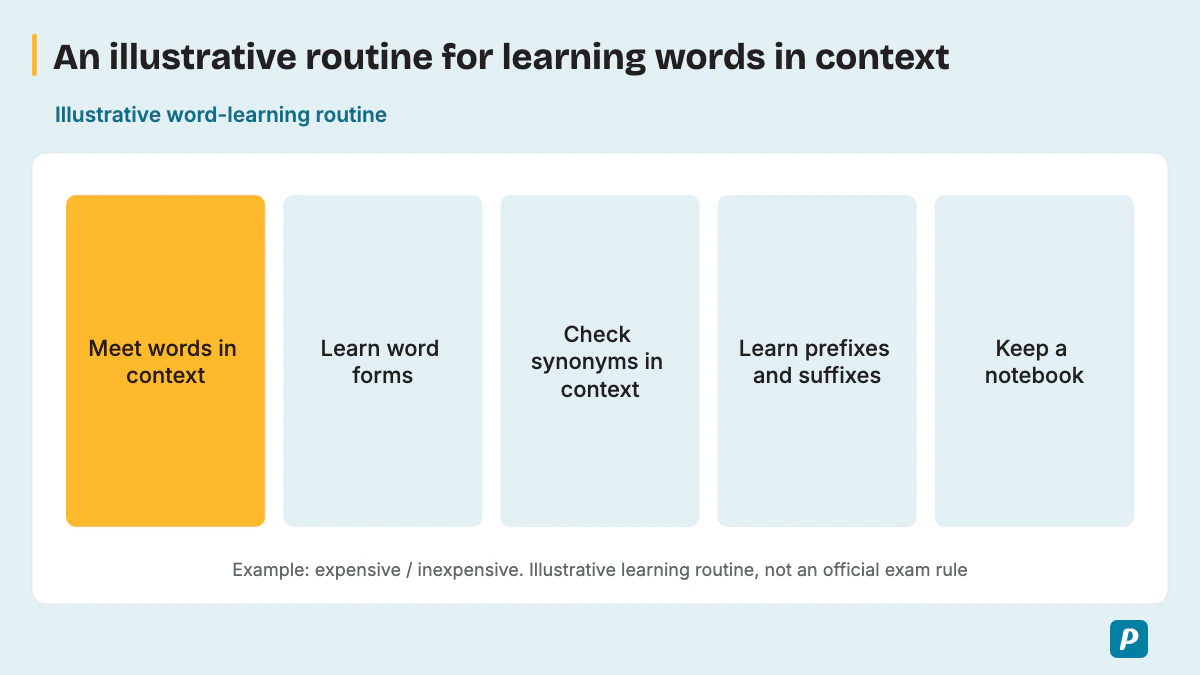
Pearson's own method is to meet a new word many times over a few days, learn its other word forms, use synonyms, learn prefixes and suffixes, and keep a notebook. Each of its five steps is shown here with one example.
- Aim for ten exposures a day. Read "allocate" in an article, write it in two sentences and hear it in a lecture, then repeat over the next couple of days.
- Learn the word forms of words you already know, such as economy, economic and economize.
- Use synonyms to avoid repetition, such as "crucial" or "essential" in place of a second "important".
- Learn common prefixes and suffixes, such as expensive and inexpensive, quick and quickly, or entertain and entertainment.
- Keep a vocabulary notebook with each new word, its meaning, its synonyms and a sentence of your own.
Turn the notebook into flashcards with your own sentence on the back. Review each word two or three days after you first meet it and again about a week later. A few words studied every day stick better than a long list crammed once and then dropped.
How Do Word Families Help PTE Vocabulary?
Word families turn one learned word into three or four usable ones, which is exactly what the Fill in the Blanks tasks test when a gap needs a noun instead of a verb. In "The ___ of the new bridge took two years," the article "the" and the preposition "of" call for a noun, so "construction" fits and "construct" doesn't. Learning noun and verb forms together means that gap no longer catches you out.
How Do You Avoid Repetition in PTE?
You avoid repetition by preparing two or three synonyms for the words your topic forces you to use often, since Pearson's Vocabulary range trait rewards variety. A thesaurus gives options, not exact matches, so check that each synonym fits your sentence. This bank of 30 common essay words lists synonyms, an antonym and a note on use.
| Common word | Synonyms | Antonym | Note on use |
|---|---|---|---|
| important | crucial, essential, vital | minor | "Vital" suits needs and services, as in vital services. |
| show | demonstrate, indicate, reveal | conceal | "Indicate" is softer than "prove". |
| big | large, considerable, substantial | small | Use "considerable" for amounts, not objects. |
| small | minor, slight, modest | large | "Slight" fits changes, as in a slight rise. |
| increase (verb) | rise, grow, climb | decrease | "Rise" takes no object; "raise" needs one. |
| decrease (verb) | decline, fall, drop | increase | "Decline" also means refuse an offer. |
| problem | issue, challenge, difficulty | solution | "Challenge" sounds more positive. |
| help | assist, support, aid | hinder | "Aid" often refers to money or supplies. |
| use (verb) | apply, employ, adopt | avoid | "Adopt" means start using a method. |
| good | effective, beneficial, positive | harmful | Name the quality: effective for methods. |
| bad | harmful, negative, poor | beneficial | "Poor" suits quality, as in poor results. |
| many | numerous, a large number of, several | few | "Several" means more than two but not many. |
| often | frequently, regularly, commonly | rarely | "Regularly" implies a fixed pattern. |
| think | believe, consider, argue | doubt | "Argue" fits a claim backed by reasons. |
| say | state, claim, suggest | deny | "Claim" hints the point may be untrue. |
| change (verb) | alter, modify, transform | preserve | "Transform" means a complete change. |
| cause (verb) | lead to, result in, trigger | prevent | "Trigger" suits a sudden start. |
| get | obtain, acquire, gain | lose | "Acquire" fits skills and property. |
| need | require, demand, call for | - | "Require" is the formal choice. |
| make sure | ensure, confirm, guarantee | neglect | Don't confuse "ensure" with "insure". |
| start | begin, launch, initiate | end | "Launch" fits products and campaigns. |
| end | finish, conclude, complete | begin | "Conclude" also means decide. |
| people | individuals, citizens, the public | - | "Citizens" means members of a country. |
| improve | enhance, upgrade, strengthen | worsen | "Upgrade" fits equipment and systems. |
| difficult | challenging, complex, demanding | easy | "Complex" means many parts, not just hard. |
| easy | simple, straightforward, effortless | difficult | "Effortless" means no effort at all. |
| clear | obvious, evident, apparent | unclear | "Evident" pairs well with "it is evident that". |
| main | primary, principal, key | secondary | Spell it "principal", not "principle", here. |
| result | outcome, consequence, effect | cause | "Consequence" often means a bad result. |
| also | in addition, as well, too | - | "In addition" works at the start of a sentence. |
Why Does Contextual Practice Work for PTE Vocabulary?
Words learned inside sentences come back with their collocations and grammar attached, while words learned alone from a list often come back misused. Contextual practice uses real text to build that habit: read one short article a day, copy three new words with the sentence they appeared in, and then write a sentence of your own for each.
What Are Common Vocabulary Mistakes in PTE?
The costly mistakes are memorizing long lists without context, forcing rare words, using informal words in writing, relying on templates and mixing spelling conventions. Each one either breaks a scoring rule or wastes study time.
- Memorized lists without context leave you unsure how a word combines, which costs Fill in the Blanks points.
- Rare words used imprecisely hurt Vocabulary range, which checks appropriateness: "the line graph deteriorated in May" is wrong, and "the figure fell in May" is right.
- Informal words lower the academic tone of an essay, so "kids get loads of homework" should read "children receive a great deal of homework".
- Templates and memorized phrases earn no credit, because Pearson gives none for unoriginal responses.
- Mixing US and UK spelling in one response breaks the rule that Pearson accepts any one of the US, UK, Australian or Canadian spelling conventions used consistently.
- Replacing words in Read Aloud lowers the content score, even when the synonym is correct.
- Cramming 50 words in one evening and never reviewing them gives each word one exposure, far short of Pearson's advice to meet a word at least ten times a day over a couple of days.
Which Resources Help Develop Vocabulary for PTE?
Start with Pearson's free Academic Collocation List and a good learner's dictionary, add daily reading and listening on academic topics, and keep your own notebook of words in sentences. Pearson itself names Longman Dictionaries as a resource for building vocabulary. For single academic words, the Academic Word List developed by Averil Coxhead at Victoria University of Wellington groups 570 word families outside the most frequent 2,000 English words into ten sublists, and the university publishes it online.
For daily reading, The Conversation publishes articles written by academic experts for the general public, which suits the topics PTE uses. These vocabulary resources combine into a weekly routine: pick ten collocations from the list each Monday, meet them in daily reading, and add each to your word notebook in a sentence of your own. End the week by using them in one timed essay or summary.
Should You Use a PTE Vocabulary Book or App?
A vocabulary book or vocabulary app helps if it shows example sentences and collocations for each word; a bare word list does not. A flashcard app that uses spaced review to bring a word back after a few days fits Pearson's advice to meet a word many times over a couple of days. Our list of new English words with meanings shows the meaning-plus-example format to look for.
How Many Words Should You Learn for PTE?
Pearson sets no daily word count. Its method is to meet each new word at least ten times a day over a couple of days, so the right number is the number you can actually give that many exposures.
A working set of five to eight new words a day, plus review of earlier ones, keeps that manageable. That's our suggestion rather than a Pearson figure, and over a month it still adds up to 150 or more words you can use.
How Can You Test Your Vocabulary Level?
The most useful vocabulary test for PTE is a timed writing or Fill in the Blanks task, because it shows whether you can use words, not just recognize them. To check your vocabulary level today, try these four practice exercises built from words in the tables above; the answer key follows them. For broader practice across all four skills, see our guide on how to improve your English.
Exercise 1: Select the word that fits the meaning.
- Researchers ___ the data before publishing the report. (a) analyzed (b) imagined (c) admired
- Fresh vegetables are ___ for children's health. (a) beneficial (b) obsolete (c) toxic
- Rents ___ sharply after the new railway opened. (a) rose (b) raised (c) arose
- A large ___ of graduates found work within six months. (a) proportion (b) constraint (c) verdict
- Critics praised the building's ___ qualities. (a) aesthetic (b) chronic (c) rural
- Doctors need an accurate ___ before they start treatment. (a) diagnosis (b) immunity (c) outbreak
- The company plans to ___ 50 new staff this year. (a) recruit (b) commute (c) comply
- Without enough rain, the region faced a severe ___. (a) drought (b) habitat (c) heritage
Exercise 2: Complete the sentence with the right form of the word in brackets.
- The ___ of the results surprised the team. (significant)
- Online shopping has grown ___ since 2015. (consider)
- Students must ___ their arguments with evidence. (justification)
- The policy was not ___ in reducing traffic. (effect)
- Small firms find it hard to ___ with large chains. (competition)
- Better roads can ___ trade links between towns. (strong)
- Her ___ of the poem was very original. (interpret)
- Prices change ___, so check them before you buy. (frequent)
Exercise 3: Rewrite each sentence in a formal style.
- Lots of kids spend too much time on their phones.
- The government should deal with this stuff quickly.
- Prices went up a lot last year.
- Researchers want to find out why fewer people vote.
- It's really hard to get a job without experience.
- The meeting got put off till next week.
Exercise 4: Pick the word that forms the correct collocation.
- ___ research: (a) conduct (b) make
- ___ a conclusion: (a) draw (b) pull
- ___ traffic: (a) heavy (b) strong
- ___ a question: (a) raise (b) lift
- ___ progress: (a) make (b) do
- ___ a role in: (a) play (b) act
- ___ access to: (a) gain (b) win
- ___ an effect on: (a) have (b) do
Answer key. Exercise 1: 1 analyzed, 2 beneficial, 3 rose, 4 proportion, 5 aesthetic, 6 diagnosis, 7 recruit, 8 drought. Exercise 2: 1 significance, 2 considerably, 3 justify, 4 effective, 5 compete, 6 strengthen, 7 interpretation, 8 frequently. Exercise 4: 1 conduct, 2 draw, 3 heavy, 4 raise, 5 make, 6 play, 7 gain, 8 have.
Model answers for Exercise 3 follow.
- Many children spend too much time on their phones.
- The government should address these issues quickly.
- Prices rose considerably last year.
- Researchers aim to discover why fewer people vote.
- It is very difficult to find employment without experience.
- The meeting was postponed until next week.
Why Do Spelling and Pronunciation Matter in PTE?
Correct spelling earns word credit in Listening Fill in the Blanks and Write from Dictation. In essays and summaries, spelling is assessed alongside other traits, so a spelling error does not automatically erase all credit for an idea. Learn both spelling and pronunciation. In PTE Academic, Write Essay and Summarize Spoken Text each have a Spelling trait worth 2 points for correct spelling, 1 for one error and 0 for more than one. Note the pronunciation by marking the stressed syllable next to each word in your notebook.
Our PTE spelling words page lists words that are often misspelled.
Practice PTE Online on EasyEnglish
Try Speaking, Writing, Reading and Listening tasks in a timed, computer-based format.
Practice scores are EasyEnglish estimates, not official Pearson scores. You can try speaking scoring without signing up.
Written by
EasyEnglish Team
The team behind EasyEnglish's PTE practice and mock tests
We build the PTE practice tasks, mock tests and scoring on EasyEnglish, and we oversee every guide on this site. We consult official test-provider and government sources where relevant. Check the sources and review date for each guide; practice examples are authored learning material. EasyEnglish is not affiliated with Pearson.
Editorial review completed .