PTE Spelling List: 180 Words With Common Misspellings
PTE Listening
You can hear a word perfectly in PTE Listening and still score nothing for it, because Write from Dictation and Listening Fill in the Blanks credit only words spelled correctly. That's why a PTE spelling list is worth drilling: one wrong letter costs a full point.
Pearson publishes no official list, so these spellings for PTE are 180 practice words grouped by the trap that causes the error, each with its common misspelling, a short meaning and a pronunciation guide.
Table of Contents
Does Pearson Publish an Official PTE Spelling List?
No. Pearson's PTE Academic and PTE Core Listening pages and Score Guides publish no official spelling list or word list, so the 50-, 100- and 150-word lists online are picks by prep publishers. That also answers "What are the most repeated spellings in the PTE exam in 2026?": we have not verified any claim about which exam words repeat, so a useful list trains the spelling patterns behind common errors instead. What Pearson does publish is how spelling is scored in each task, set out in the next section. Classic misspellings such as accommodation, separate and liaison sit in the 30-word table on our dictation words page, linked further down, so the 180 words here are all new.
Which PTE Listening Tasks Check Your Spelling?
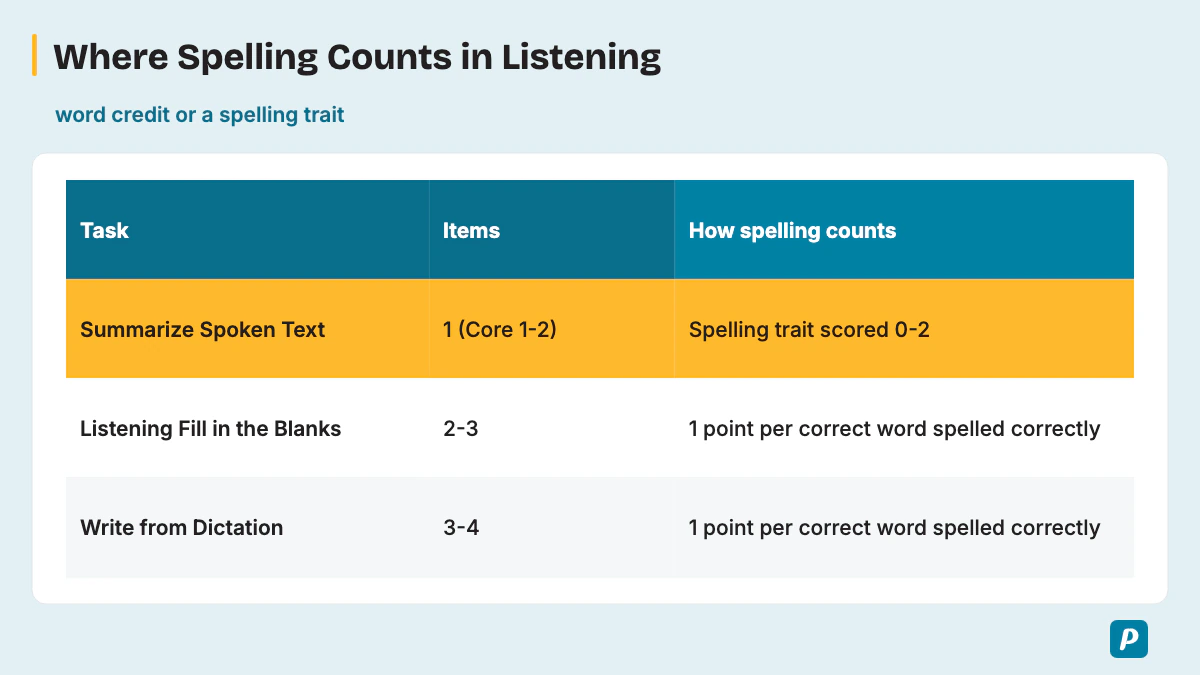
Three Listening tasks check your spelling: Summarize Spoken Text, Listening Fill in the Blanks and Write from Dictation. The item counts below come from Pearson's PTE Academic Score Guide (2025) and PTE Core Score Guide (2026).
| Task | Items (Score Guide) | How spelling counts | Skills scored |
|---|---|---|---|
| Summarize Spoken Text | Academic 1; Core 1-2 | Spelling is one of five traits, scored 0-2. | Listening and writing |
| Listening Fill in the Blanks | 2-3 | Each correct word spelled correctly scores 1 point; the minimum is 0. | Academic Score Guide: listening; task page and Core: listening and writing |
| Write from Dictation | 3-4 | 1 point for each correct word spelled correctly, 0 for an incorrect or misspelled word. | Listening and writing |
Both per-word tasks use partial credit, so one slip costs one word, not the whole item. The Spelling trait in Summarize Spoken Text works differently. In PTE Academic, the Score Guide gives Summarize Spoken Text and Write Essay 2 points for correct spelling, 1 for one spelling error and 0 for more than one.
The PTE Core Score Guide gives Summarize Spoken Text 2 for one spelling or typing error, 1 for two or three, and 0 for more than three; Core Write Email allows up to two errors for the full 2.
Pearson's tip for Fill in the Blanks deals with spelling under time pressure. You don't have time to think about spelling while the recording plays, so note what you hear on the noteboard and decide the spelling once the audio ends. Writing tasks outside Listening also score Spelling: Write Essay in PTE Academic and Write Email in PTE Core.
Is British or American Spelling Accepted in PTE?
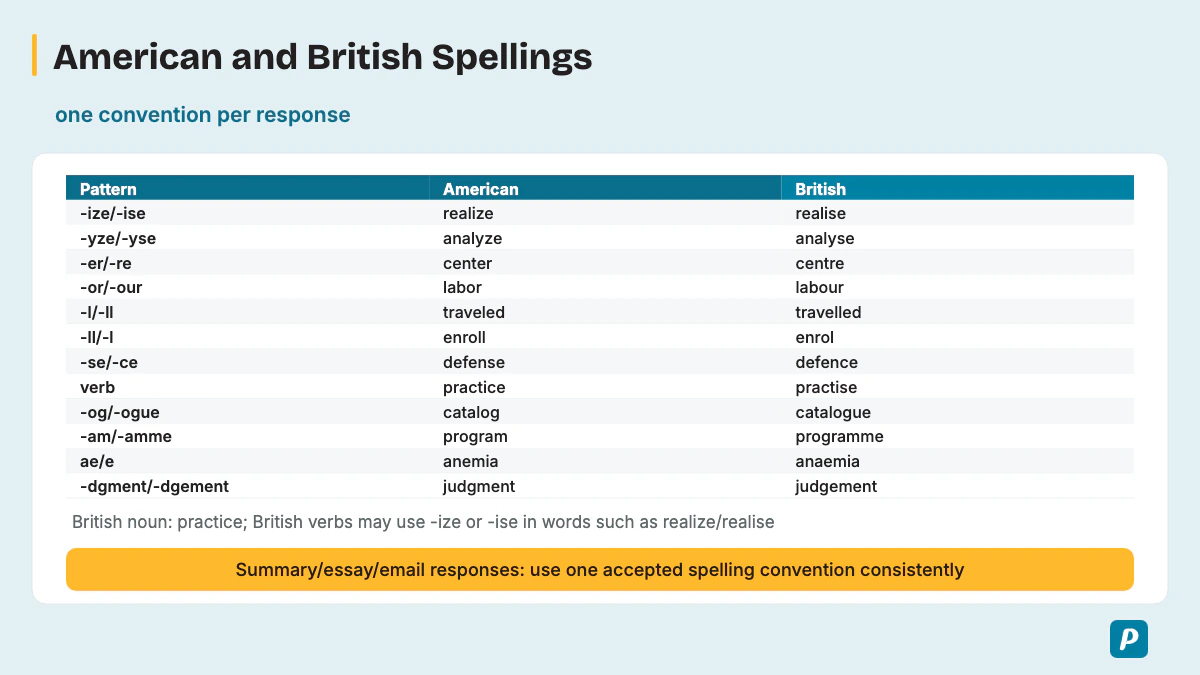
Yes. Pearson recognizes US, UK, Australian and Canadian spelling conventions, and asks you to use one convention consistently in a given response.
Pearson states this rule in the Spelling trait of Summarize Spoken Text and Write Essay in PTE Academic, and of Summarize Spoken Text and Write Email in PTE Core. The Write from Dictation and Fill in the Blanks blocks don't mention a convention at all; they ask only for correct spelling. Keeping one convention in every answer is the safe habit, and the table shows where American spelling and British spelling split.
| Pattern | American | British | Note |
|---|---|---|---|
| -ize / -ise | realize, recognize, apologize | realise, recognise, apologise | British usage also accepts -ize. |
| -yze / -yse | analyze, paralyze, catalyze | analyse, paralyse, catalyse | British spelling has no -yze form. |
| -er / -re | center, liter, fiber | centre, litre, fibre | Mostly nouns ending in an er sound. |
| -or / -our | labor, neighbor, harbor | labour, neighbour, harbour | Derived words follow: neighborhood, neighbourhood. |
| -l / -ll before an ending | traveled, canceled, labeled | travelled, cancelled, labelled | Both double when the stress is on the last syllable (controlled). |
| -ll / -l in the base word | enroll, fulfill, skillful, installment | enrol, fulfil, skilful, instalment | British uses one l in these base words and before -ment. |
| -se / -ce | defense, offense | defence, offence | Nouns only. |
| noun and verb split | practice, license (both noun and verb) | practice and licence (nouns), practise and license (verbs) | British spelling changes letters with the word class. |
| -og / -ogue | catalog, analog | catalogue, analogue | Most US writers still use dialogue. |
| -am / -amme | program | programme | British uses program for computer software. |
| ae and oe / e | anemia, pediatric, estrogen | anaemia, paediatric, oestrogen | Mostly medical and science words. |
| -dgment / -dgement | judgment, acknowledgment | judgement, acknowledgement | British also uses judgment, especially in law. |
A few words differ with no pattern at all, so learn them one by one: tire and tyre, plow and plough, curb and kerb, mustache and moustache. These ten words are useful examples to learn with -ise: advertise, compromise, devise, enterprise, exercise, improvise, revise, supervise, surprise and televise.
Which Difficult Spellings Have Double Letters?
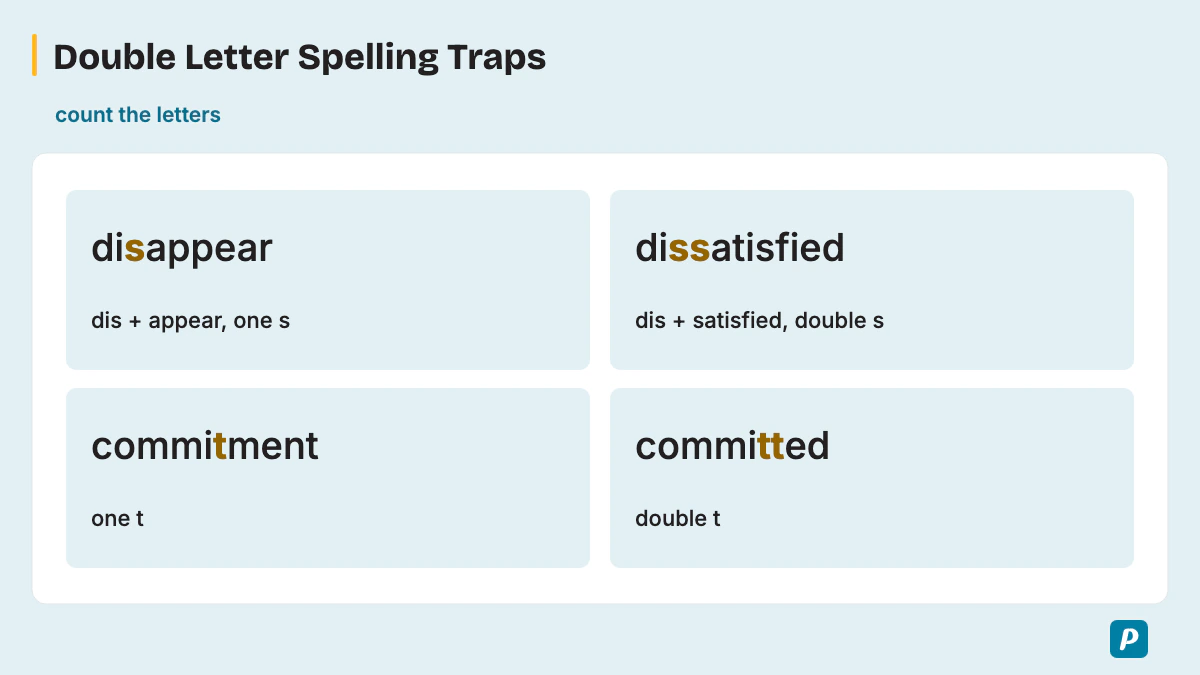
These 30 double letters words test whether a doubled consonant belongs in the word, or a single one where writers expect a double. In each table, "Say it" puts the stressed syllable in capitals, and the Trap column names the exact letters that go wrong.
| Word | Common misspelling | Meaning | Say it | Trap |
|---|---|---|---|---|
| accelerate | excelerate | to speed up | ak-SEL-uh-rayt | double c, single l |
| accumulate | acumulate | to build up over time | uh-KYOO-myuh-layt | double c, single m |
| aggregate | agregate | a total formed from parts | AG-ruh-git | double g |
| abbreviation | abreviation | a shortened form of a word | uh-bree-vee-AY-shuhn | double b |
| accurate | accurrate | correct in every detail | AK-yuh-rit | double c, single r |
| affiliate | afiliate | to connect officially with a group | uh-FIL-ee-ayt | double f, single l |
| colleague | collegue | someone who works alongside you | KOL-eeg | double l, then -eague |
| commemorate | commemmorate | to honor the memory of an event | kuh-MEM-uh-rayt | double m, then single m |
| correspondence | correspondance | letters or emails exchanged | kor-uh-SPON-duhns | double r, -ence ending |
| corridor | corridoor | a long passage in a building | KOR-ih-dor | double r, single d, -or |
| disappear | dissapear | to stop being visible | dis-uh-PEER | dis + appear: one s, double p |
| disappoint | dissapoint | to fail to meet someone's hopes | dis-uh-POYNT | dis + appoint: one s, double p |
| dissatisfied | disatisfied | not pleased | dis-SAT-is-fyd | dis + satisfied: double s |
| dissolve | disolve | to mix completely into a liquid | dih-ZOLV | double s that sounds like z |
| exaggerate | exagerate | to make something seem bigger | ig-ZAJ-uh-rayt | double g, single r |
| omission | ommission | something left out | oh-MISH-uhn | single m, double s |
| omitted | ommited | left out | oh-MIT-id | single m, double t |
| tomorrow | tommorow | the day after today | tuh-MOR-oh | single m, double r |
| vacuum | vaccum | a space with no matter in it | VAK-yoom | single c, double u |
| tyranny | tyrany | cruel and unfair rule | TIR-uh-nee | y, single r, double n |
| millionaire | millionnaire | a person worth a million or more | mil-yuh-NAIR | double l, single n |
| accessory | accesory | an extra item that adds to something | ak-SES-uh-ree | double c, double s |
| assassinate | assasinate | to murder an important person | uh-SAS-uh-nayt | two pairs of double s |
| professor | proffessor | a senior university teacher | pruh-FES-er | single f, double s |
| aggravate | agravate | to make a problem worse | AG-ruh-vayt | double g, single v |
| parallel | paralell | side by side at an equal distance | PAIR-uh-lel | double l in the middle, single l at the end |
| appropriate | apropriate | suitable for the situation | uh-PROH-pree-it | double p first, single p later |
| commitment | committment | a promise to do something | kuh-MIT-muhnt | double m, single t |
| committed | commited | dedicated; past tense of commit | kuh-MIT-id | double m and double t |
| Mediterranean | Meditteranean | the sea between Europe and Africa | med-ih-tuh-RAY-nee-uhn | single t, double r |
Prefixes explain part of this group. When the dis- prefix meets a word that starts with s, you get a double s (dis + satisfied, dis + similar); when it meets a vowel, you don't (dis + appear). Commitment and committed differ because only the -ed ending doubles the t.
Which Difficult Spellings Have Silent or Tricky Letters?
These 30 words hide a letter you never hear, or a sound with an unexpected spelling such as ps, pn, rh, gu or the -ueue in queue. The audio never gives you a silent letter, so you have to learn by sight.
| Word | Common misspelling | Meaning | Say it | Trap |
|---|---|---|---|---|
| Wednesday | Wensday | the day after Tuesday | WENZ-day | silent d |
| pneumonia | neumonia | a lung infection | noo-MOH-nyuh | silent p before n |
| psychiatrist | sychiatrist | a doctor who treats mental illness | sy-KY-uh-trist | silent p; ch spells k |
| rhyme | ryhme | words ending in the same sound | RYM | rh start; y spells the long i |
| hemorrhage | hemorage | heavy bleeding | HEM-er-ij | double r and silent h; UK haemorrhage |
| answer | anser | a reply | AN-ser | silent w |
| wreckage | reckage | the remains of something destroyed | REK-ij | silent w before r |
| benign | benine | harmless; not cancerous | bih-NYN | silent g |
| align | allign | to put in a straight line | uh-LYN | silent g; single l |
| paradigm | paradime | a model or pattern of thinking | PAIR-uh-dym | silent g |
| plumber | plumer | a person who fits water pipes | PLUHM-er | silent b |
| climb | clime (a different word) | to go up | KLYM | silent b |
| indict | indite (a different word) | to charge formally with a crime | in-DYT | silent c |
| yacht | yatch | a boat used for leisure | YOT | silent ch |
| colonel | kernel (a different word) | a senior army officer | KUR-nuhl | spelled with o, o and l but sounds like kernel |
| guard | gaurd | to protect | GARD | silent u after g |
| guilty | gilty | responsible for wrongdoing | GIL-tee | silent u after g |
| biscuit | biscit | a small baked snack | BIS-kit | silent u in -uit |
| circuit | circit | a closed path, as for electricity | SUR-kit | silent u in -uit |
| exhaust | exaust | to use up; to tire out | ig-ZAWST | silent h after x |
| exhibition | exibition | a public display | ek-suh-BISH-uhn | silent h after x |
| vehicle | vehical | a machine that carries people or goods | VEE-uh-kuhl | silent h; -icle ending |
| shepherd | sheperd | a person who looks after sheep | SHEP-erd | silent h in the middle |
| mnemonic | nemonic | a memory aid | nih-MON-ik | silent m at the start |
| scissors | sissors | a two-bladed cutting tool | SIZ-erz | sc spells s; ss sounds like z |
| fascinate | facinate | to hold someone's interest | FAS-uh-nayt | silent c after s |
| descend | desend | to go down | dih-SEND | sc spells the s sound |
| muscle | muscel | tissue that moves the body | MUHS-uhl | silent c; -le ending |
| technique | tecnique | a way of doing a task | tek-NEEK | ch spells k; -ique spells eek |
| queue | queu | a line of people waiting | KYOO | q + ueue spells kyoo; type all four vowels |
Say the silent letters in your head when you practice ("p-neumonia", "Wed-nes-day"), so each spelling has a sound to attach to. The typed answer needs letters the speaker never pronounces, and this gives you a way to recall them.
Which Difficult Spellings Have Confusing Endings?
The endings -ance and -ence, -ant and -ent, and -able and -ible sound the same in speech, so the recording can't tell you which word ending to type. These 30 words are drilled for that reason.
| Word | Common misspelling | Meaning | Say it | Trap |
|---|---|---|---|---|
| ignorance | ignorence | lack of knowledge | IG-ner-uhns | -ance, as in ignorant |
| tolerance | tolerence | willingness to accept differences | TOL-er-uhns | -ance, as in tolerant |
| resistance | resistence | the act of opposing something | rih-ZIS-tuhns | -ance, as in resistant |
| significance | significence | importance | sig-NIF-ih-kuhns | -ance, as in significant |
| acquaintance | aquaintance | a person you know slightly | uh-KWAYN-tuhns | c before q, then -ance |
| reluctance | reluctence | unwillingness | rih-LUHK-tuhns | -ance, as in reluctant |
| surveillance | surveillence | close watching, often by police | ser-VAY-luhns | -eill-, then -ance |
| inheritance | inheritence | property received after a death | in-HER-ih-tuhns | -ance after inherit |
| preference | preferrence | a greater liking for one option | PREF-er-uhns | single r: the stress moves to PREF |
| inference | inferrence | a conclusion drawn from evidence | IN-fer-uhns | single r, -ence |
| adherence | adherance | sticking to a rule | ad-HEER-uhns | -ence, as in adherent |
| recurrence | recurrance | a repeat occurrence | rih-KUR-uhns | double r, -ence |
| negligence | negligance | failure to take proper care | NEG-lih-juhns | -ence after g |
| diligence | diligance | careful, steady effort | DIL-ih-juhns | -ence after g |
| excellence | excellance | very high quality | EK-suh-luhns | double l, -ence |
| prominence | prominance | the state of being important | PROM-uh-nuhns | -ence, as in prominent |
| permanent | permanant | lasting forever | PUR-muh-nuhnt | -ent |
| consistent | consistant | staying the same | kuhn-SIS-tuhnt | -ent |
| prevalent | prevelant | widespread | PREV-uh-luhnt | -a- in the middle, -ent at the end |
| brilliant | brillient | very bright or clever | BRIL-yuhnt | double l, -iant |
| eloquent | eloquant | speaking clearly and persuasively | EL-uh-kwuhnt | -ent after qu |
| edible | edable | safe to eat | ED-uh-buhl | -ible |
| legible | legable | clear enough to read | LEJ-uh-buhl | -ible after a soft g |
| tangible | tangable | able to be touched; real | TAN-juh-buhl | -ible after a soft g |
| negligible | negligable | too small to matter | NEG-lih-juh-buhl | -ible, while negligence takes -ence |
| permissible | permissable | allowed | per-MIS-uh-buhl | double s, -ible |
| reversible | reversable | able to be changed back | rih-VUR-suh-buhl | -ible |
| irresistible | irresistable | too strong to resist | ir-ih-ZIS-tuh-buhl | double r, -ible |
| indispensable | indispensible | absolutely necessary | in-dih-SPEN-suh-buhl | -able |
| sensible | sensable | showing good judgment | SEN-suh-buhl | -ible |
A related word often sets the ending: tolerate gives tolerant and tolerance, and adhere gives adherent and adherence. When no relative helps, as with edible or indispensable, the spelling has to be learned as a whole.
Which Difficult Spellings Use IE or EI?
The trap here is whether i or e comes first, and the ie and ei order can't be heard in the recording. The "i before e except after c" rhyme works for many words with an ee sound, such as relief and conceit, but it breaks for words like deficient, caffeine and seismic.
| Word | Common misspelling | Meaning | Say it | Trap |
|---|---|---|---|---|
| relief | releif | the ease that follows pain or worry | rih-LEEF | ie for the ee sound |
| retrieve | retreive | to get something back | rih-TREEV | ie for the ee sound |
| shield | sheild | a protective barrier | SHEELD | ie for the ee sound |
| yield | yeild | to produce; to give way | YEELD | ie for the ee sound |
| fierce | feirce | violent or intense | FEERS | ie |
| pierce | peirce | to make a hole through | PEERS | ie |
| niece | neice | your brother's or sister's daughter | NEES | ie |
| priest | preist | a religious leader | PREEST | ie |
| chief | cheif | main; the head of a group | CHEEF | ie |
| mischievous | mischievious | causing minor trouble | MIS-chuh-vuhs | ie, and no i before -ous |
| deficient | deficeint | lacking something needed | dih-FISH-uhnt | cie after c breaks the rhyme |
| sufficient | sufficeint | enough | suh-FISH-uhnt | double f; cie after c |
| quotient | quoteint | the result of a division | KWOH-shuhnt | tie spells shuh |
| transient | transeint | lasting only a short time | TRAN-shuhnt | ie, then -ent |
| recipient | recipeint | a person who receives something | rih-SIP-ee-uhnt | i and e in separate syllables |
| lenient | leniant | not strict | LEE-nee-uhnt | ie, then -ent |
| conceit | conciet | too much pride in yourself | kuhn-SEET | ei after c |
| deceit | deciet | dishonest behavior | dih-SEET | ei after c |
| forfeit | forfiet | to lose something as a penalty | FOR-fit | ei with a short i sound |
| sovereign | sovereing | having supreme power | SOV-rin | ei plus silent g |
| counterfeit | counterfiet | fake and made to deceive | KOWN-ter-fit | ei with a short i sound |
| heir | hier | a person who inherits | AIR | ei; silent h |
| veil | viel | a thin cloth over the face | VAYL | ei for the ay sound |
| vein | vien | a blood vessel | VAYN | ei for the ay sound |
| beige | biege | a pale sandy color | BAYZH | ei for the ay sound |
| feign | fiegn | to pretend | FAYN | ei for the ay sound; silent g |
| freight | frieght | goods carried by truck, ship or plane | FRAYT | eigh for the ay sound |
| seismic | siesmic | relating to earthquakes | SYZ-mik | ei for the long i sound |
| caffeine | caffiene | a stimulant in coffee and tea | ka-FEEN | ei with no c before it; double f |
| hierarchy | heirarchy | a ranked system of levels | HY-uh-rar-kee | ie, then -archy |
Use the sound as a first check: ei usually spells an ay sound (vein, beige, freight), while ie usually spells ee (shield, niece). The exceptions in this group, such as seismic, forfeit and caffeine, are the ones worth writing out by hand.
Which Difficult Spellings Hide an Unstressed Vowel?
In fast speech an unstressed vowel shrinks to a short uh, or a whole syllable drops out or creeps in, so the sound doesn't show the letters. Saying each word slowly, one syllable at a time, brings back the hidden vowel or the dropped syllable.
| Word | Common misspelling | Meaning | Say it | Trap |
|---|---|---|---|---|
| February | Febuary | the second month | FEB-roo-air-ee | the first r is often not said |
| library | libary | a place to borrow books | LY-brair-ee | the first r is often dropped |
| boundary | boundry | a dividing line | BOWN-duh-ree | unstressed a before -ry |
| different | diffrent | not the same | DIF-er-uhnt | unstressed e; double f |
| comfortable | comfterble | pleasant to use or be in | KUHMF-ter-buhl | -or- and -able are swallowed |
| miniature | miniture | very small | MIN-ee-uh-cher | unstressed a in -iature |
| mathematics | mathmatics | the study of numbers and shapes | math-uh-MAT-iks | unstressed e after math |
| veterinary | vetinary | relating to animal medicine | VET-er-uh-nair-ee | -er- is often not said |
| governor | govener | the head of a state or region | GUHV-er-ner | -ern-, then -or |
| particular | perticular | specific; one and not another | per-TIK-yuh-ler | par-, then -ular |
| repetition | repitition | doing or saying again | rep-ih-TISH-uhn | e, then i, from repeat |
| hypocrisy | hypocracy | claiming beliefs you don't follow | hih-POK-ruh-see | -risy, not -racy |
| despair | dispair | loss of all hope | dih-SPAIR | de-, not di- |
| describe | discribe | to say what something is like | dih-SKRYB | de-, not di- |
| medicine | medecine | a drug that treats illness | MED-uh-sin | i after d |
| explanation | explaination | a statement that makes something clear | ek-spluh-NAY-shuhn | explain drops its i |
| exhilarate | exhilerate | to make very happy and excited | ig-ZIL-uh-rayt | silent h; a in the middle |
| inoculate | innoculate | to protect against a disease with a vaccine | ih-NOK-yuh-layt | single n, single c |
| hindrance | hinderance | something that slows progress | HIN-druhns | hinder loses its e |
| sacrilegious | sacreligious | showing disrespect for something sacred | sak-ruh-LIJ-uhs | -rile-, unlike religious |
| auxiliary | auxillary | giving extra support | awg-ZIL-yuh-ree | single l, -iary |
| kindergarten | kindergarden | a class for young children | KIN-der-gar-tuhn | -garten, from German |
| temperament | temperment | a person's usual mood | TEM-pruh-muhnt | unstressed a before -ment |
| probably | probly | likely | PROB-uh-blee | -ably; a syllable is often dropped |
| pastime | pasttime | a hobby | PAS-tym | single s, single t |
| sophomore | sophmore | a second-year US student | SOF-mor | the middle o is often not said |
| deteriorate | deteriate | to become worse | dih-TEER-ee-uh-rayt | -ior- is often swallowed |
| nuclear | nucular | relating to the center of an atom | NOO-klee-er | -clear, not -cular |
| athlete | athelete | a person who competes in sport | ATH-leet | no extra vowel after th |
| candidate | canidate | a person applying or taking an exam | KAN-dih-dayt | the d after n is often not said |
Spelling pronunciation, where you sound every letter, provides the missing letters in most of this group. Pronounce Feb-ru-ar-y and nu-cle-ar in full while you type, then switch back to natural speech for listening.
Which Difficult Spellings Change When You Add an Ending?
Adding a suffix such as -ed, -ing, -ly, -ful, -ness, -ment or -able can change the base word: drop the e, keep the e, change y to i, or double the final consonant. In the examples misspell, dissimilar and withhold, the prefix is added to the written base without changing it.
| Word | Common misspelling | Meaning | Say it | Trap |
|---|---|---|---|---|
| truly | truely | really; sincerely | TROO-lee | true drops its e |
| ninth | nineth | number nine in order | NYNTH | nine drops its e |
| awful | aweful | very bad | AW-fuhl | awe drops its e |
| wholly | wholy | completely | HOHL-lee | whole drops its e; the l doubles |
| judgment | jugment | an opinion or decision | JUHJ-muhnt | US drops the e; UK also judgement |
| desirable | desireable | worth having | dih-ZYR-uh-buhl | desire drops its e before -able |
| manageable | managable | possible to control | MAN-ih-juh-buhl | keeps the e for the soft g |
| knowledgeable | knowlegeable | knowing a lot | NOL-ih-juh-buhl | keeps the e after dg |
| courageous | couragous | brave | kuh-RAY-juhs | keeps the e for the soft g |
| ninety | ninty | the number 90 | NYN-tee | nine keeps its e |
| business | buisness | buying and selling; a company | BIZ-nis | busy changes y to i |
| studying | studing | learning about a subject | STUHD-ee-ing | y stays before -ing |
| loneliness | lonelyness | the feeling of being alone | LOHN-lee-nis | lonely changes y to i |
| occurred | occured | happened | uh-KURD | double r: stress on -CUR |
| referred | refered | mentioned or sent on | rih-FURD | double r: stress on -FER |
| transferred | transfered | moved to another place | trans-FURD | double r: stress on -FER |
| controlled | controled | managed or held back | kuhn-TROHLD | double l: stress on -TROL |
| regrettable | regretable | causing regret | rih-GRET-uh-buhl | double t |
| equipped | equiped | having the tools needed | ih-KWIPT | double p |
| benefited | benifited | gained an advantage | BEN-uh-fit-id | single t: stress on BEN; UK also benefitted |
| accidentally | accidentaly | by chance | ak-sih-DEN-tuh-lee | accidental + ly |
| basically | basicly | in the simplest terms | BAY-sik-lee | basic takes -ally |
| publicly | publically | in public | PUHB-lik-lee | public takes -ly, not -ally |
| sincerely | sincerly | honestly | sin-SEER-lee | sincere keeps its e |
| successful | successfull | achieving the aim | suhk-SES-fuhl | -ful has one l |
| openness | openess | willingness to share | OH-puhn-nis | open + ness: double n |
| development | developement | growth or progress | dih-VEL-uhp-muhnt | no e after p |
| misspell | mispell | to spell wrongly | mis-SPEL | mis + spell: double s |
| dissimilar | disimilar | not alike | dih-SIM-ih-ler | dis + similar: double s |
| withhold | withold | to keep back | with-HOHLD | with + hold: double h |
The doubling rule uses stress, which is why refer gives referred but preference, and benefit gives benefited. If the last syllable of the base word is stressed and ends in one vowel plus one consonant, double that consonant before -ed or -ing.
Which Complex Words Have Similar Spellings?
Words with similar spellings cause a different error. Some aren't misspellings at all but the wrong word of a similar pair, and in Write from Dictation or Fill in the Blanks the wrong word earns no point. These 20 pairs are extra to the 180-word list, and several are homophones that sound identical in the recording.
| Pair | Meaning of each | Example |
|---|---|---|
| precede / proceed | Precede means come before; proceed means go on. | A safety talk will precede the tour; then proceed to Gate 4. |
| ensure / insure | Ensure means make certain; insure means cover with insurance. | Ensure the files are saved; insure the lab equipment. |
| lose / loose | Lose means fail to keep; loose means not tight. | You lose a point; a loose cable |
| advice / advise | Advice is the noun; advise is the verb. | useful advice; advise students to rest |
| brake / break | A brake stops a vehicle; break means damage or a pause. | Press the brake; a ten-minute break |
| peace / piece | Peace is calm without conflict; a piece is a part. | a peace agreement; a piece of evidence |
| fair / fare | Fair means just, or an event; a fare is the price of a trip. | a fair test; the train fare |
| reign / rein | A reign is a ruler's time in power; a rein controls a horse. | a long reign; a tight rein on costs |
| dew / due | Dew is water drops on grass; due means expected or owed. | morning dew; the report is due Friday |
| then / than | Then refers to time; than compares. | Listen, then type; faster than before |
| quite / quiet | Quite means fairly; quiet means with little noise. | quite difficult; a quiet study room |
| elicit / illicit | Elicit means draw out; illicit means illegal. | elicit feedback; illicit ivory trade |
| eminent / imminent | Eminent means famous and respected; imminent means about to happen. | an eminent historian; an imminent storm |
| adverse / averse | Adverse means harmful; averse means opposed to. | adverse side effects; averse to risk |
| censor / sensor | To censor is to remove content; a sensor detects change. | censor a report; a motion sensor |
| desert / dessert | A desert is a dry region; a dessert is a sweet course. | the Gobi Desert; fruit for dessert |
| personal / personnel | Personal means private or individual; personnel are staff. | personal data; hospital personnel |
| breath / breathe | Breath is the noun; breathe is the verb. | a deep breath; breathe slowly |
| past / passed | Past is time gone by; passed is the past tense of pass. | the past decade; she passed the test |
| cue / queue | A cue is a signal; a queue is a line of people. | a cue to start; a long queue |
In dictation, meaning and grammar together help separate similar words. "Advise" is a verb (including commands such as "Advise the team"), while "advice" is a noun; "than" can follow a comparative such as "faster". Their and there, affect and effect, and accept and except appear with 13 other pairs on the dictation words page linked in the practice section below.
How Do You Practice PTE Spelling for Listening?
The best spelling practice is typing what you hear, not reading lists: hear a short sentence once, type it, check every letter, and log each error by trap. PTE written answers are typed, so your fingers need the spelling as much as your memory does. This six-step routine takes about 15 minutes a day.
- Pick one trap group from the tables above for the day.
- Read each word aloud in syllables (ac-com-mo-date, Feb-ru-ar-y) before you type it, so the hidden letters have a sound.
- Cover the table and type each word three times from memory, without copying.
- Record or ask someone to read five short sentences that use the day's words, play each once, and type it.
- Check your typing letter by letter against the original, not word by word.
- Add each misspelled word to a personal error log under its trap, and retest the log every three days.
Test yourself with a spot the misspelling drill. Each of the 12 sentences contains exactly one misspelled word from the tables above.
- Researchers recorded a recurrance of coral bleaching along the northern reef.
- The freight company transfered its main depot to a site near the port.
- Volunteers at the community garden learn which wild plants are edable.
- The lecturer asked each student to explain one paradime from the reading.
- Seismic sensors gave a warning that a landslide was imminant.
- The exhibition on ancient trade routes opens on Wensday.
- The label lists the caffiene content of each drink.
- The council removed its surveillence cameras after a public consultation.
- Her explaination of the survey results was clear and brief.
- The new rail timetable is accidentaly missing two evening services.
- The team's commitment never slipped, and the delay was negligable.
- Most delegates were dissatisfied with the venue, but the Mediteranean menu was popular.
The answer key gives each correct spelling and the group it comes from.
| Sentence | Correct spelling | Group |
|---|---|---|
| 1 | recurrence | Confusing endings |
| 2 | transferred | Adding an ending |
| 3 | edible | Confusing endings |
| 4 | paradigm | Silent or tricky letters |
| 5 | imminent | Similar spellings |
| 6 | Wednesday | Silent or tricky letters |
| 7 | caffeine | IE or EI |
| 8 | surveillance | Confusing endings |
| 9 | explanation | Unstressed vowels |
| 10 | accidentally | Adding an ending |
| 11 | negligible | Confusing endings |
| 12 | Mediterranean | Double letters |
To try the same skill on scored Listening items, create a free account on EasyEnglish.
Which Dictation Words and Spellings Should You Practice?
Practice the academic words that lecture sentences use, plus the small words that are easy to drop. In Write from Dictation, missed plural endings (-s, -es), a dropped -ed, skipped articles or prepositions, and irregular plurals typed wrong (criterion for criteria) each cost a word-point just like a misspelling. Our list of PTE dictation words adds 170 topic words, 30 classic misspellings and an irregular plural table to the 180 words here.
How Does Spelling Count in Listening Fill in the Blanks?
Each correct word spelled correctly scores one point, so a misspelled word earns nothing for that blank, and the task's minimum is 0. Pearson's advice is to note each word on the noteboard while the audio plays and fix the spelling afterward; the next item doesn't start until you click the Next button. The guide to Listening Fill in the Blanks covers the rest of the task.
What Is the Most Important Spelling for the PTE Exam?
The spelling that matters most is the one you control in your own answers: one spelling convention, and words you're sure you can spell, which is Pearson's advice for Summarize Spoken Text. In PTE Academic a second spelling error already drops that Spelling trait to 0. See how Summarize Spoken Text scores the other four traits.
How Do Spellings for PTE Listening Affect Your Score?
Spelling touches three of the eight Listening tasks in PTE Academic, and in each one a misspelling costs points toward your Listening score. Pearson's Score Guide counts Write from Dictation and Summarize Spoken Text toward the Writing score as well, so one slip there can cost you in two skills. Our overview of the PTE listening section shows how all eight tasks are scored.
What Are the 20 Hardest Words to Spell?
This is a suggested practice selection, so pick by structure: words that stack two or more traps test you hardest when you type from audio. These 20 from the tables above each combine at least two traps.
- mischievous: ie, and no extra i before -ous
- Mediterranean: single t, double r
- sacrilegious: -rile- order, soft g
- irresistible: double r, -ible
- hemorrhage: double r, silent h
- accessory: double c, double s
- assassinate: two double-s pairs
- millionaire: double l, single n
- surveillance: -eill-, -ance
- acquaintance: c before q, -ance
- sufficient: double f, cie after c
- caffeine: double f, ei
- sovereign: ei, silent g
- exhilarate: silent h, unstressed a
- auxiliary: x sounds like gz, single l
- inoculate: single n, single c
- knowledgeable: silent k, kept e
- psychiatrist: silent p, ch spells k
- vacuum: single c, double u
- correspondence: double r, -ence
Practice PTE Listening on EasyEnglish
Try Listening tasks in a timed, computer-based format like the real test.
Try speaking practice without signing up. A free account is required for full mock tests. Practice scores are estimates, not official Pearson scores.
Written by
EasyEnglish Team
The team behind EasyEnglish's PTE practice and mock tests
We build EasyEnglish PTE practice tasks and mock tests. Official test rules are checked against Pearson guidance; exercises are authored examples, not official or predicted exam questions. Practice scores are estimates. EasyEnglish is not affiliated with or endorsed by Pearson. Contact support@inverseai.com.
Editorial review completed .