10 Best Tips and Strategies for Improving PTE Listening
PTE Listening
In PTE Listening the audio plays once, a preview of 5 to 10 seconds comes before some questions, and only what you select or type earns points. Pearson owns and scores PTE, and the rules, timings and item counts here come from Pearson's Listening pages and its PTE Academic and PTE Core Score Guide editions. PTE Academic and PTE Academic UKVI share one Listening format, while PTE Core runs a shorter section without Highlight Correct Summary.
The listening tips below start from how each task is scored, because two tasks take points away and six never do. The listening strategies then move from note-taking and practice habits to a four-week plan and one main move for each question type.
Table of Contents
What Does the PTE Listening Section Test?
PTE Listening is Part 3 of the test: it plays audio or video clips once each and tests whether you can understand spoken English: academic contexts in Academic/UKVI and everyday contexts in Core. It runs 8 question types in 31-39 minutes in PTE Academic and 7 question types in 22-37 minutes in PTE Core. Every task asks you to select, type or click based only on what you heard, and each clip plays once. You can write notes on the erasable noteboard booklet throughout. Pearson's Score Guides put 15-22 scored items in PTE Academic and 10-17 in PTE Core.
Listening doesn't stop at Part 3, because four Speaking & Writing tasks in Part 1 also add to your Listening score. The next section shows how those tasks and the eight Listening tasks share the score.
How Is PTE Listening Scored?
Your Listening score (10-90) comes from the eight Listening tasks plus four Speaking & Writing tasks that also score listening: Repeat Sentence, Retell Lecture, Answer Short Question and Summarize Group Discussion. Most tasks give partial credit, and only Multiple Choice, Multiple Answers and Highlight Incorrect Words take points away for a wrong pick. Pearson's Score Guide rows for each Listening task, in test order, give these counts, clip lengths and scoring rules.
| Task | Items (Academic / Core) | Clip length (Academic) | How it is scored | Wrong answer costs points? |
|---|---|---|---|---|
| Summarize Spoken Text | 1 / 1-2 | 60-90 seconds | Five traits, partial credit | No |
| Multiple Choice, Multiple Answers | 2-3 / 1-2 | 80-120 seconds | +1 per correct option, -1 per wrong option, minimum 0 | Yes |
| Fill in the Blanks | 2-3 / 2-3 | 30-60 seconds | 1 point per correct word spelled correctly | No |
| Highlight Correct Summary | 2-3 / not in Core | 30-90 seconds | Correct or incorrect | No |
| Multiple Choice, Single Answer | 2-3 / 1-2 | 30-60 seconds | Correct or incorrect | No |
| Select Missing Word | 1-2 / 1-2 | 20-70 seconds | Correct or incorrect | No |
| Highlight Incorrect Words | 2-3 / 1-2 | 15-50 seconds | +1 per correct word, -1 per wrong word, minimum 0 | Yes |
| Write from Dictation | 3-4 / 3-4 | 3-5 seconds | 1 point per correct word spelled correctly | No |
Summarize Spoken Text has its own trait scales. In PTE Academic, Content runs 0-4 (0-2 in PTE Core), while Form, Grammar, Vocabulary and Spelling run 0-2 each. Form earns 2 for 50-70 words, 1 for 40-49 or 71-100 words, and 0 for under 40 or over 100 words, all capitals, no punctuation or bullet points only. Pearson's zero rule is stricter still: under 40 or over 100 words (under 5 or over 40 in PTE Core) scores nothing on any of the five factors, and so does a summary that misreads the topic.
Pearson's AI scoring is trained on ratings by human experts, and in Academic/UKVI a human expert also checks Summarize Spoken Text Content before confirmation. The two test variants differ in skill credit: the PTE Academic guide credits Fill in the Blanks to Listening only, while the PTE Core guide lists Listening and Writing.
Some prep sites still quote "no negative marking in Listening" or a fixed number of marks per task. The Score Guides describe raw item points and deductions; Pearson also uses question weighting in score calculations.
How Do You Get 79 in PTE Listening?
A 79 in Listening comes from steady accuracy across all eight Listening tasks and the four Part 1 tasks that also score listening, not from one task alone. Those Part 1 tasks carry plenty of items: the PTE Academic Score Guide lists 10-12 Repeat Sentence, 2-3 Retell Lecture, 5-6 Answer Short Question and 2-3 Summarize Group Discussion items.
Pearson publishes no table that turns a number of correct answers into a 79, so keep accuracy high on every task. Our guide to the PTE listening section shows where each task sits.
What Are the 10 Best PTE Listening Tips and Strategies?
The habits that lift a Listening score are using the preview seconds, noting keywords, following the main idea, matching meaning, typing every word in dictation and keeping one spelling convention. The rest manage risk and time: click only when sure where wrong picks cost points, answer every item that deducts nothing, use the pause before Next and treat Part 1 listening tasks as practice.
Each of these listening strategies ties to a scoring rule, a Pearson tip or a practice habit, in the order you meet them in the section.
- Use the preview seconds. Pearson gives 7 seconds before Fill in the Blanks and Multiple Choice, Multiple Answers, 5 seconds before Multiple Choice, Single Answer and 10 seconds before Highlight Incorrect Words, so read the question or transcript then.
- Note keywords, not sentences. Write numbers, names, dates and keywords in short form, since full sentences fall behind the speaker.
- Listen for the main idea. Track the speaker's purpose and the point each example supports, and expect natural speech with pauses, false starts and fillers like "um", so follow the meaning rather than the delivery.
- Match meaning, not words. Pearson warns that distractors in Multiple Choice, Multiple Answers reuse words from the recording, so pick the option that says what the speaker meant.
- Type every word in Write from Dictation. Pearson's tip is to type as many correct words as you can remember in the correct order, and to use grammar to place a word you're unsure of, since each correct word scores.
- Keep one spelling convention. Pearson accepts US, UK, Australian and Canadian spelling, but a single response should stick to one.
- Select only what you're sure of. In Highlight Incorrect Words and Multiple Choice, Multiple Answers a wrong pick takes a point off that item's score.
- Never leave a no-penalty item blank. Select Missing Word, Multiple Choice, Single Answer, Highlight Correct Summary, Fill in the Blanks and Write from Dictation deduct nothing for a wrong answer.
- Use the pause before the Next button. Most items wait for you to click Next, which gives you a moment to review your answer.
- Treat Part 1 listening tasks as listening work. Repeat Sentence, Retell Lecture, Answer Short Question and Summarize Group Discussion all feed your Listening score.
To make tip 1 automatic, start a stopwatch when a practice screen opens and read the question before it reaches 5 or 7 seconds. Repeat it until you can name the question focus before the audio begins.
How Do You Take Notes in PTE Listening?
Good note-taking means keywords, numbers, names, dates and stressed words on the erasable noteboard in short forms and symbols, with spelling and answers decided after the recording ends. Each clip plays once, so your notes are the only record you'll have when the options appear or the typing starts. Highlight Incorrect Words is the exception: skip notes there and follow the transcript with the cursor.
What you write changes with the task on screen.
- Summary tasks: write the main idea first, then two or three supporting points.
- Fill in the Blanks: write each missing word as you hear it and fix the spelling after the audio.
- Multiple Choice tasks: take notes during the audio and don't click until it ends.
- Write from Dictation: jot first letters or short chunks to hold the sentence in memory.
- Highlight Incorrect Words: take no notes and keep the cursor on the word being spoken, as Pearson advises.
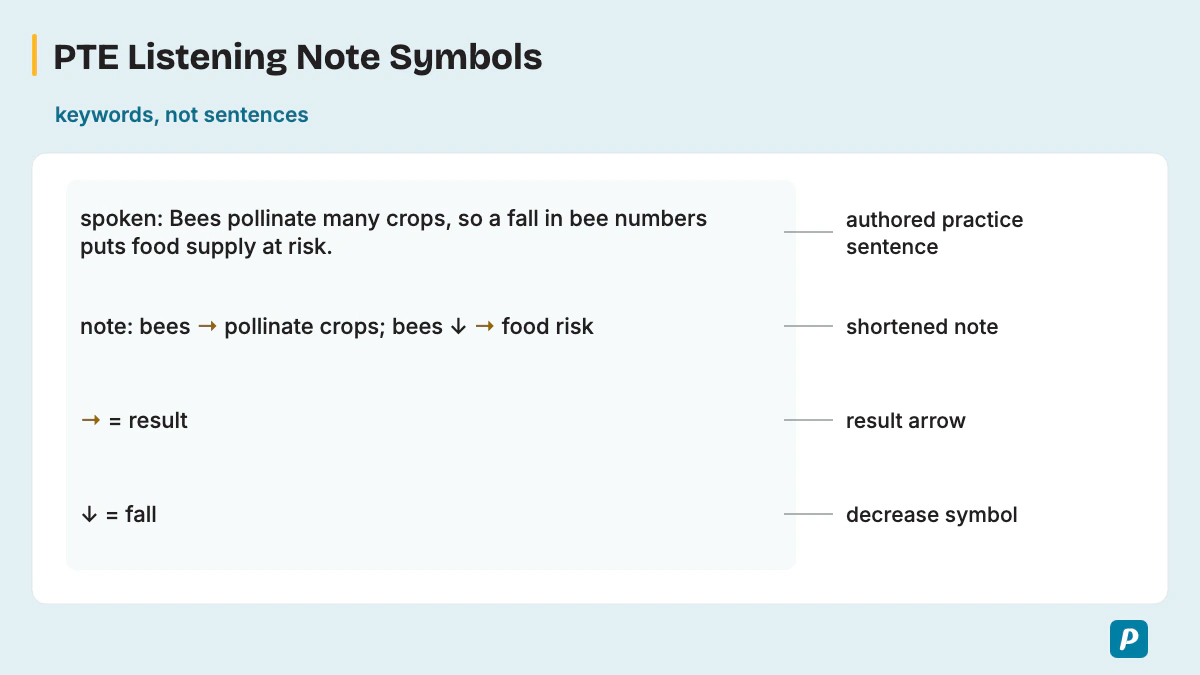
Symbols and abbreviations are a practice habit, not a Pearson rule. Build one personal set and keep it, so you never stop to decide what a mark means. Twelve authored practice sentences turned into notes show how the main symbols work; their scenarios and numbers illustrate note-taking, not independently verified facts.
| What the speaker says | Your note | Technique |
|---|---|---|
| "The Silk Road linked China with the Mediterranean for more than a thousand years." | SILK RD: China ↔ Med, 1000+ yrs | CAPS for a name, ↔ for a link, + for "more than" |
| "Bees pollinate many crops, so a fall in bee numbers puts food supply at risk." | bees → pollinate crops; bees ↓ → food risk | → for result, ↓ for a fall |
| "Unlike solar panels, wind turbines can generate power at night." | solar vs wind: wind ✓ night | vs for contrast, ✓ for "can" |
| "Urbanization is the growth in the share of people living in cities." | urbanization = ↑ % ppl in cities | = for a definition, ↑ for growth |
| "Marie Curie won Nobel Prizes in both physics and chemistry." | CURIE: Nobel phys + chem | CAPS for a name, + for "and" |
| "Remote work grew sharply in 2020 because of the pandemic." | remote work ↑↑ 2020 b/c pandemic | ↑↑ for a sharp rise, b/c for "because" |
| "The speaker doubts that electric cars are cheaper over their whole life." | spkr: EV cheaper lifetime? | ? for the speaker's doubt |
| "Plants grown without enough nitrogen produce smaller leaves." | plants w/o N → smaller leaves | w/o for "without", a chemical symbol |
| "Roman aqueducts carried water to cities using gravity alone." | ROMAN aqueducts: water → cities, gravity only | colon to group a topic and its detail |
| "The museum's visitor numbers rose from about 40,000 to 65,000 in five years." | museum ~40k → 65k, 5 yrs | ~ for "about", k for thousand, digits |
| "Inflation changes the real value of savings over time." | inflation → Δ real value savings | Δ for change |
| "First the team collected samples, then tested them, and finally published the results." | 1 collect → 2 test → 3 publish | numbers for a sequence |
Which PTE Listening Tasks Should You Prioritize?
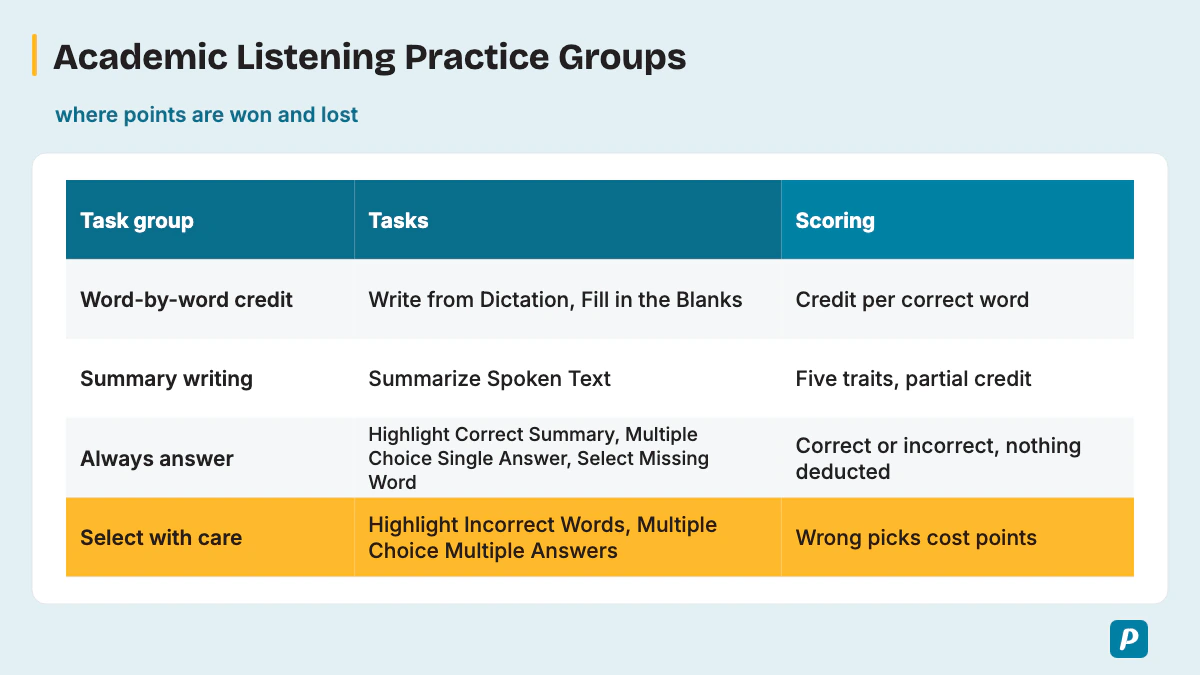
Put your practice priority on the tasks where accurate words or a good summary earn credit: Write from Dictation, Fill in the Blanks and Summarize Spoken Text. Then drill the single choice tasks you should always answer, and practice careful selection on the two tasks where wrong picks cost points. Grouping the PTE Academic tasks by how points are won and lost gives four practice blocks.
| Task group | Tasks | Items in PTE Academic | Practice priority | Why |
|---|---|---|---|---|
| Word-by-word credit | Write from Dictation, Fill in the Blanks | 3-4 and 2-3 | First | Each correct word scores |
| Summary writing | Summarize Spoken Text | 1 | Second | Partial credit across five traits |
| Always-answer single choice | Highlight Correct Summary, Multiple Choice, Single Answer, Select Missing Word | 2-3, 2-3 and 1-2 | Third | Correct or incorrect, nothing deducted |
| Careful-select tasks | Highlight Incorrect Words, Multiple Choice, Multiple Answers | 2-3 and 2-3 | Ongoing | Wrong picks cost points |
This is a suggested practice order based on item counts, partial credit and deductions, not an official ranking or a calculation of score contributions. Write from Dictation and Fill in the Blanks also add to Writing in at least one of the two Score Guides, so accurate spelling pays twice. Highlight Correct Summary appears in PTE Academic only.
How Can You Improve Your Listening Skills for PTE?
Build listening skills outside the test by listening daily to academic talks and podcasts in several English accents, writing one-sentence summaries and dictating short sentences you then check against a transcript. Each habit below trains a listening skill the section measures, from following accents to typing speed.
- Watch one of the short academic lectures each day and write a single sentence that sums it up.
- Listen to podcasts and news in Australian, British, American, Canadian and other English accents.
- Pause audio after a sentence, type it from memory and run a transcript check on every word.
- Try shadowing: repeat a speaker's sentence aloud a beat behind them to train your ear for stress.
- Learn to touch-type, so dictation and blanks don't wait on your fingers.
- Turn off spell-check and autocorrect while you practice, so every misspelling shows up.
- Once a week, do one timed set with clips played back to back under real section timing.
Keep a log of every word you mishear in dictation practice, and review it at the start of each session.
How Do You Practice for Test-Center Noise?
Practice some timed sets with low background speech playing, because at a test center other test takers speak at the same time while you listen. Background noise like this is normal in the room. Pearson provides the headset in your booth and asks you to keep it on for the whole test. For speaking tasks, your headset microphone captures your response; Listening tasks also score your typed answers and selections. Our guide to PTE headphones covers the equipment in each test setting.
What Are Common PTE Listening Mistakes to Avoid?
The common mistakes are writing full sentences, clicking during the audio, guessing on the two deduction tasks, mixing spellings, missing small endings, losing focus and clicking Next too early. Every mistake on this list has a fix in one of the numbered tips.
- Writing full sentences: you fall behind the speaker, so note keywords instead (tip 2).
- Clicking options while the audio plays: the order of ideas may differ from the options, so wait (tip 4).
- Random guessing in Highlight Incorrect Words or Multiple Choice, Multiple Answers: each wrong pick takes a point, so click only when sure (tip 7).
- Mixing spelling conventions: switching between US and UK forms inside one answer, so pick one (tip 6).
- Missing plural endings and small grammar words in Write from Dictation: each one costs a word, so listen for them (tip 5).
- Losing focus in long clips: train with full 5-6 minute talks and restate the point to yourself every 15-20 seconds, since Multiple Choice, Multiple Answers runs 80-120 seconds and Summarize Group Discussion up to 3 minutes (tip 3).
- Clicking Next before checking answers: rushing the end of an item throws away the review pause (tip 9).
How Do You Recover After Missing a Clip?
Answer what you can from your notes, submit, and give the next item your full attention, because every item is scored on its own and a missed clip can't be replayed. A no-penalty task still deserves your best guess. On Highlight Incorrect Words and Multiple Choice, Multiple Answers, select only what you're sure of. Our page on PTE exam anxiety covers how to steady your nerves after a bad item.
Which Mistakes Should You Avoid in Every PTE Section?
The same habits that cost Listening points, such as unchecked spelling and ignored word limits, also cost points in Speaking, Writing and Reading. Word limits matter in Summarize Spoken Text and in the writing tasks across all sections. Our list of common mistakes in PTE covers each section.
What Is a Four-Week PTE Listening Preparation Plan?
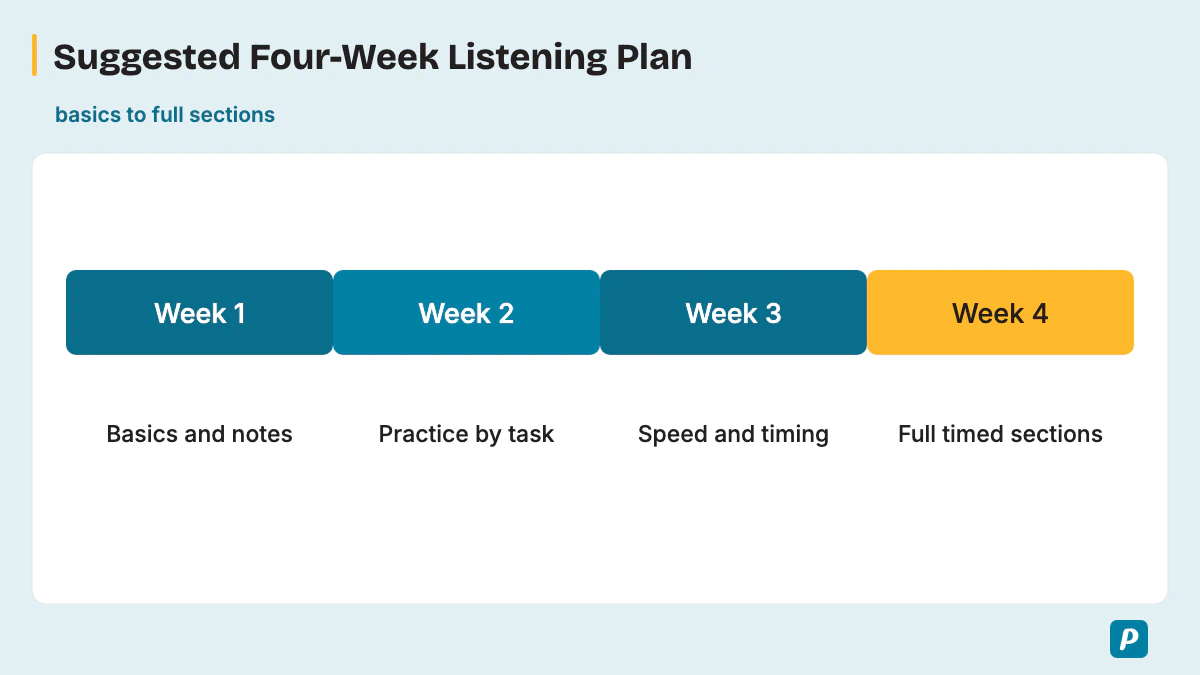
A four-week plan moves from basics to focused practice by task, then to strategy and speed under time, and ends with full timed sections and review. It's a suggestion, not a Pearson requirement. Build from timed practice on single tasks to a full-length section, and time each full section against 31-39 minutes for PTE Academic or 22-37 minutes for PTE Core.
| Week | Focus | Daily practice |
|---|---|---|
| Week 1 | Basics and notes | Learn the eight task rules, 10 dictation sentences, one note-symbol drill |
| Week 2 | Practice by task | Two tasks, about 10 items each, start an error log |
| Week 3 | Speed and timing | Timed sets with preview seconds, 15 dictation sentences |
| Week 4 | Full timed sections | 3-4 full Listening sections across the week, one official practice test, review |
Use Pearson’s current official preparation page to choose resources that fit your practice plan, checking availability, access duration and local price before purchasing. Keep the four-week schedule flexible and start with the free resources available to you.
Keep the error log running through all four weeks, and start the final review from that log, not from a fresh set. For daily drills, create a free account on our Listening practice.
Which Strategy Works for Each PTE Listening Question Type?
Each of the question types has one main move, from summarizing in your own words to typing every word you hear. Note before you select, spell after the audio, listen before reading options, use the preview, answer at the end and follow the cursor. This task strategy follows Pearson task order, and the task pages linked in each part hold the full method and samples.
How Do You Approach Summarize Spoken Text?
Note the main idea and key supporting points, write 50-70 words in your own words (20-30 in PTE Core), and leave a minute or two to check grammar and spelling. PTE Academic gives a 60-90 second clip and 10 minutes, and PTE Core a 45-75 second clip and 8 minutes. Pearson awards no credit for copied wording.
Running past 70 words lowers the Form score, and a summary in bullet points only scores 0 for Form. The full method is on our page for Summarize Spoken Text in PTE.
How Do You Approach Multiple Choice, Multiple Answers in Listening?
Read the question in the 7 seconds before the audio, take notes instead of clicking during it, and pick only the options whose meaning you heard. The clip runs 80-120 seconds in PTE Academic, with 2-3 items per test. Multiple Choice, Multiple Answers gives partial credit: each correct option earns 1 point and each wrong one loses 1, and an item can't score below 0.
Don't select every option that repeats a word from the clip; if you're sure of only one, select only that one. See PTE listening multiple choice multiple answer for sample items.
How Do You Approach Listening Fill in the Blanks?
Skim the transcript in the 7 seconds before the audio, write each missing word on the noteboard as you hear it, and decide the spelling after the recording ends. The clip lasts 30-60 seconds, and a test has 2-3 items. Pearson awards one point for every correct word spelled correctly, and its task page notes that the Tab key moves you between gaps.
The usual losses are a wrong word form, such as a missing plural -s or the wrong verb tense, and slow typing. Use Tab instead of the mouse, and read each completed sentence for grammar before you move on. Practice items sit on our PTE listening fill in the blanks page.
How Do You Approach Highlight Correct Summary?
Listen and note first, and read the summary options only after the recording ends, then pick the one that best matches your notes (PTE Academic only). Pearson advises against reading the options before or during the audio. The clip runs 30-90 seconds, with 2-3 items, and the task scores listening and reading.
Cross out any option that adds a detail the speaker never said or reverses the speaker's view. Our PTE listening highlight correct summary guide walks through a sample.
How Do You Approach Multiple Choice, Single Answer in Listening?
Use the 5 seconds before the audio to see whether the question asks for the main idea, a detail, an inference or the speaker's purpose, and listen for that. The clip runs 30-60 seconds, with 2-3 items in PTE Academic and 1-2 in PTE Core. Multiple Choice, Single Answer deducts nothing for a wrong pick, so always answer.
The answer is often a paraphrase, so don't reject an option just because its words differ from the speaker's. More on PTE listening multiple choice single answer.
How Do You Approach Select Missing Word?
Follow the line of the talk to predict the ending, click your answer when the beep replaces the last words, and use the pause before Next to reconsider. The clip runs 20-70 seconds, with 1-2 items and 3-5 options.
Rule out options that clash with the register or grammar of the final sentence, since a formal lecture rarely ends on a slang phrase. To train prediction, pause a recorded lecture 20 seconds in and say what comes next. Our PTE select missing word page has a worked sample.
How Do You Approach Highlight Incorrect Words?
Skim the transcript in the 10 seconds before the audio, follow it with the cursor, and click only the words you are sure differ, because each wrong click takes a point away. In Academic/UKVI the clip runs 15-50 seconds with 2-3 items; Core has 1-2 items, but its recording length is not reliably stated on the current Core page, and an item can't score below 0. Take no notes here.
Pausing to second-guess a word loses your place, so click and keep moving. The PTE highlight incorrect words page covers the scoring in full.
How Do You Approach Write From Dictation?
Type as many correct words as you remember in the correct order, use grammar to place any word you're unsure of, and check spelling, because each correct word earns credit. Each sentence lasts 3-5 seconds, and the 3-4 items close the test.
Dropped plural -s, articles and past-tense -ed endings are the small words that lose points, so jot first letters while the audio plays. Then read the typed sentence once for grammar order, such as a verb after its subject, before you click Next. Practice sentences are on our PTE write from dictation page.
Practice PTE Listening on EasyEnglish
Try Listening tasks in a timed, computer-based format like the real test.
Try speaking practice without signing up. A free account is required for full mock tests. Practice scores are estimates, not official Pearson scores.
Written by
EasyEnglish Team
The team behind EasyEnglish's PTE practice and mock tests
We build EasyEnglish PTE practice tasks and mock tests. Official test rules are checked against Pearson guidance; exercises are authored examples, not official or predicted exam questions. Practice scores are estimates. EasyEnglish is not affiliated with or endorsed by Pearson. Contact support@inverseai.com.
Editorial review completed .