17 Most Common Mistakes in All PTE Sections to Avoid
Exam Preparation
A pause that runs too long ends an item, an essay far outside the word range brings a zero score, and a guess in the wrong task costs a point. Each of these common mistakes, whether in Speaking, Writing, Reading or Listening, breaks a rule Pearson states on its PTE Academic format pages or in its own article on test-day errors. PTE Core swaps Write Essay for Write Email, so the essay limits here don't apply to Core.
Table of Contents
What Are the Common Speaking Mistakes in PTE?
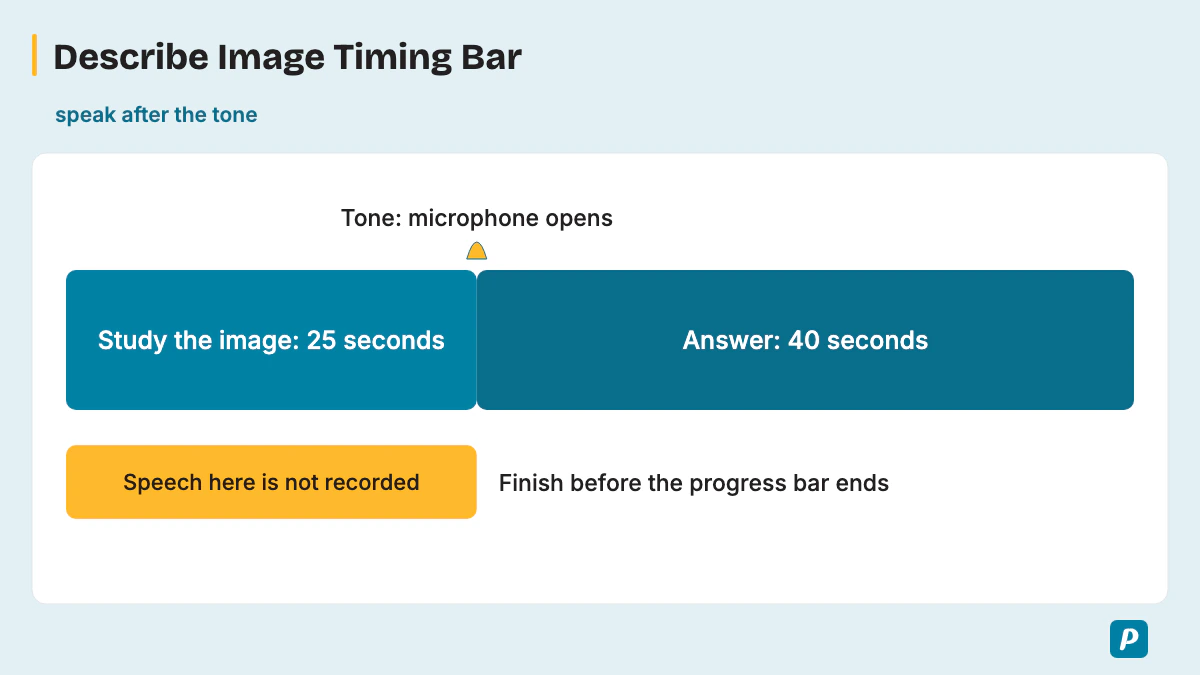
The common Speaking mistakes are starting before the microphone opens, pausing too long, filling silence with "um" or rushing, and running past the progress bar. All four cost you recorded speech, which is the only evidence the scoring can use.
- 1. Speaking before the tone. Pearson says speech before the microphone opens isn't recorded. Wait for the short tone where there is one; Answer Short Question has none, so start as soon as its recording ends. Use the equipment check before the test to confirm your headset and microphone work.
- 2. Pausing too long. In Answer Short Question, waiting more than 3 seconds to start or stopping for 3 seconds ends the item, and Pearson says the same applies to Read Aloud, Repeat Sentence, Describe Image and Retell Lecture. In every speaking item, finish before the progress bar ends.
- 3. Filler sounds, speed and a badly placed microphone. Oral fluency means a smooth, natural pace, not a fast one, so replace "um" and "uh" with a short silent breath. Pearson adds that repeating ideas, correcting yourself or hesitating uses up time and loses points, so keep talking past a slip. Pearson places the microphone about two fingers from your mouth and asks you to speak clearly without shouting or whispering.
- 4. Not finishing in time. Describe Image gives 25 seconds to study the image and 40 seconds to answer, and Repeat Sentence gives 15 seconds. Plan an answer that fits the window.
Pearson doesn't name Summarize Group Discussion or Respond to a Situation in its 3-second sentence, but a long silence still wastes time you need before the progress bar ends. Keep the headset on for the whole test, since other test takers in the room speak at the same time and only your own microphone is assessed.
What Goes Wrong When You Describe an Image?
Describe Image goes wrong when test takers recite a memorized description instead of the image on screen, which Pearson says usually leads to a very low score or even a zero. Describe what you actually see, with its numbers and trend. Our PTE describe image page shows how.
What Is the 3-Second Rule in PTE Speaking?
Pearson states the 3-second rule in the Answer Short Question block: wait more than three seconds to start, or stop for three seconds while speaking, and the item ends. Pearson adds that this also applies to Read Aloud, Repeat Sentence, Describe Image and Retell Lecture, and the item is then marked complete with whatever you said. Read more on the PTE three second rule.
What Are the Common Writing Mistakes in PTE?
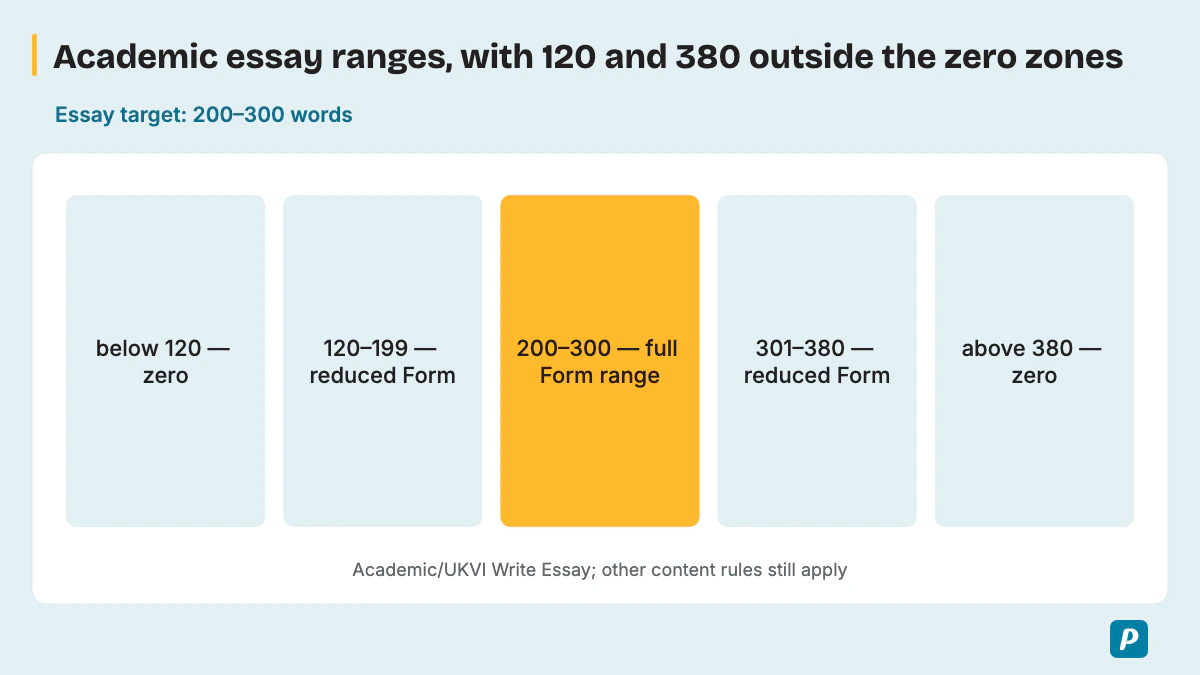
The common Writing mistakes are breaking the word limit, writing more than one sentence in Summarize Written Text, using informal language and mixing spelling conventions. Each one breaks a written rule Pearson publishes on its Speaking & Writing page.
- 5. Missing the essay word limit. Write Essay asks for 200-300 words. Missing that range by a few words costs Form credit, while under 120 or over 380 words scores zero on all seven factors.
- 6. More than one sentence in Summarize Written Text. The task wants one sentence of up to 75 words. Under 5 or over 75 words earns no points.
- 7. Informal language. Casual phrasing and slang don't suit an academic task. Write in a neutral, formal register.
- 8. Mixing spelling conventions. Pearson accepts US, UK, Australian and Canadian spelling, but one spelling convention has to run through each response. Pick one and keep it.
PTE Core uses Write Email instead of Write Essay: the task asks for 80-120 words in 9 minutes, and an email far under or over that length loses Form. Core's Summarize Written Text also differs, asking for 25-50 words in one or more complete sentences, and a summary outside 25-50 words isn't scored.
What Are Common PTE Essay Mistakes?
Essay mistakes cluster around the topic and the shape: misreading the prompt, a disorganized structure, and grammar slips in long sentences. Read the essay prompt twice, then use a clear structure such as an introduction, two body paragraphs and a conclusion. Keep complex sentences under control, hold one tense through each argument, and check subject-verb agreement, because these slips count against Grammar. Use words you know well rather than showy ones in the wrong collocation, and leave out contractions and slang.
A workable split of the 20 minutes is about 2-3 minutes to plan, 14-15 to write and 3 to check; our guide to the PTE write essay task covers structure.
What Are the Common Reading Mistakes in PTE?
The common Reading mistakes are ignoring linking words in Re-order Paragraphs, guessing extra options in Multiple Choice, Multiple Answers and filling blanks by meaning alone. Two of them lose credit quietly, and one actively takes points away.
- 9. Ignoring linking words. Pearson names this a common Re-order Paragraphs mistake, along with missing the introduction and conclusion. Track words like "however" and "this" to link sentences.
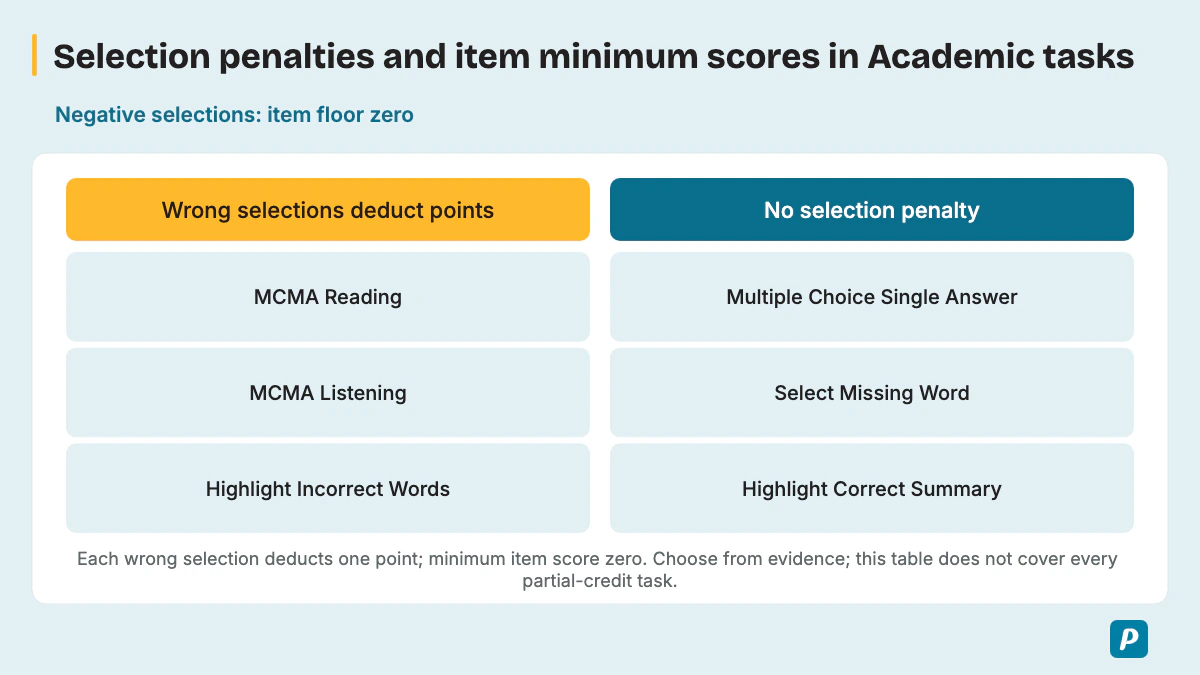
- 10. Guessing in Multiple Choice, Multiple Answers. Wrong options cost points here, so negative marking turns a guess into a loss. Select options supported by the passage; each incorrect selection reduces the item score, which cannot fall below zero.
- 11. Ignoring grammar fit. A word can fit the meaning but not the sentence's grammar. Check tense, number and word class before you drop it in.
Some prep sites list choosing two answers in Multiple Choice, Single Answer as a negative-marking trap. That task allows one answer and is scored correct or incorrect. Negative marking applies only to Multiple Choice, Multiple Answers (Reading and Listening) and Highlight Incorrect Words.
How Do You Avoid Mistakes When Reordering Paragraphs?
Find the sentence that introduces the topic, then follow pronouns, articles and linking words to chain the rest. A topic sentence rarely starts with "it" or "this". Our PTE reorder paragraphs page works through a sample.
Which PTE Tasks Have Negative Marking?
Only Multiple Choice, Multiple Answers (in Reading and Listening) and Highlight Incorrect Words take points away for wrong choices; Pearson lists no other task that deducts points. Other tasks use correct/incorrect or trait-based partial-credit scoring; a mistake may reduce credit without a negative-selection penalty. See PTE negative marking for the scoring.
What Are the Common Listening Mistakes in PTE?
The common Listening mistakes are copying the audio in Summarize Spoken Text, typing during Fill in the Blanks and clicking doubtful words in Highlight Incorrect Words. Every clip plays once, so each of these comes down to what you do while it plays.
- 12. Copying the recording. Pearson calls word-for-word copying in Summarize Spoken Text a common mistake. Paraphrase the talk in a 50-70 word summary within 10 minutes.
- 13. Losing your place while typing. For Listening Fill in the Blanks, note the missing words while you listen, then check spelling and enter them before moving on. Pearson recommends the noteboard; typing during playback is not itself a rule violation. Use the method you can manage accurately.
- 14. Guessing in Highlight Incorrect Words. Each wrong click costs a point. Click only words you're sure differ from the audio.
Leaving the noteboard unused is a mistake of its own: jot the main idea and keywords for Summarize Spoken Text there while the talk plays. In Write from Dictation, Pearson's tip is to type as many correct words as you can remember in the correct order. Use grammar to place a word you're unsure about, since each correctly spelled word earns a point. Listening isn't free of negative marking either, since two of its tasks deduct.
How Do You Avoid Mistakes in Summarize Spoken Text?
Note the main idea and supporting points, write the summary in your own words, and keep a minute or two to check grammar and spelling. A grammar check at the end catches agreement slips. Our page on Summarize Spoken Text in PTE has a sample.
Why Is Not Checking Answers a Costly PTE Mistake?
Pearson calls simple written errors, such as spelling, punctuation, vocabulary, grammar and unfinished tasks, the biggest problem it sees. Pearson's fix is a few seconds of proofreading before you move on.
- 15. Moving on without proofreading. A misspelled word in Write from Dictation or Fill in the Blanks earns nothing, and an unfinished task gives away credit you could have earned. In Write Essay, Pearson's Score Guide gives the Spelling trait 2 points for correct spelling, 1 for one error and 0 for more than one.
Read each written answer once for spelling and once for punctuation. Check that every sentence ends with a full stop and that each task is complete. In Summarize Written Text, confirm the response is still one sentence after your edits.
Why Do Test Takers Run Out of Time in PTE?
Test takers run out of time by spending too long on early items, ignoring the on-screen timer and rereading instructions they could have learned before test day.
- 16. Losing track of time. PTE Academic takes about 2 hours: Speaking & Writing runs 76-84 minutes, Reading 23-30 minutes and Listening 31-39 minutes.
Good time management and pacing start with knowing which clock you're on in each of the timed parts. Write Essay has its own 20 minutes, and Summarize Written Text and Summarize Spoken Text have 10 each, so set a checkpoint halfway through each.
Reading has one timer for the whole part and no per-item timer, so check the remaining time after every few items and move on when one stalls you. Learn the on-screen instructions while you prepare, but still glance at the word range and whether one answer or more is wanted before you click Next.
Why Is Using Templates Blindly a Mistake?
Pearson gives no credit for an unoriginal response in Describe Image, Retell Lecture, Summarize Group Discussion and Write Essay. A memorized template that ignores the prompt can score very low or zero.
- 17. Reciting a memorized script. Pearson asks for your own words in all four tasks, so a script that could fit any prompt earns nothing for content.
A structure you adapt is different from a memorized script you recite. A structure is an order of ideas, such as main point, two details and a conclusion, filled in your own words from the prompt. A script is fixed wording that sounds the same whatever the image or lecture says. In Retell Lecture and Summarize Group Discussion, the content has to come from what you heard. Templates fail the moment they replace that content.
How Do You Clear PTE in the First Attempt?
Clearing PTE in the first attempt comes from knowing each task's rule, doing timed practice and keeping a mistake log. After each practice set, log every lost point against the rule it broke, fix that habit and retest. Treat mock tests like the real sitting: no pausing the timer, no phone, headset on. Then review each error in your log instead of reading only the practice score.
Which Is the Hardest Section in PTE?
No section is hardest for everyone; the hardest is usually the one whose task rules you have practiced least. Your mistake log shows your hardest section, because practice gaps cluster there. Our PTE exam format page lists every section and task.
Can You Crack PTE Without Coaching?
Yes, you can prepare on your own with Pearson's task rules, timed practice and honest review of your mistakes. Self-study works when you mark your practice against the rules, not by feel. Coaching adds outside feedback on speaking and writing, and our PTE preparation guide covers both routes.
Can You Pass PTE in 2 Weeks?
Two weeks can be enough if your English is already near your target score and you spend it on task rules and timed practice, not on new English learning. Use the two weeks to remove these 17 mistakes. Our PTE tips give a short plan.
Practice PTE Online on EasyEnglish
Try Speaking, Writing, Reading and Listening tasks in a timed, computer-based format.
Practice scores are EasyEnglish estimates, not official Pearson scores. You can try speaking scoring without signing up.
Written by
EasyEnglish Team
The team behind EasyEnglish's PTE practice and mock tests
We build the PTE practice tasks, mock tests and scoring on EasyEnglish, and we oversee every guide on this site. We consult official test-provider and government sources where relevant. Check the sources and review date for each guide; practice examples are authored learning material. EasyEnglish is not affiliated with Pearson.
Editorial review completed .