200 Common PTE Dictation Words Plus 200 Spelling Drills
PTE Listening
One wrong letter costs you a point in PTE Listening, because dictation words earn credit only when you type them exactly. These words fill Write from Dictation and the listening gap-fill task, where Pearson gives one point for each correct word spelled correctly.
This is an authored dictation practice list, not an official exam-word list, so the 200 dictation words here are our practice list: 170 academic words with meaning, pronunciation and a spelling note, plus 30 commonly misspelled words. Each of those 200 names the trap that would cost its point, and 200 more spelling drill words follow in 10 pattern groups, each with its rule.
Table of Contents
What Are Dictation Words in the PTE Listening Section?
Dictation words are the words you type from audio in Write from Dictation and Listening Fill in the Blanks, each worth one point when spelled correctly. Write from Dictation plays a 3-5 second sentence; the listening gap-fill task plays a 30-60 second recording over a gapped transcript.
Pearson's Score Guide lists 3-4 Write from Dictation items and 2-3 Listening Fill in the Blanks items in PTE Academic, and Write from Dictation feeds Listening and Writing in both tests. The gap-fill counts toward Listening only in the PTE Academic Score Guide, though its task page says listening and writing, and toward Listening and Writing in PTE Core. Our list is a publisher’s practice selection; its size does not predict the words that will appear on an exam.
What Are Some Good Dictation Words for PTE Students?
Good dictation words are the academic words that lecture-style sentences use and that are easy to misspell under time pressure. The word list below sorts 170 of them into 10 topic groups of 17, each with a short meaning, a pronunciation guide and a spelling note. In the "Say it" column, the syllable in capitals carries the stress, so you can match the written word to the sound you'll hear.
Science and research
| Word | Meaning | Say it | Spelling note |
|---|---|---|---|
| hypothesis | an idea to be tested | hy-POTH-uh-sis | y after h; ends -esis |
Practice 1Catalogue study mode: nearby vocabulary may show the answer. | |||
| phenomenon | an event that can be observed | fuh-NOM-uh-non | ph start; plural phenomena |
Practice 2Catalogue study mode: nearby vocabulary may show the answer. | |||
| analysis | a detailed examination | uh-NAL-uh-sis | y in the middle |
Practice 3Catalogue study mode: nearby vocabulary may show the answer. | |||
| experiment | a test to discover something | ik-SPER-uh-muhnt | -ment ending |
Practice 4Catalogue study mode: nearby vocabulary may show the answer. | |||
| laboratory | a room for scientific work | LAB-ruh-tor-ee | -or- is often swallowed |
Practice 5Catalogue study mode: nearby vocabulary may show the answer. | |||
| evidence | facts that show something is true | EV-ih-duhns | -ence ending |
Practice 6Catalogue study mode: nearby vocabulary may show the answer. | |||
| theory | an idea that explains facts | THEER-ee | eo, not oe |
Practice 7Catalogue study mode: nearby vocabulary may show the answer. | |||
| methodology | the system of methods in a study | meth-uh-DOL-uh-jee | -ology ending |
Practice 8Catalogue study mode: nearby vocabulary may show the answer. | |||
| variable | a factor that can change | VAIR-ee-uh-buhl | -able ending |
Practice 9Catalogue study mode: nearby vocabulary may show the answer. | |||
| empirical | based on observation | em-PEER-ih-kuhl | -ical ending |
Practice 10Catalogue study mode: nearby vocabulary may show the answer. | |||
| quantitative | measured in numbers | KWON-tih-tay-tiv | -itative, not -ative |
Practice 11Catalogue study mode: nearby vocabulary may show the answer. | |||
| qualitative | about qualities, not numbers | KWOL-ih-tay-tiv | -itative, not -ative |
Practice 12Catalogue study mode: nearby vocabulary may show the answer. | |||
| sample | a small part used for testing | SAM-puhl | -ple ending |
Practice 13Catalogue study mode: nearby vocabulary may show the answer. | |||
| correlation | a link between two things | kor-uh-LAY-shuhn | double r |
Practice 14Catalogue study mode: nearby vocabulary may show the answer. | |||
| molecule | the smallest unit of a substance | MOL-ih-kyool | -cule ending |
Practice 15Catalogue study mode: nearby vocabulary may show the answer. | |||
| observation | the act of watching carefully | ob-zer-VAY-shuhn | s sounds like z |
Practice 16Catalogue study mode: nearby vocabulary may show the answer. | |||
| statistics | numerical data | stuh-TIS-tiks | ends in -ics |
Practice 17Catalogue study mode: nearby vocabulary may show the answer. | |||
Environment
| Word | Meaning | Say it | Spelling note |
|---|---|---|---|
| environment | the natural world around us | en-VY-ruhn-muhnt | n before -ment is easy to drop |
Practice 18Catalogue study mode: nearby vocabulary may show the answer. | |||
| climate | long-term weather patterns | KLY-mit | ends in -ate |
Practice 19Catalogue study mode: nearby vocabulary may show the answer. | |||
| pollution | harmful substances in nature | puh-LOO-shuhn | double l |
Practice 20Catalogue study mode: nearby vocabulary may show the answer. | |||
| biodiversity | the variety of living things | by-oh-dy-VUR-sih-tee | one word |
Practice 21Catalogue study mode: nearby vocabulary may show the answer. | |||
| sustainable | able to continue without harm | suh-STAY-nuh-buhl | -able ending |
Practice 22Catalogue study mode: nearby vocabulary may show the answer. | |||
| temperature | how hot or cold something is | TEM-pruh-cher | -era- in the middle |
Practice 23Catalogue study mode: nearby vocabulary may show the answer. | |||
| atmosphere | the gases around the earth | AT-muhs-feer | ph sounds like f |
Practice 24Catalogue study mode: nearby vocabulary may show the answer. | |||
| ecosystem | living things and their surroundings | EE-koh-sis-tuhm | y in -system |
Practice 25Catalogue study mode: nearby vocabulary may show the answer. | |||
| emission | gas released into the air | ih-MISH-uhn | double s |
Practice 26Catalogue study mode: nearby vocabulary may show the answer. | |||
| renewable | able to be replaced naturally | rih-NOO-uh-buhl | -able ending |
Practice 27Catalogue study mode: nearby vocabulary may show the answer. | |||
| drought | a long period without rain | DROWT | -ough- spells ow |
Practice 28Catalogue study mode: nearby vocabulary may show the answer. | |||
| habitat | the natural home of an animal | HAB-ih-tat | single b, single t |
Practice 29Catalogue study mode: nearby vocabulary may show the answer. | |||
| conservation | the protection of nature | kon-ser-VAY-shuhn | -tion ending |
Practice 30Catalogue study mode: nearby vocabulary may show the answer. | |||
| deforestation | the clearing of forests | dee-for-ih-STAY-shuhn | de + forest + -ation |
Practice 31Catalogue study mode: nearby vocabulary may show the answer. | |||
| species | a group of similar living things | SPEE-sheez | same form for one and many |
Practice 32Catalogue study mode: nearby vocabulary may show the answer. | |||
| glacier | a large mass of slow-moving ice | GLAY-sher | -cier ending |
Practice 33Catalogue study mode: nearby vocabulary may show the answer. | |||
| carbon | a chemical element in all living things | KAR-buhn | -on ending |
Practice 34Catalogue study mode: nearby vocabulary may show the answer. | |||
Economy and business
| Word | Meaning | Say it | Spelling note |
|---|---|---|---|
| government | the group that runs a country | GUV-ern-muhnt | n before -ment |
Practice 35Catalogue study mode: nearby vocabulary may show the answer. | |||
| economy | the system of money and trade | ih-KON-uh-mee | single c, single n |
Practice 36Catalogue study mode: nearby vocabulary may show the answer. | |||
| investment | money put in to make a profit | in-VEST-muhnt | -ment ending |
Practice 37Catalogue study mode: nearby vocabulary may show the answer. | |||
| financial | relating to money | fy-NAN-shuhl | -cial ending |
Practice 38Catalogue study mode: nearby vocabulary may show the answer. | |||
| commercial | relating to buying and selling | kuh-MUR-shuhl | double m, -cial |
Practice 39Catalogue study mode: nearby vocabulary may show the answer. | |||
| industry | the production of goods | IN-duh-stree | ends in -try |
Practice 40Catalogue study mode: nearby vocabulary may show the answer. | |||
| budget | a plan for spending money | BUJ-it | d before g |
Practice 41Catalogue study mode: nearby vocabulary may show the answer. | |||
| revenue | income of a company or state | REV-uh-noo | -ue ending |
Practice 42Catalogue study mode: nearby vocabulary may show the answer. | |||
| inflation | a general rise in prices | in-FLAY-shuhn | -tion ending |
Practice 43Catalogue study mode: nearby vocabulary may show the answer. | |||
| consumer | a person who buys goods | kuhn-SOO-mer | -er ending |
Practice 44Catalogue study mode: nearby vocabulary may show the answer. | |||
| entrepreneur | a person who starts a business | on-truh-pruh-NUR | -eur ending |
Practice 45Catalogue study mode: nearby vocabulary may show the answer. | |||
| profit | money left after costs | PROF-it | single f, single t |
Practice 46Catalogue study mode: nearby vocabulary may show the answer. | |||
| recession | a period of economic decline | rih-SESH-uhn | double s |
Practice 47Catalogue study mode: nearby vocabulary may show the answer. | |||
| currency | the money a country uses | KUR-uhn-see | double r, -ency |
Practice 48Catalogue study mode: nearby vocabulary may show the answer. | |||
| infrastructure | basic systems such as roads and power | IN-fruh-struk-cher | infra + structure |
Practice 49Catalogue study mode: nearby vocabulary may show the answer. | |||
| commodity | a product that is bought and sold | kuh-MOD-ih-tee | double m |
Practice 50Catalogue study mode: nearby vocabulary may show the answer. | |||
| negotiate | to discuss to reach an agreement | nih-GOH-shee-ayt | -tiate ending |
Practice 51Catalogue study mode: nearby vocabulary may show the answer. | |||
Education
| Word | Meaning | Say it | Spelling note |
|---|---|---|---|
| curriculum | the subjects in a course | kuh-RIK-yuh-luhm | double r, -ulum |
Practice 52Catalogue study mode: nearby vocabulary may show the answer. | |||
| knowledge | understanding gained by learning | NOL-ij | silent k, then -dge |
Practice 53Catalogue study mode: nearby vocabulary may show the answer. | |||
| semester | half of an academic year | sih-MES-ter | -er ending |
Practice 54Catalogue study mode: nearby vocabulary may show the answer. | |||
| lecture | a formal talk to students | LEK-cher | -ture ending |
Practice 55Catalogue study mode: nearby vocabulary may show the answer. | |||
| tutorial | a small teaching session | too-TOR-ee-uhl | -ial ending |
Practice 56Catalogue study mode: nearby vocabulary may show the answer. | |||
| assignment | a task given to students | uh-SYN-muhnt | silent g |
Practice 57Catalogue study mode: nearby vocabulary may show the answer. | |||
| dissertation | a long academic essay | dis-er-TAY-shuhn | double s |
Practice 58Catalogue study mode: nearby vocabulary may show the answer. | |||
| undergraduate | a student on a first degree | un-der-GRAJ-oo-it | under + graduate |
Practice 59Catalogue study mode: nearby vocabulary may show the answer. | |||
| literacy | the ability to read and write | LIT-er-uh-see | -acy ending |
Practice 60Catalogue study mode: nearby vocabulary may show the answer. | |||
| scholarship | money given to support study | SKOL-er-ship | sch sounds like sk |
Practice 61Catalogue study mode: nearby vocabulary may show the answer. | |||
| faculty | teaching staff or a university division | FAK-uhl-tee | -ty ending |
Practice 62Catalogue study mode: nearby vocabulary may show the answer. | |||
| academic | relating to education | ak-uh-DEM-ik | -ic ending |
Practice 63Catalogue study mode: nearby vocabulary may show the answer. | |||
| enrollment | the act of joining a course | en-ROHL-muhnt | US enrollment, UK enrolment |
Practice 64Catalogue study mode: nearby vocabulary may show the answer. | |||
| discipline | a field of study; self-control | DIS-uh-plin | sc spells the s sound |
Practice 65Catalogue study mode: nearby vocabulary may show the answer. | |||
| assessment | an evaluation of learning | uh-SES-muhnt | two pairs of double s |
Practice 66Catalogue study mode: nearby vocabulary may show the answer. | |||
| seminar | a class for discussion | SEM-uh-nar | -ar ending |
Practice 67Catalogue study mode: nearby vocabulary may show the answer. | |||
| graduate | a person with a degree | GRAJ-oo-it | -ate ending |
Practice 68Catalogue study mode: nearby vocabulary may show the answer. | |||
Society and politics
| Word | Meaning | Say it | Spelling note |
|---|---|---|---|
| community | a group of people living together | kuh-MYOO-nih-tee | double m |
Practice 69Catalogue study mode: nearby vocabulary may show the answer. | |||
| population | the people living in an area | pop-yuh-LAY-shuhn | single p in the middle |
Practice 70Catalogue study mode: nearby vocabulary may show the answer. | |||
| generation | people born around the same time | jen-uh-RAY-shuhn | -tion ending |
Practice 71Catalogue study mode: nearby vocabulary may show the answer. | |||
| democracy | government elected by the people | dih-MOK-ruh-see | -cracy ending |
Practice 72Catalogue study mode: nearby vocabulary may show the answer. | |||
| legislation | laws made by a government | lej-is-LAY-shuhn | -tion ending |
Practice 73Catalogue study mode: nearby vocabulary may show the answer. | |||
| parliament | an elected law-making body | PAR-luh-muhnt | the ia is barely heard |
Practice 74Catalogue study mode: nearby vocabulary may show the answer. | |||
| policy | a plan of action | POL-ih-see | -icy ending |
Practice 75Catalogue study mode: nearby vocabulary may show the answer. | |||
| citizen | a legal member of a country | SIT-ih-zuhn | c sounds like s |
Practice 76Catalogue study mode: nearby vocabulary may show the answer. | |||
| immigration | moving to a new country to live | im-ih-GRAY-shuhn | double m |
Practice 77Catalogue study mode: nearby vocabulary may show the answer. | |||
| inequality | unfair difference between groups | in-ih-KWOL-ih-tee | in + equality |
Practice 78Catalogue study mode: nearby vocabulary may show the answer. | |||
| urban | relating to cities | UR-buhn | -an ending |
Practice 79Catalogue study mode: nearby vocabulary may show the answer. | |||
| welfare | well-being; state support | WEL-fair | one l |
Practice 80Catalogue study mode: nearby vocabulary may show the answer. | |||
| bureaucracy | a system with many rules and officials | byoo-ROK-ruh-see | eau in bureau |
Practice 81Catalogue study mode: nearby vocabulary may show the answer. | |||
| authority | the power to make decisions | uh-THOR-ih-tee | -ity ending |
Practice 82Catalogue study mode: nearby vocabulary may show the answer. | |||
| tradition | a custom passed down over time | truh-DISH-uhn | -tion ending |
Practice 83Catalogue study mode: nearby vocabulary may show the answer. | |||
| diversity | a range of different people or things | dih-VUR-sih-tee | -ity ending |
Practice 84Catalogue study mode: nearby vocabulary may show the answer. | |||
| census | an official count of a population | SEN-suhs | c at the start, s at the end |
Practice 85Catalogue study mode: nearby vocabulary may show the answer. | |||
Health and medicine
| Word | Meaning | Say it | Spelling note |
|---|---|---|---|
| disease | an illness | dih-ZEEZ | both s letters sound like z |
Practice 86Catalogue study mode: nearby vocabulary may show the answer. | |||
| nutrition | the food needed for health | noo-TRISH-uhn | single t before -tion |
Practice 87Catalogue study mode: nearby vocabulary may show the answer. | |||
| physician | a medical doctor | fih-ZISH-uhn | ph, then -cian |
Practice 88Catalogue study mode: nearby vocabulary may show the answer. | |||
| hygiene | practices that keep you clean | HY-jeen | y, then ie |
Practice 89Catalogue study mode: nearby vocabulary may show the answer. | |||
| psychology | the study of the mind | sy-KOL-uh-jee | silent p |
Practice 90Catalogue study mode: nearby vocabulary may show the answer. | |||
| immune | protected against disease | ih-MYOON | double m |
Practice 91Catalogue study mode: nearby vocabulary may show the answer. | |||
| therapy | treatment for an illness or problem | THER-uh-pee | th, y ending |
Practice 92Catalogue study mode: nearby vocabulary may show the answer. | |||
| surgery | treatment by an operation | SUR-juh-ree | -ery ending |
Practice 93Catalogue study mode: nearby vocabulary may show the answer. | |||
| vaccine | a substance that protects against disease | vak-SEEN | cc sounds like ks |
Practice 94Catalogue study mode: nearby vocabulary may show the answer. | |||
| symptom | a sign of illness | SIMP-tuhm | y, then p before t |
Practice 95Catalogue study mode: nearby vocabulary may show the answer. | |||
| diagnosis | identifying an illness | dy-uhg-NOH-sis | -osis ending |
Practice 96Catalogue study mode: nearby vocabulary may show the answer. | |||
| chronic | lasting a long time | KRON-ik | ch sounds like k |
Practice 97Catalogue study mode: nearby vocabulary may show the answer. | |||
| obesity | being very overweight | oh-BEE-sih-tee | -ity ending |
Practice 98Catalogue study mode: nearby vocabulary may show the answer. | |||
| anxiety | a feeling of worry | ang-ZY-uh-tee | x sounds like z here |
Practice 99Catalogue study mode: nearby vocabulary may show the answer. | |||
| pharmaceutical | relating to medicines | far-muh-SOO-tih-kuhl | ph, then -eu- |
Practice 100Catalogue study mode: nearby vocabulary may show the answer. | |||
| infection | a disease caused by germs | in-FEK-shuhn | -ction ending |
Practice 101Catalogue study mode: nearby vocabulary may show the answer. | |||
| respiratory | relating to breathing | RES-pruh-tor-ee | middle vowel is often unheard |
Practice 102Catalogue study mode: nearby vocabulary may show the answer. | |||
Technology
| Word | Meaning | Say it | Spelling note |
|---|---|---|---|
| technology | the practical use of science | tek-NOL-uh-jee | ch sounds like k |
Practice 103Catalogue study mode: nearby vocabulary may show the answer. | |||
| digital | using computer technology | DIJ-ih-tuhl | -al ending |
Practice 104Catalogue study mode: nearby vocabulary may show the answer. | |||
| software | computer programs | SOFT-wair | one word |
Practice 105Catalogue study mode: nearby vocabulary may show the answer. | |||
| algorithm | a set of steps for solving a problem | AL-guh-rith-uhm | -rithm, no y |
Practice 106Catalogue study mode: nearby vocabulary may show the answer. | |||
| automation | the use of machines to do work | aw-tuh-MAY-shuhn | auto + -mation |
Practice 107Catalogue study mode: nearby vocabulary may show the answer. | |||
| invention | something new that someone creates | in-VEN-shuhn | -tion ending |
Practice 108Catalogue study mode: nearby vocabulary may show the answer. | |||
| artificial | made by people, not natural | ar-tih-FISH-uhl | -cial ending |
Practice 109Catalogue study mode: nearby vocabulary may show the answer. | |||
| device | a machine or tool | dih-VYS | noun device, verb devise |
Practice 110Catalogue study mode: nearby vocabulary may show the answer. | |||
| network | a system of connected parts | NET-wurk | one word |
Practice 111Catalogue study mode: nearby vocabulary may show the answer. | |||
| database | an organized store of data | DAY-tuh-bays | one word |
Practice 112Catalogue study mode: nearby vocabulary may show the answer. | |||
| electricity | a form of energy | ih-lek-TRIS-ih-tee | c before -ity |
Practice 113Catalogue study mode: nearby vocabulary may show the answer. | |||
| engineering | the design of machines and structures | en-juh-NEER-ing | -eer- in the middle |
Practice 114Catalogue study mode: nearby vocabulary may show the answer. | |||
| satellite | an object that orbits a planet | SAT-uh-lyt | single t, double l |
Practice 115Catalogue study mode: nearby vocabulary may show the answer. | |||
| transmission | the act of sending something | tranz-MISH-uhn | double s |
Practice 116Catalogue study mode: nearby vocabulary may show the answer. | |||
| virtual | existing on computers, not physically | VUR-choo-uhl | -ual ending |
Practice 117Catalogue study mode: nearby vocabulary may show the answer. | |||
| cybersecurity | protection of computer systems | sy-ber-sih-KYOOR-ih-tee | usually one word |
Practice 118Catalogue study mode: nearby vocabulary may show the answer. | |||
| interface | the point where two systems meet | IN-ter-fays | inter + face |
Practice 119Catalogue study mode: nearby vocabulary may show the answer. | |||
History and culture
| Word | Meaning | Say it | Spelling note |
|---|---|---|---|
| civilization | an advanced human society | siv-uh-lih-ZAY-shuhn | US -ization, UK also -isation |
Practice 120Catalogue study mode: nearby vocabulary may show the answer. | |||
| archaeology | the study of past human remains | ar-kee-OL-uh-jee | aeo; US also archeology |
Practice 121Catalogue study mode: nearby vocabulary may show the answer. | |||
| ancient | very old | AYN-shuhnt | -cient ending |
Practice 122Catalogue study mode: nearby vocabulary may show the answer. | |||
| heritage | traditions passed down | HER-ih-tij | -age ending |
Practice 123Catalogue study mode: nearby vocabulary may show the answer. | |||
| architecture | the design of buildings | AR-kih-tek-cher | ch sounds like k |
Practice 124Catalogue study mode: nearby vocabulary may show the answer. | |||
| century | a period of 100 years | SEN-chuh-ree | -ury ending |
Practice 125Catalogue study mode: nearby vocabulary may show the answer. | |||
| empire | countries under one ruler | EM-pyr | -ire ending |
Practice 126Catalogue study mode: nearby vocabulary may show the answer. | |||
| monument | a structure built in memory | MON-yuh-muhnt | u, not e, after n |
Practice 127Catalogue study mode: nearby vocabulary may show the answer. | |||
| literature | written works of value | LIT-er-uh-cher | -ature ending |
Practice 128Catalogue study mode: nearby vocabulary may show the answer. | |||
| philosophy | the study of knowledge and existence | fih-LOS-uh-fee | ph twice |
Practice 129Catalogue study mode: nearby vocabulary may show the answer. | |||
| revolution | a sudden, major change | rev-uh-LOO-shuhn | -tion ending |
Practice 130Catalogue study mode: nearby vocabulary may show the answer. | |||
| colonial | relating to colonies | kuh-LOH-nee-uhl | -ial ending |
Practice 131Catalogue study mode: nearby vocabulary may show the answer. | |||
| museum | a building that displays objects | myoo-ZEE-uhm | -eum ending |
Practice 132Catalogue study mode: nearby vocabulary may show the answer. | |||
| artifact | an object made by people in the past | AR-tih-fakt | US artifact, UK artefact |
Practice 133Catalogue study mode: nearby vocabulary may show the answer. | |||
| manuscript | a handwritten document | MAN-yuh-skript | manu + script |
Practice 134Catalogue study mode: nearby vocabulary may show the answer. | |||
| indigenous | native to a place | in-DIJ-uh-nuhs | -genous, not -ginous |
Practice 135Catalogue study mode: nearby vocabulary may show the answer. | |||
| medieval | of the Middle Ages | med-ee-EE-vuhl | -ieval ending |
Practice 136Catalogue study mode: nearby vocabulary may show the answer. | |||
Psychology and behavior
| Word | Meaning | Say it | Spelling note |
|---|---|---|---|
| behavior | the way someone acts | bih-HAYV-yer | US -or, UK -our |
Practice 137Catalogue study mode: nearby vocabulary may show the answer. | |||
| cognitive | relating to thinking | KOG-nih-tiv | g before n is sounded |
Practice 138Catalogue study mode: nearby vocabulary may show the answer. | |||
| perception | the way something is understood | per-SEP-shuhn | -ption ending |
Practice 139Catalogue study mode: nearby vocabulary may show the answer. | |||
| motivation | the reason for doing something | moh-tuh-VAY-shuhn | -tion ending |
Practice 140Catalogue study mode: nearby vocabulary may show the answer. | |||
| emotion | a strong feeling | ih-MOH-shuhn | -tion ending |
Practice 141Catalogue study mode: nearby vocabulary may show the answer. | |||
| memory | the ability to remember | MEM-uh-ree | -ory ending |
Practice 142Catalogue study mode: nearby vocabulary may show the answer. | |||
| personality | a person's character | pur-suh-NAL-ih-tee | -ality ending |
Practice 143Catalogue study mode: nearby vocabulary may show the answer. | |||
| stimulus | something that causes a reaction | STIM-yuh-luhs | plural stimuli |
Practice 144Catalogue study mode: nearby vocabulary may show the answer. | |||
| attitude | a way of thinking or feeling | AT-ih-tood | double t |
Practice 145Catalogue study mode: nearby vocabulary may show the answer. | |||
| consciousness | awareness | KON-shuhs-nis | sc, then double s |
Practice 146Catalogue study mode: nearby vocabulary may show the answer. | |||
| subconscious | below conscious awareness | sub-KON-shuhs | sc spells the sh sound |
Practice 147Catalogue study mode: nearby vocabulary may show the answer. | |||
| interaction | communication between people | in-ter-AK-shuhn | inter + action |
Practice 148Catalogue study mode: nearby vocabulary may show the answer. | |||
| adolescent | a young person in their teens | ad-uh-LES-uhnt | sc spells the s sound |
Practice 149Catalogue study mode: nearby vocabulary may show the answer. | |||
| empathy | understanding others' feelings | EM-puh-thee | -athy ending |
Practice 150Catalogue study mode: nearby vocabulary may show the answer. | |||
| habit | something done regularly | HAB-it | single b |
Practice 151Catalogue study mode: nearby vocabulary may show the answer. | |||
| stress | mental pressure | STRES | double s |
Practice 152Catalogue study mode: nearby vocabulary may show the answer. | |||
| fatigue | extreme tiredness | fuh-TEEG | -gue ending |
Practice 153Catalogue study mode: nearby vocabulary may show the answer. | |||
Academic verbs and connectors
| Word | Meaning | Say it | Spelling note |
|---|---|---|---|
| analyze | to examine in detail | AN-uh-lyz | US -yze, UK -yse |
Practice 154Catalogue study mode: nearby vocabulary may show the answer. | |||
| demonstrate | to show clearly | DEM-uhn-strayt | -ate ending |
Practice 155Catalogue study mode: nearby vocabulary may show the answer. | |||
| indicate | to show or point to | IN-dih-kayt | -ate ending |
Practice 156Catalogue study mode: nearby vocabulary may show the answer. | |||
| establish | to set up | ih-STAB-lish | -ish ending |
Practice 157Catalogue study mode: nearby vocabulary may show the answer. | |||
| contribute | to give or add to | kuhn-TRIB-yoot | -ute ending |
Practice 158Catalogue study mode: nearby vocabulary may show the answer. | |||
| emphasize | to give special importance | EM-fuh-syz | US -ize, UK -ise |
Practice 159Catalogue study mode: nearby vocabulary may show the answer. | |||
| investigate | to examine to find facts | in-VES-tih-gayt | -igate ending |
Practice 160Catalogue study mode: nearby vocabulary may show the answer. | |||
| significantly | in an important way | sig-NIF-ih-kuhnt-lee | -antly ending |
Practice 161Catalogue study mode: nearby vocabulary may show the answer. | |||
| consequently | as a result | KON-sih-kwent-lee | -ently ending |
Practice 162Catalogue study mode: nearby vocabulary may show the answer. | |||
| hence | for this reason | HENS | -ence ending |
Practice 163Catalogue study mode: nearby vocabulary may show the answer. | |||
| nevertheless | despite that | nev-er-thuh-LES | one word |
Practice 164Catalogue study mode: nearby vocabulary may show the answer. | |||
| therefore | for that reason | THAIR-for | one word, -fore |
Practice 165Catalogue study mode: nearby vocabulary may show the answer. | |||
| although | despite the fact that | awl-THOH | one l |
Practice 166Catalogue study mode: nearby vocabulary may show the answer. | |||
| whereas | while in contrast | wair-AZ | one word |
Practice 167Catalogue study mode: nearby vocabulary may show the answer. | |||
| approximately | close to but not exactly | uh-PROK-sih-mit-lee | double p |
Practice 168Catalogue study mode: nearby vocabulary may show the answer. | |||
| predominantly | mainly | prih-DOM-ih-nuhnt-lee | -antly ending |
Practice 169Catalogue study mode: nearby vocabulary may show the answer. | |||
| acquire | to get or gain | uh-KWYR | c before q |
Practice 170Catalogue study mode: nearby vocabulary may show the answer. | |||
For a starter set of 20, take the 17 science and research words plus the first three environment words (environment, climate, pollution). Once those are safe, add one topic group a day; ten groups cover the whole list in under two weeks.
Which PTE Dictation Words Are Most Commonly Misspelled?
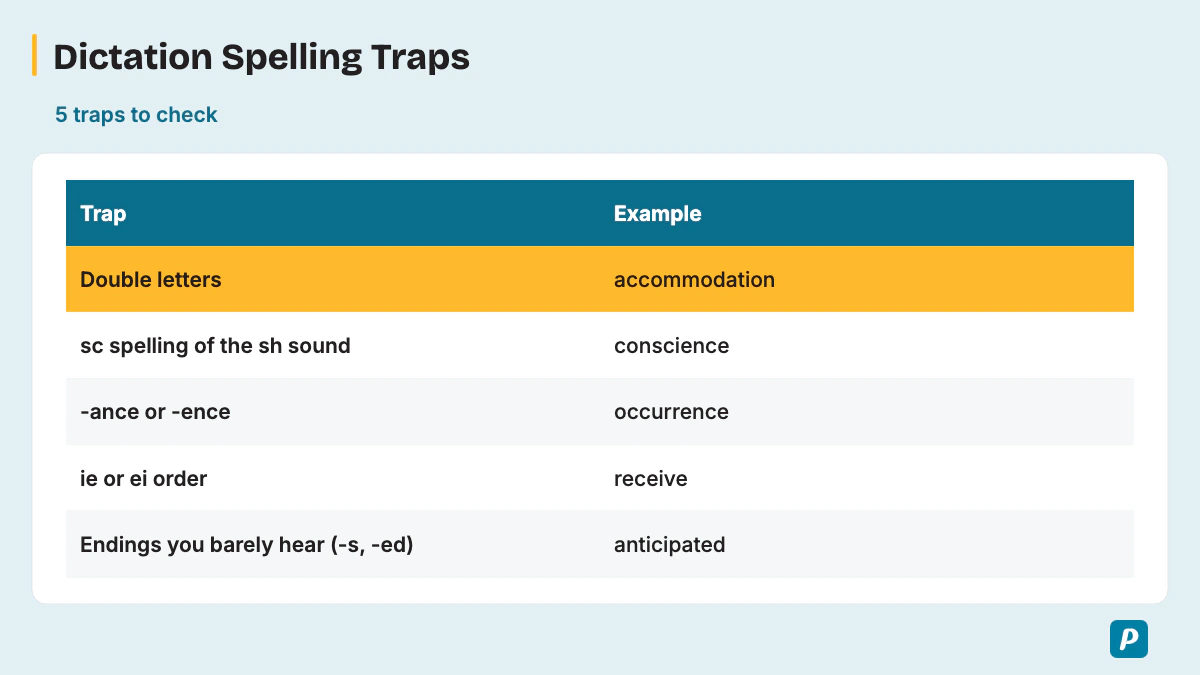
The commonly misspelled words share a handful of traps: double letters, silent letters and unusual letter groups, -ance/-ence endings, ie and ei order, unstressed vowels, and word endings you don't hear clearly (-s, -ed). Pearson scores a misspelled word as 0, so each of the 30 words in this table costs a full point when one letter slips. The table pairs each correct spelling with a common wrong form and the trap behind it.
| Word | Common misspelling | Trap |
|---|---|---|
| accommodation | accomodation | double c and double m |
Practice 171Catalogue study mode: nearby vocabulary may show the answer. | ||
| occurrence | occurence | double c, double r, -ence |
Practice 172Catalogue study mode: nearby vocabulary may show the answer. | ||
| separate | seperate | unstressed middle a |
Practice 173Catalogue study mode: nearby vocabulary may show the answer. | ||
| conscience | concience | sc spelling of the sh sound |
Practice 174Catalogue study mode: nearby vocabulary may show the answer. | ||
| consensus | concensus | s, not c, in the middle |
Practice 175Catalogue study mode: nearby vocabulary may show the answer. | ||
| relinquish | relinguish | qu after n |
Practice 176Catalogue study mode: nearby vocabulary may show the answer. | ||
| resilient | resiliant | -ent, not -ant |
Practice 177Catalogue study mode: nearby vocabulary may show the answer. | ||
| anticipated | anticipate | unheard -ed ending |
Practice 178Catalogue study mode: nearby vocabulary may show the answer. | ||
| receive | recieve | e before i after c |
Practice 179Catalogue study mode: nearby vocabulary may show the answer. | ||
| independence | independance | -ence, not -ance |
Practice 180Catalogue study mode: nearby vocabulary may show the answer. | ||
| achievement | acheivement | i before e |
Practice 181Catalogue study mode: nearby vocabulary may show the answer. | ||
| argument | arguement | the e of argue drops |
Practice 182Catalogue study mode: nearby vocabulary may show the answer. | ||
| definitely | definately | -ite, not -ate |
Practice 183Catalogue study mode: nearby vocabulary may show the answer. | ||
| embarrass | embarass | double r and double s |
Practice 184Catalogue study mode: nearby vocabulary may show the answer. | ||
| foreign | foriegn | ei after for- |
Practice 185Catalogue study mode: nearby vocabulary may show the answer. | ||
| liaison | liason | i on both sides of a |
Practice 186Catalogue study mode: nearby vocabulary may show the answer. | ||
| maintenance | maintainance | -ten-, not -tain- |
Practice 187Catalogue study mode: nearby vocabulary may show the answer. | ||
| millennium | millenium | double l and double n |
Practice 188Catalogue study mode: nearby vocabulary may show the answer. | ||
| questionnaire | questionaire | double n |
Practice 189Catalogue study mode: nearby vocabulary may show the answer. | ||
| rhythm | rythm | h after r |
Practice 190Catalogue study mode: nearby vocabulary may show the answer. | ||
| committee | commitee | double m, t and e |
Practice 191Catalogue study mode: nearby vocabulary may show the answer. | ||
| privilege | priviledge | no d before g |
Practice 192Catalogue study mode: nearby vocabulary may show the answer. | ||
| necessary | neccessary | one c, double s |
Practice 193Catalogue study mode: nearby vocabulary may show the answer. | ||
| existence | existance | -ence, not -ance |
Practice 194Catalogue study mode: nearby vocabulary may show the answer. | ||
| guarantee | guarentee | -an- in the middle |
Practice 195Catalogue study mode: nearby vocabulary may show the answer. | ||
| occasion | occassion | double c, single s |
Practice 196Catalogue study mode: nearby vocabulary may show the answer. | ||
| beginning | begining | double n before -ing |
Practice 197Catalogue study mode: nearby vocabulary may show the answer. | ||
| recommend | reccomend | one c, double m |
Practice 198Catalogue study mode: nearby vocabulary may show the answer. | ||
| pronunciation | pronounciation | -nun-, not -noun- |
Practice 199Catalogue study mode: nearby vocabulary may show the answer. | ||
| conscientious | consciencious | -tious ending |
Practice 200Catalogue study mode: nearby vocabulary may show the answer. | ||
PTE recognizes US, UK, Australian and Canadian spelling conventions. Pearson states the one-convention rule for Summarize Spoken Text, Write Essay and PTE Core's Write Email: use a single spelling convention consistently in a given response. Apply the same habit to dictation, use a consistent spelling style in practice. British English can use both -ize and -ise forms, so those two endings alone do not prove an inconsistent response.
Which Dictation Words Share the Same Spelling Pattern?
Most dictation spelling errors repeat a small set of spelling patterns, so drilling words in pattern groups fixes many words at once. When you note your mistakes, file each one under its pattern (double letters, silent letters, vowel confusion). Here are 200 drill words in 10 groups of 20, each with the rule that trips people up.
| Pattern | Rule | 20 drill words |
|---|---|---|
| Double consonants | Say the word slowly and count the doubled letters before you type it. | address, aggressive, allocate, annual, apparent, appearance, collapse, collaborate, commission, communicate, harass, difficult, dilemma, efficient, illustrate, immediate, irrelevant, opportunity, possession, succeed |
Practice 201Catalogue study mode: nearby vocabulary may show the answer. Practice 202Catalogue study mode: nearby vocabulary may show the answer. Practice 203Catalogue study mode: nearby vocabulary may show the answer. Practice 204Catalogue study mode: nearby vocabulary may show the answer. Practice 205Catalogue study mode: nearby vocabulary may show the answer. Practice 206Catalogue study mode: nearby vocabulary may show the answer. Practice 207Catalogue study mode: nearby vocabulary may show the answer. Practice 208Catalogue study mode: nearby vocabulary may show the answer. Practice 209Catalogue study mode: nearby vocabulary may show the answer. Practice 210Catalogue study mode: nearby vocabulary may show the answer. Practice 211Catalogue study mode: nearby vocabulary may show the answer. Practice 212Catalogue study mode: nearby vocabulary may show the answer. Practice 213Catalogue study mode: nearby vocabulary may show the answer. Practice 214Catalogue study mode: nearby vocabulary may show the answer. Practice 215Catalogue study mode: nearby vocabulary may show the answer. Practice 216Catalogue study mode: nearby vocabulary may show the answer. Practice 217Catalogue study mode: nearby vocabulary may show the answer. Practice 218Catalogue study mode: nearby vocabulary may show the answer. Practice 219Catalogue study mode: nearby vocabulary may show the answer. Practice 220Catalogue study mode: nearby vocabulary may show the answer. | ||
| Silent letters | These letters are written but not spoken, so the audio never gives them to you. | debt, doubt, subtle, island, column, autumn, solemn, condemn, honest, hour, receipt, design, campaign, acknowledge, castle, listen, fasten, mortgage, rhetoric, pseudonym |
Practice 221Catalogue study mode: nearby vocabulary may show the answer. Practice 222Catalogue study mode: nearby vocabulary may show the answer. Practice 223Catalogue study mode: nearby vocabulary may show the answer. Practice 224Catalogue study mode: nearby vocabulary may show the answer. Practice 225Catalogue study mode: nearby vocabulary may show the answer. Practice 226Catalogue study mode: nearby vocabulary may show the answer. Practice 227Catalogue study mode: nearby vocabulary may show the answer. Practice 228Catalogue study mode: nearby vocabulary may show the answer. Practice 229Catalogue study mode: nearby vocabulary may show the answer. Practice 230Catalogue study mode: nearby vocabulary may show the answer. Practice 231Catalogue study mode: nearby vocabulary may show the answer. Practice 232Catalogue study mode: nearby vocabulary may show the answer. Practice 233Catalogue study mode: nearby vocabulary may show the answer. Practice 234Catalogue study mode: nearby vocabulary may show the answer. Practice 235Catalogue study mode: nearby vocabulary may show the answer. Practice 236Catalogue study mode: nearby vocabulary may show the answer. Practice 237Catalogue study mode: nearby vocabulary may show the answer. Practice 238Catalogue study mode: nearby vocabulary may show the answer. Practice 239Catalogue study mode: nearby vocabulary may show the answer. Practice 240Catalogue study mode: nearby vocabulary may show the answer. | ||
| -ance and -ence | Both endings sound the same in speech, so learn each word's ending by sight. | abundance, allowance, assistance, attendance, clearance, compliance, dominance, endurance, guidance, insurance, performance, relevance, absence, coincidence, competence, confidence, convenience, influence, interference, persistence |
Practice 241Catalogue study mode: nearby vocabulary may show the answer. Practice 242Catalogue study mode: nearby vocabulary may show the answer. Practice 243Catalogue study mode: nearby vocabulary may show the answer. Practice 244Catalogue study mode: nearby vocabulary may show the answer. Practice 245Catalogue study mode: nearby vocabulary may show the answer. Practice 246Catalogue study mode: nearby vocabulary may show the answer. Practice 247Catalogue study mode: nearby vocabulary may show the answer. Practice 248Catalogue study mode: nearby vocabulary may show the answer. Practice 249Catalogue study mode: nearby vocabulary may show the answer. Practice 250Catalogue study mode: nearby vocabulary may show the answer. Practice 251Catalogue study mode: nearby vocabulary may show the answer. Practice 252Catalogue study mode: nearby vocabulary may show the answer. Practice 253Catalogue study mode: nearby vocabulary may show the answer. Practice 254Catalogue study mode: nearby vocabulary may show the answer. Practice 255Catalogue study mode: nearby vocabulary may show the answer. Practice 256Catalogue study mode: nearby vocabulary may show the answer. Practice 257Catalogue study mode: nearby vocabulary may show the answer. Practice 258Catalogue study mode: nearby vocabulary may show the answer. Practice 259Catalogue study mode: nearby vocabulary may show the answer. Practice 260Catalogue study mode: nearby vocabulary may show the answer. | ||
| -ible and -able | The endings sound alike; as a rule of thumb, -able often follows a complete word (accept, consider) and -ible often does not (credible, feasible), so learn the exceptions by sight. | accessible, compatible, credible, eligible, feasible, flexible, invisible, plausible, responsible, susceptible, acceptable, available, comparable, considerable, inevitable, reliable, valuable, vulnerable, noticeable, predictable |
Practice 261Catalogue study mode: nearby vocabulary may show the answer. Practice 262Catalogue study mode: nearby vocabulary may show the answer. Practice 263Catalogue study mode: nearby vocabulary may show the answer. Practice 264Catalogue study mode: nearby vocabulary may show the answer. Practice 265Catalogue study mode: nearby vocabulary may show the answer. Practice 266Catalogue study mode: nearby vocabulary may show the answer. Practice 267Catalogue study mode: nearby vocabulary may show the answer. Practice 268Catalogue study mode: nearby vocabulary may show the answer. Practice 269Catalogue study mode: nearby vocabulary may show the answer. Practice 270Catalogue study mode: nearby vocabulary may show the answer. Practice 271Catalogue study mode: nearby vocabulary may show the answer. Practice 272Catalogue study mode: nearby vocabulary may show the answer. Practice 273Catalogue study mode: nearby vocabulary may show the answer. Practice 274Catalogue study mode: nearby vocabulary may show the answer. Practice 275Catalogue study mode: nearby vocabulary may show the answer. Practice 276Catalogue study mode: nearby vocabulary may show the answer. Practice 277Catalogue study mode: nearby vocabulary may show the answer. Practice 278Catalogue study mode: nearby vocabulary may show the answer. Practice 279Catalogue study mode: nearby vocabulary may show the answer. Practice 280Catalogue study mode: nearby vocabulary may show the answer. | ||
| ie and ei | After c, ei is common (ceiling, receipt); elsewhere ie is more frequent, with exceptions to learn. | believe, brief, ceiling, conceive, deceive, perceive, field, grief, height, leisure, neighbor, neither, protein, seize, siege, weight, weird, society, variety, proficient |
Practice 281Catalogue study mode: nearby vocabulary may show the answer. Practice 282Catalogue study mode: nearby vocabulary may show the answer. Practice 283Catalogue study mode: nearby vocabulary may show the answer. Practice 284Catalogue study mode: nearby vocabulary may show the answer. Practice 285Catalogue study mode: nearby vocabulary may show the answer. Practice 286Catalogue study mode: nearby vocabulary may show the answer. Practice 287Catalogue study mode: nearby vocabulary may show the answer. Practice 288Catalogue study mode: nearby vocabulary may show the answer. Practice 289Catalogue study mode: nearby vocabulary may show the answer. Practice 290Catalogue study mode: nearby vocabulary may show the answer. Practice 291Catalogue study mode: nearby vocabulary may show the answer. Practice 292Catalogue study mode: nearby vocabulary may show the answer. Practice 293Catalogue study mode: nearby vocabulary may show the answer. Practice 294Catalogue study mode: nearby vocabulary may show the answer. Practice 295Catalogue study mode: nearby vocabulary may show the answer. Practice 296Catalogue study mode: nearby vocabulary may show the answer. Practice 297Catalogue study mode: nearby vocabulary may show the answer. Practice 298Catalogue study mode: nearby vocabulary may show the answer. Practice 299Catalogue study mode: nearby vocabulary may show the answer. Practice 300Catalogue study mode: nearby vocabulary may show the answer. | ||
| Unstressed vowels | The middle vowel sounds like a short uh, so the ear cannot tell you which letter it is. | category, desperate, grammar, calendar, cemetery, temporary, benefit, comparative, competitive, primitive, elegant, sentence, original, opposite, prejudice, average, celebrate, positive, secretary, vegetable |
Practice 301Catalogue study mode: nearby vocabulary may show the answer. Practice 302Catalogue study mode: nearby vocabulary may show the answer. Practice 303Catalogue study mode: nearby vocabulary may show the answer. Practice 304Catalogue study mode: nearby vocabulary may show the answer. Practice 305Catalogue study mode: nearby vocabulary may show the answer. Practice 306Catalogue study mode: nearby vocabulary may show the answer. Practice 307Catalogue study mode: nearby vocabulary may show the answer. Practice 308Catalogue study mode: nearby vocabulary may show the answer. Practice 309Catalogue study mode: nearby vocabulary may show the answer. Practice 310Catalogue study mode: nearby vocabulary may show the answer. Practice 311Catalogue study mode: nearby vocabulary may show the answer. Practice 312Catalogue study mode: nearby vocabulary may show the answer. Practice 313Catalogue study mode: nearby vocabulary may show the answer. Practice 314Catalogue study mode: nearby vocabulary may show the answer. Practice 315Catalogue study mode: nearby vocabulary may show the answer. Practice 316Catalogue study mode: nearby vocabulary may show the answer. Practice 317Catalogue study mode: nearby vocabulary may show the answer. Practice 318Catalogue study mode: nearby vocabulary may show the answer. Practice 319Catalogue study mode: nearby vocabulary may show the answer. Practice 320Catalogue study mode: nearby vocabulary may show the answer. | ||
| One sound, unusual spelling | ph spells f, ch can spell k, gh can spell f, and c before e, i or y sounds like s. | phase, physical, phrase, photograph, chaos, character, chemistry, mechanism, orchestra, scheme, enough, tough, cough, laugh, cycle, cylinder, certain, cease, choir, sphere |
Practice 321Catalogue study mode: nearby vocabulary may show the answer. Practice 322Catalogue study mode: nearby vocabulary may show the answer. Practice 323Catalogue study mode: nearby vocabulary may show the answer. Practice 324Catalogue study mode: nearby vocabulary may show the answer. Practice 325Catalogue study mode: nearby vocabulary may show the answer. Practice 326Catalogue study mode: nearby vocabulary may show the answer. Practice 327Catalogue study mode: nearby vocabulary may show the answer. Practice 328Catalogue study mode: nearby vocabulary may show the answer. Practice 329Catalogue study mode: nearby vocabulary may show the answer. Practice 330Catalogue study mode: nearby vocabulary may show the answer. Practice 331Catalogue study mode: nearby vocabulary may show the answer. Practice 332Catalogue study mode: nearby vocabulary may show the answer. Practice 333Catalogue study mode: nearby vocabulary may show the answer. Practice 334Catalogue study mode: nearby vocabulary may show the answer. Practice 335Catalogue study mode: nearby vocabulary may show the answer. Practice 336Catalogue study mode: nearby vocabulary may show the answer. Practice 337Catalogue study mode: nearby vocabulary may show the answer. Practice 338Catalogue study mode: nearby vocabulary may show the answer. Practice 339Catalogue study mode: nearby vocabulary may show the answer. Practice 340Catalogue study mode: nearby vocabulary may show the answer. | ||
| -tion, -sion and -cian | All three end in a shun or zhun sound; -cian usually names a person. | decision, discussion, expansion, extension, permission, tension, conclusion, explosion, comprehension, attention, competition, definition, distribution, evaluation, foundation, production, musician, politician, technician, electrician |
Practice 341Catalogue study mode: nearby vocabulary may show the answer. Practice 342Catalogue study mode: nearby vocabulary may show the answer. Practice 343Catalogue study mode: nearby vocabulary may show the answer. Practice 344Catalogue study mode: nearby vocabulary may show the answer. Practice 345Catalogue study mode: nearby vocabulary may show the answer. Practice 346Catalogue study mode: nearby vocabulary may show the answer. Practice 347Catalogue study mode: nearby vocabulary may show the answer. Practice 348Catalogue study mode: nearby vocabulary may show the answer. Practice 349Catalogue study mode: nearby vocabulary may show the answer. Practice 350Catalogue study mode: nearby vocabulary may show the answer. Practice 351Catalogue study mode: nearby vocabulary may show the answer. Practice 352Catalogue study mode: nearby vocabulary may show the answer. Practice 353Catalogue study mode: nearby vocabulary may show the answer. Practice 354Catalogue study mode: nearby vocabulary may show the answer. Practice 355Catalogue study mode: nearby vocabulary may show the answer. Practice 356Catalogue study mode: nearby vocabulary may show the answer. Practice 357Catalogue study mode: nearby vocabulary may show the answer. Practice 358Catalogue study mode: nearby vocabulary may show the answer. Practice 359Catalogue study mode: nearby vocabulary may show the answer. Practice 360Catalogue study mode: nearby vocabulary may show the answer. | ||
| Endings you barely hear | Final -s and -ed blur into the next word, so check every noun and verb ending. | results, researchers, students, costs, tasks, texts, months, facts, effects, concepts, developed, increased, decreased, reduced, required, asked, based, involved, suggested, obtained |
Practice 361Catalogue study mode: nearby vocabulary may show the answer. Practice 362Catalogue study mode: nearby vocabulary may show the answer. Practice 363Catalogue study mode: nearby vocabulary may show the answer. Practice 364Catalogue study mode: nearby vocabulary may show the answer. Practice 365Catalogue study mode: nearby vocabulary may show the answer. Practice 366Catalogue study mode: nearby vocabulary may show the answer. Practice 367Catalogue study mode: nearby vocabulary may show the answer. Practice 368Catalogue study mode: nearby vocabulary may show the answer. Practice 369Catalogue study mode: nearby vocabulary may show the answer. Practice 370Catalogue study mode: nearby vocabulary may show the answer. Practice 371Catalogue study mode: nearby vocabulary may show the answer. Practice 372Catalogue study mode: nearby vocabulary may show the answer. Practice 373Catalogue study mode: nearby vocabulary may show the answer. Practice 374Catalogue study mode: nearby vocabulary may show the answer. Practice 375Catalogue study mode: nearby vocabulary may show the answer. Practice 376Catalogue study mode: nearby vocabulary may show the answer. Practice 377Catalogue study mode: nearby vocabulary may show the answer. Practice 378Catalogue study mode: nearby vocabulary may show the answer. Practice 379Catalogue study mode: nearby vocabulary may show the answer. Practice 380Catalogue study mode: nearby vocabulary may show the answer. | ||
| US and UK spelling pairs | Pearson recognizes both conventions; pick one and keep it through the response. | color/colour, center/centre, organize/organise, defense/defence, labor/labour, traveled/travelled, favor/favour, theater/theatre, catalog/catalogue, fulfill/fulfil, modeling/modelling, aging/ageing, gray/grey, jewelry/jewellery, mold/mould, aluminum/aluminium, maneuver/manoeuvre, honor/honour, humor/humour, fiber/fibre |
Practice 381Catalogue study mode: nearby vocabulary may show the answer. Practice 382Catalogue study mode: nearby vocabulary may show the answer. Practice 383Catalogue study mode: nearby vocabulary may show the answer. Practice 384Catalogue study mode: nearby vocabulary may show the answer. Practice 385Catalogue study mode: nearby vocabulary may show the answer. Practice 386Catalogue study mode: nearby vocabulary may show the answer. Practice 387Catalogue study mode: nearby vocabulary may show the answer. Practice 388Catalogue study mode: nearby vocabulary may show the answer. Practice 389Catalogue study mode: nearby vocabulary may show the answer. Practice 390Catalogue study mode: nearby vocabulary may show the answer. Practice 391Catalogue study mode: nearby vocabulary may show the answer. Practice 392Catalogue study mode: nearby vocabulary may show the answer. Practice 393Catalogue study mode: nearby vocabulary may show the answer. Practice 394Catalogue study mode: nearby vocabulary may show the answer. Practice 395Catalogue study mode: nearby vocabulary may show the answer. Practice 396Catalogue study mode: nearby vocabulary may show the answer. Practice 397Catalogue study mode: nearby vocabulary may show the answer. Practice 398Catalogue study mode: nearby vocabulary may show the answer. Practice 399Catalogue study mode: nearby vocabulary may show the answer. Practice 400Catalogue study mode: nearby vocabulary may show the answer. | ||
The audio gives no clue to double consonants or silent letters, so drill those two groups by sight. For the US and UK spelling pairs, Pearson recognizes either form, so choose one convention and keep it the same through the response.
Which Sound-Alike Words and Irregular Plurals Cause Dictation Errors?
Sound-alike words and irregular plurals score as wrong words when you type the wrong form, so the sentence's grammar has to choose the spelling. Homophones such as their and there sound identical, so only the grammar clue around them tells you which one the speaker meant.
| Words | How to tell them apart |
|---|---|
| their / there / they're | their = belonging to them; there = a place or "there is"; they're = they are |
Practice 401Catalogue study mode: nearby vocabulary may show the answer. | |
| affect / effect | affect is usually the verb; effect is usually the noun |
Practice 402Catalogue study mode: nearby vocabulary may show the answer. | |
| accept / except | accept = agree to take; except = apart from |
Practice 403Catalogue study mode: nearby vocabulary may show the answer. | |
| principal / principle | principal = main, or head of a school; principle = a rule or belief |
Practice 404Catalogue study mode: nearby vocabulary may show the answer. | |
| complement / compliment | complement = completes something; compliment = praise |
Practice 405Catalogue study mode: nearby vocabulary may show the answer. | |
| stationary / stationery | stationary = not moving; stationery = paper and pens |
Practice 406Catalogue study mode: nearby vocabulary may show the answer. | |
| weather / whether | weather = rain or sun; whether = if |
Practice 407Catalogue study mode: nearby vocabulary may show the answer. | |
| cite / site / sight | cite = quote a source; site = a place; sight = vision |
Practice 408Catalogue study mode: nearby vocabulary may show the answer. | |
| council / counsel | council = an elected group; counsel = advice, or to advise |
Practice 409Catalogue study mode: nearby vocabulary may show the answer. | |
| aloud / allowed | aloud = out loud; allowed = permitted |
Practice 410Catalogue study mode: nearby vocabulary may show the answer. | |
| role / roll | role = a part or function; roll = to turn over, or a list |
Practice 411Catalogue study mode: nearby vocabulary may show the answer. | |
| whole / hole | whole = complete; hole = a gap |
Practice 412Catalogue study mode: nearby vocabulary may show the answer. | |
| discrete / discreet | discrete = separate; discreet = careful not to be noticed |
Practice 413Catalogue study mode: nearby vocabulary may show the answer. | |
| course / coarse | course = a program of study or a route; coarse = rough |
Practice 414Catalogue study mode: nearby vocabulary may show the answer. | |
| waste / waist | waste = unwanted material; waist = the middle of the body |
Practice 415Catalogue study mode: nearby vocabulary may show the answer. | |
| led / lead | led = past tense of the verb lead; lead the metal sounds like led |
Practice 416Catalogue study mode: nearby vocabulary may show the answer. | |
Irregular plurals add a second trap: the plural doesn't end in -s, so an ear tuned to listen for -s misses it. Check singular and plural agreement with the verb ("the criteria are", "the phenomenon is") before you move on.
| Singular | Plural |
|---|---|
| child | children |
Practice 417Catalogue study mode: nearby vocabulary may show the answer. | |
| woman | women |
Practice 418Catalogue study mode: nearby vocabulary may show the answer. | |
| person | people |
Practice 419Catalogue study mode: nearby vocabulary may show the answer. | |
| mouse | mice |
Practice 420Catalogue study mode: nearby vocabulary may show the answer. | |
| goose | geese |
Practice 421Catalogue study mode: nearby vocabulary may show the answer. | |
| tooth | teeth |
Practice 422Catalogue study mode: nearby vocabulary may show the answer. | |
| foot | feet |
Practice 423Catalogue study mode: nearby vocabulary may show the answer. | |
| phenomenon | phenomena |
Practice 424Catalogue study mode: nearby vocabulary may show the answer. | |
| criterion | criteria |
Practice 425Catalogue study mode: nearby vocabulary may show the answer. | |
| analysis | analyses |
Practice 426Catalogue study mode: nearby vocabulary may show the answer. | |
| hypothesis | hypotheses |
Practice 427Catalogue study mode: nearby vocabulary may show the answer. | |
| crisis | crises |
Practice 428Catalogue study mode: nearby vocabulary may show the answer. | |
| thesis | theses |
Practice 429Catalogue study mode: nearby vocabulary may show the answer. | |
| bacterium | bacteria |
Practice 430Catalogue study mode: nearby vocabulary may show the answer. | |
| curriculum | curricula (curriculums is also used) |
Practice 431Catalogue study mode: nearby vocabulary may show the answer. | |
Which PTE Dictation Phrases Should You Practice?
Practice short academic word groups such as "according to the", "a significant number of" and "as a result of", because Write from Dictation sentences are easier to hold in meaning chunks than word by word. These 15 academic phrases each use a small word that slips out at speed, and a dropped word loses its own point. Learn these dictation phrases as single units, then listen for the small word inside each.
Practice 432
Catalogue study mode: nearby vocabulary may show the answer.
Practice 433
Catalogue study mode: nearby vocabulary may show the answer.
Practice 434
Catalogue study mode: nearby vocabulary may show the answer.
Practice 435
Catalogue study mode: nearby vocabulary may show the answer.
Practice 436
Catalogue study mode: nearby vocabulary may show the answer.
Practice 437
Catalogue study mode: nearby vocabulary may show the answer.
Practice 438
Catalogue study mode: nearby vocabulary may show the answer.
Practice 439
Catalogue study mode: nearby vocabulary may show the answer.
Practice 440
Catalogue study mode: nearby vocabulary may show the answer.
Practice 441
Catalogue study mode: nearby vocabulary may show the answer.
Practice 442
Catalogue study mode: nearby vocabulary may show the answer.
Practice 443
Catalogue study mode: nearby vocabulary may show the answer.
Practice 444
Catalogue study mode: nearby vocabulary may show the answer.
Practice 445
Catalogue study mode: nearby vocabulary may show the answer.
Practice 446
Catalogue study mode: nearby vocabulary may show the answer.
Collocations are word groups that habitually go together, so hearing the first word lets you predict the second. These 12 collocations turn up across academic topics.
| Collocation | Meaning |
|---|---|
| conduct research | carry out a study |
Practice 447Catalogue study mode: nearby vocabulary may show the answer. | |
| draw a conclusion | decide what the evidence means |
Practice 448Catalogue study mode: nearby vocabulary may show the answer. | |
| raise awareness | make more people know about an issue |
Practice 449Catalogue study mode: nearby vocabulary may show the answer. | |
| reach a consensus | come to general agreement |
Practice 450Catalogue study mode: nearby vocabulary may show the answer. | |
| pose a challenge | create a difficulty |
Practice 451Catalogue study mode: nearby vocabulary may show the answer. | |
| play a crucial role | be very important |
Practice 452Catalogue study mode: nearby vocabulary may show the answer. | |
| be associated with | be connected to |
Practice 453Catalogue study mode: nearby vocabulary may show the answer. | |
| provide evidence | give proof |
Practice 454Catalogue study mode: nearby vocabulary may show the answer. | |
| make a decision | decide |
Practice 455Catalogue study mode: nearby vocabulary may show the answer. | |
| gain insight | understand something more deeply |
Practice 456Catalogue study mode: nearby vocabulary may show the answer. | |
| address an issue | deal with a problem |
Practice 457Catalogue study mode: nearby vocabulary may show the answer. | |
| meet the requirements | satisfy what is needed |
Practice 458Catalogue study mode: nearby vocabulary may show the answer. | |
How Are PTE Dictation Words Scored?
In Write from Dictation and Listening Fill in the Blanks, each correct word spelled correctly earns one point, with partial credit, so one misspelling loses one word's point, not the whole sentence. Pearson's Score Guide gives 1 point for each correct word spelled correctly and 0 for each incorrect or misspelled word. Write from Dictation scores Content only: whether your response has all the words in the sentence and only those words.
Practice 469
Catalogue study mode: nearby vocabulary may show the answer.
What Are the Common Challenges in the PTE Dictation Task?
The task tests hearing every word in fast connected speech, holding the whole sentence in memory, and typing it with correct spelling, word forms and word order. Each listening challenge below pairs the problem with one fix.
- Fast, connected speech: words blend, so "going to" can sound like "gonna". Type the full written form of every word you hear.
- Accents: one word can sound different across accents (the t in "water" is crisp in British speech and soft in American speech), so practice with podcasts and lectures from British, American and Australian speakers.
- Short-term memory: a 3-5 second sentence fades fast. Split each sentence into 3-4 word chunks as you hear it, and train by repeating 6-8 word sentences aloud without writing, then build up to 10-12 words.
- Over-reliance on note-taking: writing too much pulls attention off the audio. Jot only the first letter of each word, or fixed short forms such as "govt" and "env", on the noteboard.
- Panic after a missed word: one gap costs one point, while losing focus costs the rest. Keep listening to the end of the sentence.
- Small words: "a" and "the" are short and unstressed, so a swapped or dropped article costs a point. Check that each noun has the article you heard.
- Spelling under time pressure: typing fast invites slips. Read your answer once for endings before you click Next.
- Typing speed and accuracy: slow typing lets the sentence fade. Do short daily typing drills until common words come from muscle memory.
Practice 470
Catalogue study mode: nearby vocabulary may show the answer.
Pearson plays each recording once only, so there's no replay of the dictation audio. Its tip for Write from Dictation is to type as many correct words as you can remember, in the correct order, and to check your spelling.
How Do You Practice PTE Dictation Words?
The best dictation practice is a practice loop: hear a sentence once, type it, check every word against the original, and add each misspelled word to a personal word list you review daily. A 15-minute daily routine built on the lists above fits around any study plan.
Spend 5 minutes on daily review of your personal list and one pattern group, then 8 minutes typing dictation sentences heard once. Use the last 2 minutes for a self-check against the original, filing each new misspelling under its pattern.
These 10 drill sentences reuse words from the lists above. Ask a partner to read each one aloud once, or record yourself and play it back once, then type it.
Practice 459
Catalogue study mode: nearby vocabulary may show the answer.
Practice 460
Catalogue study mode: nearby vocabulary may show the answer.
Practice 461
Catalogue study mode: nearby vocabulary may show the answer.
Practice 462
Catalogue study mode: nearby vocabulary may show the answer.
Practice 463
Catalogue study mode: nearby vocabulary may show the answer.
Practice 464
Catalogue study mode: nearby vocabulary may show the answer.
Practice 465
Catalogue study mode: nearby vocabulary may show the answer.
Practice 466
Catalogue study mode: nearby vocabulary may show the answer.
Practice 467
Catalogue study mode: nearby vocabulary may show the answer.
Practice 468
Catalogue study mode: nearby vocabulary may show the answer.
To practice with scored listening items after each drill session, create a free account on EasyEnglish.
How Do You Write Dictation in PTE?
Write from Dictation plays one short sentence once, and you type it exactly as heard in the response box. Pearson allows notes on the erasable noteboard while the audio plays, and advises typing as many correct words as you remember in the correct order, then checking your spelling. Our guide to PTE write from dictation covers the full method.
Should You Use a Write From Dictation Template?
No, a template cannot help here, because Write from Dictation scores the exact words of the sentence you hear. The time is better spent on the spelling traps and pattern groups above. Our PTE listening tips cover the tasks where structure does help.
Where Can You Find a PTE Spelling List?
The most useful spelling list starts with your own errors. For further practice, our PTE listening spelling words page offers an authored selection grouped by spelling trap.
Which Words Appear in PTE Listening Fill in the Blanks?
Listening Fill in the Blanks gaps fall on words in an academic transcript. Pearson allows 7 seconds to skim the transcript before the audio starts, and its tip is to look for proper nouns and repeated nouns. The topic tables above give you content words to practice, and this guide’s gap-fill vocabulary is an authored practice selection. Our page on PTE listening fill in the blanks explains the task.
Where Can You Find More PTE Collocations?
Pearson publishes its own Academic Collocation List of 2,469 collocations drawn from written academic English, free on its teacher pages. Our page on PTE collocations sorts the ones most useful for the test.
How Does Write From Dictation Fit Into PTE Listening?
Write from Dictation sits in Part 3 of the test, which runs 8 question types in PTE Academic, and every recording there plays once with no replay button. Pearson's Score Guide lists 3-4 Write from Dictation items in PTE Academic, and the task feeds both your Listening and Writing scores. Write from Dictation is one of several listening task types, and our guide to the PTE listening section explains how all of them are structured and scored.
Practice PTE Listening on EasyEnglish
Try Listening tasks in a timed, computer-based format like the real test.
Try speaking practice without signing up. A free account is required for full mock tests. Practice scores are estimates, not official Pearson scores.
Written by
EasyEnglish Team
The team behind EasyEnglish's PTE practice and mock tests
We build EasyEnglish PTE practice tasks and mock tests. Official test rules are checked against Pearson guidance; exercises are authored examples, not official or predicted exam questions. Practice scores are estimates. EasyEnglish is not affiliated with or endorsed by Pearson. Contact support@inverseai.com.
Editorial review completed .