PTE Writing Tips: Task-by-Task Tricks for Academic and Core
PTE Writing
Writing tips only help when they match the task on screen, and the two tests don't share the same tasks. These PTE writing tips follow the tasks: PTE Academic gives you Summarize Written Text and Write Essay, while PTE Core gives you Summarize Written Text and Write Email. Your Writing score also collects points from listening and reading answers, so the tips cover those tasks too.
Each tip names its test, and three popular claims fail against Pearson's Score Guide. Under 200 words doesn't zero an essay (under 120 does), and Pearson sets no minute split. The "more than one spelling mistake scores zero" line applies to the Spelling trait, not the whole essay.
Table of Contents
What Is the PTE Writing Test Format?
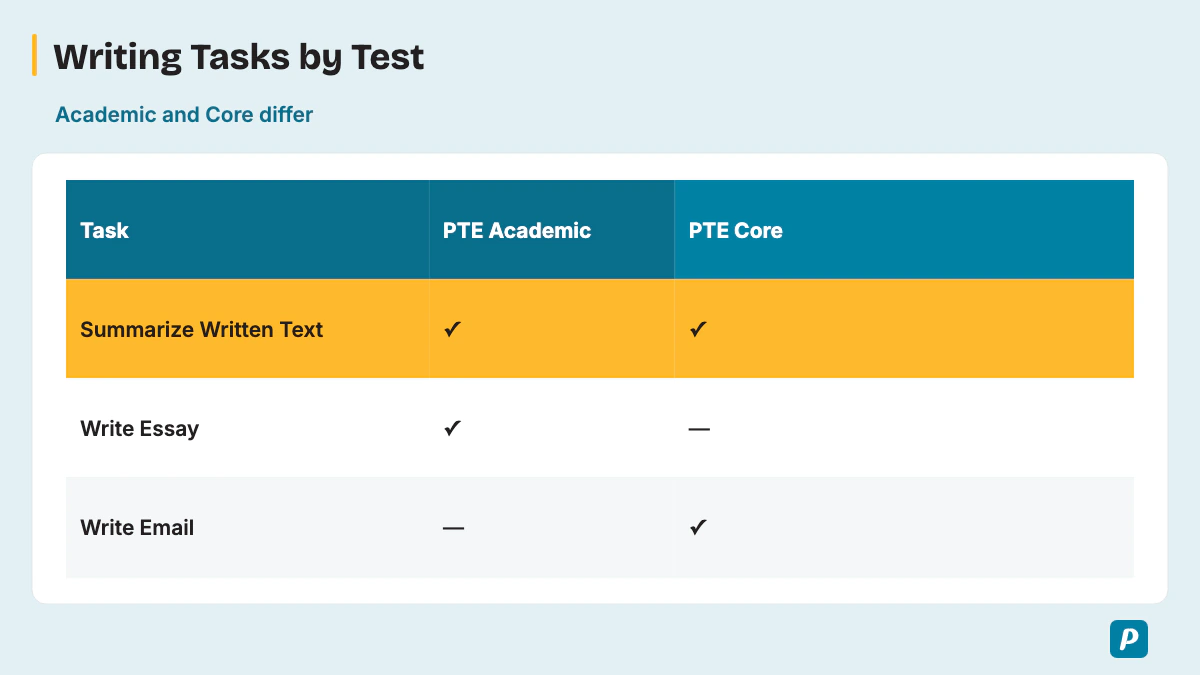
PTE Academic writing has Summarize Written Text and Write Essay, and PTE Core writing has Summarize Written Text and Write Email. Both tests place these writing tasks in Part 1 Speaking & Writing, each with its own timer and word count. The item counts below come from the two Score Guides.
| Task | PTE Academic | PTE Core | Time | Length asked |
|---|---|---|---|---|
| Summarize Written Text | Yes, 2 items. | Yes, 1-2 items. | 10 minutes. | Academic: one sentence, 5-75 words; Core: 25-50 words. |
| Write Essay | Yes, 1 item. | No. | 20 minutes. | 200-300 words. |
| Write Email | No. | Yes, 2-3 items. | 9 minutes. | 80-120 words. |
The source text runs up to 300 words in the Academic summary and up to 200 words in the Core summary. The email prompt runs up to 100 words and ends with three bullet points. Every writing box shows a live word count under your answer and has Cut, Copy and Paste buttons, so you can move a clause without retyping it.
How Do You Use the Scoring System to Target Your Practice?
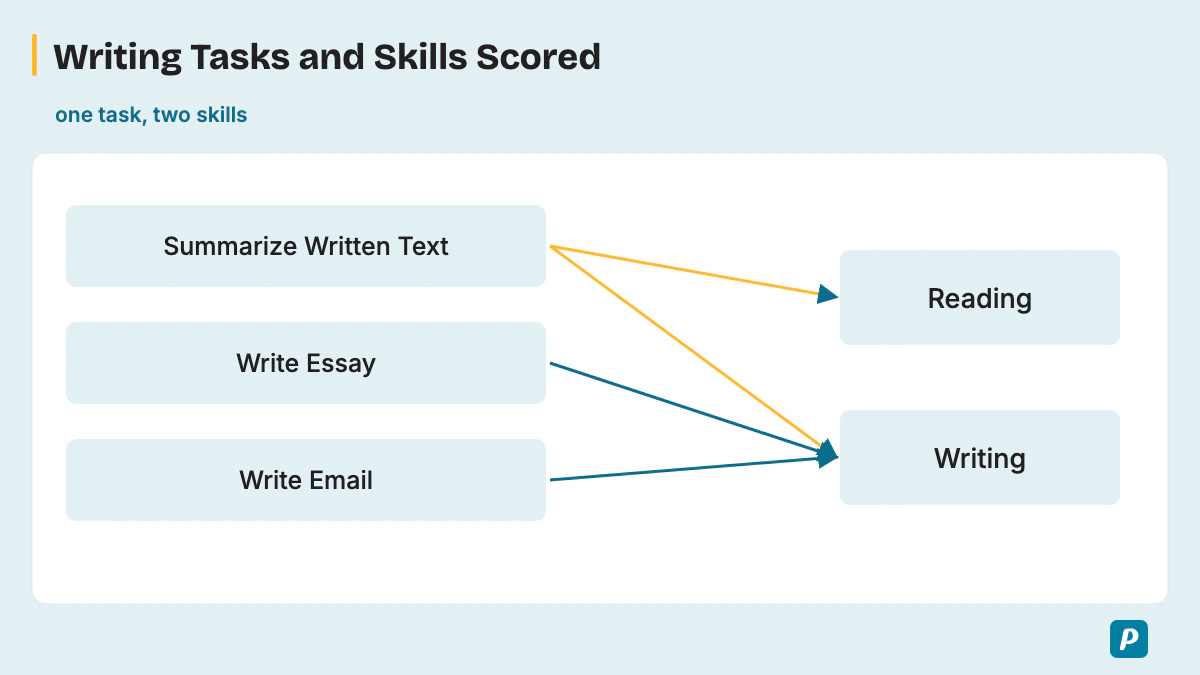
Practice against the named traits and their Score Guide scales, and protect Content and Form first. Pearson's Score Guide states that "When the response is scored as 0 for Content or Form, no score points for the response will be given." Each writing task carries these scoring traits.
| Task | Traits and Score Guide scale | What to protect first |
|---|---|---|
| Summarize Written Text, Academic | Content 0-4, Form 0-1, Grammar 0-2, Vocabulary 0-2. | One sentence of 5-75 words that keeps the main idea. |
| Summarize Written Text, Core | Content 0-2, Form 0-2, Grammar 0-2, Vocabulary 0-2. | 25-50 words that keep the main idea. |
| Write Essay | Content 0-6; Development, structure and coherence 0-6; Form 0-2; General linguistic range 0-6; Grammar usage and mechanics 0-2; Vocabulary range 0-2; Spelling 0-2. | An on-topic answer of 200-300 words with clear paragraphs. |
| Write Email | Content 0-3; Email conventions 0-2; Form 0-2; Organization 0-2; Grammar 0-2; Vocabulary 0-2; Spelling 0-2. | All three bullet points answered in 50-120 words. |
In Write Essay, three traits (Content; Development, structure and coherence; General linguistic range) carry 18 of the 26 points. A human expert also reviews those three before the score is final, so practice developing relevant ideas and clear paragraphs as well as accurate language. Scores are reported on the 10-90 scale, and the listed trait points are not percentages of the final reported score.
Which Tasks Feed the PTE Writing Score?
Four tasks feed the PTE Academic Writing score: Summarize Written Text, Write Essay, Summarize Spoken Text and Write from Dictation. Core replaces Write Essay with Write Email and also credits Reading and Writing: Fill in the Blanks and listening Fill in the Blanks, for six contributing tasks. Pearson calls tasks like these integrated skills items.
Pearson's Academic reading page intro says the drop-down blanks task also assesses writing, but that task's own note and the Academic Score Guide credit it to Reading only. The full breakdown by part is in the PTE Writing section guide.
What Are the Best Tips for Summarize Written Text?
Find the main point, join it to the key supporting point with a connector, and keep to the word range: one sentence of 5-75 words in PTE Academic, 25-50 words in PTE Core. Each habit carries a tag for the test it applies to.
- Scan the text first and note the points it repeats, since those usually carry the main idea (Both).
- Write one sentence with a capital letter at the start and one full stop at the end (Academic).
- Write 25-50 words in one or more complete sentences (Core).
- Build a main clause plus a subordinate clause, the shape Pearson says the best responses use (Both).
- Leave out examples and supporting evidence, as Pearson's 2021 tips article advises (Both).
- Use words from the passage, then swap in synonyms and noun phrases where you can (Both).
- Write in the third person and avoid contractions, which keeps the summary neutral (Both).
- Never type in all capitals or all lower case (Both).
- Check articles, prepositions, tenses, plurals and subject-verb agreement, and turn any run-on into a complex sentence (Both).
Pearson's 2021 article says a good Academic sentence is 20-35 words long, and it warns that an all-capitals or all-lower-case summary scores zero. The Academic Score Guide also gives Form 0 to a summary in capital letters. For PTE Core, the web page says a summary under 25 or over 50 words isn't scored, while the Core Score Guide still gives 1 Form point at 5-24 or 51-60 words, so stay inside 25-50.
Try this 115-word practice passage before reading the models.
In a growing number of neighborhoods, residents have placed refrigerators on the street where anyone can leave or take food for free. These community fridges are usually stocked by cafés, bakeries and households with more than they can eat, and volunteers check them daily to remove anything that has spoiled.
Supporters say the fridges do two jobs at once: they reduce the amount of edible food sent to landfill, and they give people on low incomes fresh produce without the forms that charities often require.
However, the model has limits. Without a reliable team of volunteers, hygiene standards can slip quickly, and some local councils have removed fridges after complaints about mess or food-safety risks.
PTE Academic model, 33 words in one sentence:
"Community fridges let residents share surplus food freely, which cuts the waste sent to landfill and helps people on low incomes, although they depend on reliable volunteers to keep hygiene standards from slipping."
PTE Core model, 39 words in three sentences:
"Community fridges are street refrigerators where anyone can leave or take free food. They reduce food waste and give low-income residents fresh produce without paperwork. However, they need reliable volunteers, or hygiene problems can lead councils to remove them."
Both models keep the purpose, both benefits and the risk, and drop the examples (cafés, bakeries) and the daily checking detail.
What Are the Best Tips for Write Essay?
Identify the prompt type, then answer every part of it in your own words, in four paragraphs and 200-300 words, using correct complex sentences (PTE Academic only). Every habit here protects at least one of the seven traits.
- Note the key words in the prompt before you plan, as Pearson's task page advises.
- Identify the prompt type: agree or disagree, or how different groups might feel, plus the common labels discuss both views, problem-solution and advantages-disadvantages.
- Choose one clear position and keep it from the first paragraph to the last.
- Plan four paragraphs: an introduction, two body paragraphs and a short conclusion.
- Give each body paragraph one idea, backed by a specific example.
- Link paragraphs with linking words that show a real relationship between ideas.
- Stay inside 200-300 words and check the word count after each paragraph.
- Use complex sentences you can control rather than long ones you can't punctuate.
- Choose precise words you're sure of instead of rare ones you might misuse.
- Write full sentences, never bullet points, note form or all capitals.
Pearson's rule on originality is direct: "No credit is given for no response, an irrelevant response or an unoriginal response. You must use your own words."
Pearson's own 2021 article, like some prep sites, still says an essay under 200 words scores zero. Pearson's current page says the score only decreases below 200, and the Score Guide gives 1 Form point at 120-199 words. The zero line is under 120 or over 380 words.
Each paragraph has one job, and the sentence counts are a guide rather than a Pearson rule.
| Paragraph | Job | Rough length |
|---|---|---|
| Introduction | Paraphrase the prompt, state your position and preview your two points. | 2-3 sentences. |
| Body 1 | Topic sentence, reason, specific example, link back to your position. | 3-5 sentences. |
| Body 2 | A second idea in the same shape, or the other side for a two-views prompt. | 3-5 sentences. |
| Conclusion | Restate your position in new words, with no new argument. | 2 sentences. |
The Score Guide's top Development, structure and coherence descriptor rewards "a variety of connective devices effectively and consistently". Pick connective devices by the job they do, and keep one or two per paragraph where they carry meaning.
| Job | Linking words |
|---|---|
| Adding a point | in addition, also, as well as |
| Contrasting | however, whereas, on the other hand |
| Cause and result | because, as a result, therefore |
| Giving an example | for example, such as, in the case of |
| Conceding | although, admittedly, even though |
| Concluding | overall, on balance, all things considered |
What Are the Best Tips for Write Email in PTE Core?
Note who the email is to and why, cover all three bullet points, match the register to the reader, and include a salutation, an introduction, a conclusion and a farewell, inside 9 minutes (PTE Core only). Each habit protects one of Pearson's scoring factors.
- Note the key words, the reader and the purpose before you type, as Pearson's test tip says.
- Answer every one of the three bullet points, one short paragraph each, which protects Content.
- Match a formal or informal register to the reader, since the Score Guide marks conventions down for an "inappropriate register".
- Include all four email conventions: salutation, introduction, conclusion and farewell.
- Aim for 80-120 words, the range the task instruction gives.
- Group related ideas and join them with transitions, which protects Organization.
- Write each email fresh, because the Score Guide scores Content 0 for significant pre-prepared or memorized material.
Pearson gives two length figures. The task tells you to write "between 80 and 120 words", while the Form trait gives full credit at 50-120 words, 1 point at 30-49 or 121-140 words, and 0 under 30 or over 140. Aim for 80-120 words and you meet both.
How Do Listening and Reading Tasks Add to Your Writing Score?
Summarize Spoken Text and Write from Dictation add to the Writing score in both tests. PTE Core also credits Writing for two blanks tasks: the drop-down blanks in reading and the typed blanks in listening. So spelling and grammar in your listening answers move your Writing score as well. Write from Dictation gives 1 point for each correct word spelled correctly, according to both Score Guides.
What Are the Best Tips for Summarize Spoken Text?
Note the main idea and the supporting points while the recording plays once, then write 50-70 words in PTE Academic (10 minutes) or 20-30 words in PTE Core (8 minutes). Pearson's test tips say to keep a minute or two to check grammar, spelling and punctuation. The PTE Summarize Spoken Text guide has worked models.
- Note the speaker's main idea and two or three supporting points on the noteboard.
- Reuse the lecture's key words and add synonyms where you're sure of them.
- Stay in range: Form 0 under 40 or over 100 words (Academic), under 5 or over 40 (Core).
- Keep one spelling convention, since Spelling drops to 0 after more than one error (Academic) or more than three (Core).
What Are the PTE Writing Tips for Write from Dictation?
Type as many correct words as you remember in the correct order, because each correct word spelled correctly earns 1 point. The sentence lasts 3-5 seconds and plays once. The PTE Write from Dictation guide has practice sentences.
- Jot the first letters of each word on the noteboard while the sentence plays.
- Rebuild the word order with grammar when you're unsure where a word goes, as Pearson suggests.
- Check plural endings, verb endings and small words like "the" and "of".
- Fix every spelling, since a misspelled word scores 0.
What Are the Best Tips for Reading and Writing Fill in the Blanks?
Skim the whole text for its meaning, then read the surrounding words of each gap and pick the option that fits both meaning and grammar, as in Pearson's "gain access to" example.
PTE Core credits this drop-down task to reading and writing, while the PTE Academic Score Guide credits its drop-down blanks to Reading only. The PTE Reading and Writing Fill in the Blanks guide has full sets.
- Skim first for the main topic, since related options often share it.
- Test each option's collocation and the word after the gap: a preposition, an article or a verb form.
- Scan for repeated words to find the answering sentence faster.
What Are the PTE Core Writing Tips for Listening Fill in the Blanks?
In PTE Core, listening Fill in the Blanks counts toward listening and writing, and each correct word spelled correctly earns 1 point, so type every word you hear and spell it carefully. The Academic Score Guide credits the Academic version to Listening only, though Pearson's Academic task note says listening and writing. More drills are in PTE Listening Fill in the Blanks.
- Read the transcript before the audio starts so you know what each gap needs.
- Type straight into each gap and press Tab to move to the next one.
- Check spelling and word form against the grammar of the sentence.
How Do You Manage Time in PTE Writing?
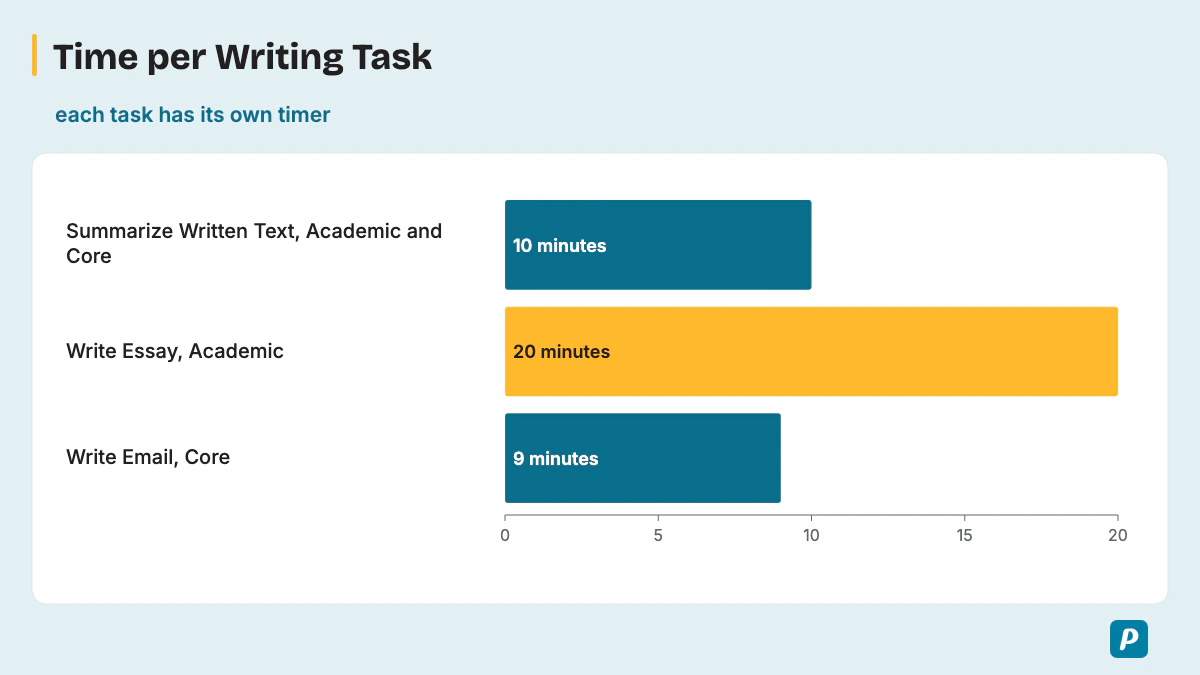
Each writing task has its own timer: 10 minutes for Summarize Written Text, 20 minutes for Write Essay and 9 minutes for Write Email. Pearson publishes no fixed split inside them, so good time management means rehearsing your own. This starting split is our suggestion, and each row adds up to the task's full time.
| Task | Time | Read and plan | Write | Check |
|---|---|---|---|---|
| Summarize Written Text | 10 minutes | About 3 minutes. | About 4 minutes. | About 3 minutes. |
| Write Essay | 20 minutes | About 3 minutes. | About 14 minutes. | About 3 minutes. |
| Write Email | 9 minutes | About 1 minute. | About 6 minutes. | About 2 minutes. |
Typing speed sets how much of the essay timer is left for proofreading. At 25 words per minute, a 250-word essay takes 10 minutes of pure typing, so measure your speed with a timed typing test and practice until the draft fits comfortably. Use the on-screen word count instead of counting, and Cut and Paste to move a clause. Summarize Spoken Text runs on its own timer too: 10 minutes in PTE Academic and 8 minutes in PTE Core.
How Do You Avoid Spelling Mistakes in PTE Writing?
Pick one spelling convention (US, UK, Australian or Canadian) and keep it for the whole response, then proofread every word. Spelling is a scored trait in Write Essay, Write Email and Summarize Spoken Text, and every Write from Dictation word has to be spelled correctly to count. The Spelling trait works differently in each task.
| Task | Spelling rule in the Score Guide |
|---|---|
| Write Essay | 2 for correct spelling, 1 for one error, 0 for more than one. |
| Summarize Spoken Text, Academic | 2 for correct spelling, 1 for one error, 0 for more than one. |
| Summarize Spoken Text, Core | 2 for one error, 1 for two or three, 0 for more than three. |
| Write Email | 2 for up to two spelling or typing errors, 1 for three or four, 0 for numerous errors. |
| Write from Dictation | 1 point per correct word spelled correctly; a misspelled word scores 0. |
| Summarize Written Text | No separate Spelling trait in either Score Guide. |
Pearson's 2021 essay tips warn that more than one spelling mistake "will mean you will score zero for this question". The Score Guide applies that zero to the essay's Spelling trait, so the other six traits are still scored. Pearson accepts US and UK spelling as long as one convention runs through each response, and these eight words change between the two.
- analyze (US) / analyse (UK)
- behavior (US) / behaviour (UK)
- center (US) / centre (UK)
- color (US) / colour (UK)
- traveled (US) / travelled (UK)
- defense (US) / defence (UK)
- labor (US) / labour (UK)
- catalog (US) / catalogue (UK)
Four words keep one spelling everywhere but still trip writers under time pressure: necessary, environment, government and accommodation.
What Mistakes Should You Avoid in the PTE Writing Section?
The costly mistakes are breaking a word range, going off topic, pasting memorized wording, writing two sentences in the Academic summary, skipping an email bullet point and leaving typos. Each row names the task a slip affects and the score it costs.
| Mistake | Task | What it costs |
|---|---|---|
| Breaking the word range | Summaries, essay and email. | Form points; a Form score of zero stops further scoring. |
| Going off topic | Essay, email and summaries. | Content 0, so no score points at all. |
| Memorized wording | Essay and email. | Content 0 under the Score Guides. |
| Two sentences in the Academic summary | Summarize Written Text, Academic. | Form 0, so no score points. |
| Bullet points or note form | Write Essay. | Form 0. |
| Typing in capital letters only | Summaries, essay and email. | Form 0. |
| Skipping a bullet point | Write Email. | Content points. |
| Mixing US and UK spelling | Essay, email, spoken summary. | Spelling points. |
| Slang or contractions in the essay | Write Essay. | Vocabulary range, which rewards academic words. |
| Generic phrases that fit any topic | Write Essay. | Content, which rewards reformulating the issue in your own words. |
Cut generic openers on sight, such as "This topic has become a hot issue nowadays" or "There are many points of view on this matter". Neither says anything about the actual prompt, so replace each with a sentence that names the issue and your position.
How Can You Improve Your PTE Writing Score?
Practice each task under its own timer, review it against that task's traits, and fix the weakest trait first. Daily timed practice covers one summary plus one essay (PTE Academic) or one email (PTE Core). Two or three times a week, add a Write from Dictation set and a Summarize Spoken Text item.
Keep a review log: after each response, note the one trait that slipped, and a week of notes shows your weakest trait. To get scored feedback on each trait, create a free account on our practice app.
How Do You Practice Summarize Written Text?
Summarize one new passage a day under a 10-minute timer, then check the word range for your test and whether your sentence carries the passage's main idea. Once a week, rewrite an old summary with a different connector (although, whereas, which) to widen your sentence patterns. The PTE Summarize Written Text guide has the full rules and more passages.
How Do You Practice Write Essay?
Write a timed essay of 20 minutes on a fresh prompt every other day, then score it against the seven traits and the 200-300 word range. These three practice prompts follow Pearson's 2-3 sentence style, one per prompt type, and the PTE Write Essay task guide covers the task in full.
- Agree or disagree: "Some universities now let students hand in videos or podcasts instead of written assignments. Written work should remain the main form of assessment at university. To what extent do you agree or disagree?"
- Different groups: "A large company plans to close its staff canteen and give employees meal vouchers for nearby restaurants instead. How might office staff, canteen workers and local restaurant owners feel about this change?"
- Problem-solution: "Many small rural schools are closing as young families move to cities. What problems does this cause for rural communities, and what could be done to solve them?"
How Do You Practice Write Email for PTE Core?
Answer one email prompt in 9 minutes, then tick off the three bullet points, the four email conventions and the word count. Alternate a formal reader with an informal one, and use the PTE Core Write Email guide for models.
- Formal: "The heating in your apartment has not worked for three days. Write to your building manager, Mr. Lee. In your email: describe the problem; explain how it is affecting you; ask when it will be repaired."
- Informal: "Your friend Priya is moving to your city next month and has asked for advice. Write to her. In your email: recommend an area to live in; explain how to get around the city; suggest something you could do together."
Should You Use a PTE Writing Template?
Use a structure, not memorized wording: Pearson gives no credit for an unoriginal essay, and both Score Guides treat significant pre-prepared or memorized material as a Content 0 response. Test each stock phrase by deleting it: if the sentence still says the same thing, the phrase was filler. A writing template that fixes the paragraph plan and leaves every sentence to your own words is in PTE essay template and structure.
How Do You Get 90 in PTE Writing?
No single tip guarantees 90, because the Writing score combines several tasks; strong scores come from meeting every trait in every writing-scored item, including the listening tasks. Accurate dictation spelling and a relevant, well-developed essay both deserve practice; there is no fixed one-word-to-one-paragraph equivalence. The PTE score 90 guide shows what 90 in writing takes across every task.
Practice PTE Writing on EasyEnglish
Try Writing tasks in a timed, computer-based format like the real test.
Try speaking practice without signing up. A free account is required for full mock tests. Practice scores are estimates, not official Pearson scores.
Written by
EasyEnglish Team
The team behind EasyEnglish's PTE practice and mock tests
EasyEnglish provides independent PTE practice and estimated scores. EasyEnglish is not affiliated with or endorsed by Pearson. Contact support@inverseai.com.
Format and scoring sources checked on 26 October 2026: Academic Speaking & Writing; Core Speaking & Writing; Academic Score Guide; Core Score Guide (January 2026). Academic and Academic UKVI details use the format introduced on 7 August 2025; Core details use its January 2026 Score Guide. Where a task page and Score Guide differ, the distinction is identified in the text; use the Guide for scoring criteria. Practice passages, names, figures, prompts and model answers are authored examples supplied with this guide, not authentic exam items or independently verified research findings. Suggested practice schedules and time splits are coaching advice, not Pearson requirements or score guarantees.
Editorial review completed .