PTE Pronunciation: Rules, Scoring, Tips and Word List
PTE Speaking
You can keep your own accent in PTE and still do well on pronunciation, as long as a listener catches every word. Pronunciation counts as one of three traits in most speaking tasks. Pearson checks whether most regular speakers of English understand you easily, whether your vowels and consonants come out clearly, and whether word stress falls in the right places.
PTE Academic scores it in six speaking tasks and PTE Core in four, with separate delivery-trait scores. The scoring rules here come from Pearson's PTE Academic and PTE Core format pages, quoted word for word where the wording changes, and the practice section ends with 135 words for pronunciation practice.
Table of Contents
What Is Pronunciation in PTE?
Pronunciation in PTE is a scored trait that Pearson judges by how easily most regular speakers of English understand you. The pronunciation trait looks at three things: speech that's easy to follow, vowels and consonants produced clearly, and words and phrases stressed correctly. In most speaking tasks it sits beside Content and Oral Fluency as a separate score. It measures whether you're understood, not whether you copy a British, American or Australian accent.
How Is Pronunciation Scored in PTE?
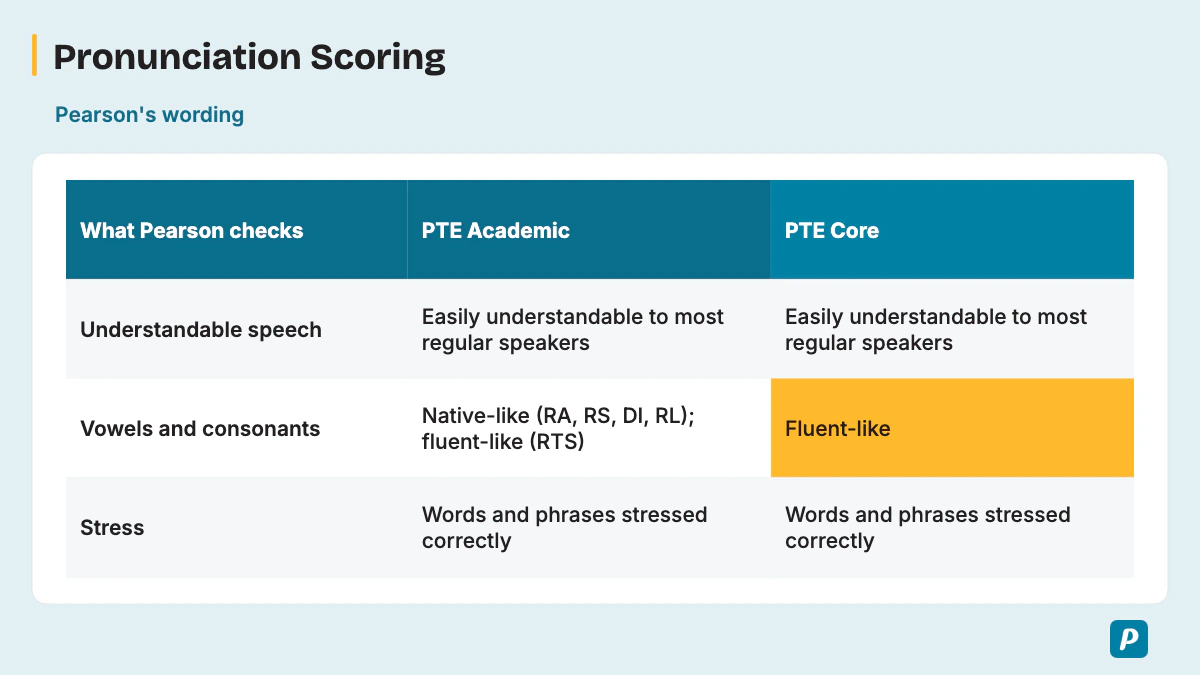
Pearson scores pronunciation on three points: speech that's easily understandable to most regular speakers, clear vowels and consonants, and words and phrases stressed correctly. Only the vowel and consonant wording changes, from "native-like" in most PTE Academic task blocks to "fluent-like" in Respond to a Situation and on the PTE Core page.
| What Pearson checks | PTE Academic wording | PTE Core wording |
|---|---|---|
| Understandable speech | Speech is easily understandable to most regular speakers. | Same wording as PTE Academic. |
| Vowels and consonants | "Native-like" on the Read Aloud, Repeat Sentence, Describe Image and Retell Lecture blocks; "fluent-like" on the Respond to a Situation block. | "Fluent-like" on the Core page. |
| Word and phrase stress | Words and phrases are stressed correctly. | Same wording as PTE Academic. |
Pearson's Academic and Core Score Guides rate Pronunciation from 0 to 5. The format pages explain clarity, sounds and stress; the score guides supply the numerical scale. Aim for speech that regular English speakers can understand.
Which PTE Speaking Tasks Score Pronunciation?
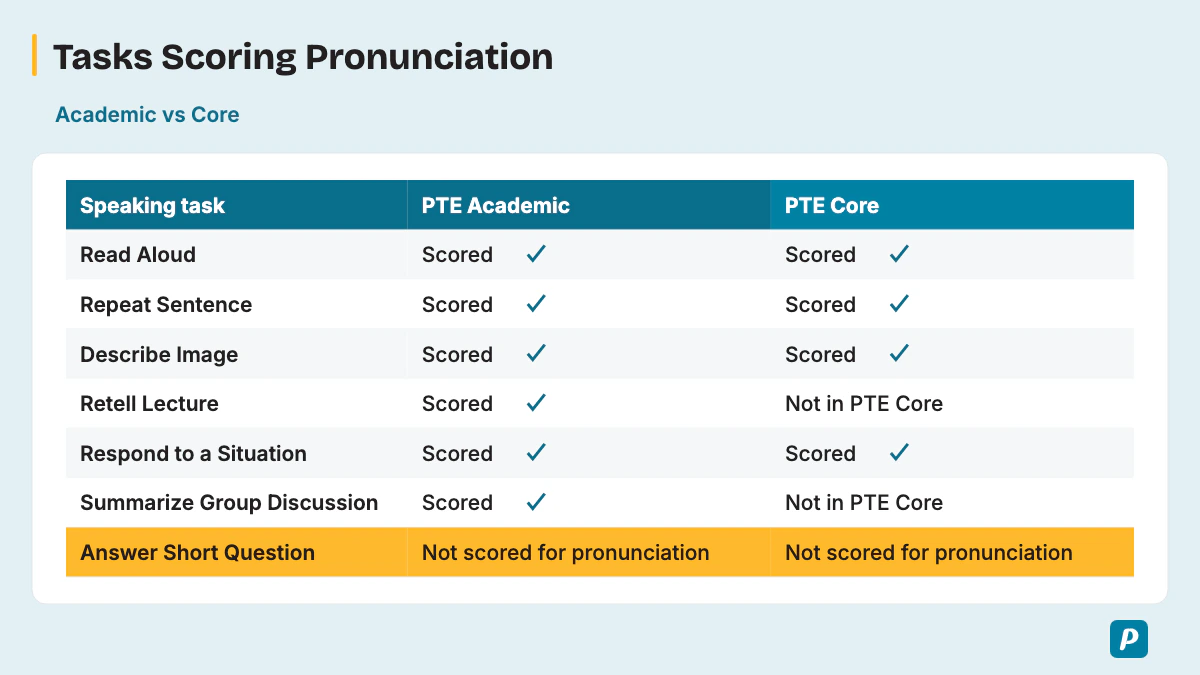
In PTE Academic, Pronunciation is scored in Read Aloud, Repeat Sentence, Describe Image, Retell Lecture, Respond to a Situation and Summarize Group Discussion, but not in Answer Short Question. PTE Core scores it in Read Aloud, Repeat Sentence, Describe Image and Respond to a Situation, because Core has no Retell Lecture or Summarize Group Discussion.
| Speaking task | PTE Academic | PTE Core |
|---|---|---|
| Read Aloud | Scored | Scored |
| Repeat Sentence | Scored | Scored |
| Describe Image | Scored | Scored |
| Retell Lecture | Scored | Not in this test |
| Respond to a Situation | Scored | Scored |
| Summarize Group Discussion | Scored | Not in this test |
| Answer Short Question | Not scored for pronunciation | Not scored for pronunciation |
Practise pronunciation across all tasks that score it; no task-specific percentage is established in this guide. The Personal Introduction isn't scored at all.
Does Accent Affect PTE Pronunciation?
Not by itself: Pearson says PTE recognizes regional and national varieties of English pronunciation to the degree that they're understandable to most regular speakers of the language. Its test-taker FAQ adds that you're scored on what you say, not on your accent. For an Indian or Bangladeshi test taker, an Indian English or other regional accent carries no penalty, yet understandable speech still depends on clear vowels, full word endings and correct stress.
Pearson's confidence article (December 16, 2024) gives one figure: "PTE's automated scoring technology is trained to understand over 120 different accents." Aim for clarity over accent, and keep the accent you already have.
Why Is Pronunciation Important in PTE Speaking?
Pronunciation matters because it's a scored trait in nearly every scored speaking task, so one unclear habit lowers several task scores at once. Dropping final consonants costs you a little in Read Aloud, again in Repeat Sentence and again in Describe Image.
Several of those responses also feed more than one skill score: Pearson lists Repeat Sentence, Retell Lecture and Summarize Group Discussion under listening and speaking, and Read Aloud under Reading and Speaking in Core, but Speaking only in the current Academic Score Guide. Clear speech therefore supports your speaking score and the other skill scores those tasks feed. The overall result also considers question difficulty and weighting; a single trait does not determine it.
What Are the Key PTE Pronunciation Rules?
Five rules follow from Pearson's trait wording and task tips: clear sounds, correct syllable stress, sentence stress, linking with pauses, and natural intonation.
- Vowel and consonant sounds: keep long and short vowels apart, as in ship and sheep, and finish every final consonant.
- Word stress: stress the right syllable, because stress can change meaning, as in PREsent (a noun) and preSENT (a verb).
- Sentence stress: Pearson's Read Aloud tip is to stress the words that convey meaning by reading them in a slightly louder voice.
- Connected speech and pausing: link words inside a phrase, and break a text into meaningful chunks using the punctuation as a guide, as Pearson advises.
- Intonation and rhythm: let your voice rise and fall at punctuation, since Pearson's confidence article says punctuation helps you decide where to pause and change your intonation.
Each row below pairs two consonant sounds or two vowel sounds that a learner can merge into one. Say each set of minimal pairs aloud, record it, and check that a listener could tell the two words apart. If your first language has no separate sound for one side of a pair, start with that pair.
| Sound pair | Words to contrast | How to make the difference |
|---|---|---|
| /θ/ vs /t/ | thin / tin, three / tree, thank / tank | For /θ/, rest your tongue tip lightly between your teeth and push air out; for /t/, tap the ridge behind your top teeth. |
| /ð/ vs /d/ | they / day, then / den, though / dough | Use the /θ/ tongue position and add voice for /ð/; keep the tongue behind the teeth for /d/. |
| /v/ vs /w/ | vest / west, vine / wine, verse / worse | Touch your top teeth to your lower lip for /v/; round your lips with no teeth contact for /w/. |
| /v/ vs /b/ | vote / boat, very / berry, van / ban | Let air flow between teeth and lip for /v/; close both lips fully for /b/. |
| /r/ vs /l/ | right / light, rice / lice, correct / collect | Keep the tongue tip off the roof of your mouth for /r/; press it on the ridge behind your top teeth for /l/. |
| /s/ vs /ʃ/ | sip / ship, sea / she, save / shave | Spread your lips for /s/; round them and pull the tongue slightly back for /ʃ/. |
| /ɪ/ vs /iː/ | ship / sheep, live / leave, fill / feel | Keep /ɪ/ short and relaxed; hold /iː/ longer with lips spread. |
| /ʊ/ vs /uː/ | full / fool, pull / pool, look / Luke | Keep /ʊ/ short; hold /uː/ longer with lips tightly rounded. |
| /æ/ vs /e/ | bad / bed, man / men, sat / set | Drop your jaw lower for /æ/; keep it half open for /e/. |
Stress also separates nouns from verbs in a set of common PTE words. The IPA mark ˈ sits before the syllable with primary stress; ˌ marks secondary stress. Text between slashes is IPA. The capitalized spellings alongside it are approximate English respellings, not IPA. The following practice transcriptions use a non-rhotic British-English model; other accents and dictionary conventions may differ.
| Word | Noun | Verb |
|---|---|---|
| present | PRE-zunt /ˈpreznt/ | pri-ZENT /prɪˈzent/ |
| record | REK-awd /ˈrekɔːd/ | rih-KAWD /rɪˈkɔːd/ |
| object | OB-jikt /ˈɒbdʒɪkt/ | ub-JEKT /əbˈdʒekt/ |
| project | PROJ-ekt /ˈprɒdʒekt/ | pruh-JEKT /prəˈdʒekt/ |
| increase | IN-kreess /ˈɪŋkriːs/ | in-KREESS /ɪnˈkriːs/ |
| decrease | DEE-kreess /ˈdiːkriːs/ | dih-KREESS /dɪˈkriːs/ |
| export | EK-spawt /ˈekspɔːt/ | ik-SPAWT /ɪkˈspɔːt/ |
| import | IM-pawt /ˈɪmpɔːt/ | im-PAWT /ɪmˈpɔːt/ |
| contrast | KON-trahst /ˈkɒntrɑːst/ | kun-TRAHST /kənˈtrɑːst/ |
| conduct | KON-dukt /ˈkɒndʌkt/ | kun-DUKT /kənˈdʌkt/ |
| permit | PUR-mit /ˈpɜːmɪt/ | puh-MIT /pəˈmɪt/ |
| produce | PROD-yooss /ˈprɒdjuːs/ | pruh-DYOOSS /prəˈdjuːs/ |
What Are Common PTE Pronunciation Problems?
The problems that cost marks are the ones that make a word hard to recognize: dropped endings, merged sounds, misplaced stress, rushed or quiet speech, and over-careful delivery. Seven of them break one of Pearson's three pronunciation checks, and the last two run against Pearson's advice to speak clearly without shouting, whispering or slowing down.
- Dropping final consonants such as -ed and -s breaks the vowels and consonants check, so "worked" turns into "work".
- Merging vowel pairs, so "full" sounds like "fool", also breaks the vowels and consonants check.
- Swapping consonants such as v and w, or th and t, turns "vest" into "west" and "three" into "tree".
- Adding an extra vowel before or inside a consonant cluster, so "school" becomes "iskool", changes the word's shape.
- Putting syllable stress in the wrong place on long academic words, such as deVELopment, breaks the word stress check.
- Reading in a flat, unbroken line, with every word equally loud, breaks the phrase stress check.
- Raising your speaking speed until syllables vanish breaks the understandable speech check.
- Low speaking volume hides clear sounds from the microphone, and Pearson's equipment tip is to speak clearly without shouting or whispering.
- Over-pronouncing every sound makes speech slow and choppy, which hurts natural stress and oral fluency.
A list of "most repeated words" is a practice aid, not something Pearson publishes; the 135-word list in the practice section gives you academic words to drill with their stress marked.
What Is the Difference Between PTE Pronunciation and Fluency?
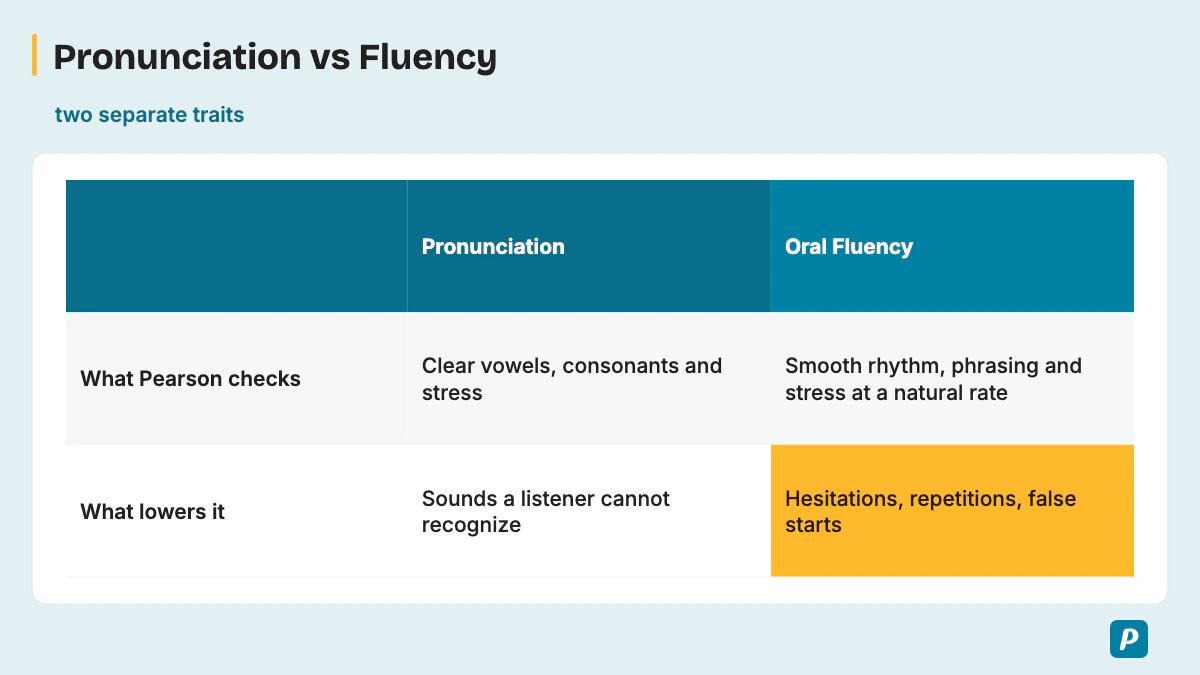
Pronunciation covers how clearly each sound and stressed syllable comes out, while oral fluency covers how smoothly the whole response flows. Pearson defines oral fluency by whether your rhythm, phrasing and stress are smooth.
| Trait | What Pearson checks | What lowers it |
|---|---|---|
| Pronunciation | Clear vowels, consonants and stress that most regular speakers understand. | Sounds a listener can't recognize. |
| Oral Fluency | Smooth rhythm, phrasing and stress at a constant, natural rate. | Hesitations, repetitions and false starts. |
These are separate traits. A fast, fluent speaker can still lose pronunciation marks, and a clear speaker can lose fluency marks by stopping to self-correct.
How Do You Improve Pronunciation for PTE?
You improve it by recording yourself on real task types, listening back for what a listener would miss, and fixing one problem at a time with short pronunciation drills. A simple daily routine works. Shadowing a short clip trains your ear, self-recording the same text shows what changed, and repeating the hardest words inside short phrases fixes them.
Break each long word into syllables and rebuild it slowly, as in en-tre-pre-NEUR, then at normal speed. Check a new word's stress in an audio dictionary before you say it in a practice answer, so you never rehearse the wrong version. Keep that practice loop short enough to repeat every day.
How Can You Practice PTE Pronunciation at Home?
At home, the most useful loop is to record yourself on a real task type, play it back, and mark every word a stranger might not catch. Home practice gains most from short sessions every day rather than one long session a week, with playback after each recording. This suggested 30-minute daily routine is a study plan, not a Pearson rule; the benefits of online PTE practice page explains timed task drills.
| Minutes | Activity | What to listen for |
|---|---|---|
| 5 | Difficult sounds and minimal pairs | Two clearly different words in each pair |
| 10 | Read Aloud practice | Final consonants and stress on long words |
| 10 | Repeat Sentence practice | The speaker's stress and intonation copied |
| 5 | Review of recordings | One or two problems to fix tomorrow |
Which Words Should You Practice for PTE Pronunciation?
Practice long academic words that PTE texts and lectures use, and learn each word's stress before you say it in a full sentence. The five tables below form an author-selected 135-word practice list, not an official Pearson vocabulary quota, using one non-rhotic British-English model. The IPA column uses phonemic symbols between slashes; ˈ marks primary stress and ˌ marks secondary stress. The last column is an approximate English respelling, not IPA; capitals mark primary stress only. Respelling vowels depend on the reader's accent, so use the IPA to resolve ambiguity. In this non-rhotic model, final "(r)" indicates a linking r that may be pronounced before a following vowel sound. Some British accents pronounce r in more positions. Endings such as /ʃn/ and /bl/ use a dictionary convention that can leave the weak vowel before a syllabic consonant unwritten. These are practice models, not the only acceptable pronunciations. Our guide to how English accents differ shows which sounds, such as the r after a vowel, change from accent to accent.
Which Nouns Are Hard to Pronounce in PTE?
These 30 nouns turn up in academic texts and lectures, and 20 of them carry stress away from the first syllable.
| Word | British IPA model | Approximate respelling |
|---|---|---|
| hypothesis | /haɪˈpɒθəsɪs/ | hy-POTH-uh-sis |
| phenomenon | /fəˈnɒmɪnən/ | fuh-NOM-ih-nun |
| entrepreneur | /ˌɒntrəprəˈnɜː(r)/ | on-truh-pruh-NUR |
| analysis | /əˈnæləsɪs/ | uh-NAL-uh-sis |
| hierarchy | /ˈhaɪərɑːki/ | HY-uh-rah-kee |
| anomaly | /əˈnɒməli/ | uh-NOM-uh-lee |
| percentage | /pəˈsentɪdʒ/ | puh-SEN-tij |
| majority | /məˈdʒɒrəti/ | muh-JOR-uh-tee |
| environment | /ɪnˈvaɪrənmənt/ | in-VY-run-ment |
| infrastructure | /ˈɪnfrəstrʌktʃə(r)/ | IN-fruh-struk-chuh |
| legislation | /ˌledʒɪsˈleɪʃn/ | lej-is-LAY-shun |
| chaos | /ˈkeɪɒs/ | KAY-oss |
| archive | /ˈɑːkaɪv/ | AH-kyve |
| debris | /ˈdebriː/ | DEB-ree |
| fatigue | /fəˈtiːɡ/ | fuh-TEEG |
| colleague | /ˈkɒliːɡ/ | KOL-eeg |
| photosynthesis | /ˌfəʊtəʊˈsɪnθəsɪs/ | foh-toh-SIN-thuh-sis |
| biodiversity | /ˌbaɪəʊdaɪˈvɜːsəti/ | by-oh-dy-VUR-suh-tee |
| ecosystem | /ˈiːkəʊsɪstəm/ | EE-koh-sis-tum |
| metabolism | /məˈtæbəlɪzəm/ | muh-TAB-uh-li-zum |
| algorithm | /ˈælɡərɪðəm/ | AL-guh-ri-thum (voiced th) |
| inflation | /ɪnˈfleɪʃn/ | in-FLAY-shun |
| migration | /maɪˈɡreɪʃn/ | my-GRAY-shun |
| mortality | /mɔːˈtæləti/ | maw-TAL-uh-tee |
| fertility | /fəˈtɪləti/ | fuh-TIL-uh-tee |
| urbanization | /ˌɜːbənaɪˈzeɪʃn/ | ur-buh-ny-ZAY-shun |
| agriculture | /ˈæɡrɪkʌltʃə(r)/ | AG-rih-kul-chuh |
| carbohydrate | /ˌkɑːbəʊˈhaɪdreɪt/ | kah-boh-HY-drayt |
| temperature | /ˈtemprətʃə(r)/ | TEM-pruh-chuh |
| vocabulary | /vəˈkæbjələri/ | vuh-KAB-yuh-luh-ree |
Which Verbs Are Hard to Pronounce in PTE?
Twenty-five of these 30 verbs end in -ate or -ize, and in all but three of them (deteriorate, categorize, characterize) the stress falls two syllables before that ending.
| Word | British IPA model | Approximate respelling |
|---|---|---|
| analyze | /ˈænəlaɪz/ | AN-uh-lyze |
| determine | /dɪˈtɜːmɪn/ | dih-TUR-min |
| distribute | /dɪˈstrɪbjuːt/ | dih-STRIB-yoot |
| fluctuate | /ˈflʌktʃueɪt/ | FLUK-choo-ayt |
| interpret | /ɪnˈtɜːprət/ | in-TUR-prit |
| investigate | /ɪnˈvestɪɡeɪt/ | in-VES-tih-gayt |
| prioritize | /praɪˈɒrətaɪz/ | pry-OR-uh-tize |
| recognize | /ˈrekəɡnaɪz/ | REK-ug-nize |
| accelerate | /əkˈseləreɪt/ | uk-SEL-uh-rayt |
| deteriorate | /dɪˈtɪəriəreɪt/ | dih-TEER-ee-uh-rayt |
| stabilize | /ˈsteɪbəlaɪz/ | STAY-buh-lize |
| compensate | /ˈkɒmpenseɪt/ | KOM-pen-sayt |
| consolidate | /kənˈsɒlɪdeɪt/ | kun-SOL-ih-dayt |
| contaminate | /kənˈtæmɪneɪt/ | kun-TAM-ih-nayt |
| cultivate | /ˈkʌltɪveɪt/ | KUL-tih-vayt |
| diminish | /dɪˈmɪnɪʃ/ | dih-MIN-ish |
| eliminate | /ɪˈlɪmɪneɪt/ | ih-LIM-ih-nayt |
| evaporate | /ɪˈvæpəreɪt/ | ih-VAP-uh-rayt |
| minimize | /ˈmɪnɪmaɪz/ | MIN-ih-mize |
| negotiate | /nɪˈɡəʊʃieɪt/ | nih-GOH-shee-ayt |
| originate | /əˈrɪdʒɪneɪt/ | uh-RIJ-ih-nayt |
| participate | /pɑːˈtɪsɪpeɪt/ | pah-TIS-ih-payt |
| accommodate | /əˈkɒmədeɪt/ | uh-KOM-uh-dayt |
| categorize | /ˈkætəɡəraɪz/ | KAT-uh-guh-rize |
| generalize | /ˈdʒenrəlaɪz/ | JEN-ruh-lize |
| summarize | /ˈsʌməraɪz/ | SUM-uh-rize |
| characterize | /ˈkærəktəraɪz/ | KAR-uk-tuh-rize |
| proliferate | /prəˈlɪfəreɪt/ | pruh-LIF-uh-rayt |
| regenerate | /rɪˈdʒenəreɪt/ | rih-JEN-uh-rayt |
| irrigate | /ˈɪrɪɡeɪt/ | IR-ih-gayt |
Which Adjectives Are Hard to Pronounce in PTE?
Many of these 30 adjectives come from science, geography and economics lectures. Every -ical word in the table, such as biological, geographical and statistical, stresses the syllable just before -ical.
| Word | British IPA model | Approximate respelling |
|---|---|---|
| significant | /sɪɡˈnɪfɪkənt/ | sig-NIF-ih-kunt |
| sustainable | /səˈsteɪnəbl/ | suh-STAY-nuh-bul |
| vulnerable | /ˈvʌlnərəbl/ | VUL-nuh-ruh-bul |
| economic | /ˌiːkəˈnɒmɪk/ | ee-kuh-NOM-ik |
| specific | /spəˈsɪfɪk/ | spuh-SIF-ik |
| qualitative | /ˈkwɒlɪtətɪv/ | KWOL-ih-tuh-tiv |
| agricultural | /ˌæɡrɪˈkʌltʃərəl/ | ag-rih-KUL-chuh-rul |
| atmospheric | /ˌætməsˈferɪk/ | at-mus-FER-ik |
| biological | /ˌbaɪəˈlɒdʒɪkl/ | by-uh-LOJ-ih-kul |
| chronological | /ˌkrɒnəˈlɒdʒɪkl/ | kron-uh-LOJ-ih-kul |
| environmental | /ɪnˌvaɪrənˈmentl/ | in-vy-run-MEN-tul |
| geographical | /ˌdʒiːəˈɡræfɪkl/ | jee-uh-GRAF-ih-kul |
| hereditary | /həˈredɪtri/ | huh-RED-ih-tree |
| industrial | /ɪnˈdʌstriəl/ | in-DUS-tree-ul |
| infectious | /ɪnˈfekʃəs/ | in-FEK-shus |
| molecular | /məˈlekjələ(r)/ | muh-LEK-yuh-luh |
| nutritious | /njuˈtrɪʃəs/ | nyoo-TRISH-us |
| numerous | /ˈnjuːmərəs/ | NYOO-muh-rus |
| renewable | /rɪˈnjuːəbl/ | rih-NYOO-uh-bul |
| statistical | /stəˈtɪstɪkl/ | stuh-TIS-tih-kul |
| superficial | /ˌsuːpəˈfɪʃl/ | soo-puh-FISH-ul |
| theoretical | /ˌθɪəˈretɪkl/ | thee-uh-RET-ih-kul |
| thorough | /ˈθʌrə/ | THUH-ruh |
| analytical | /ˌænəˈlɪtɪkl/ | an-uh-LIT-ih-kul |
| catastrophic | /ˌkætəˈstrɒfɪk/ | kat-uh-STROF-ik |
| controversial | /ˌkɒntrəˈvɜːʃl/ | kon-truh-VUR-shul |
| exponential | /ˌekspəˈnenʃl/ | ek-spuh-NEN-shul |
| hierarchical | /ˌhaɪəˈrɑːkɪkl/ | hy-uh-RAH-kih-kul |
| mandatory | /ˈmændətəri/ | MAN-duh-tuh-ree |
| simultaneous | /ˌsɪməlˈteɪniəs/ | sim-ul-TAY-nee-us |
Which Adverbs Are Hard to Pronounce in PTE?
Describe Image answers lean on adverbs such as roughly, sharply, slightly and steadily, so these 30 deserve daily drilling.
| Word | British IPA model | Approximate respelling |
|---|---|---|
| considerably | /kənˈsɪdərəbli/ | kun-SID-uh-ruh-blee |
| dramatically | /drəˈmætɪkli/ | druh-MAT-ik-lee |
| particularly | /pəˈtɪkjələli/ | puh-TIK-yuh-luh-lee |
| primarily | /praɪˈmerəli/ | pry-MER-uh-lee |
| relatively | /ˈrelətɪvli/ | REL-uh-tiv-lee |
| respectively | /rɪˈspektɪvli/ | rih-SPEK-tiv-lee |
| steadily | /ˈstedəli/ | STED-uh-lee |
| annually | /ˈænjuəli/ | AN-yoo-uh-lee |
| apparently | /əˈpærəntli/ | uh-PAR-unt-lee |
| drastically | /ˈdræstɪkli/ | DRAS-tik-lee |
| entirely | /ɪnˈtaɪəli/ | in-TY-uh-lee |
| exponentially | /ˌekspəˈnenʃəli/ | ek-spuh-NEN-shuh-lee |
| financially | /faɪˈnænʃəli/ | fy-NAN-shuh-lee |
| frequently | /ˈfriːkwəntli/ | FREE-kwunt-lee |
| globally | /ˈɡləʊbəli/ | GLOH-buh-lee |
| historically | /hɪˈstɒrɪkli/ | hih-STOR-ik-lee |
| increasingly | /ɪnˈkriːsɪŋli/ | in-KREE-sing-lee |
| internationally | /ˌɪntəˈnæʃnəli/ | in-tuh-NASH-nuh-lee |
| moderately | /ˈmɒdərətli/ | MOD-uh-rut-lee |
| occasionally | /əˈkeɪʒnəli/ | uh-KAY-zhnuh-lee |
| previously | /ˈpriːviəsli/ | PREE-vee-us-lee |
| rapidly | /ˈræpɪdli/ | RAP-id-lee |
| roughly | /ˈrʌfli/ | RUF-lee |
| sharply | /ˈʃɑːpli/ | SHAHP-lee |
| slightly | /ˈslaɪtli/ | SLITE-lee |
| substantially | /səbˈstænʃəli/ | sub-STAN-shuh-lee |
| traditionally | /trəˈdɪʃənəli/ | truh-DISH-uh-nuh-lee |
| typically | /ˈtɪpɪkli/ | TIP-ik-lee |
| ultimately | /ˈʌltɪmətli/ | UL-tih-mut-lee |
| simultaneously | /ˌsɪməlˈteɪniəsli/ | sim-ul-TAY-nee-us-lee |
Which Linking Words Are Hard to Pronounce in PTE?
These 15 linking words, also called transition words, connect ideas in longer answers such as Describe Image and Retell Lecture. Five contain the voiced /ð/ sound, so keep your tongue between your teeth instead of saying /d/.
| Word | British IPA model | Approximate respelling |
|---|---|---|
| however | /haʊˈevə(r)/ | how-EV-uh |
| therefore | /ˈðeəfɔː(r)/ | THAIR-faw (voiced th) |
| moreover | /mɔːrˈəʊvə(r)/ | maw-ROH-vuh |
| whereas | /ˌweərˈæz/ | wair-AZ |
| although | /ɔːlˈðəʊ/ | awl-THOH (voiced th) |
| hence | /hens/ | HENSS |
| thereby | /ˌðeəˈbaɪ/ | thair-BY (voiced th) |
| likewise | /ˈlaɪkwaɪz/ | LIKE-wize |
| meanwhile | /ˈmiːnwaɪl/ | MEEN-wile |
| thus | /ðʌs/ | THUSS (voiced th) |
| otherwise | /ˈʌðəwaɪz/ | UTH-uh-wize (voiced th) |
| similarly | /ˈsɪmələli/ | SIM-uh-luh-lee |
| alternatively | /ɔːlˈtɜːnətɪvli/ | awl-TUR-nuh-tiv-lee |
| overall | /ˌəʊvərˈɔːl/ | oh-vuh-RAWL |
| despite | /dɪˈspaɪt/ | dih-SPITE |
Which Words Have Pronunciation Variants?
These nine words illustrate differences in stress, vowels or British and American pronunciation models. The IPA entries are examples, not an exhaustive inventory for either variety or a rule for every speaker. Dictionary conventions may differ. For example, Cambridge lists both initial-vowel variants of dilemma, and Oxford lists the British and American models shown for debris. A dictionary pronunciation does not certify a Pearson item score. Choose a model that you can say clearly.
| Word | British | American | Note |
|---|---|---|---|
| research (noun) | /rɪˈsɜːtʃ/ or /ˈriːsɜːtʃ/ | /ˈriːsɜːrtʃ/ or /rɪˈsɜːrtʃ/ | Both stress patterns are listed in both varieties. |
| controversy | /ˈkɒntrəvɜːsi/ or /kənˈtrɒvəsi/ | /ˈkɑːntrəvɜːrsi/ | The American model shown here stresses the first syllable. |
| advertisement | /ədˈvɜːtɪsmənt/ | /ˌædvərˈtaɪzmənt/ | Stress moves from the second to the third syllable. |
| address (noun) | /əˈdres/ | /əˈdres/ or /ˈædres/ | American English also stresses the first syllable. |
| contribute | /kənˈtrɪbjuːt/ or /ˈkɒntrɪbjuːt/ | /kənˈtrɪbjuːt/ | Second-syllable stress works in both varieties. |
| debris | /ˈdebriː/ or /ˈdeɪbriː/ | /dəˈbriː/ | The British models shown stress the first syllable; the American model shown stresses the second. |
| primarily | /praɪˈmerəli/ or /ˈpraɪmərəli/ | /praɪˈmerəli/ | pry-MER-uh-lee works in both. |
| dilemma | /dɪˈlemə/ or /daɪˈlemə/ | /dɪˈlemə/ or /daɪˈlemə/ | "dih-LEM-uh" and "dye-LEM-uh" are both correct. |
| furthermore | /ˌfɜːðəˈmɔː(r)/ | /ˌfɜːrðərˈmɔːr/ | Final-syllable primary stress is shown here; this table does not list every variant. |
How Do You Improve Pronunciation in Read Aloud?
Read Aloud gives you 30-40 seconds to read the text and prepare before the microphone opens, which is enough to spot the two or three hardest words and say them under your breath. Use that preparation time to mark stress on the hard words and split the text into meaningful chunks at the punctuation, then stress meaning words slightly louder, as Pearson advises. The PTE Read Aloud rules page has the full timing and scoring.
How Do You Improve Pronunciation in Repeat Sentence?
In Repeat Sentence, copy the stress and intonation you hear, because Pearson's tip is to make a mental note of how the speaker uses stress and intonation and to listen for meaningful phrases. The audio plays once, and your response feeds both your listening and speaking scores. Our PTE Repeat Sentence guide covers the task in full.
How Do You Improve Pronunciation in Describe Image?
Describe Image gives you 25 seconds to study the image and 40 seconds to speak, so use the study time to say the labels and numbers you will read out. Numbers need clear stress, so keep fifteen and fifty apart: Oxford gives /ˌfɪfˈtiːn/ and /ˈfɪfti/, with stress on -teen but on the first syllable of -ty numbers. Pearson's tip is to organize the answer as general content, main point, then other details and a conclusion; our PTE Describe Image guide covers each chart type.
How Do You Improve Pronunciation in Retell Lecture?
Retell Lecture gives you 3 seconds to look at the image before the lecture of up to 90 seconds, then 10 seconds to prepare and 40 seconds to speak. Note the lecture's key terms on the erasable noteboard with the stressed syllable underlined, so you say each technical word the way the lecturer did. The PTE Retell Lecture guide covers note-taking in full.
How Do You Improve Pronunciation in Respond to a Situation?
In Respond to a Situation, Pearson judges vowels and consonants against a "fluent-like" standard, and you get 10 seconds to prepare in PTE Academic (20 in PTE Core) and 40 seconds to speak. Choose formal or informal language to suit the listener, and say polite phrases such as "I was wondering if" and "would you mind" as linked, smoothly stressed units. Our PTE Respond to a Situation guide shows how the register changes.
How Do You Improve Pronunciation in Summarize Group Discussion?
Summarize Group Discussion gives you 2 minutes to speak after a discussion of up to 3 minutes between 3 people. Pearson warns that repeating ideas, correcting yourself or hesitating uses up valuable time and loses score points. Keep talking, ignore mistakes, and hold a steady pace with clear stress to the end. The PTE Summarize Group Discussion guide covers the task's scoring.
How Do You Build Oral Fluency Alongside Pronunciation?
Fluency grows when you keep going after a slip instead of correcting it, because Pearson counts hesitations, repetitions and false starts against oral fluency. Smooth delivery comes from finishing every practice recording without self-correction, even when a word comes out wrong, and fixing that word in the next drill. See oral fluency in PTE for the full trait.
Which Pronunciation Problems Should You Fix First?
Fix the problem that stops a listener recognizing words first, and leave polish such as intonation for last. This priority order keeps practice focused, so move on only when a recording sounds clear at the current step; the PTE speaking section guide shows where each task fits.
- If listeners strain to catch words, drill single sounds, minimal pairs and final consonants.
- If words are clear but some sound wrong, drill word stress with the 135-word list.
- If speech is clear but robotic delivery flattens it, drill linking, sentence stress and intonation on Read Aloud texts.
How Do You Make Sure the Microphone Catches Clear Speech?
Clear sounds only count if the microphone picks them up, so Pearson's test-equipment tip sets the microphone position at around 2 fingers' distance from your mouth. On speaking volume, Pearson says to "speak clearly without shouting or whispering," and adds that "there is no need to speak slowly or loudly."
You're assessed only on what goes through your headset microphone, and the PTE headphones and microphone guide covers the equipment check.
Is a PTE Pronunciation App or Audio List Useful?
A pronunciation app or audio word list helps you hear the model sound, but it only pays off when you record yourself saying the same words inside full sentences. An audio dictionary such as Oxford Learner's Dictionaries or the Cambridge Dictionary plays British and American recordings.
Use an audio dictionary to hear pronunciation models and record yourself using the words in sentences. Third-party practice feedback, including EasyEnglish scores, is an estimate rather than an official Pearson result.
Practice PTE Speaking on EasyEnglish
Try Speaking tasks in a timed, computer-based format like the real test.
Try speaking practice without signing up. A free account is required for full mock tests. Practice scores are estimates, not official Pearson scores.
Written by
EasyEnglish Team
The team behind EasyEnglish's PTE practice and mock tests
EasyEnglish provides PTE practice and independent preparation guides. Official test rules are checked against the sources identified in each guide; practice examples are illustrative, not real exam questions. Practice scores are estimates. Questions or corrections: support@inverseai.com. EasyEnglish is not affiliated with or endorsed by Pearson.
Editorial review completed .