How to Improve Repeat Sentence in PTE: 8 Practical Tips
PTE Speaking
A sentence plays once, the microphone opens, and half the words are already gone. In PTE Academic and PTE Core, Repeat Sentence rewards what your short-term memory keeps and how smoothly you say it back. The fix is to hear phrase chunks instead of single words, copy the speaker's tune, and keep talking when a word slips, because restarts cost oral fluency.
Every tip ends in a drill you can run today. The mistake table and 56 original practice sentences, split into chunks across four length levels, give you the material to run those drills.
Table of Contents
Why Is Repeat Sentence an Important Question Type?
With 10-12 items in every test, Repeat Sentence gives you more scored attempts than the other speaking task types, and each attempt counts toward both your listening score and your speaking score. That double skill contribution means a drill that saves one extra chunk per sentence pays off on every one of those 10-12 items.
What Are the Common Challenges in Repeat Sentence?
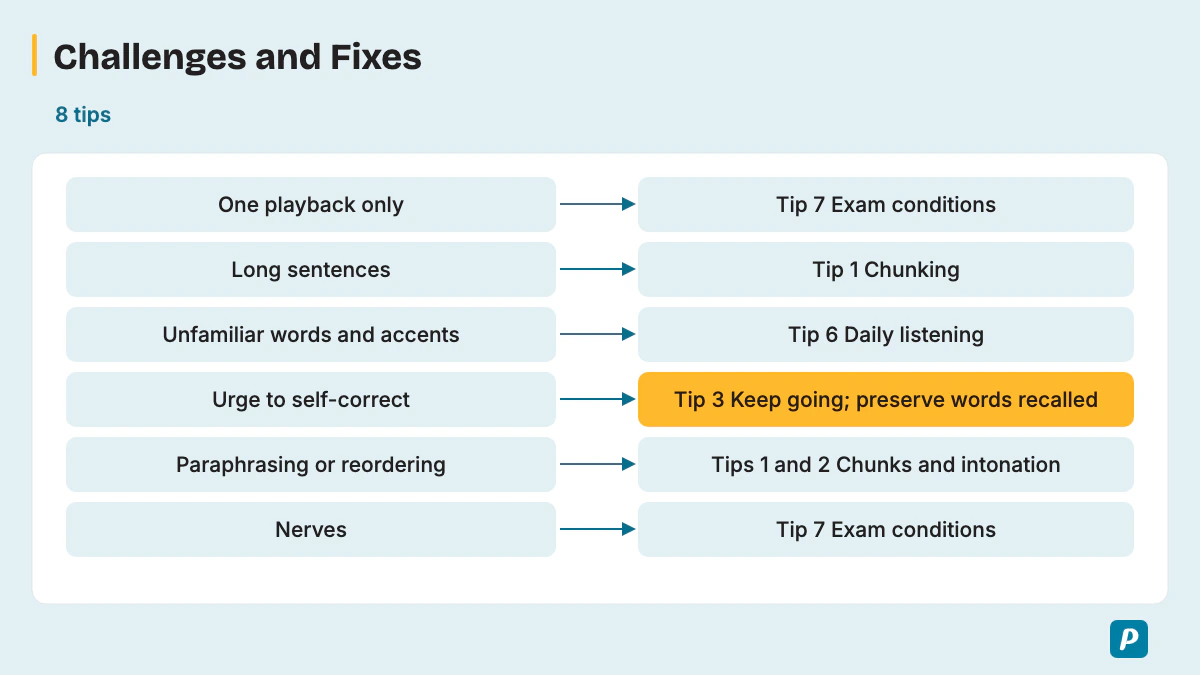
Repeat Sentence gets hard at the single playback, in long sentences, and at the moment you stop, fix or reword what you heard. Each challenge maps to a tip that fixes it.
- One playback leaves no second chance to catch a word, which tip 7 trains for.
- Long sentences overflow short-term memory when you hold single words, which tip 1 fixes.
- Unfamiliar academic words and accents are harder to catch at speed, which tip 6 builds up.
- The urge toward self-correction breaks your flow mid-sentence, which tip 3 deals with.
- Paraphrasing or reordering breaks the word sequence that Content counts, which tips 1 and 2 prevent.
- Exam nerves push you to rush or freeze, which tip 7 rehearses away.
1. Chunk the Sentence to Boost Short-Term Memory
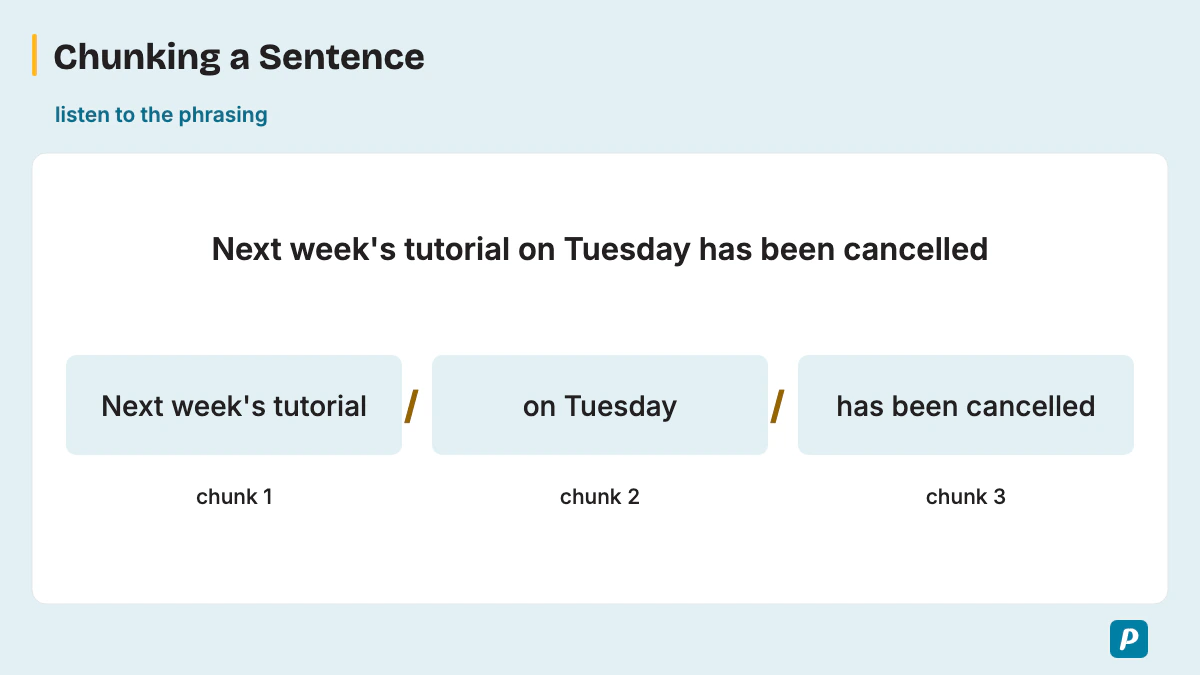
Hear the sentence as three or four meaning chunks rather than ten separate words. Pearson's own tip is to listen to the phrasing, and its example splits "Next week's tutorial / on Tuesday / has been cancelled". Your short-term memory holds three phrases far more easily than ten loose words.
Chunks protect Content as well. Pearson's Score Guide counts words from the prompt said in the correct sequence, and a remembered chunk keeps its own word sequences intact. A chunk you lose costs a few words, while a chunk you keep arrives in order.
Catch the main idea before you try to hold the words: who did what, where and when. Then visualize the scene as a quick picture. Take "The marine biology students / spent the weekend / counting seabirds / on a small island". Picture students with clipboards on a rocky island, and the picture hands back "seabirds", "island" and "weekend" when you speak.
Drill: read a Level 1 or Level 2 practice sentence aloud with a short pause at each slash, then say it again as one smooth run without pauses.
2. Improve Through Imitation of Intonation
Copy the speaker's stress patterns and intonation as well as the words; this is Pearson's second official tip for the task. The rise and fall of a sentence works like a tune, and a tune is easier to recall than a list of words. Pearson's wording asks you to copy the stress and intonation patterns of the sentence you hear. Imitation also keeps your pronunciation and fluency natural, since you aren't inventing a rhythm of your own.
Shadowing trains the habit. Play a short clip and speak a half-step behind the speaker, matching their pace, their pauses and the words they stress. A tongue twister such as "Peter Piper picked a peck of pickled peppers" before a session warms up your mouth for fast, clean sounds; treat it as a warm-up, not a scoring rule.
Drill: shadow one 30-second clip three times, then repeat its first sentence alone from memory.
3. Focus on Fluency Over Perfect Recall
If a word slips, keep going: this avoids adding a false start, while missing words can still reduce Content. Pearson says hesitations, repetitions and false starts negatively affect your score, so self-correction costs Oral Fluency points. Should you aim for perfect recall or fluency? Choose fluency, as long as you still say every chunk you caught.
The Score Guide explains why. For Content, it ignores hesitations and pauses and counts only replacements, omissions and insertions as errors, and Content drops to 0 only when almost nothing from the prompt comes through. Oral Fluency, scored separately, does count every pause and restart.
When a long sentence overflows, use a salvage order: say the opening chunk exactly, then every chunk you still hold in the order you heard it, then the closing chunk. That's practice advice, not a Pearson rule. Never fill the gap with invented words, because insertions are Content errors.
Drill: record ten Level 3 sentences and finish every one without stopping, whatever you miss.
4. Use Shorthand Only If It Helps You
Some prep sites recommend learning shorthand; others say never write initials; Pearson's page gives listening tips, not a note-taking rule. So test both approaches and keep whichever leaves your listening focus on the audio. Pearson's handbook describes an erasable whiteboard and pens; follow the test-centre instructions for the materials provided. Whether it helps on a 3-9 second sentence is the question your recordings answer.
Drill: run one Level 3 set with initials and one without, then compare how many full sentences each recording contains.
5. Give Clarity and Pronunciation Top Priority
Say each word with enough clarity that most regular speakers would understand it. Pearson scores pronunciation on understandable speech, clear vowels and consonants, and correct stress. A regional accent isn't the problem: Pearson's task page says it recognizes regional and national varieties of English pronunciation to the degree that they are understandable. Rushing and swallowed word endings are the problem. For vowels and consonants, Pearson's Academic Repeat Sentence wording says "native-like", while the Core page says "fluent-like".
Minimal pairs train the sounds that carry meaning. Say full/fool, live/leave, walk/work and bed/bad, and ask a partner which word they heard. Then work on word endings in words such as "asked", "results" and "months", where the final consonants are easy to drop at speed.
Drill: say the last word of every chunk in a Level 2 sentence fully, including any final -s or -ed.
6. Improve Your Listening Ability Daily
Short daily listening to spoken English trains your ear to catch whole phrases at speed. Lecture clips, podcasts, news reports and film scenes all work, as long as they carry academic English or clear everyday speech with clean sentence boundaries. Pause after one sentence and repeat it before moving on, which raises listening speed and recall together.
Rotate different accents and speeds: American, British and Australian speakers, plus others you meet less often. Pearson says its automated scoring is trained to understand over 120 accents; that concerns how you're scored, so accent exposure is a listening drill for catching the sentence, not a scoring trick. Plan five short daily sessions rather than one long weekly session; that's practice advice, not a Pearson rule.
Drill: pick one clip a day in a new accent and repeat five sentences from it.
7. Practice Under Actual Exam Circumstances
Practice under exam conditions: a headset, one playback, and speaking straight away, because the real task gives no replay. The PTE Academic page says the microphone opens after a short tone, while the PTE Core page says there's no short tone, so rehearse the version you're taking.
Don't start before the microphone opens. Keep your eyes on the status box until it shows "Recording"; closing your eyes to concentrate makes it easy to begin too early, and anything said before the microphone opens isn't recorded. Pearson's 3-second rule also covers this task, so a long pause mid-sentence can end the recording.
Add background noise to some practice sets. Pearson's test-tip article says other test takers in the room will be speaking at the same time as you, and you're assessed only on the responses you give through your headset microphone.
Drill: set your practice tool to one playback, play a talk radio station quietly in the background, and run a full Level 4 set.
8. Note Down Your Progress on a Schedule
Keep a simple progress log of practice sets and the words or chunks you dropped, and review it weekly. A fixed practice schedule plus an error review shows patterns, such as always losing the middle chunk, rather than single mistakes. Recording playback against the written sentence shows exactly what went missing and where you paused or restarted.
| Date | Set | Fully correct | Chunk lost most | Restarts |
|---|---|---|---|---|
| Monday | Level 2, sentences 15-28 | 9 of 14 | Middle chunk | 2 |
| Thursday | Level 2, sentences 15-28 | 12 of 14 | Final chunk | 0 |
Practice scores in any app are estimates, not official Pearson scores.
Drill: after each set, add one log line and circle the chunk position you lost most often.
What Mistakes Cost the Most Marks in Repeat Sentence?
The costliest mistakes are starting before the microphone opens, going silent over a lost word, rewording or reordering the sentence, adding words, and restarting. Nine common mistakes appear in the table with the trait each one hits and the fix to drill.
| Mistake | What it costs | Fix |
|---|---|---|
| Speaking before the microphone opens | Words outside the recording aren't captured | Wait for "Recording" (and the tone in PTE Academic) |
| Going silent to recall a word | Three seconds of silence ends the recording | Skip the word and say the next chunk |
| Paraphrasing the sentence | Replacements are Content errors | Repeat the speaker's exact words |
| Reordering chunks | Content counts words in the correct sequence | Keep chunks in the order you heard them |
| Adding your own words, such as "also" or "actually" | Insertions are Content errors | Say only the sentence you heard |
| Filling gaps with "um" or "er" | Filled pauses are ignored for Content but count as hesitations | Breathe at the slash instead of filling it |
| Restarting or self-correcting | Repetitions and false starts lower Oral Fluency | Finish your first attempt |
| Rushing or speaking in a flat voice | Rhythm, phrasing and stress feed Oral Fluency and Pronunciation | Match the speaker's pace and stress |
| Swallowing word endings | Unclear sounds lower Pronunciation | Finish every -s, -ed and final consonant |
Paraphrasing is the mistake that feels safest and costs the most, because a sentence with the right meaning but different words breaks the sequence the Score Guide counts. Restarting is next, since one restart turns a smooth answer into a false start.
What Repeat Sentence Examples Can You Use for Practice?
Practice with original sentences in four length levels, slashes marking the chunks, moving up a level only when the shorter set comes out complete and smooth. The 56 practice sentences were written for this guide and aren't real or predictive exam items. Each shows its word count in brackets, and the slashes are chunk marks, not pauses to read aloud.
Without audio, ask a partner to read each sentence once at normal speed without pausing at the slashes, or record the set today and play it back tomorrow. Cover the text, repeat, then check your attempt against the chunked version.
Level 1: 5-8 words
- The art studio / opens after lunch. (6)
- Bring a pencil / to the quiz. (6)
- The shuttle bus / leaves every hour. (6)
- Your locker key / is at reception. (6)
- The chemistry lab / is closed today. (6)
- Please switch off / your phone now. (6)
- The careers fair / starts at ten. (6)
- Our tutorial group / meets on Mondays. (6)
- The gym offers / free trial classes. (6)
- Return the projector / to the front desk. (7)
- The canteen serves soup / until two. (6)
- Graduation photos / are now online. (5)
- The guest speaker / has arrived early. (6)
- Check the noticeboard / for room changes. (6)
Level 2: 9-12 words
- The reading list / for this module / was updated yesterday. (9)
- All visitors / must sign in / at the main entrance. (9)
- The second assignment / is worth more marks / than the first. (10)
- Our study group / will meet / in the café / near the gate. (11)
- Students can borrow laptops / from the IT help desk. (9)
- The field trip / to the coast / depends on the weather. (10)
- Please email your tutor / if you will miss the class. (10)
- The final exam timetable / will be released / next Wednesday. (9)
- Several new courses / in data science / start this fall. (9)
- The bookshop / is offering a discount / on used textbooks. (9)
- The coffee machine / on the ground floor / is out of order. (11)
- You should cite every source / that you quote / in your essay. (11)
- Our flight was delayed / because of / a technical problem. (9)
- The rental agreement / includes water and internet / but not gas. (10)
Level 3: 13-16 words
- The orientation session / for international students / will take place / in the great hall on Monday. (15)
- If you lose your student card, / report it to campus security / as soon as possible. (15)
- The research team / collected water samples / from three different rivers / over a period of six months. (16)
- Anyone who wants feedback on a draft / should book / a fifteen-minute slot / with the tutor. (15)
- The city council / plans to add / more bicycle lanes / along the main roads next year. (15)
- Late submissions / are only accepted / if you can show / a medical certificate or similar evidence. (15)
- The guest lecture / on ocean currents / has moved / to the larger theater downstairs. (13)
- Our department / is looking for volunteers / to help at the open day / this Saturday. (14)
- The new software / lets students track their grades / and deadlines / in one place. (13)
- Please keep the emergency exits clear / and do not leave bags / in the corridor. (14)
- The history seminar / will compare / how two ancient cities / managed their water supply. (13)
- First-year students / are strongly encouraged / to join at least one club / or student society. (14)
- The supermarket near the station / now stays open / until midnight / from Monday to Friday. (14)
- Before the practical class, / read the safety notes / and wear closed shoes / and a lab coat. (16)
Level 4: 17-20 words
- The committee has decided / to postpone the vote / until every member / has had time / to read the report. (18)
- Although the survey received / over two thousand responses, / the researchers say / the sample is still too small. (17)
- Students who need extra support / with academic writing / can attend free workshops / every Tuesday and Thursday afternoon. (17)
- The architecture course / includes a site visit, / so bring a hard hat / and comfortable boots / on Friday morning. (18)
- If the train is canceled again, / the company will provide / a replacement bus / from the station to the airport. (19)
- Most of the lecture / covers the causes of the drought, / but we will also discuss / its effects on farming. (19)
- The marine biology students / spent the weekend / counting seabirds / on a small island / off the northern coast. (17)
- Guests should arrive / thirty minutes early / because the security checks at the venue / can take longer than expected. (18)
- The housing office / can help you find / a shared apartment / if you contact them / before the end of the month. (20)
- During the group project, / each member must keep a record / of the tasks they completed / and the hours they spent. (20)
- The professor explained / that the original manuscript / had been damaged by water / and was very difficult to read. (18)
- Our new manager / wants every team / to present its quarterly results / in under ten minutes / at the meeting. (18)
- The museum's evening tour / is free for students, / but places are limited, / so book online / as early as possible. (19)
- Volunteers at the food bank / sort the donations, / pack the boxes / and deliver them / to families who cannot travel. (19)
How Do You Practice Repeat Sentence in PTE?
Practice with audio in short daily sets: listen once, repeat at once, record, and compare against the written sentence. Daily practice keeps chunking automatic, and each of your practice sets should copy the test, with one playback and no pausing. Audio practice matters more than reading because the task tests your ear first. A simple weekly routine built on the four levels runs like this.
- Days 1-2: Level 1 and Level 2 sets with chunk pauses, then smooth runs.
- Days 3-4: Level 3 sets, recording every attempt and logging lost chunks.
- Day 5: Level 4 sets with background noise and one playback only.
- Day 6: a mixed set of all four levels, scored against the written sentences.
- Day 7: review the log and pick the next week's weak chunk position.
What Are the Repeat Sentence Format and Scoring Rules?
The format, the PTE Academic and PTE Core timings and both scoring scales live on the Repeat Sentence task page, which this tips guide sits under. Pearson's Score Guides rate Content 0-3 and the two delivery scoring traits run 0-5; read PTE Repeat Sentence format and scoring for the full tables.
How Do You Get 90 in Repeat Sentence?
No method guarantees a top score, but the Score Guide defines the top of each trait: every word in the correct sequence for Content, and "Highly proficient" for Pronunciation and Oral Fluency. Smooth delivery with no hesitations or restarts separates the top level of the two delivery scoring traits from the levels below. Read what a PTE score of 90 takes for the wider picture.
Do Fixed Phrases or Templates Help in Repeat Sentence?
No, fixed phrases and templates don't help, because Repeat Sentence gives you nothing to fill in: the Score Guide counts any word you add as an insertion error, so added words lower Content. What helps instead is a fixed listening routine: catch the main idea, hold the chunks, wait for "Recording", then say the chunks in the order you heard them. For speaking habits that do carry across tasks, see our PTE speaking tips.
Where Can You Practice Repeat Sentence for Free?
Free practice works best when it plays audio once and records you, so you train the same conditions as the test rather than reading sentences on a page or a PDF. PDF lists give you text, but the task needs audio playback, so use the practice sentences here with a partner or a recording. Read about the benefits of online PTE practice.
How Does the 3-Second Rule Affect Repeat Sentence?
Pearson states the rule in its Answer Short Question block: "If you stop for three seconds whilst speaking, the recording status will change to 'completed' even if you haven't finished". Pearson then names the other items it covers. "This also applies to speaking item types Read aloud, Repeat Sentence, Describe Image and Re-tell Lecture."
After a long silence the recording ends, and every word you hadn't said yet is lost. More detail is on the 3-second rule in PTE speaking.
How Do You Stay Calm and Focused During Repeat Sentence?
Treat a lost word as a small Content error, not a reason to stop: say what you still hold, in order, and move to the next item. Exam nerves spread when one bad sentence carries into the next, so take one slow breath as a reset while the next audio loads. Our guide to managing PTE exam anxiety has more calming steps for test day.
Should You Practice With a Headset and Background Noise?
Yes, practice with a headset and some background noise, because Pearson says other test takers in the room will be speaking at the same time as you. Pearson adds that you're assessed only on what your headset microphone records. For microphone position, Pearson advises about two fingers' distance from your mouth. Read our guide to choosing headphones for PTE practice.
To practice with instant feedback on all three traits, create a free account on EasyEnglish.
Practice PTE Speaking on EasyEnglish
Try Speaking tasks in a timed, computer-based format like the real test.
Try speaking practice without signing up. A free account is required for full mock tests. Practice scores are estimates, not official Pearson scores.
Written by
EasyEnglish Team
The team behind EasyEnglish's PTE practice and mock tests
EasyEnglish provides PTE practice and independent preparation guides. Official test rules are checked against the sources identified in each guide; practice examples are illustrative, not real exam questions. Practice scores are estimates. Questions or corrections: support@inverseai.com. EasyEnglish is not affiliated with or endorsed by Pearson.
Editorial review completed .