10 Best Ways to Improve Oral Fluency in PTE
PTE Speaking
If your PTE Speaking answers feel choppy, the fix is rarely more vocabulary; it's smoother delivery. Pearson's oral fluency trait rewards speech whose rhythm, phrasing and stress flow at a constant, natural rate, and hesitations, repetitions and false starts pull it down. Per Pearson's own pages, Oral Fluency is scored in six PTE Academic speaking tasks and four PTE Core tasks, and never in Answer Short Question.
Table of Contents
What Is Oral Fluency in PTE?
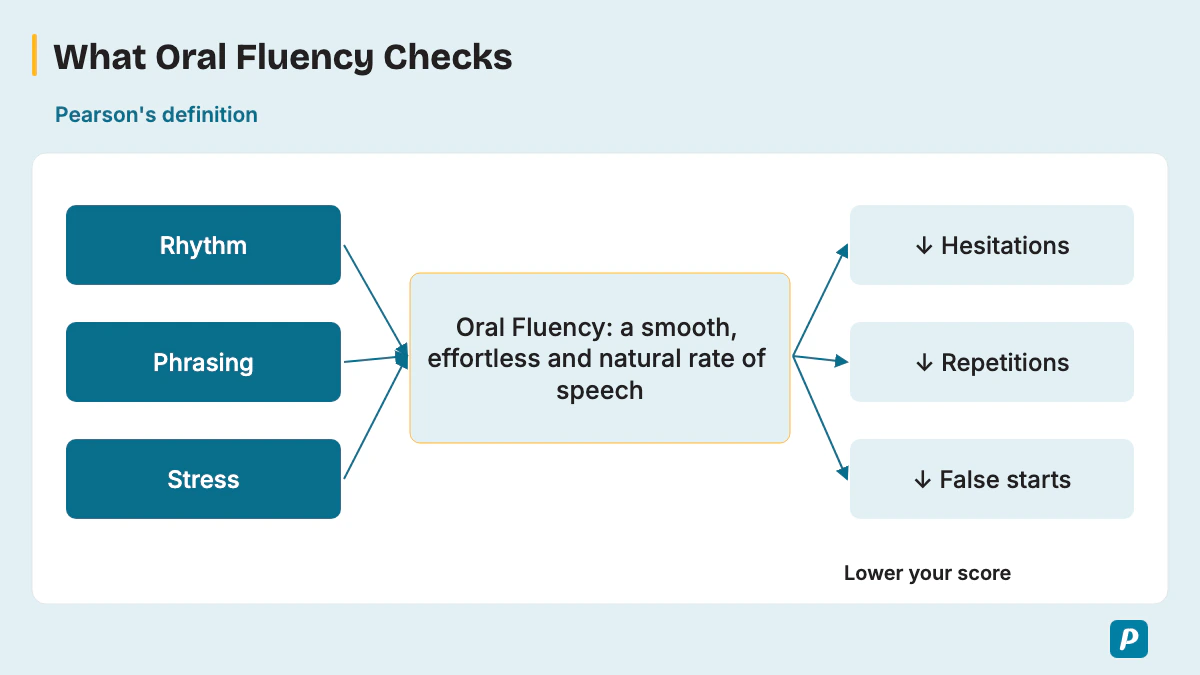
In general English, oral fluency means speaking smoothly without long stops; Oral Fluency in PTE is the speaking trait that measures whether your rhythm, phrasing and stress flow at a constant, natural rate. Pearson asks whether your response shows "a smooth, effortless and natural rate of speech", and hesitations, repetitions and false starts lower it. Compare "The chart shows, um, the… the number of, the number of visitors" with "The chart shows the number of visitors to three museums": the second is fluent. Fluency isn't speed, so a fast answer full of restarts scores worse than a steady one. Pearson scores what you say, not your accent.
Which PTE Speaking Tasks Score Oral Fluency?
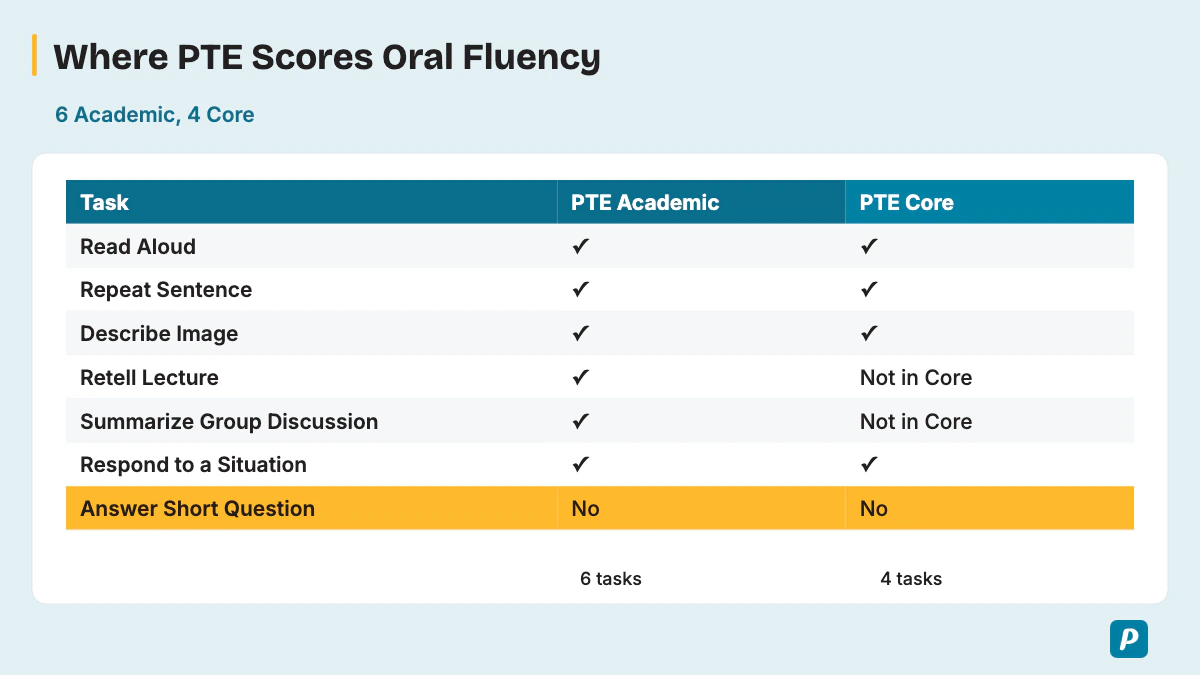
Six tasks score Oral Fluency in PTE Academic and four tasks in PTE Core, while Answer Short Question never does. The full split by test looks like this.
| Task | PTE Academic | PTE Core |
|---|---|---|
| Read Aloud | Yes | Yes |
| Repeat Sentence | Yes | Yes |
| Describe Image | Yes | Yes |
| Retell Lecture | Yes | Not in Core |
| Summarize Group Discussion | Yes | Not in Core |
| Respond to a Situation | Yes | Yes |
| Answer Short Question | No, scored correct or incorrect | No |
Pearson's 2021 articles and some prep sites still list only Read Aloud, Repeat Sentence, Describe Image and Retell Lecture. Pearson's current PTE Academic page adds Summarize Group Discussion and Respond to a Situation. AI scoring rates Oral Fluency on a 0-5 scale in Pearson's Score Guides: 5 Highly proficient, 4 Advanced, 3 Good, 2 Intermediate, 1 Limited and 0 Disfluent. The PTE Core Score Guide calls the same trait "Fluency" and uses the same scale.
Pearson also warns that memorized responses or templated sentences can get 0 for Content, and then fluency and pronunciation aren't scored at all.
1. Set a Natural Pace for Oral Fluency
Aim for a natural pace at a constant rate, neither rushed nor slow, because Pearson's best responses keep an even pace with appropriate phrasing. Rushing produces slips you then repeat, so keep your speed not too fast and not too slow. Four steps build the habit.
- Read a short text aloud at your normal talking speed.
- Time one minute and keep an even pace from start to end.
- Pause briefly at commas and full stops, and say each thought group as one unit.
- Slow down slightly for numbers and names rather than speeding up.
2. Reduce Fillers and Hesitations
Cut "um", "ah" and long silences, because Pearson names hesitations among the things that lower Oral Fluency. Fix fillers by type: first find out which kind you use and what comes right before each one. Try these steps.
- Record one answer and sort your fillers into sounds ("um", "er"), words ("basically", "like") and phrases ("you know what I mean").
- Note what came before each one: a missing word, a fast burst, a lost idea or nerves.
- For filler sounds after a fast burst, slow your overall rate.
- For a missing word, replace the filler with a short silent pause at a phrase boundary and carry on with a simpler word, without restarting.
- Plan your first sentence before the tone so you start cleanly.
3. Keep Your Speech Fluency Under Pressure
When you slip, keep going: Pearson's own Summarize Group Discussion tip says repeating ideas, correcting yourself or hesitating uses up time and loses score points, so keep talking. In Read Aloud, Pearson's 2021 article adds that a self-correction counts as added words, so it can cost Content too. Repetitions hurt twice, in time and in fluency.
- Never restart a sentence during practice.
- If a word comes out wrong, carry on to the next idea.
- Practice under the real timer so the clock feels normal on test day.
4. Train Fluency With Read Aloud
Read Aloud is the easiest place to build fluency, because the words are given and you can focus on chunking, rhythm and stress. Treat it as a fluency drill, where meaning chunks keep the rhythm natural.
- Mark meaning chunks at commas and full stops.
- Follow Pearson's Tiny Texts routine: read a short text silently, listen to it while reading, then read it aloud at a similar pace.
- Record yourself and compare with the audio.
5. Copy the Rhythm in Repeat Sentence
In Repeat Sentence, copy the speaker's rhythm and intonation but keep your own accent, as Pearson's 2021 article advises. For fluency, focus on phrase groups.
- Listen for the stressed words.
- Repeat in the same phrase groups the speaker used.
- Keep going even if you lose a word.
6. Plan Describe Image Answers
Fluent Describe Image answers come from a plan made in the preparation time, not from a memorized script. Pearson says templated sentences can get 0 for Content, and then fluency isn't scored. Some prep sites and videos still tell you to use phrasing templates for fluency, but Pearson's current advice is the opposite. The distinction is relevance: use normal connectors to link actual ideas from the prompt, rather than padding the answer with stock sentences.
- Note the main point and two details on the noteboard.
- Say them in that order and close with one line of conclusion.
- Keep a few flexible phrases you can fit to any image, short connectors such as "the highest value is" or "compared with", never whole memorized sentences.
- Describe real charts from news sites or magazines aloud in 40 seconds to build fluency on unseen images.
7. Stress Key Words for Pronunciation
Stress the content words, the nouns, verbs and numbers that carry meaning, because Pearson scores stress inside Oral Fluency and word stress inside Pronunciation. Treat this as a fluency habit, not a full Pronunciation lesson. Good sentence stress also makes your rhythm sound natural.
- Underline the content words in a sentence.
- Say it with stress on those words only.
- Listen back for flat or evenly stressed speech.
- Read a paragraph into a dictation tool and investigate any misheard words by listening to your recording; recognition errors alone do not prove a pronunciation problem.
8. Build Vocabulary You Can Say Smoothly
Use words you can say without stopping: a simple word said smoothly helps fluency more than a rare word you hesitate over. Pearson scores Oral Fluency on flow, so vocabulary only helps when it comes out cleanly.
- Keep a short list of easy words and linking words you already use, such as "also" and "however".
- Say each new word aloud in a sentence until it comes out smoothly.
- Swap any word you stumble on for a simpler word.
9. Record Oral Fluency Practice and Listen Back
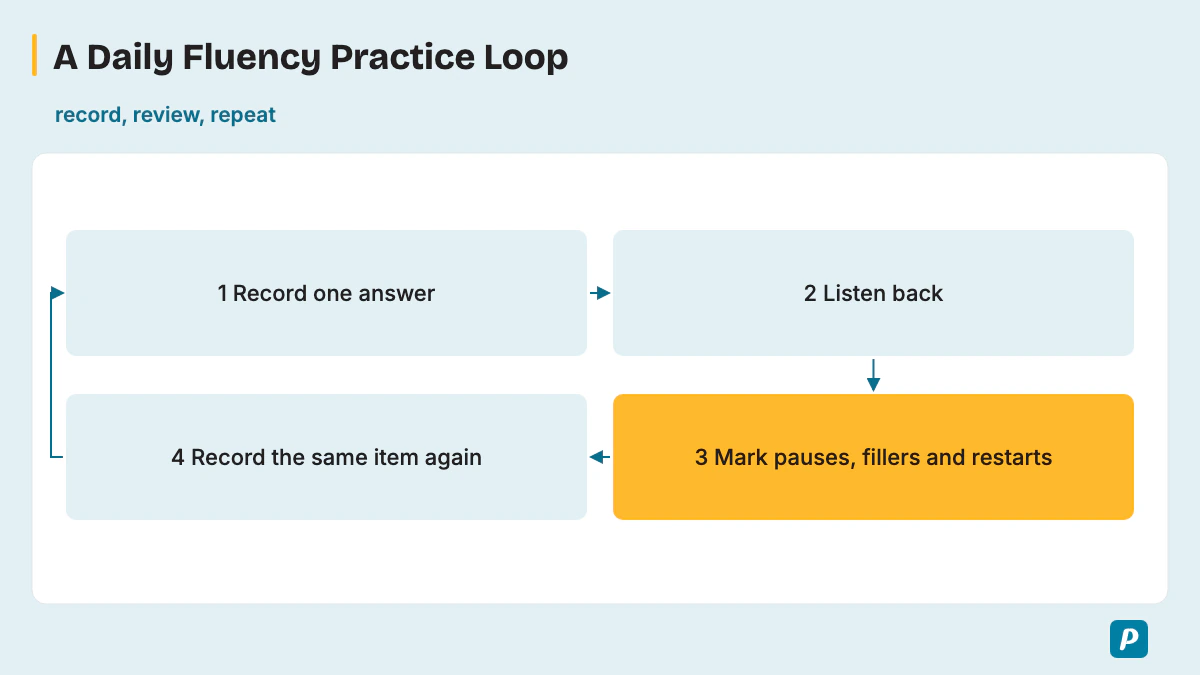
Record yourself and listen back: Pearson suggests this if you speak too slowly or too fast, and it shows hesitations you don't notice while speaking. Make oral fluency practice a short daily loop.
- Record one answer per task each day.
- Mark every pause and filler, and count the restarts.
- Check for the signs Pearson's Score Guide lists below a 5: hesitations, repetitions, false starts, long pauses and uneven or staccato rhythm.
- Record the same item again and compare.
10. Improve English Speaking Fluency Every Day
Fluency grows from daily use: Pearson's advice is to speak English as often as you can, and to read, listen and write in English as much as possible after you book. Plan daily practice in short sessions you can keep up.
- Join an English-speaking club or a short course.
- Try shadowing short audio, such as news or talks, at the same pace.
- For an even rhythm, read along to a slow metronome or pacing app, one beat per stressed word.
- Run a one-minute drill: speak on a random topic without stopping, as a practice habit rather than a Pearson rule.
How Do You Improve Fluency Across PTE Speaking?
Apply the same habits in every one of the fluency-scored tasks, practice under each task's real timer, and check the related rules that affect how long you can pause. A simple weekly routine works: one recorded answer per fluency-scored task, reviewed for pauses, fillers and restarts.
What Is the 3-Second Rule in PTE?
Pearson's 3-second wording appears in the Answer Short Question rules: wait more than three seconds, or stop for three seconds while speaking, and the recording closes. Pearson adds "This also applies to speaking item types Read aloud, Repeat Sentence, Describe Image and Re-tell Lecture", four of the fluency-scored tasks. It isn't part of the Oral Fluency trait itself. Our page on the 3-second rule in PTE speaking explains where it applies.
How Is Pronunciation Different From Oral Fluency?
Pronunciation checks whether most regular speakers can understand your sounds and word stress; Oral Fluency checks whether your speech flows at a smooth, natural rate. An answer can be understandable yet choppy, or flowing at a smooth rate yet unclear. See PTE pronunciation for that trait.
Does Answer Short Question Score Oral Fluency?
No, Answer Short Question is scored only correct or incorrect, so one or a few right words matter more than how smoothly you say them, and a short answer is what Pearson asks for. The PTE answer short question page explains the task.
How Do You Practice Oral Fluency PTE Questions?
Fluency practice works best on real PTE-style speaking items, each recorded once under its own timer and reviewed for pauses and restarts. Read more on the benefits of online PTE practice, including recorded answers you can replay.
How Does Oral Fluency Fit Into PTE Speaking?
Oral Fluency is one of three traits, with Content and Pronunciation, that most PTE speaking tasks score, and those task scores feed the Speaking skill score and the overall score. Answer Short Question is the exception. The PTE speaking section overview shows every task in order.
Practice PTE Speaking on EasyEnglish
Try Speaking tasks in a timed, computer-based format like the real test.
Try speaking practice without signing up. A free account is required for full mock tests. Practice scores are estimates, not official Pearson scores.
Written by
EasyEnglish Team
The team behind EasyEnglish's PTE practice and mock tests
EasyEnglish provides PTE practice and independent preparation guides. Official test rules are checked against the sources identified in each guide; practice examples are illustrative, not real exam questions. Practice scores are estimates. Questions or corrections: support@inverseai.com. EasyEnglish is not affiliated with or endorsed by Pearson.
Editorial review completed .