8 Tips for PTE Retell Lecture Practice
PTE Speaking
A lecture of up to 90 seconds plays once, your lecture notes fill the noteboard, and a short tone gives you 40 seconds to speak.
The winning answer in Retell Lecture is a connected retelling in your own words: the topic, three or four linked points and the conclusion. Pearson gives no credit for an unoriginal response, so a memorized script won't save you. Retell Lecture appears only in PTE Academic and PTE Academic UKVI, and the eight tips that follow come from Pearson's own advice and its current Score Guide.
Table of Contents
Why Is Retell Lecture Significant in PTE Academic?
Retell Lecture counts toward your listening score and your speaking score at once, and Pearson's Score Guide lists 2-3 items per test. It's a task for PTE Academic only, since PTE Core's task list has no Retell Lecture. AI scores Content (0-6), Pronunciation and Oral Fluency (0-5 each), and a human review of Content follows before Pearson confirms the score. Pearson gives no credit for an unoriginal response and the final result also considers question difficulty and weighting; train both skills without treating a task percentage as a score prediction.
How Do You Approach Retell Lecture Step by Step?
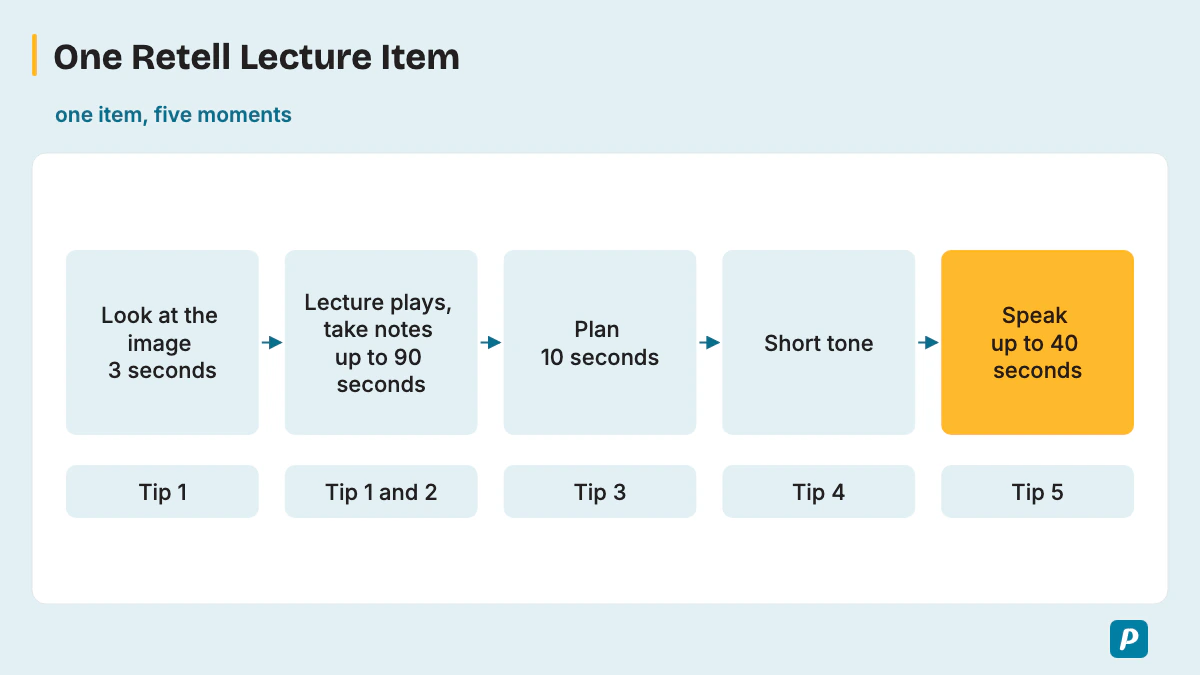
The approach is simple: look at the image for 3 seconds, take notes while the lecture of up to 90 seconds plays, and use the 10 seconds to prepare. Then start after the short tone and speak for up to 40 seconds. You record once, and each moment of a single item matches one of the tips.
- Preview the image for 3 seconds and predict the topic (tip 1).
- Note short phrases while the audio or video lecture runs up to 90 seconds (tips 1 and 2).
- Spend the 10 seconds to prepare on your first sentence (tip 3).
- Start speaking right after the short tone, linking each idea (tip 4).
- Keep talking until the 40 seconds are nearly used (tip 5).
Pearson's tip for the image is to "think about the vocabulary you might hear" during those 3 seconds, so name the subject to yourself before the audio starts. When the image is a chart or diagram and the lecturer talks about it, copy one or two of its labels or figures into your notes. Some prep sites say the lecture runs "40 to 90 seconds" or "60 to 90 seconds". Pearson states only "up to 90 seconds", so expect short lectures too.
1. Master Effective Note-Taking With Symbols
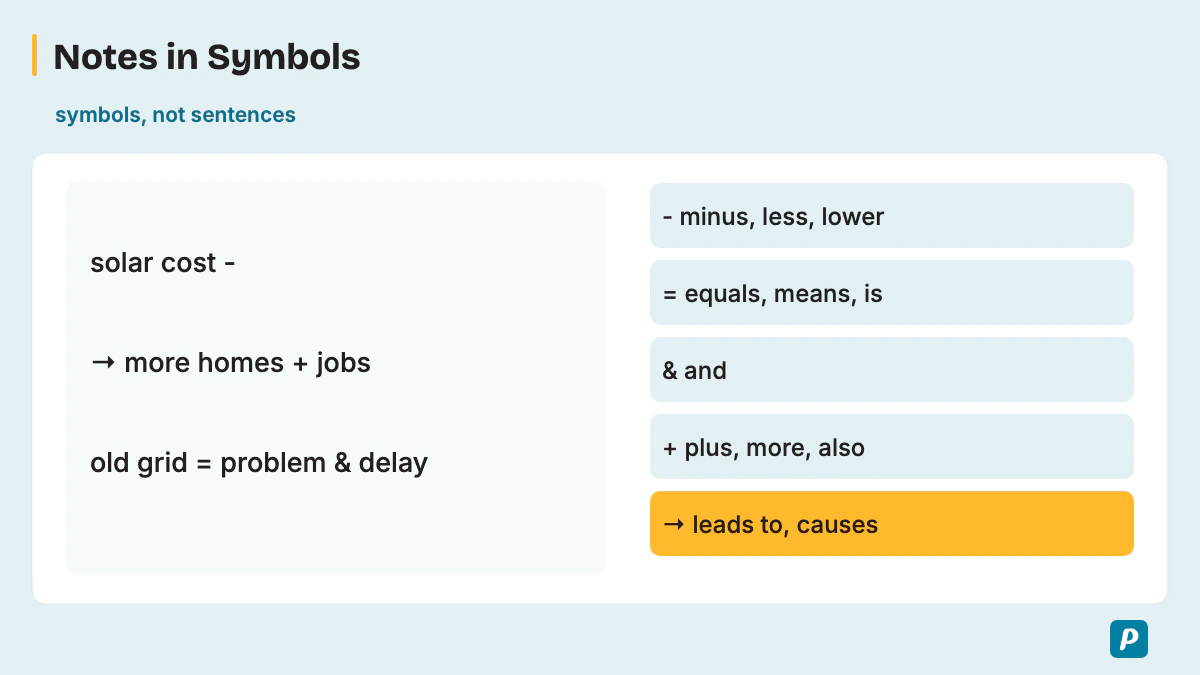
Good note-taking means short phrases and symbols, never full sentences. Pearson's Retell Lecture article suggests symbols and arrows such as - = & + plus bullet points, and you write on the erasable noteboard while the audio plays. Keep the first line for the topic: if the lecturer names it at the start, that line becomes your opening sentence. Give each idea its own line so you have room to draw how ideas connect, and copy names and numbers exactly.
Symbols save time because one mark replaces a whole phrase. A line like "solar cost - → more homes + jobs" holds a cause and two results in a few marks, and "old grid = problem & delay" pins a definition and a pair.
The key below pairs Pearson's symbols with common note abbreviations, each with a sample note.
| Symbol | Meaning | Sample note |
|---|---|---|
| - | minus, less, lower | rain - → crops - |
| = | equals, means, is | GDP = total output |
| & | and | trade & ideas |
| + | plus, more, also | + bike lanes |
| → | leads to, causes | heat → bleaching |
| ← | comes from, caused by | resistance ← overuse |
| ↑ | rise, increase | bus use ↑ |
| ↓ | fall, decrease | car trips ↓ |
| b/c | because | b/c parking fee |
| e.g. | for example | e.g. paper, compass |
| vs | compared with, against | 2015 vs 2025 |
| ≠ | is not, differs from | memory ≠ fixed |
| ~ | about, roughly | ~ half of trips |
| w/ | with | trees w/ shade |
| w/o | without | algae w/o color |
| ∴ | so, therefore | ∴ cities hotter |
Drill: take notes on a lecture clip of up to 90 seconds, close the audio, and retell it from the notes alone.
2. Retell the Lecture's Key Points and Relationships
Your answer should name the key points and show their relationships: cause, contrast or result. Pearson's Content trait looks for the situation, characters, aspects, actions and developments, plus their relationships, possible developments and conclusions or implications. A list of facts misses half of that. Pearson puts it plainly: "Mentioning a few disjointed ideas will negatively affect your score."
The lecturer's transition words tell you where each relationship sits, so note the symbol the moment you hear one.
| Transition words the lecturer says | Relationship it marks | How to note it |
|---|---|---|
| first, to begin with | the first point | 1. |
| in addition, also | another point of the same kind | + |
| however, on the other hand | contrast | vs or ≠ |
| although, despite | concession | but |
| because, due to | cause | b/c or ← |
| as a result, therefore | result | → or ∴ |
| for example, for instance | example | e.g. |
| in contrast, whereas | comparison | vs |
| this means that | implication | = |
| finally, lastly | the last point | last |
| overall, to sum up | conclusion | ∴ or a boxed line |
The current Score Guide scores Content from 0 to 6, and the levels below paraphrase its wording. Some prep sites still show an older 0-5 Content scale with different descriptions.
| Content score | What the Score Guide describes |
|---|---|
| 6 | Full comprehension; main ideas paraphrased smoothly in your own words, important points expanded with specifics, ideas well connected |
| 5 | Main ideas and some important details, own words with minor slips, ideas connected and easy to follow |
| 4 | Some main ideas and details, possibly a few inaccurate ideas or minor details, ideas not well connected |
| 3 | Some ideas, main points not separated from details, possible irrelevant information or lecture wording repeated without reformulation, mostly unconnected |
| 2 | Mostly inaccurate or incomplete, heavy repetition of lecture language, hard to follow |
| 1 | Isolated words and phrases from the lecture with no hierarchy of ideas |
| 0 | Related to the lecture but too limited for a higher score |
Drill: after each practice lecture, say the one main idea and two links between key points before you start recording.
3. Use the 10-Second Preparation Window
Once the lecture ends, 10 seconds pass before the microphone opens, and that preparation window is for planning, not panic.
Circle the main idea in your notes, fix your opening sentence and tick the three or four points you'll cover. Take one breath, then start right after the tone. Don't speak early, because Pearson warns that your voice isn't recorded before the microphone opens. A ready first line lets you start without a hesitation or a false start, and Pearson's Oral Fluency trait counts both against you.
Drill: before each practice answer, say your opening sentence silently while a 10-second timer runs.
4. Link Ideas in Your Speaking and Delivery
Join your points with linking words such as "so" and "then" and relative clauses with "which", "who" and "that", the two tools Pearson's Retell Lecture article recommends. They make the answer sound connected rather than listed.
For delivery, Pearson's Oral Fluency trait rewards a constant, natural rate with appropriate phrasing. Pearson's instructions also tell you to speak clearly and say there's no need to rush. The Score Guide's top Pronunciation level includes correct word stress and appropriate sentence stress, so lift the key words instead of speaking in a flat tone. Pearson also recognizes regional and national varieties of English pronunciation when most regular speakers understand them easily.
Keep this bank of short connectors ready and pick the one that fits the relationship in your notes.
| Job | Connectors |
|---|---|
| Adding a point | also, in addition, on top of that |
| Contrast | however, but, whereas |
| Cause and result | because, so, as a result, which means |
| Example | for example, such as |
| Relative clause | which, who, that, where |
| Sequence | first, then, after that, finally |
| Conclusion | overall, so the lecturer concludes that |
Drill: retell one lecture twice, adding one relative clause and one result connector the second time.
5. Speak for Up to 40 Seconds in Retell Lecture
You have 40 seconds of speaking time, and Pearson's advice is to speak for up to 40 seconds. Its article explains that the longer you speak, the more likely you are to cover the content requirements. Finish before the progress bar reaches the end.
Some prep sites set a "25 to 35 seconds" target; Pearson's pages give no such target. Pearson also says you can't mention everything in 40 seconds, so plan three or four main points plus the conclusion, a practice habit rather than a Pearson rule.
Drill: time three practice answers in a row and note where each one ran short or got cut off.
6. Skip the Retell Lecture Template and Use Your Own Words
Pearson gives no credit for an unoriginal response and says "You must use your own words". Its Retell Lecture article adds that a significant amount of pre-memorized content gets a score of 0, with fluency and pronunciation not scored. The Score Guide lists the same case among responses that earn no points.
Some prep sites still sell a fill-in template; Pearson's page says "Do not use memorized responses or templated sentences." Use a structure instead of fixed sentences: main idea, key points, how they relate, conclusion. That shape comes from tip 2 and changes with every lecture, so your sentences change with it.
7. Avoid Common Mistakes in PTE Retell Lecture
Each of these eleven common mistakes costs Content, Oral Fluency or Pronunciation, and each one has a fix you can practice.
- Disconnected key words: listing terms without links costs Content, so join every point to the next with a linking word.
- Trying to mention everything: a crowded answer leaves no time for the conclusion, so cap your plan at three or four points.
- Filler words: words that aren't about the lecture add nothing to Content, so cut stock phrases that could fit any lecture.
- "Um" and "uh": these hesitation sounds break your rhythm and cost Oral Fluency, so pause silently for a moment instead, well under three seconds.
- Self-correction and hesitation: restarts waste seconds and cost Oral Fluency, so keep going after a slip.
- Your own opinion or invented facts: the Score Guide marks Content down for inaccurate ideas and irrelevant information, so retell only what the lecturer said.
- Lecture sentences repeated word for word: repetition without reformulation sits at Content 3 or lower, so paraphrase each point.
- Rushing: Pearson says there's no need to rush, and a steady pace keeps your words clear for Pronunciation.
- A flat, monotone delivery: sentence stress is part of the top Pronunciation level, so stress the key word in each sentence.
- A long silence: a three-second pause can end the recording, so read the next note aloud rather than stop.
- Speaking before the microphone opens: nothing is recorded, so wait for the tone.
Pearson's tip covers the hesitation habit directly: "If you repeat ideas, correct yourself or hesitate, you will use up valuable time and lose score points. So keep talking and ignore any mistakes that you make."
8. Practice With Retell Lecture Sample Answers
Study a worked sample to see the shape of a strong answer, then record your own answer and use recording playback to compare it with your notes. Run a quick self-review with four checks: did you name the main idea, link the points, reach the conclusion and keep talking without restarts? Sample answers show structure, so don't memorize them, because pre-memorized content scores 0.
Practice scores from any app, ours included, are estimates and not official Pearson scores. The three samples below are original, and each model answer runs 86 to 91 words, so read it aloud against a 40-second timer and cut a clause if you run over.
Sample 1: Urban heat islands
Lecture transcript:
Today I want to look at why cities are often warmer than the countryside around them, an effect called the urban heat island. The first cause is the surface itself. Asphalt roads and dark roofs absorb sunlight during the day and release that heat slowly at night, so city nights stay warm. A second cause is the loss of vegetation.
Trees and soil cool the air as water evaporates from them, but concrete offers no such cooling. On top of that, cars, factories and air conditioners all give off waste heat. The consequences are serious. Hot nights put elderly people at greater risk of heat illness, and higher temperatures push up demand for electricity.
However, cities can respond. Planting street trees, building green roofs and painting roofs in light, reflective colors all lower surface temperatures. So the heat island is largely a design problem, which means better design can reduce it.
Notes: topic: city heat island / dark surfaces → absorb heat, release @ night / - trees = - evaporation cooling / + waste heat (cars, AC) / → risk elderly + electricity ↑ / fix: trees, green roofs, light roofs / ∴ design problem
Model answer:
The lecture explained why cities are warmer than nearby rural areas. First, dark roads and roofs take in heat during the day and give it back at night, so evenings stay hot. Second, cities have fewer trees, which normally cool the air through evaporation.
Traffic and air conditioners also add waste heat. As a result, older people face more heat illness and electricity use rises. However, street trees, green roofs and light-colored roofs can cool cities, so the lecturer concluded that better urban design can reduce the problem.
What makes it work: the first sentence names the topic, "First", "Second" and "also" carry three causes, "As a result" links them to the effects, and the last sentence gives the lecturer's conclusion.
Sample 2: The printing press
Lecture transcript:
In the mid-fifteenth century, Johannes Gutenberg developed a printing press with movable metal type in the German city of Mainz. Before this, books in Europe were mostly copied by hand, which made them slow to produce and very expensive. Movable type changed that, because individual letters could be arranged, printed and then reused for the next page. As a result, books became faster and cheaper to make, and printing workshops spread to many European cities within a few decades.
The effects went far beyond the book trade. Cheaper books helped more people learn to read, and printed copies meant that everyone reading a text saw the same words, which made knowledge easier to share and check. Printed pamphlets also allowed new religious and political ideas to travel quickly. In short, the printing press did not just make books; it changed how ideas moved through society.
Notes: Gutenberg, Mainz, mid-1400s, movable metal type / before: hand copy → slow & expensive / letters reused → faster + cheaper / workshops spread / effects: literacy ↑, same text = share & check / pamphlets → ideas fast (religion, politics) / ∴ changed how ideas moved
Model answer:
The lecturer talked about Gutenberg's printing press, which he built in Mainz in the mid-fifteenth century. Before it, books were copied by hand, so they were slow to make and costly. Because movable type let printers reuse letters, books became quicker and cheaper, and print shops soon spread across Europe.
This led to wider reading, and identical copies made knowledge easier to share and check. Pamphlets also carried religious and political ideas quickly. Overall, the lecturer argued that printing changed the way ideas spread through society.
What makes it work: one relative clause ("which he built") adds detail without a new sentence, "Because" and "This led to" show cause and effect, and "Overall" introduces the implication.
Sample 3: How students travel to campus (image-based, fictional practice data)
Image: a bar chart titled "How students travel to campus, 2015 and 2025" for a fictional university. Car 48% to 30%, bus 22% to 28%, bicycle 12% to 25%, walking 18% to 17%.
Lecture transcript:
This chart comes from a survey of how students at one university travel to campus, and it compares 2015 with 2025. The biggest change is in car use, which fell from 48 percent to 30 percent. Over the same period, cycling roughly doubled, rising from 12 to 25 percent, and bus use grew from 22 to 28 percent. Walking stayed almost flat at around 17 or 18 percent.
Why did this happen? The university built protected bike lanes linking the main student housing areas to campus, and it raised parking fees. It also introduced a discounted bus pass for students. The result has been less traffic around campus at peak hours.
However, the planners note that walking has not grown, probably because most students live too far away to walk. So the lesson is that travel habits respond to price and infrastructure, but distance still sets a limit.
Notes: uni travel 2015 vs 2025 / car ↓ 48 → 30 / bike ↑ 12 → 25 (~ double) / bus ↑ 22 → 28 / walk ~ flat 18 → 17 / b/c: bike lanes, parking fee ↑, cheap bus pass / → traffic ↓ peak / but walk ≠ grow b/c distance / ∴ price & infrastructure, distance = limit
Model answer:
The lecture described a survey of how students reached one university in 2015 and 2025. Car travel dropped from 48 to 30 percent, while cycling about doubled to 25 percent and bus use rose to 28 percent. Walking hardly changed.
The lecturer said the shift came from new protected bike lanes, higher parking fees and a cheaper bus pass, which cut peak-hour traffic. However, walking did not grow; the planners suggested this might be because most students live too far away. So the main point was that cost and infrastructure change travel habits, but distance still limits them.
What makes it work: every figure in the answer matches the chart and the lecture, "while" sets two trends side by side, and the final sentence states the lesson rather than a new opinion.
Drill: score one recording a day against the four checks above.
How Do You Practice Retell Lecture Effectively?
Effective practice means short timed practice sets: one lecture of up to 90 seconds, notes, 10 seconds to plan, 40 seconds to speak, then a replay. Run the review loop with tips 2, 4 and 7 in mind, and fix one weakness before the next lecture. Beyond test-style items, cut 60 to 90 second segments from recorded university lectures, academic podcasts or TED talks. Mix in subjects you don't know, so an unfamiliar word doesn't stop your notes.
What Are the Retell Lecture Format and Scoring Rules?
Retell Lecture gives you an audio or video lecture of up to 90 seconds, 10 seconds to prepare and 40 seconds to answer, and you record once. Pearson scores it with partial credit on three scoring traits, Content, Pronunciation and Oral Fluency, and the task assesses listening and speaking. The task page sets out the full format, the scoring rules and how each trait is judged in PTE Retell Lecture format and scoring.
How Does the 3-Second Rule Affect Retell Lecture?
Pearson sets out the 3-second rule in its Answer Short Question instructions. If you stop for three seconds while speaking, the recording status changes to completed even if you haven't finished. Pearson then adds that this "also applies to speaking item types Read aloud, Repeat Sentence, Describe Image and Re-tell Lecture".
So a long pause ends your Retell Lecture answer, and pausing to search your notes is the habit to break. Read more about the 3-second rule in PTE speaking.
What Retell Lecture Practice Questions Can You Try?
These eleven practice lectures are original transcripts. The first ten run 105 to 125 words each, and lecture 11 runs about 200 words, close to the 90-second maximum. Ask someone to read one aloud at a steady pace, or paste it into a text-to-speech tool, then take notes without looking at the text and answer in 40 seconds.
Practice lecture 1: Coral bleaching (environment)
Coral reefs depend on a partnership. Tiny algae live inside coral tissue and supply the coral with most of its food through photosynthesis, and they also give reefs their color. When sea water stays unusually warm for weeks, this partnership breaks down. The stressed coral expels the algae and turns white, which is why we call it bleaching.
A bleached coral isn't dead yet. If temperatures fall soon enough, the algae can return and the coral recovers. However, if the heat lasts too long, the coral starves. This matters far beyond the coral itself, because reefs shelter a huge variety of fish and protect coastlines from waves. So rising ocean temperatures threaten whole ecosystems, not just a single species.
Practice lecture 2: Opportunity cost (economics)
Economists use the term opportunity cost for the value of the best option you give up when you make a choice. Imagine a student who spends an evening working a paid shift instead of studying. The money is visible, but the cost is the study time she lost. Businesses face the same trade-off.
A factory that uses its machines to make one product can't use them to make another at the same time. The idea also applies to governments, since money spent on roads can't be spent on hospitals. The key point is that every choice has a hidden cost, even when no money changes hands. So good decisions compare options, not just prices.
Practice lecture 3: Antibiotic resistance (health)
Antibiotics kill bacteria or stop them from growing, and they've saved millions of lives. The problem is that bacteria evolve. When an antibiotic is used, the few bacteria that happen to survive it can multiply and pass on their resistance. Over time, a drug that once worked well can lose its effect.
Overuse speeds this up. Antibiotics are sometimes taken for viral infections such as colds, where they don't help at all, and they're widely used in farm animals. Doctors therefore ask patients to take antibiotics only when prescribed and to follow the prescription exactly. The lecture's message is that antibiotics are a shared resource, and careless use today makes infections harder to treat tomorrow.
Practice lecture 4: Forests and carbon (science)
Forests play a quiet part in the climate system. Through photosynthesis, trees take carbon dioxide from the air and store the carbon in their wood, roots and the soil beneath them. That's why scientists call forests carbon sinks. However, the process also runs in reverse.
When forests are cleared or burned, much of that stored carbon returns to the atmosphere. Young forests and old forests also behave differently, because old forests hold large stores of carbon that took centuries to build. As a result, protecting an existing forest keeps its carbon locked away now, while newly planted trees need decades to store as much. So forests can either slow climate change or add to it, depending on how we manage them.
Practice lecture 5: The Silk Road (history)
The Silk Road wasn't one road. It was a network of trade routes that linked China with Central Asia, the Middle East and the Mediterranean for many centuries. Silk was the famous export, but merchants also carried spices, horses, glass and precious metals. Cities along the way, such as Samarkand, grew rich as trading hubs. More importantly, ideas moved along the same routes.
Religions such as Buddhism spread along them, and technologies such as papermaking traveled west from China. Unfortunately, diseases traveled too, carried by people and animals on the move. So the lecturer's main point is that trade routes connect whole cultures, carrying knowledge and risks as well as goods.
Practice lecture 6: Confirmation bias (psychology)
Confirmation bias is our tendency to notice and remember information that supports what we already believe. For example, someone who thinks a certain diet works will remember the friend who lost weight and forget the three who didn't. The bias also shapes how we search. We tend to type questions that assume the answer we want, so the results agree with us.
This matters in science, which is why researchers use control groups and try to disprove their own ideas. In everyday life, a simple fix is to ask what evidence would change your mind. The conclusion is that we can't remove the bias, but we can design habits that check it.
Practice lecture 7: Loanwords in English (linguistics)
English has borrowed words from many languages. After the Norman Conquest in 1066, French became the language of the ruling class in England, and thousands of French words entered English, especially in law, government and food. That's why English has pairs such as 'cow' and 'beef', with the animal name from Old English and the meat name from French. Later, scholars borrowed from Latin and Greek for science.
Trade and empire brought words from further away, including 'shampoo' and 'bungalow' from Indian languages. The lecturer's point is that English vocabulary is a record of contact between peoples, and every borrowing reflects a moment in history.
Practice lecture 8: The fifteen-minute city (urban planning)
The fifteen-minute city is a planning idea associated with the researcher Carlos Moreno and promoted by the city of Paris. The goal is that people can reach daily needs such as shops, schools, parks and doctors within a short walk or bike ride from home.
Supporters argue that this cuts traffic and pollution and gives people back time they now spend commuting. It also asks cities to mix housing and services in every neighborhood, instead of separating homes from workplaces.
Critics, however, worry about cost and about whether every district can really offer everything. So the idea is less a fixed plan than a direction for how cities might grow.
Practice lecture 9: The spacing effect (education)
In the nineteenth century, the psychologist Hermann Ebbinghaus tested his own memory by learning lists of nonsense syllables. He found that we forget new information quickly at first, then more slowly, a pattern known as the forgetting curve. He also found that reviewing material several times, spread out over days, kept it in memory far longer than cramming it in one session. This is called the spacing effect.
Later research has repeatedly supported it. For students, the practical lesson is to plan short reviews at growing intervals rather than one long session before a test. In short, when you study matters as much as how long you study.
Practice lecture 10: How GPS finds your position (technology)
A GPS receiver, like the one in your phone, doesn't send anything to the satellites. Instead, it listens. Each satellite constantly broadcasts its position and the exact time from an onboard atomic clock. The receiver measures how long each signal took to arrive, and since the signals travel at the speed of light, it can work out its distance from each satellite.
With signals from at least four satellites, it can calculate its position and correct its own less accurate clock. Timing is everything, because a tiny clock error becomes a large position error. So GPS is really a timing system that turns very precise clocks into location.
Practice lecture 11: Why bees matter to farming (agriculture, full length)
Today's topic is pollination, and why bees matter so much to the food we eat. Many flowering plants can't make seeds or fruit unless pollen moves from one flower to another. Wind carries pollen for crops such as wheat and rice, but many fruits, nuts and vegetables depend on animals, and bees are the most important of them.
As a bee collects nectar, pollen sticks to its hairy body and rubs off on the next flower it visits. Farmers who grow crops such as almonds, apples and blueberries often rent hives during flowering season for exactly this reason. However, bee populations face several pressures at once.
The first is habitat loss, because large single-crop farms offer flowers for only a few weeks a year. The second is pesticides, some of which can harm bees even when they don't kill them directly. Disease and parasites, such as the varroa mite in honeybees, add further stress.
So what can be done? Farmers can plant strips of wildflowers between fields, time spraying to avoid flowering periods and protect wild bee species as well as managed hives. The main point is that pollination is a service nature provides for free, and losing it would make many foods scarcer and more expensive.
After each answer, check it against tip 2: one main idea, at least two links between points, and the lecturer's conclusion.
Where Can You Practice Retell Lecture for Free?
Free practice works best when it plays the lecture once and records you, so you train under test conditions. PDF tips can explain the method, but they can't record your answer. Audio playback of your own answer shows the pauses and restarts that notes hide. For timed Retell Lecture items with playback, create a free account, and see the benefits of online PTE practice before you plan your week.
How Does Retell Lecture Help You Get 79 in PTE Listening?
Retell Lecture is one of the Speaking & Writing tasks that Pearson says also assesses listening, so better notes here feed your Listening score as well as your Speaking score. Treat it as one integrated task among several; improvement on one task cannot guarantee 79 in Listening. The PTE listening section guide covers the other tasks.
Frequently Asked Questions
How Long Should You Speak in Retell Lecture?
Pearson advises speaking for up to 40 seconds, because the longer you speak the more likely you are to cover the content requirements. Finish before the progress bar reaches the end and plan three or four points plus the conclusion.
Should You Use a Template in Retell Lecture?
No. Pearson says not to use memorized responses or templated sentences; a significant amount of pre-memorized content gets a score of 0, with fluency and pronunciation not scored.
Practice PTE Speaking on EasyEnglish
Try Speaking tasks in a timed, computer-based format like the real test.
Try speaking practice without signing up. A free account is required for full mock tests. Practice scores are estimates, not official Pearson scores.
Written by
EasyEnglish Team
The team behind EasyEnglish's PTE practice and mock tests
EasyEnglish provides PTE practice and independent preparation guides. Official test rules are checked against the sources identified in each guide; practice examples are illustrative, not real exam questions. Practice scores are estimates. Questions or corrections: support@inverseai.com. EasyEnglish is not affiliated with or endorsed by Pearson.
Editorial review completed .