What Is the 3-Second Silence Rule in PTE Speaking?
PTE Speaking
The microphone opens, you hesitate for a moment, and the recording status on screen flips to "Completed" before you've said a word. That's the 3-second rule. Pearson writes it inside its Answer Short Question instructions for both PTE Academic and PTE Core, then extends it to four more speaking tasks. Start promptly when Recording appears and avoid long silences on the tasks Pearson names. A two-second start target is a practice habit, not a separate Pearson rule or a score guarantee.
Table of Contents
What Is the 3-Second Rule in PTE?
The 3-second rule is the point where the recording stops if you stay silent for three seconds, and Pearson's wording covers two moments. The first moment comes before you start, when the recording stops early.
"If you wait for more than three seconds, the recording will stop and the item status will change to 'completed', which means that you have lost your chance to give your answer".
The second moment comes once you're talking.
"If you stop for three seconds whilst speaking, the recording status will change to 'completed' even if you haven't finished, and you won't be able to continue answering".
That Pearson wording sits in the Answer Short Question block of the PTE Academic page; the PTE Core page has the same rule with "while" and a capital "Completed". Pearson's own tip goes further than the cut-off: "don't stop for more than a second or two until you have finished".
How Does the 3-Second Rule Work?
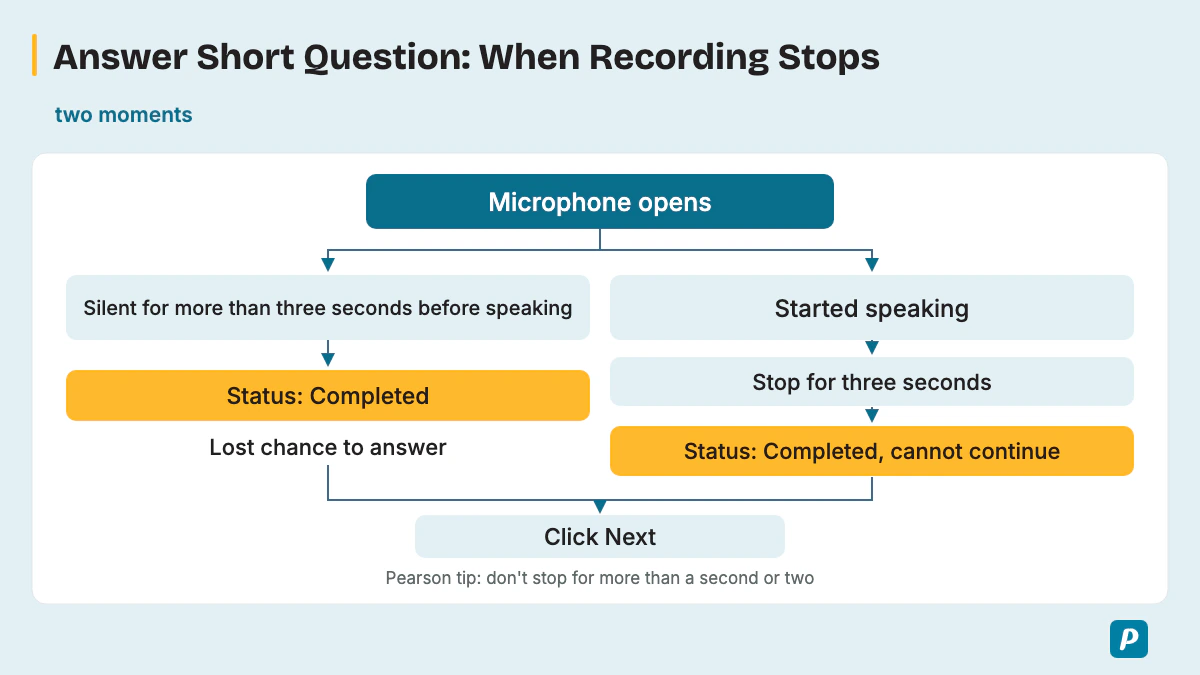
The rule triggers at two moments: a start delay of more than three seconds, or a mid-answer pause of three seconds. Either way the status changes to "Completed", and Pearson requires you to move on with the Next button.
| Moment | What Pearson says happens | What it costs you |
|---|---|---|
| Start of the answer | The recording stops after more than three seconds of silence. | You lose your chance to answer. |
| Mid-answer pause | A three-second stop ends the recording. | Anything you hadn't said goes unscored. |
| After Completed status | You click Next to move on. | No way back to the item. |
"Start" means the moment the microphone opens. In PTE Academic, Read Aloud, Repeat Sentence, Describe Image, Retell Lecture, Summarize Group Discussion and Respond to a Situation play a short tone at that point, while Answer Short Question has no short tone. On the PTE Core page, Repeat Sentence also has no short tone, so speak as soon as the audio ends. The system listens for your voice, so speak clearly at your normal volume rather than a whisper.
Some prep sites say the voice check lasts "three to four seconds"; Pearson says three seconds.
Which PTE Speaking Tasks Does the 3-Second Rule Affect?
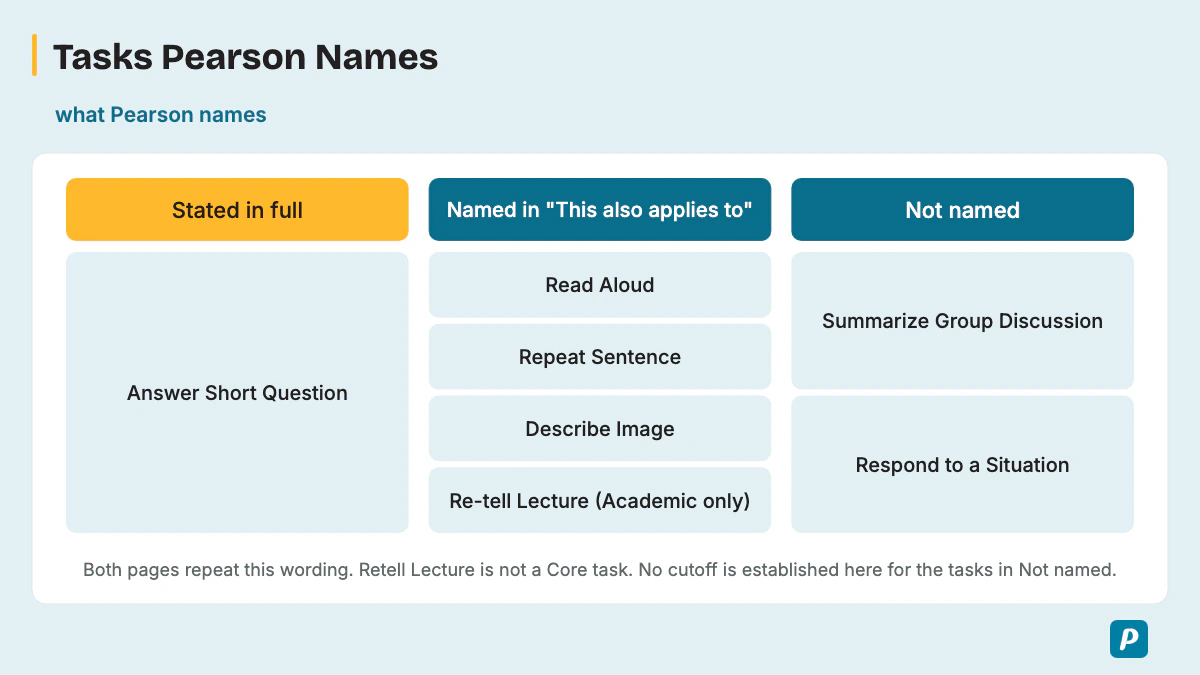
Pearson states the rule for Answer Short Question and then writes "This also applies to speaking item types Read aloud, Repeat Sentence, Describe Image and Re-tell Lecture". It doesn't name Summarize Group Discussion or Respond to a Situation, and the table sets out each task.
| Task | Variant | What Pearson's page says |
|---|---|---|
| Answer Short Question | Academic and Core | Rule stated in full. |
| Read Aloud | Academic and Core | Named in "This also applies to". |
| Repeat Sentence | Academic and Core | Named in "This also applies to". |
| Describe Image | Academic and Core | Named in "This also applies to". |
| Re-tell Lecture | Academic only | Named in "This also applies to". |
| Summarize Group Discussion | Academic only | Not named. |
| Respond to a Situation | Academic and Core | Not named. |
| Personal Introduction | Unscored | Not named. |
The "This also applies to" sentence comes right after the click-Next line, so plan for the full rule (start fast, never stop for three seconds) in all five named tasks. For the unnamed tasks, Pearson's blocks say only to finish before the progress bar reaches the end.
The PTE Core page repeats the same sentence, Re-tell Lecture included, even though PTE Core has no Retell Lecture, so read that as a copied line.
What Happens If You Start Speaking Late After the Beep?
In Answer Short Question, a late start ends the item, and Pearson says you have "lost your chance to give your answer". That lost chance counts as no response, and Pearson gives no credit for no response. Pearson extends the rule to Read Aloud, Repeat Sentence, Describe Image and Retell Lecture, so a late start after the short tone carries the same risk there. Don't speak early either, because the system records nothing said before the microphone opens.
Is It Okay to Pause While Answering?
Short, natural pauses at commas and full stops are fine, but Pearson's tip is not to stop for more than a second or two, and a three-second stop ends the recording. Silence still costs Oral Fluency: Pearson's Score Guide treats hesitations as fluency errors, allowing no more than one for a 4 out of 5 and one long pause for a 2. Pearson's Retell Lecture advice is to "keep talking and ignore any mistakes that you make". Once you have said everything, you can stop and let the recording close; in Respond to a Situation, though, Pearson asks you to try to speak for the whole 40 seconds.
Do Fillers Like Uh or Um Matter in PTE Speaking?
Yes, fillers lower Oral Fluency, because "um" and "uh" are hesitations, which Pearson's Oral Fluency trait penalizes, and Pearson doesn't say a filler stops the three-second cut-off. Some prep sites still advise fillers such as "Well, you see, Actually", but Pearson's page says hesitations lower your score. A planned linking phrase like "this shows that" or "another point is" moves your answer on to its next idea instead. Record one answer, count every "um" on playback, then record it again with a linking phrase in each of those spots.
How Can You Avoid Losing Marks to the 3-Second Rule?
Five habits target the exact moments the rule bites: the first second after the microphone opens and the gap between two ideas.
- Start the moment the microphone opens, since a late start costs the whole answer.
- Use the preparation time to fix an opening sentence before the tone.
- Never go back to fix a word; self-correction burns seconds and, in Read Aloud, adds words.
- Bridge a gap with a linking phrase, not silence, to protect Oral Fluency.
- Give short answers in Answer Short Question, because Pearson says "Do not try to give a long answer".
Have your first words ready before the tone, so the first second is never silent. Use openers such as "This chart compares…" or "Overall, the picture shows…" for Describe Image, and "The speaker explains how…" or "The talk is mainly about…" for Retell Lecture. Keep a few bridges for the gaps between ideas: "Moving to the next part…", "On top of that…", "A second point the speaker raises is…" and "Looking at the other side…".
Run this five-point check before the Speaking part begins:
- Wait for the microphone to open; nothing said before it is recorded.
- Speak within two seconds of the tone.
- Never stop for three seconds; bridge instead.
- Let small slips go.
- Keep the flow first, polish second.
How Do You Practice for the 3-Second Rule in Each Task?
The best practice session uses continuous recording that stops the way the test does, then drills the pause point each task is most likely to trigger. Work task by task: a late start hurts Answer Short Question and Repeat Sentence most, a mid-answer stall hurts Describe Image and Retell Lecture, and backtracking hurts Read Aloud.
Set a countdown timer that matches the task's preparation time, start recording when it ends, and begin speaking within two seconds. If you stop mid-answer, discard the take and record the whole item again rather than continuing. On playback, check only two things: did you start at once, and was there any break of about three seconds?
How Do You Start Fast in Answer Short Question?
Answer Short Question has no short tone, so the clock starts the moment the question ends. Say your one-word answer, or a few words, at once rather than building a sentence; Pearson scores it as correct or incorrect, so length adds nothing. More drills are on the PTE Answer Short Question page.
Why Does Self-Correction Cost You in Read Aloud?
In Read Aloud, going back to fix a word breaks your fluency. Pearson's Read Aloud tips warn that a self-correction "will be counted as added words". The Score Guide counts each insertion as one Content error, so fixing a slip adds an error rather than removing one. Read on past a slip instead. See PTE Read Aloud for the scoring.
How Do You Avoid Freezing in Repeat Sentence?
In Repeat Sentence, a long pause while you search for a lost word risks the cut-off. Say the words you have, in word order, and keep going; a partial answer still offers something to score. Practice drills are in PTE Repeat Sentence tips.
How Do You Keep Talking Through Describe Image and Retell Lecture?
Describe Image and Retell Lecture each give you 40 seconds to fill, and running out of ideas mid-answer triggers the cut-off. Note three planned points in the preparation time. When one point runs out, a bridge phrase carries you into the next, so a sentence is always ready. Read more on PTE Describe Image.
Does the 3-Second Rule Apply to Summarize Group Discussion?
Pearson's three-second sentence does not name Summarize Group Discussion or Respond to a Situation; their blocks say only to finish before the progress bar reaches the end. Some prep sites claim the microphone closes after 3 seconds of silence in Summarize Group Discussion, but Pearson's Summarize Group Discussion block has no such sentence. On those tasks, keep a natural flow for fluency, but do not claim a verified three-second recording cutoff.
Pearson's Oral Fluency trait still measures every hesitation, so keep talking, as covered in PTE Summarize Group Discussion.
Will Speaking Fast Make You Sound Fluent?
No, Pearson's best responses keep a constant, natural rate with appropriate phrasing, so racing to avoid pauses trades one fluency problem for another. Pearson's Oral Fluency trait measures rhythm and phrasing, so speaking speed only helps when the phrasing stays natural. See oral fluency in PTE.
How Does the 3-Second Rule Fit Into PTE Speaking?
The timing rule affects what is captured before recording ends. In current PTE Academic, Answer Short Question contributes to Listening rather than Speaking; other tasks contribute to the skills identified in their score guide. A shorter recording can omit useful content, but it does not imply a fixed numerical deduction.
Practice PTE Speaking on EasyEnglish
Try Speaking tasks in a timed, computer-based format like the real test.
Try speaking practice without signing up. A free account is required for full mock tests. Practice scores are estimates, not official Pearson scores.
Written by
EasyEnglish Team
The team behind EasyEnglish's PTE practice and mock tests
EasyEnglish provides PTE practice and independent preparation guides. Official test rules are checked against the sources identified in each guide; practice examples are illustrative, not real exam questions. Practice scores are estimates. Questions or corrections: support@inverseai.com. EasyEnglish is not affiliated with or endorsed by Pearson.
Editorial review completed .