10 Common Challenges in PTE Speaking and How to Overcome Them
PTE Speaking
Timing, pronunciation and delivery habits can make speaking tasks harder. PTE Speaking records each answer once, on a strict clock, and Pearson's AI scores it on Content, Oral Fluency and Pronunciation. PTE Academic has seven scored speaking tasks in the Speaking section; PTE Core has five.
Table of Contents
1. Time Management
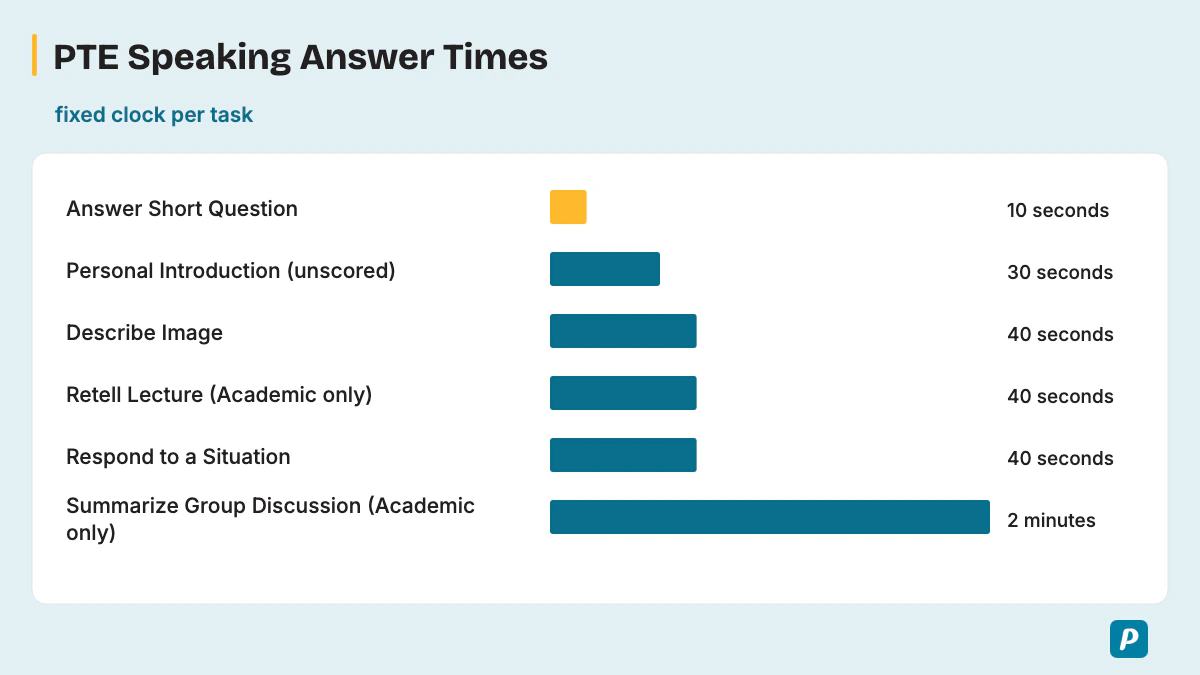
Each speaking task runs on its own fixed clock: 40 seconds of answer time for Describe Image, Retell Lecture and Respond to a Situation, 10 seconds for Answer Short Question and 2 minutes for Summarize Group Discussion. The progress bar closes the recording when time is up, and Pearson's status box changes from "Recording" to "Completed". Anything you haven't said by then is lost, and even the unscored Personal Introduction allows only 30 seconds. Repeat Sentence gives 15 seconds after a short tone on Pearson's Academic page, while the Core page shows 40 seconds and no tone.
- Practice every task with its real task timer, never an open-ended one.
- Plan the answer during the preparation time instead of rereading the prompt.
- Aim to finish a few seconds before the progress bar ends.
2. Fluency and Coherence
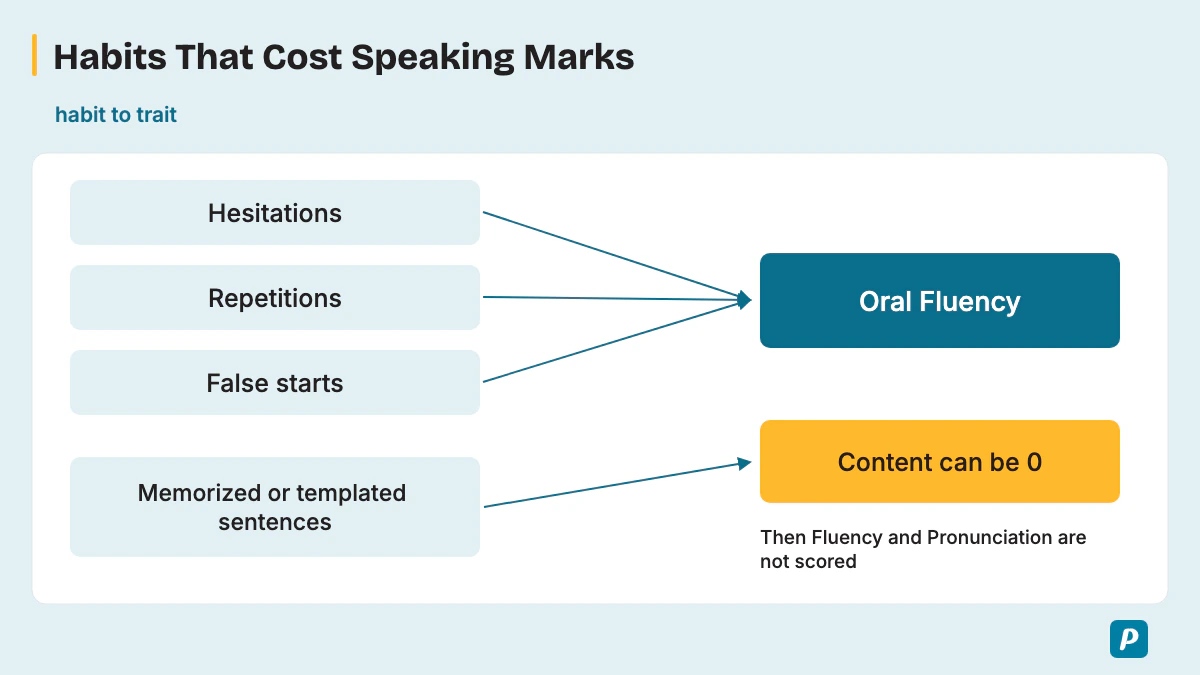
Pearson scores oral fluency on smooth rhythm, phrasing and stress at a constant, natural rate, and it says hesitations, repetitions and false starts lower it. Self-correction adds repetitions and false starts, and in Read Aloud Pearson counts a correction as added words. Speaking too fast is the other risk, because rushed words blur. Pearson's own line is plain: "There is no need to rush." Pearson's own tip for Retell Lecture, Summarize Group Discussion and Respond to a Situation says to keep talking and ignore mistakes.
- Keep talking after a slip instead of going back to fix it.
- Speak in meaning chunks and drop fillers such as "um".
- Link ideas with simple connectors like "because" and "as a result" so the answer stays coherent.
- Shadow a short clip at native speed for five minutes a day, speaking along with it to train rhythm and pace.
3. Pronunciation and Intonation
Pearson scores pronunciation on whether most regular speakers of English understand you easily, and it recognizes regional varieties of English to that degree. Pearson's FAQ adds that you're scored on what you say, not your accent, and Pearson says its scoring is trained on over 120 accents. Flat intonation and swallowed word endings are the real risks, because they make words hard to follow.
- Put word stress on the important words and pause at punctuation, as Pearson's confidence tips advise.
- Finish word endings such as "-ed" and "-s" clearly.
- Drill stress pairs where stress changes the word: a PROject but to proJECT, a PREsent but to preSENT.
- Let your voice rise at the end of yes/no questions and fall at the end of statements.
- Practice minimal pairs that change meaning, such as "bat" and "bet" or "thin" and "tin".
- Aim for clarity, not an imitation accent.
4. Repeat Sentence Memory Load
Repeat Sentence plays a 3-9 second sentence once, with no replay, and Pearson gives partial credit for correct word sequences. Long sentences strain short-term memory, and a single lost word can break the sequence. Chunking turns one long sentence into three or four short units you can hold. Speakers also use different accents, which makes an unfamiliar voice harder to follow.
- Listen in chunks of meaning rather than single words.
- Keep the rhythm going even when a word is lost.
- Practice with sentences that grow in length week by week.
- Train with recordings in several English accents, not just one.
- Leave the noteboard alone, as Pearson advises, and if a word is unclear, say what you think you heard.
5. Vocabulary
Open tasks such as Describe Image, Retell Lecture and Summarize Group Discussion need words for trends, comparisons and ideas, and Pearson gives no credit for an unoriginal response. That makes topic vocabulary more useful than memorized phrases. You need trend words to describe a graph and enough range to paraphrase a lecture in your own words.
- Build small topic word sets for trends, comparisons and cause and effect.
- Use each new word in your own sentences, out loud.
- Learn everyday general-knowledge words for Answer Short Question, which both Score Guides rate on a Vocabulary trait: 1 for an appropriate word choice, 0 for an inappropriate one.
6. Nervousness and Anxiety
PTE Speaking has no face-to-face examiner, and around 10-15 people may test in the same room, and you may hear your neighbors speak. With no examiner in front of you, the screen is your only audience. Test-day nerves show up as hesitations, so anxiety turns into an Oral Fluency cost. Confidence comes from repetition: a familiar format leaves less to react to on the day.
- Rehearse full timed runs so the format feels familiar.
- Use the seconds before recording to breathe slowly and plan your first sentence.
- Remember that Pearson says microphones won't pick up what neighbors say.
7. Organization and Structure
Pearson scores Content on how fully you cover the task, and its Describe Image advice puts it plainly. "If you organize what you say, you will get a better score." A rambling answer can miss the main point even when every sentence is correct. A flexible order of ideas keeps you on track without locking you into fixed sentences.
- For Describe Image, follow the labels on Pearson's sample answer: general content, main point, other details and conclusion.
- For Retell Lecture, take notes in shorthand with symbols such as -, =, & and arrows, as Pearson's lecture article suggests.
- For Summarize Group Discussion, paraphrase each speaker instead of retelling the discussion.
- Say the main point early, so your Content score doesn't depend on time running out.
8. Understanding Task Requirements
Each speaking task asks for something different, and PTE Academic added Summarize Group Discussion and Respond to a Situation in August 2025, so older guides miss them. Some older prep pages still print a 54-67 minute part with eight tasks; Pearson's current page says 76-84 minutes and nine question types for PTE Academic. Answering the wrong task requirements costs Content.
- Read Pearson's current format page before you build a study plan.
- Note which tasks are PTE Academic only: Retell Lecture and Summarize Group Discussion.
- In Respond to a Situation, choose a formal or informal register to fit the situation.
9. Microphone and Background Noise
Test takers record in a shared room, so neighbors' voices and a badly placed headset microphone can rattle you. Pearson says its microphones won't pick up what neighbors say, so background noise is a distraction rather than a recording problem, yet it can still break your rhythm. Speaking before the short tone is a separate problem, because Pearson says speech before the microphone opens isn't recorded.
- Position the headset microphone and check your volume during the microphone check.
- Set the headset microphone the same way in every practice session.
- Start when the status shows Recording; wait for the tone where that task has one.
10. Relying on a PTE Speaking Template
Some prep sites still teach one speaking template for every task, but Pearson says memorized responses or templated sentences can lead to a Content score of 0, and then Fluency and Pronunciation aren't scored either. Pearson also gives no credit for an unoriginal response on Describe Image, Retell Lecture and Summarize Group Discussion.
- Keep a flexible order of ideas, not fixed sentences.
- Fill that order with what you actually see or hear.
- Practice new prompts so your wording changes every time.
How Do You Improve the Speaking Section in PTE?
Improve the Speaking section by practicing each task under real timing, self-recording and fixing one trait at a time: Content, Oral Fluency, then Pronunciation. A simple daily routine works: short speaking drills each day, one timed set per task type during the week, and one full Part 1 run at the weekend. Finish each set with a trait review of your recordings, marking every restart and long pause. Pearson's confidence advice adds short practice every day, English shows with different accents, a language exchange partner and speech-recognition apps. A one-minute recorded talk on a random topic builds thinking speed.
| Challenge | Fix |
|---|---|
| Time management | Practice with the real task timer |
| Fluency | Keep talking after a slip; shadow native-speed audio |
| Pronunciation and intonation | Stress pairs, minimal pairs, rising and falling tones |
| Repeat Sentence memory | Listen in meaning chunks |
| Vocabulary | Topic word sets used aloud |
| Nerves | Full timed runs and slow breathing |
| Organization | General content, main point, details, conclusion |
| Task requirements | Check Pearson's current task list |
| Microphone and noise | Set the headset in the microphone check |
| Templates | A flexible order filled with your own words |
Is PTE Speaking Difficult?
PTE Speaking is hard mainly because of its timing and single recording, not because of rare vocabulary, and format familiarity removes most of the surprise. Practice every task once under its real timer and that speaking difficulty shrinks. See the PTE speaking section overview for every task in one place.
What Is the 3-Second Rule in PTE?
Pearson states the 3-second rule for Answer Short Question: if you wait more than three seconds, or stop for three seconds while speaking, the recording stops and the item status changes to completed. Pearson then says it "also applies" to Read Aloud, Repeat Sentence, Describe Image and Re-tell Lecture, and gives no such rule for Summarize Group Discussion or Respond to a Situation. Read more on the 3-second rule in PTE speaking.
Which Is the Toughest Section in PTE?
Which section feels toughest depends on the test taker, but Speaking & Writing is the longest part, at 76-84 minutes in PTE Academic. The PTE exam format page lays out all three test parts, so you can judge your own toughest section.
How Do You Get 65 in PTE in 10 Days?
A ten-day plan can help you learn the format and fix timing habits, but no page can promise a score; how far you move depends on where you start. A 10-day plan should spend the days on format practice under real timers and set a realistic target from a timed practice test. Use our PTE preparation plan to set one.
What Are the Best PTE Speaking Tips?
The best speaking tips are the ones that protect a scoring trait: start promptly, keep going after a slip, and cover what the task asks. A prompt start, right after the tone, keeps your first words on the recording. The PTE speaking tips page gives them task by task.
Practice PTE Speaking on EasyEnglish
Try Speaking tasks in a timed, computer-based format like the real test.
Try speaking practice without signing up. A free account is required for full mock tests. Practice scores are estimates, not official Pearson scores.
Written by
EasyEnglish Team
The team behind EasyEnglish's PTE practice and mock tests
EasyEnglish provides PTE practice and independent preparation guides. Official test rules are checked against the sources identified in each guide; practice examples are illustrative, not real exam questions. Practice scores are estimates. Questions or corrections: support@inverseai.com. EasyEnglish is not affiliated with or endorsed by Pearson.
Editorial review completed .