12 Best Tips and Tricks for PTE Reading to Get a High Score
PTE Reading
These 12 PTE reading tips and tricks each protect marks under a Pearson scoring rule: partial credit per blank or pair, or negative marking of one point per wrong multiple-answer pick. The 23-30 minute part (27-37 in PTE Core) has no per-item timer, so a high score depends on one clock.
- Blanks: skim the text for its topic first.
- Blanks: decide the part of speech each gap needs.
- Blanks: choose the option that collocates and fits.
- Blanks: fill every gap; errors cost nothing.
- Reorder: find the sentence that stands alone.
- Reorder: chain boxes by pronouns and linkers.
- Reorder: secure the pairs you're sure of.
- Single answer: note the prompt's key words first.
- Single answer: match meaning, not repeated words.
- Multiple answers: know the minus point.
- Multiple answers: scan for repeated option words.
- Multiple answers: never select every option.
Table of Contents
What Does the PTE Reading Section Test?
PTE Academic Part 2 Reading gives 23-30 minutes for five question types: Fill in the Blanks (Dropdown); Multiple Choice, Multiple Answers; Reorder Paragraph; Fill in the Blanks (Drag and Drop); and Multiple Choice, Single Answer. Across the PTE Reading section, the PTE Academic Score Guide sets 15-20 items in total, from 5-6 dropdown items down to 2-3 of each multiple-choice type. PTE Core gives 27-37 minutes for the same five question types, with 1-2 of each multiple-choice type.
Text length runs from up to 80 words in drag and drop to up to 350 words in Multiple Choice, Multiple Answers (275 in Core). The texts are academic, and Pearson India's reading blog names the humanities, natural sciences and social sciences as subject areas. That older blog post also shows 29-30 minutes and 300-word texts, but Pearson's current Score Guide and reading page give the figures above.
What Does the PTE Reading Test Module Include?
The Reading module runs the five task types in a fixed order under one timer, and each task has its own text limit and scoring rule. Time you spend on one item comes straight out of the time left for the rest. Our PTE Reading section guide sets out the format and scoring, with a sample item for every task.
What Is the Real Source of Your PTE Reading Score?
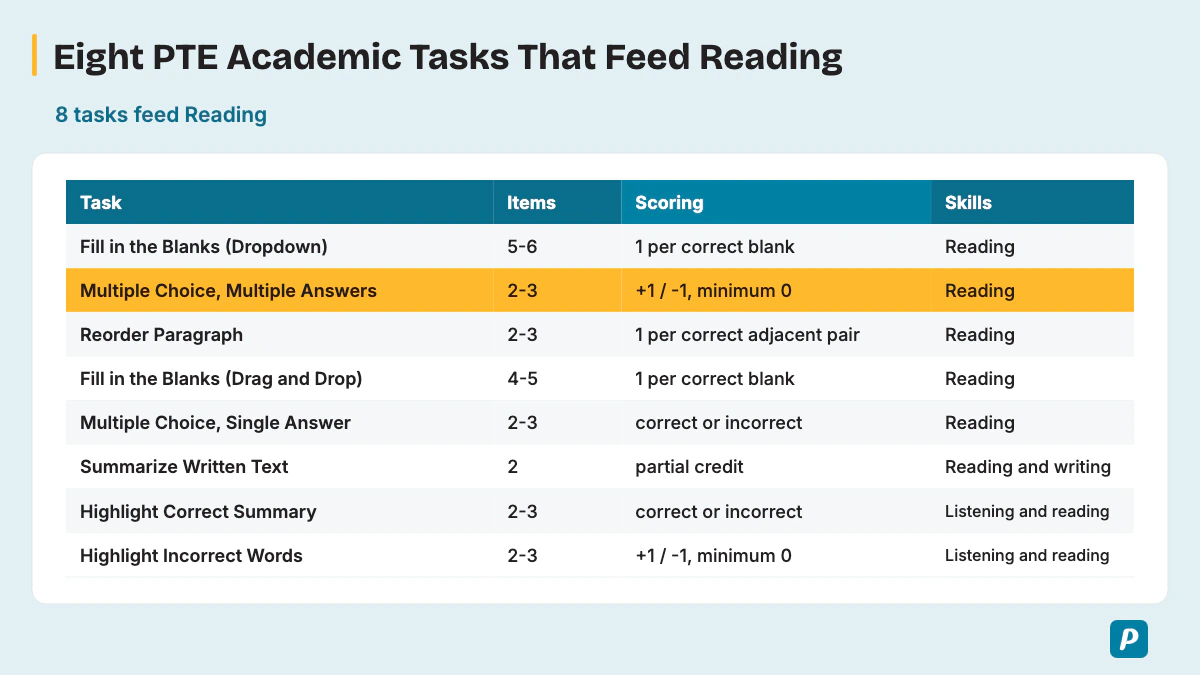
In PTE Academic, the five Reading tasks, Summarize Written Text and two Listening tasks, Highlight Correct Summary and Highlight Incorrect Words, all feed your Reading score. Pearson's Score Guide calls these integrated skills questions, and their points count toward both skills they assess. The table pairs each task with its item count, its scoring rule and the skills credited.
| Task (part) | Items (Academic) | How Pearson scores it | Skills credited |
|---|---|---|---|
| Fill in the Blanks (Dropdown) | 5-6 | 1 point per correct blank | Reading (Core: reading and writing) |
| Multiple Choice, Multiple Answers | 2-3 | +1 per correct option, -1 per wrong one, minimum 0 | Reading |
| Reorder Paragraph | 2-3 | 1 point per correct adjacent pair | Reading |
| Fill in the Blanks (Drag and Drop) | 4-5 | 1 point per correct blank | Reading |
| Multiple Choice, Single Answer | 2-3 | Correct or incorrect | Reading |
| Summarize Written Text (Part 1) | 2 | Partial credit on content, form, grammar and vocabulary | Reading and writing |
| Highlight Correct Summary (Part 3) | 2-3 | Correct or incorrect | Listening and reading |
| Highlight Incorrect Words (Part 3) | 2-3 | +1 per correct word, -1 per wrong one, minimum 0 | Listening and reading |
Partial credit means one wrong blank or box never cancels the rest. Read Aloud is the split case: the Academic Score Guide lists it under Speaking only, while Pearson's Academic task notes still mention reading, and the PTE Core Score Guide credits it to reading and speaking. The dropdown task shows the same kind of gap, since the Academic page intro says it also assesses writing while its task block and the Score Guide say Reading.
PTE Core has no Highlight Correct Summary, but its Highlight Incorrect Words (1-2 items) and Summarize Written Text (1-2 items) still feed Reading. Put both Highlight tasks and the summary task into your reading practice, and treat Highlight Incorrect Words with the same care as Multiple Answers, since it's the other task that deducts.
Which High-Scoring Question Types Should You Master First?
Start with the two Fill in the Blanks tasks and Reorder Paragraph, because every correct blank or pair earns a point and a wrong one costs nothing. Fill in the Blanks also covers 9-11 of the 15-20 Reading items. Pearson's scoring rules take points away for wrong picks in Multiple Choice, Multiple Answers, so treat it with care. This is a suggested practice priority based on item counts and partial credit, not a measured score-weight ranking.
What Are the Best Fill in the Blanks Grammar and Collocation Tricks?
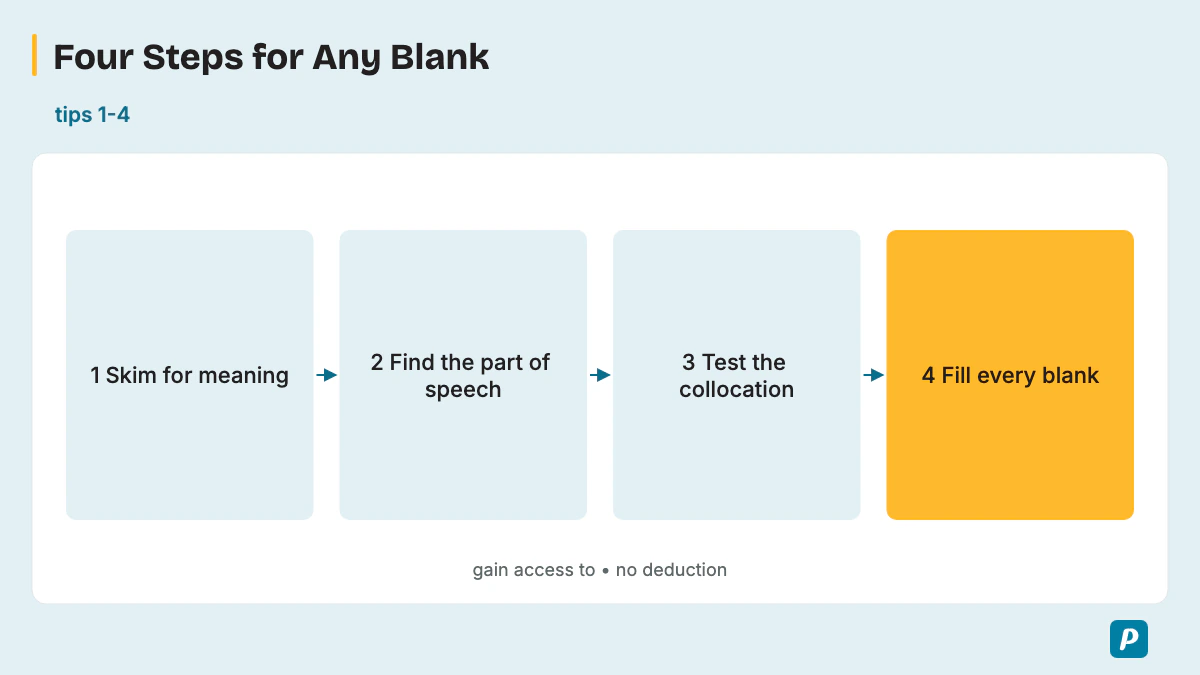
Skim the passage for meaning, decide the part of speech the blank needs, test the options for collocation, and fill every blank. Tips 1-4 apply to both Fill in the Blanks tasks, dropdown and drag and drop.
- Skim for overall meaning first. Pearson's dropdown example skims a passage to find its topic, "change", before any blank is filled.
- Read around the blank and decide the part of speech. In Pearson's drag-and-drop example, "beginning to" calls for an infinitive verb, so nouns and adjectives drop out; an article begins a noun phrase, which may include adjectives; infinitive to and modals take a base verb, while prepositional to can take an -ing form.
- Choose by collocation and meaning. Pearson points to "the general public" and "gain access to", and notes we "cite" references rather than "view" them.
- Never leave a blank empty. A wrong blank costs nothing, so Pearson's advice is to guess from context clues rather than leave a gap.
In drag and drop there are more words than gaps, so place the words you're sure of first and the hard gaps get a shorter list. Mouth each sentence silently with the option in place, because a wrong part of speech usually sounds broken.
Which PTE Reading Grammar Rules Matter Most?
The rules that decide most blanks are part of speech, verb form after "to" and modals, articles before nouns, and singular-plural agreement. Six quick checks catch most of the rest.
- Keep tense consistency: in "The engineers inspected the dam in 2019 and found cracks", the second verb matches the first.
- Put a plural noun after "one of the", as in "one of the busiest ports".
- Put a singular noun after "another", as in "another survey".
- Read a colon as a signal that an explanation follows: "The plan had one flaw: it ignored repair costs."
- Treat contrast linkers such as "however" and "although" as signs that the next idea turns the other way.
- A singular countable noun normally needs a determiner such as a, an or the. Uncountable equipment cannot take a or an, but can take the when specific: "the equipment in this room".
Our page of PTE grammar rules explains each verb form and article rule with more examples.
Which Fill in the Blanks Tips and Tricks Work Best?
Read the completed sentence back after each choice; if it doesn't sound like a phrase you've seen in academic writing, the collocation is probably wrong. Try these three original items before you check the answers.
- "The council will ___ close attention to the cost of the new bridge." (give / pay / take / bring). Answer: pay, because "pay attention" is the fixed pair.
- "Rising sea levels pose a serious ___ to low-lying farmland." (threaten / threat / threatening / threatened). Answer: threat, because "a serious" needs a noun.
- "With only mild side effects, the drug was judged ___ for long-term use." (suitable / eligible / capable / available). Answer: suitable, because the sentence judges fitness for use; "eligible" takes "for" and means qualifying under a rule, "capable" needs "of", and "available" means ready to obtain.
These Fill in the Blanks tips get fuller treatment, with timed sets, in our guide to PTE reading fill in the blanks.
What Are the Best Reorder Paragraphs Strategies?
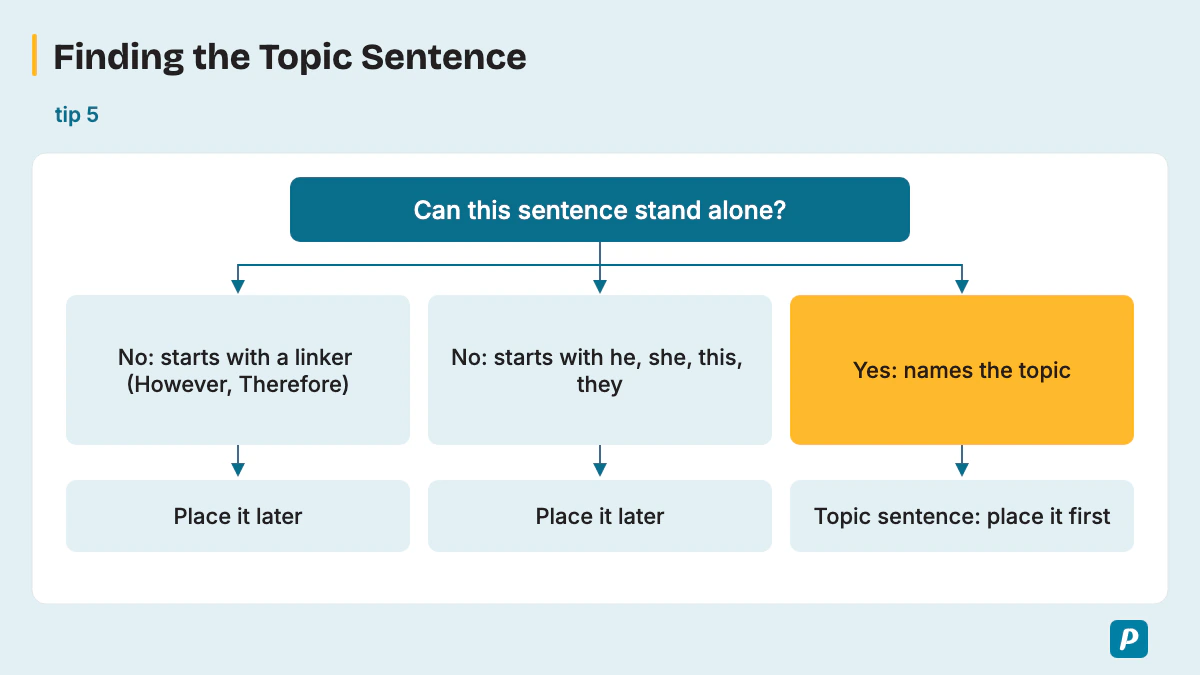
Find the sentence that can stand alone, chain the rest by pronouns, articles, linkers and time order, and secure the pairs you're sure of, because each correct adjacent pair scores. Tips 5-7 cover Reorder Paragraphs.
- Find the topic sentence first. Pearson says it can stand alone, doesn't begin with a linker or a back-referring pronoun such as "he" or "this", and doesn't point back through a passive such as "No link was found".
- Chain boxes by pronoun reference and cohesive devices. Link each pronoun to the noun it replaces, put "a" + noun before "the" + the same noun, and place a sentence opening with "However" or "Yet" right after the idea it contrasts.
- Lock in the pairs you're sure of. Each correct adjacent pair earns 1 point. A misplaced box may leave some pairs correct, but credit depends on the pairs actually preserved.
Try this original four-box set before reading the answer.
- (A) "After the move, the city added 40 more stations within a year."
- (B) "In 2018, a mid-sized city launched a bike-sharing scheme with 20 stations."
- (C) "However, the stations stood far from train lines, so few commuters used them."
- (D) "Planners therefore moved them closer to public transport, and use rose quickly."
The order is B-C-D-A. B stands alone and introduces "a bike-sharing scheme", C contrasts it with "However", D gives the result with "therefore", and A needs "the move" from D. No other order works, and B-C-D-A holds 3 adjacent pairs, worth 3 points.
Which Reorder Paragraph Tips Work Best?
Read all the boxes quickly before dragging any, note the key words, and form the overall idea first. Those Reorder Paragraph tips stop you from fixing a wrong first box. Our page on PTE reorder paragraphs works through full practice sets with answers.
How Do You Handle Multiple-Choice, Choose Single Answer?
Note the key words in the prompt before you read, then look for the option that paraphrases the text, not the one that repeats its words. Tips 8-9 cover Multiple Choice, Single Answer.
- Read the prompt first and note its key words. Pearson's tip is to note them before you read the text, so you know what to look for.
- Match meaning, not words. Pearson says the text's own words are generally not used in the correct answer, so learn synonyms and paraphrasing.
Elimination works best when you know the five distractor traps.
- An option adds a detail the text never gives, or drops a condition it does.
- An option reuses a text word in a different sense.
- An option gets the writer's tone or attitude wrong.
- An option is too narrow for a main-idea question, or too broad for a detail question.
- An option reverses cause and effect, or links two facts the text keeps apart.
The item is marked correct or incorrect on a text of up to 110 words, with no deduction. If you're unsure, choose the most likely option rather than leaving it blank.
How Do You Handle Multiple-Choice, Choose Multiple Answers?
Read the stem and options closely, scan the text for the words they repeat, and choose only the options you can prove, because each wrong pick costs a point. Tips 10-12 cover Multiple Choice, Multiple Answers.
- Know the scoring. It's +1 per correct option and -1 per wrong one, never below 0, the only negative marking inside the Reading part.
- Note repeated words in the options and scan for them. Pearson's examples are adjectives such as "multigrade" and nouns such as "classes".
- Never choose all the options. Wrong options cancel right ones, so picking everything usually scores nothing.
Pearson says the question can ask about the content or the tone of a text of up to 350 words (275 in Core), so decide the writer's purpose and attitude before judging the stem's options. Pearson's reading article also says this task needs more time than the single-answer one. Its "choose the most likely option" tip mentions this task too, but a wrong option here costs a point, so add a second pick only when the text proves it.
What Mistakes Should You Avoid in the PTE Reading Section?
The common mistakes that cost the most are word matching instead of meaning, guessing freely in Multiple Choice, Multiple Answers, leaving blanks empty and letting one item eat the section clock. Seven of them are worth checking against your last practice set.
- Word matching: picking the option that repeats text words, which Pearson names as the usual single-answer error.
- Choosing every option in Multiple Choice, Multiple Answers, which cancels your correct picks.
- Leaving empty blanks in Fill in the Blanks, which throws away partial credit a guess could earn.
- Ignoring grammar and collocation and choosing by meaning alone.
- Poor time management, such as spending five minutes on one Reorder set.
- Skipping the Listening and Writing tasks that also feed your Reading score.
- Trusting outdated format specs, such as 29-30 minutes or 300-word texts.
How Do You Plan Time Management in PTE Reading?
There is one section clock and no per-item timer, so split the block yourself. Pearson lists the time to answer each Reading task as "Not applicable". Five rules make up the time management plan.
- Know your block: 23-30 minutes in PTE Academic and 27-37 minutes in PTE Core.
- Budget about 1.5 minutes per item, since 23-30 minutes over 15-20 items gives roughly 1.2 to 2.
- Set a checkpoint halfway through the block and compare it with the items done.
- Move on after a best guess on any item that stalls you.
- Check every blank in the current item before clicking Next; you cannot return to previous questions.
Per-item minute splits shared online are personal plans, because Pearson sets none. Give the long Multiple Choice, Multiple Answers text more of your budget and the 80-word drag-and-drop texts less.
How Do You Practice for PTE Reading?
Practice each task type separately until the tips above are automatic, then take full timed sections, and read short academic articles daily to build speed. Pearson's reading article suggests short articles of about 300 words, read often, at 220 words per minute or more, in chunks rather than single words. Pick texts from the humanities, natural sciences and social sciences, the subject areas PTE passages come from.
Keep a vocabulary journal with each new word, its meaning, one collocation, a synonym and a sentence of your own. Error review matters as much as volume: after each set, match every wrong answer to the tip that would have saved it. Once that feels steady, a mock test under test conditions shows whether your PTE reading practice holds across the full block, and you can create a free account for timed Reading sets.
How Do You Get 90 in PTE Reading?
90 is the top of the reported scale; the linked Guide does not give a raw-accuracy threshold for 90 on each task. It also needs the reading credit from Summarize Written Text, Highlight Correct Summary and Highlight Incorrect Words; there is no shortcut task. Pearson doesn't publish how many correct answers equal a score of 90, so set your target by accuracy per task.
Which PTE Reading Tips Lead to a Score of 90?
These accuracy habits can support a high-score goal: check collocations, preserve correct Reorder pairs and avoid unsupported multiple-answer picks. They do not define a conversion from 79 to 90. The full section-by-section method is on our page on how to score 90 in PTE.
How Do You Get 79+ in the PTE Exam?
79+ needs strong work in all four skills, and reading credit comes from more than the Reading part, so a reading plan alone isn't enough. Our PTE exam tips and tricks cover the speaking, writing and listening tasks.
How Do You Improve Your Reading Speed in PTE?
Pearson's reading article suggests daily practice on short articles of about 300 words, aiming for at least 220 words per minute and reading in chunks. Time yourself on one article a day and log the words per minute. Our guide to improve PTE reading speed adds a self-test.
What Are the 7 Reading Techniques?
There is no official list of seven; a practical set for PTE is skimming, scanning, close (intensive) reading, extensive reading, reading for paraphrase, predicting and chunking. Skim for the topic in Fill in the Blanks, scan for repeated words in Multiple Answers, and read closely around each blank or answer line.
Read for paraphrase in both multiple-choice tasks, predict the missing word before you look at the options, and use extensive reading and chunking to build speed. Our guide to skimming and scanning in PTE Reading has drills for the first two reading techniques.
How Do You Crack PTE in 15 Days?
Use a 15-day period to study the rules, practice under time and review errors. The improvement possible depends on your starting level, available time and practice results. A 15-day plan works best as a polish of existing preparation, and our PTE preparation plan shows how to lay one out.
Practice PTE Reading on EasyEnglish
Try Reading tasks in a timed, computer-based format like the real test.
Try speaking practice without signing up. A free account is required for full mock tests. Practice scores are estimates, not official Pearson scores.
Written by
EasyEnglish Team
The team behind EasyEnglish's PTE practice and mock tests
EasyEnglish provides independent PTE practice and estimated scores. EasyEnglish is not affiliated with or endorsed by Pearson. Contact support@inverseai.com.
Format and scoring sources checked on 26 October 2026: Academic Reading; Core Reading; Academic Score Guide; Core Score Guide (January 2026). Academic and Academic UKVI details use the format introduced on 7 August 2025; Core details use its January 2026 Score Guide. Where a task page and Score Guide differ, the distinction is identified in the text; use the Guide for scoring criteria. Practice passages, names, figures, prompts and model answers are authored examples supplied with this guide, not authentic exam items or independently verified research findings. Suggested practice schedules and time splits are coaching advice, not Pearson requirements or score guarantees.
Reading pace suggestions come from Pearson's 8 July 2021 reading advice, checked 26 October 2026. They are practice targets, not requirements for a particular score.
Editorial review completed .