PTE Reading Skimming and Scanning: Definition, Differences, Examples and Tips
PTE Reading
With one clock running over every PTE Reading task, reading every word at the same pace wastes minutes you need later. Skimming surfaces the main idea of a text in seconds, and scanning locates one specific detail without reading the rest. Pearson's own task tips name both reading techniques: skim for overall meaning in Fill in the Blanks, and scan for repeated words in Multiple Choice, Multiple Answers.
The task names and timings here are PTE Academic, where Part 2 Reading runs 23-30 minutes. PTE Core uses the same five task types in 27-37 minutes.
Table of Contents
What Is Skimming?
Skimming is reading a text quickly for its main idea and structure, not for every detail. You take the gist from the title, the first and last sentences and the topic sentence that opens each paragraph. Skim when time is short, as a first pass before you answer, or when you only need the topic of a passage. A skim deliberately skips examples, numbers and supporting detail. In PTE terms, Pearson's Fill in the Blanks tip says to skim for overall meaning before you choose a word.
What Is Scanning?
Scanning is moving your eyes through a text to find one specific piece of information, then reading only around it. The target is a specific detail such as a name, a date, a number or a keyword. You scan when the question already names that detail, so you know what you're looking for before you start, which is why scanning starts from the question, not from the text. In PTE, Pearson's Multiple Choice, Multiple Answers tip says to look for repeated words from the options, find them in the text, then read around the match.
What Are the Key Differences Between Skimming and Scanning?
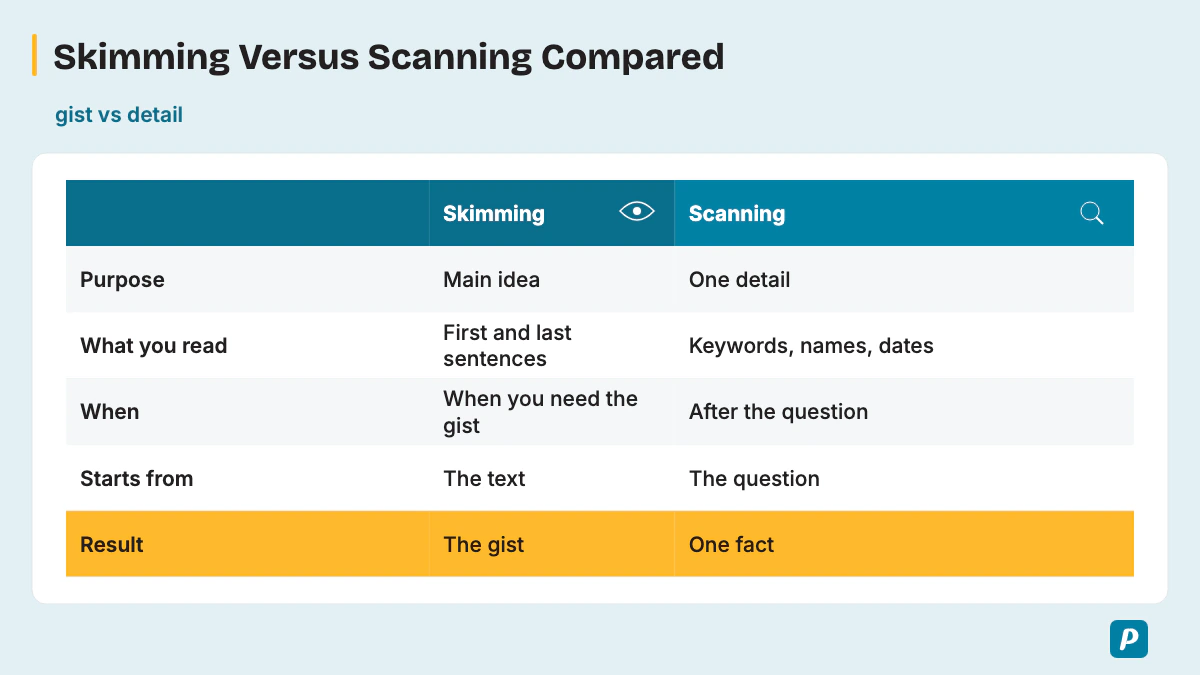
Skimming reads for the overall meaning of a text, while scanning hunts for one detail; you skim for gist and scan once you have a target detail. The difference between skimming and scanning comes down to the purpose of reading, as the comparison shows.
| Point of difference | Skimming | Scanning |
|---|---|---|
| Purpose | Get the overall meaning of the text. | Find specific information fast. |
| What you look at | Titles, first and last sentences. | Names, dates, numbers and keywords. |
| When you use it | When you need the gist, including after reading a question. | After you know what the question asks. |
| Starting point | The text itself. | The question or stem. |
| Output | The gist and the writer's tone. | One detail and its sentence. |
| Best PTE Reading tasks | Reorder Paragraph and both Fill in the Blanks tasks. | The two Multiple Choice tasks. |
No standard list of ten differences exists, and the six rows above cover the real ones. Used in that order, skim then scan, the pair raises your reading speed across the whole Reading block.
Why Do Skimming and Scanning Matter in PTE Reading?
PTE Academic gives one timed block of 23-30 minutes for all five reading task types, and the tasks have no per-item time limit. That makes time management in the PTE Reading section your own job, since minutes saved on one item go to the next. Text length varies from up to 80 words in drag-and-drop Fill in the Blanks to up to 350 words in Multiple Choice, Multiple Answers, which one reading pace can't cover. PTE Core gives 27-37 minutes for the same five types, and Pearson's Score Guides list 15-20 Reading items in PTE Academic and 13-18 in PTE Core. Some prep sites still quote about 29-30 minutes for up to 18 questions; Pearson's current page says 23-30 minutes.
How Do You Use Skimming in PTE Reading?
Pearson's own Fill in the Blanks example shows the method: a quick skim tells you the passage is about "change" before you fill a single blank. Read the first sentence of each paragraph and the last sentence of the text, name the topic in a word or two, and only then read the questions or blanks. Five short steps turn that into a routine.
- Read the title or the first line to fix the subject.
- Read the first sentence of each paragraph to see how the text moves.
- Read the conclusion or last sentence to see where it lands.
- Name the topic and the writer's tone in two or three words.
- Decide which part you'll read closely for the question.
For Reorder Paragraph, Pearson's tip is to read all the boxes quickly first and note key words. That first skim gives you the overall idea before you move a single box. Treat it as your way to skim for overall meaning, then switch to close reading.
Transition words show where an argument turns, so let your eyes stop on them during a skim. "However", "in contrast" and "despite" mark a change of direction, while "therefore" and "as a result" mark a conclusion. Read the sentence after each one, because it usually carries the writer's real point.
How Do You Use Scanning in PTE Reading?
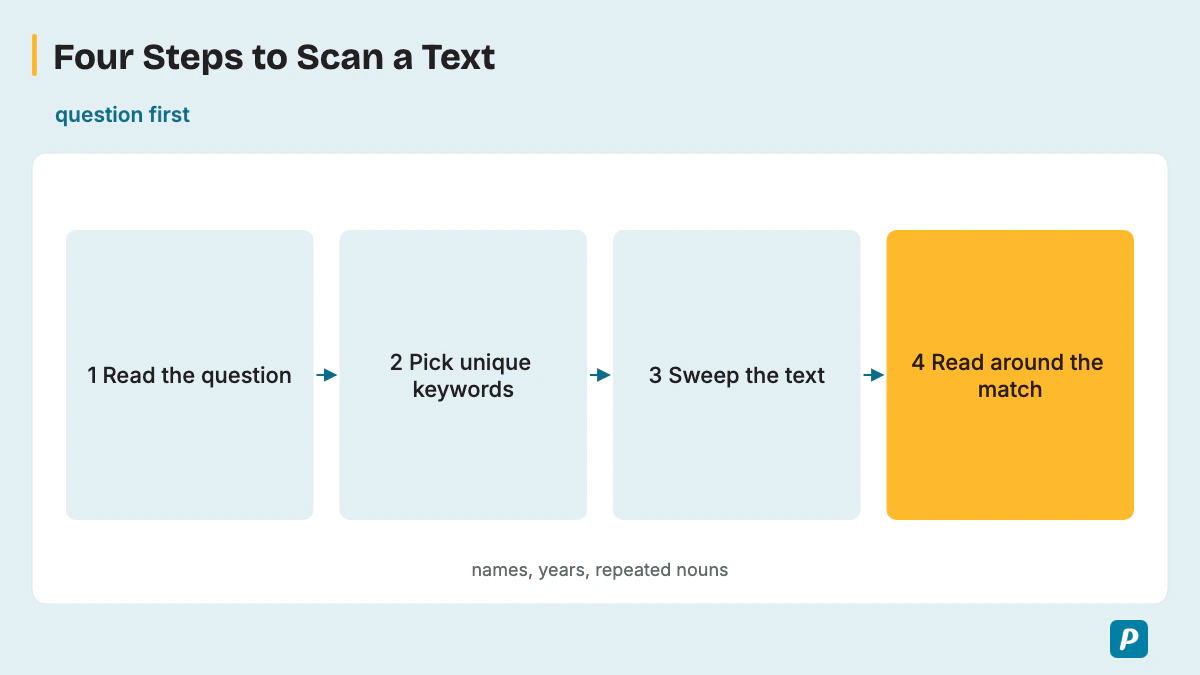
Read the question first, pick one or two words that will stand out in the text, sweep the text for them, then read the sentence before and after the match. Good targets are proper nouns, years and repeated nouns. The steps run in this order.
- Read the question stem before you look at the text.
- Choose unique keywords that will be easy to spot.
- Sweep the text for those words or their synonyms.
- Stop at the match and read the sentences around it.
- Check the option against that sentence before you select it.
Pearson's tip for Multiple Choice, Multiple Answers is to note repeated words in the options, such as "multigrade" or "classes". You scan for repeated words like these, then read around them. A match only marks a place to read; it is never the answer by itself.
Visual cues speed up the sweep: capital letters flag names and places, digits flag years and figures, and abbreviations flag technical terms. Let your eyes jump between those cues instead of moving line by line, and run the cursor down the screen if it helps you keep your place.
The text often paraphrases the question, so scan for the meaning as well as the word. A question about "the cost of housing" may point to a sentence about "what families pay for a home". Before you scan, list one or two likely paraphrases for each keyword.
| Word in the question | Wording the text may use instead |
|---|---|
| reduce | cut, lower, bring down |
| cause | lead to, result in, trigger |
| expensive | costly, high-priced |
| difficult | challenging, demanding |
| growth | expansion, rise |
| workers | employees, staff, the workforce |
How Do You Apply Skimming and Scanning to Different PTE Reading Tasks?
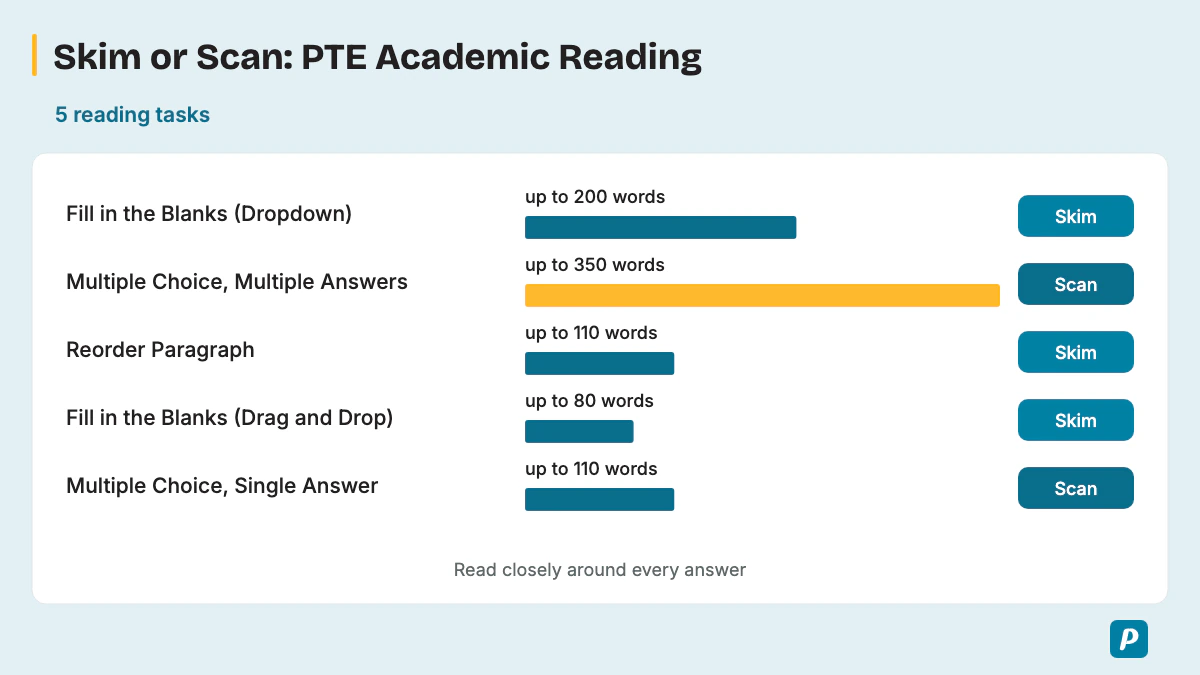
Skim first in Reorder Paragraph and both Fill in the Blanks tasks; scan after reading the question in the two Multiple Choice tasks, and in every task read closely around the part that matters. The map follows Pearson's task order and text lengths.
| PTE Reading task | Text length (Pearson) | Skim or scan | What to do |
|---|---|---|---|
| Fill in the Blanks (Dropdown); Reading & Writing: Fill in the Blanks in PTE Core | Up to 200 words | Skim | Get the topic, then read before and after each blank. |
| Multiple Choice, Multiple Answers | Up to 350 words | Scan | Read the stem and options, then scan for their words. |
| Reorder Paragraph | Up to 110 words | Skim | Read every box fast and find the topic sentence. |
| Fill in the Blanks (drag and drop) | Up to 80 words | Skim | Get the meaning, then test each word in its gap. |
| Multiple Choice, Single Answer | Up to 110 words | Scan | Note the prompt key words, then check the text closely. |
Pearson warns that scan reading and matching text words to answer words is a common Multiple Choice, Single Answer mistake. Each technique only gets you to the right spot; intensive reading of that spot earns the mark. Negative marking in Reading applies only to Multiple Choice, Multiple Answers, where wrong picks lose points.
In both Fill in the Blanks tasks, the skim gives you the topic, and the words either side of each gap decide the answer. Pearson's dropdown example accepts only "access" in "gained ... to technologies", because the meaning and the grammar both need "gain access to". Its drag-and-drop tips add two more clues: words that often go together, such as "the general public", and the part of speech the gap needs, such as a verb after "beginning to".
What Are Examples of Skimming and Scanning?
Skimming is reading a news page's headlines to see what happened; scanning is running down a timetable for your train's departure time. These skimming and scanning examples come from daily life first.
- Reading newspaper headlines to see the day's main stories.
- Reading a book's back cover to decide if it's worth buying.
- Glancing over a contents page to see what a report covers.
- Running a finger down a phone directory for one name.
- Checking a timetable for the next train's departure time.
- Looking up one word's meaning in a dictionary entry.
The PTE examples below are original practice scenarios, not items from a test.
- Skimming a 110-word Reorder Paragraph set to name its topic before ordering.
- Scanning a Multiple Choice text for a year named in the stem.
- Skimming a dropdown Fill in the Blanks passage before choosing any word.
What Common Mistakes Stop Skimming and Scanning From Working?
The costly mistakes are matching words instead of meaning, skimming when the task needs close reading, and scanning without first reading the question. These common mistakes each come with a cost.
- Choosing the option that repeats words from the text. Pearson names this word matching habit as a common Multiple Choice, Single Answer mistake.
- Filling a blank from the skim alone. You lose the partial credit that reading before and after the gap would have saved.
- Scanning for a keyword the text has turned into a paraphrase. The exact word never appears, so the scan finds nothing.
- Picking extra options in Multiple Choice, Multiple Answers. Wrong options cost a point each under Pearson's Score Guide, so a guess can cancel a right answer.
- Re-reading a whole passage instead of the sentence around the match. The minutes you spend there come out of the next task.
- Staying too long on one hard item. The block clock is shared, so make your best choice and move on.
What Exercises Build Skimming and Scanning Skills?
Timed drills build both: a short skim with a one-line summary, a keyword hunt against the clock, and a synonym list that trains you to spot paraphrase. Each drill takes five minutes, so three of them make a 15-minute daily session.
- Skimming practice: give a 150-250 word article 30 seconds, then answer three questions: what is the topic, what is the main message, and is the writer explaining, comparing or arguing?
- A scanning drill: find five named details in a timetable or long article against a timer.
- Timed reading: read a short academic text and answer two questions before the clock runs out.
- Synonym recognition: list two synonyms for each keyword in a paragraph before you read it.
Pearson's reading article suggests daily practice with short articles of about 300 words.
Here is the first drill worked through on a short original text.
Seed banks store the seeds of crops and wild plants so that a species lost in the field can be grown again. The largest ones hold millions of samples in cold, dry vaults. Smaller community seed banks keep local varieties that farmers have selected over generations. Both types depend on regular testing, because stored seeds slowly lose the ability to grow.
A 30-second skim of the first and last sentences gives the topic (seed banks), the main message (they protect plant species but need upkeep) and the purpose (explaining).
How Do You Improve Reading in PTE Beyond Skimming and Scanning?
Skimming and scanning only find the right place; the marks come from reading that place closely, so pair them with intensive reading, a faster base reading speed and task practice. To improve PTE reading, treat the two techniques as navigation and spend your practice time on the close reading that follows them.
What Is the Difference Between Skimming and Reading?
Skimming takes the gist and skips detail; ordinary reading, and the intensive reading Pearson asks for around each blank or stem, takes in every word of the part that matters. Pearson's reading article puts close reading first for Multiple Choice, Multiple Answers: read the stem and options intensively, then scan.
What Are the 7 Reading Techniques?
There is no official list of seven; common lists name skimming, scanning, intensive reading and extensive reading, then add techniques such as previewing or note-taking. Of these reading techniques, PTE Reading rewards skimming plus intensive reading around the answer most. Extensive reading builds the base vocabulary behind both, and our PTE Reading section overview shows where each task fits.
How Do You Improve Reading Speed for PTE?
Pearson's reading article suggests reading short articles of about 300 words every day, aiming for at least 220 words per minute and reading in chunks rather than word by word. Read in chunks, groups of words instead of single words, and try reading familiar phrases as groups, while checking that you still understand them. The full method to improve PTE reading speed has its own page.
Which PTE Reading Tips Help the Most?
Choose task-specific habits to guide practice. Read before and after every blank, find the topic sentence first in Reorder Paragraph, and choose only the options you are sure of in Multiple Choice, Multiple Answers. Those last two protect partial credit and points. The full list of PTE reading tips and tricks goes task by task.
How Do You Practice Skimming on Reorder Paragraph?
Skim all the boxes first and look for the one that can stand alone. Pearson says the topic sentence does not begin with a linker or a pronoun that points back, such as "he" or "this". Once you have it, link the rest through pronouns and linking words. Our PTE Reorder Paragraph guide works through a full set.
Written by
EasyEnglish Team
The team behind EasyEnglish's PTE practice and mock tests
EasyEnglish provides independent PTE practice and estimated scores. EasyEnglish is not affiliated with or endorsed by Pearson. Contact support@inverseai.com.
Format and scoring sources checked on 26 October 2026: Academic Reading; Core Reading; Academic Score Guide; Core Score Guide (January 2026). Academic and Academic UKVI details use the format introduced on 7 August 2025; Core details use its January 2026 Score Guide. Where a task page and Score Guide differ, the distinction is identified in the text; use the Guide for scoring criteria. Practice passages, names, figures, prompts and model answers are authored examples supplied with this guide, not authentic exam items or independently verified research findings. Suggested practice schedules and time splits are coaching advice, not Pearson requirements or score guarantees.
Reading pace suggestions come from Pearson's 8 July 2021 reading advice, checked 26 October 2026. They are practice targets, not requirements for a particular score.
Editorial review completed .