PTE Reading Format: Sections, Question Types and Answers for 2026
PTE Reading
Walking into Part 2 already knowing the task order means you don't spend the running clock reading instructions on screen. The PTE Reading format sets that order, fixes the text length of each task, times the whole part with one clock and decides how every answer earns credit. Every timing and text length here comes from Pearson's current PTE Academic and PTE Core Reading pages, and every item count comes from Pearson's Score Guides.
PTE Academic Reading gives you 15-20 items in 23-30 minutes, and PTE Core gives 13-18 items in 27-37 minutes. Both tests use the same five tasks in the same order, so one practice routine covers both.
Table of Contents
What Is the PTE Reading Module?
The PTE Reading module is Part 2 of the test, with 5 question types in 23-30 minutes in PTE Academic and 27-37 minutes in PTE Core. It's a single timed part of written-text tasks that sits between Part 1 Speaking & Writing and Part 3 Listening. Pearson's pages simply call it "Part 2: Reading", so module, section and part mean the same thing here. PTE Academic is a single test of about 2 hours with 22 question types in all: Part 1 Speaking & Writing holds 9 of them in 76-84 minutes, Reading holds 5, and Part 3 Listening holds 8 in 31-39 minutes. Pearson says Multiple Choice, Single Answer judges your ability to analyze, interpret and evaluate a short reading text on an academic subject.
What Is the PTE Academic Test Format?
PTE Academic runs three parts in one sitting, Speaking & Writing, then Reading, then Listening, so Reading is the shortest part in the middle of the test. The full test format, with every part and question type, sits on our PTE test format page.
How Much Time Do You Get for PTE Reading?
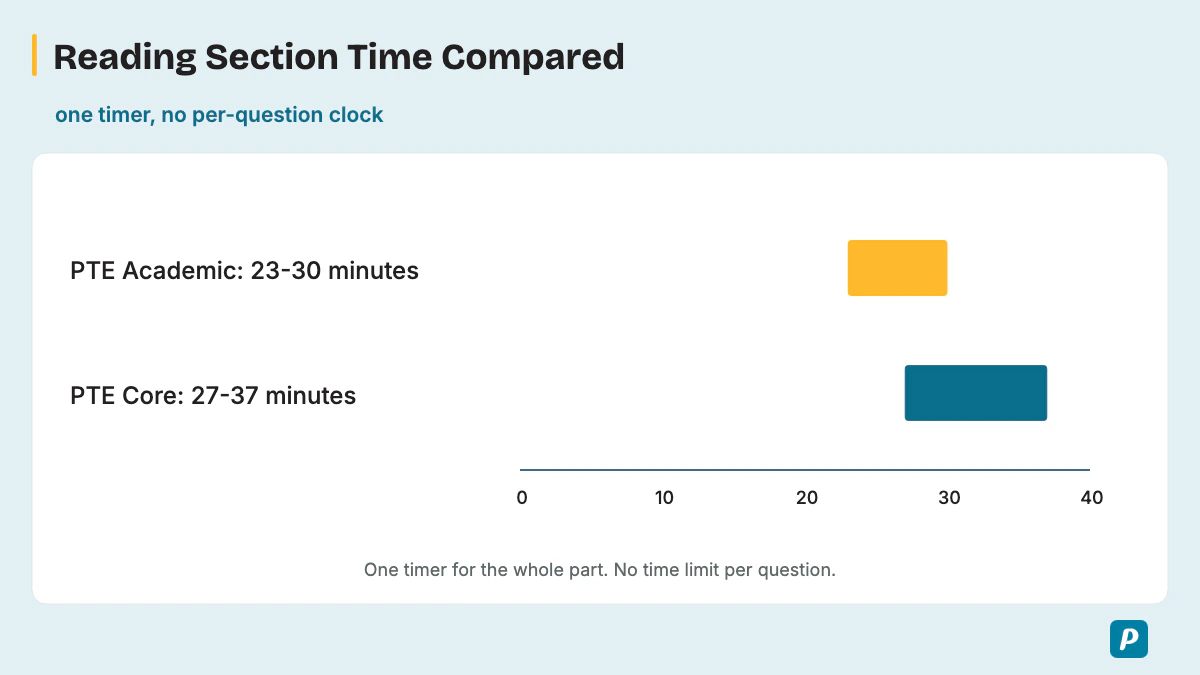
PTE Academic gives 23-30 minutes for the whole Reading part and PTE Core 27-37 minutes; there is no separate timer for each question. Both tests run the section time on one clock, as the comparison shows.
| Feature | PTE Academic | PTE Core |
|---|---|---|
| Section time | 23-30 minutes | 27-37 minutes |
| How it is timed | A single timer for the whole part | A single timer for the whole part |
| Time per question | Time to answer: Not applicable | Time to answer: Not applicable |
| Question types | 5 | 5 |
| Items | 15-20 | 13-18 |
Some prep sites still print 32-41 minutes or 29-30 minutes for Reading. Pearson's current pages say 23-30 minutes for Academic and 27-37 minutes for Core, and they list "Time to answer: Not applicable" on every Reading task.
Because Pearson sets no time per item, set your own time budget. Spread 23-30 minutes over 15-20 items and you get roughly 1.2 to 2 minutes per item. If one item stalls you, choose your best answer and move on, since the clock keeps running for the items still ahead. Keep a minute or two at the end so the last Multiple Choice, Single Answer items still get a careful read.
What Are the 5 PTE Reading Question Types?
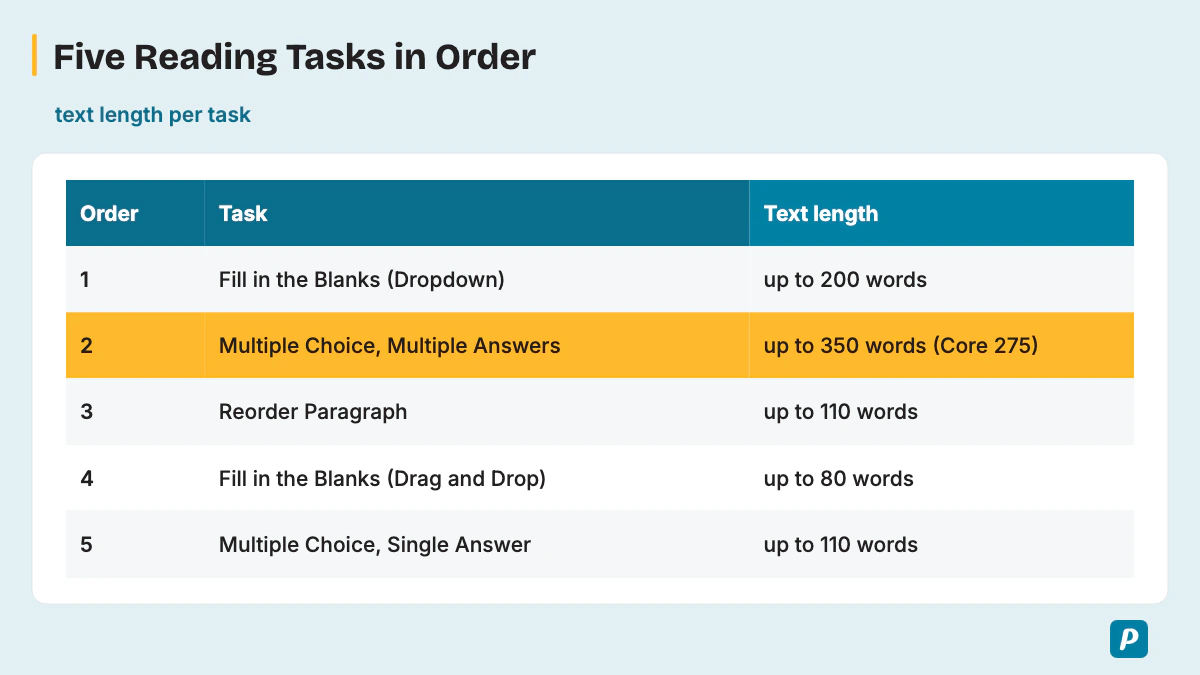
In test order, the five PTE Academic tasks are Fill in the Blanks (Dropdown), Multiple Choice, Multiple Answers, Reorder Paragraph, Fill in the Blanks (Drag and Drop) and Multiple Choice, Single Answer. PTE Core calls the first task Reading & Writing: Fill in the Blanks and the fourth simply Fill in the Blanks. Pearson's own order, the maximum text length and the PTE Core name of each of the five question types line up in one table.
| Order | Question type (Academic name) | PTE Core name | Text length | What you do |
|---|---|---|---|---|
| 1 | Fill in the Blanks (Dropdown) | Reading & Writing: Fill in the Blanks | Up to 200 words | Pick a word from a drop-down list at each gap |
| 2 | Multiple Choice, Multiple Answers | Same | Up to 350 words (Core 275) | Select every correct option; picks turn yellow |
| 3 | Reorder Paragraph | Same | Up to 110 words | Restore the order of text boxes by dragging or with arrow buttons |
| 4 | Fill in the Blanks (Drag and Drop) | Fill in the Blanks | Up to 80 words | Drag words from a word box into the gaps |
| 5 | Multiple Choice, Single Answer | Same | Up to 110 words | Select one option |
Pearson's older 2021 Reading article gave 300 words for the multiple-choice texts, 50 words for Reorder Paragraph and 80 words for the dropdown task. The current format pages replace those limits with the lengths in this table.
How Many Questions Are in PTE Reading?
PTE Academic Reading has 15-20 questions and PTE Core Reading has 13-18, per Pearson's Score Guides, which give the item count for each of the 5 question types. The exact number of items per type varies inside these ranges from one test to the next.
| Question type | PTE Academic items | PTE Core items |
|---|---|---|
| Fill in the Blanks (Dropdown) | 5-6 | 5-6 |
| Multiple Choice, Multiple Answers | 2-3 | 1-2 |
| Reorder Paragraph | 2-3 | 2-3 |
| Fill in the Blanks (Drag and Drop) | 4-5 | 4-5 |
| Multiple Choice, Single Answer | 2-3 | 1-2 |
| Total | 15-20 | 13-18 |
Pearson's Reading web pages give no question count, so these figures come from the PTE Academic Test Taker Score Guide and the PTE Core Score Guide (January 2026). The tasks always come in the fixed order of the table, and an older Pearson article from 2021 also gave 15-20 for Academic.
What Is the PTE Core Reading Format?
PTE Core Reading keeps the same 5 question types in the same order but gives 27-37 minutes instead of 23-30 and 13-18 items instead of 15-20. It also uses a shorter Multiple Choice, Multiple Answers text of up to 275 words and calls the first task Reading & Writing: Fill in the Blanks. Only these rows differ between the two tests.
| Feature | PTE Academic | PTE Core |
|---|---|---|
| Section time | 23-30 minutes | 27-37 minutes |
| Items | 15-20 | 13-18 |
| Multiple-choice items | 2-3 of each type | 1-2 of each type |
| Task 1 name | Fill in the Blanks (Dropdown) | Reading & Writing: Fill in the Blanks |
| Multiple Choice, Multiple Answers text | Up to 350 words | Up to 275 words |
| Task 4 name | Fill in the Blanks (Drag and Drop) | Fill in the Blanks |
| Dropdown task credit (Score Guide) | Reading | Reading and writing |
The Core task names change on screen, but the tasks work the same way. In PTE Core, Part 1 Speaking & Writing runs 50-65 minutes with 7 question types before Reading starts.
How Is the PTE Reading Section Scored?
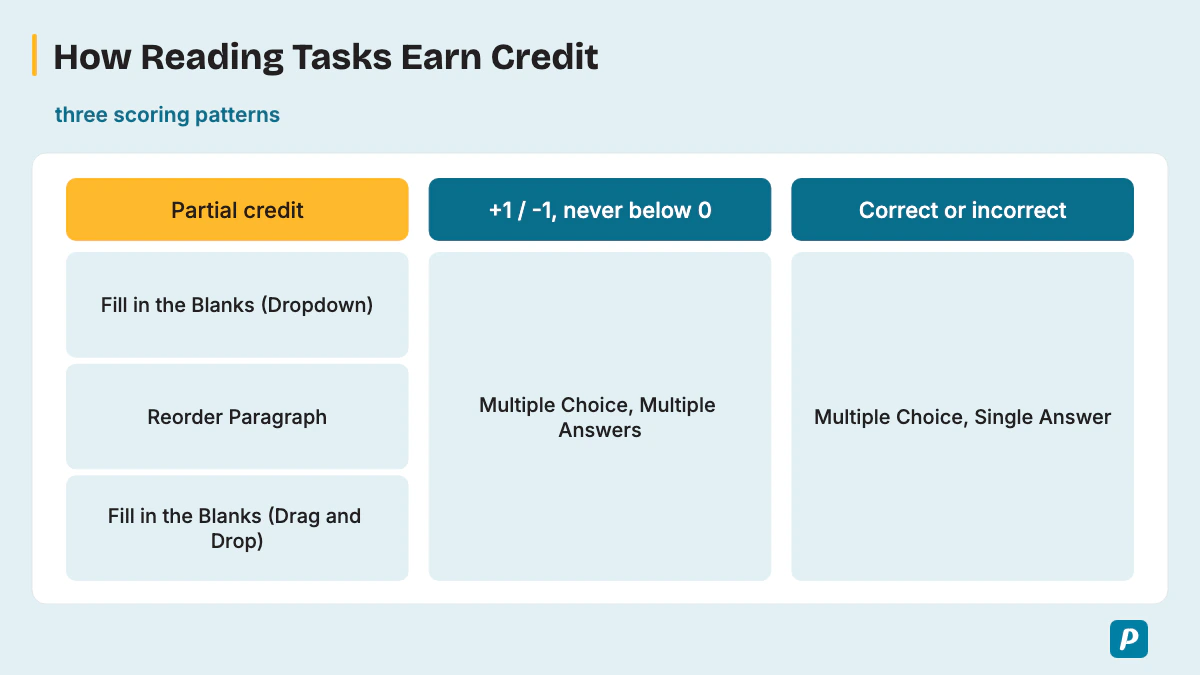
Reading tasks earn credit in three ways: partial credit per correct blank or adjacent pair, a point per correct option with a point lost per wrong option, and correct or incorrect. Pearson's Score Guides set out each pattern.
- Partial credit: both Fill in the Blanks tasks give one point per correctly completed blank, and Reorder Paragraph gives one point per correctly ordered adjacent pair of boxes. If the right order is A-B-C-D and you place A-B-D-C, only the pair A-B matches, so you earn 1 of 3 points.
- Plus and minus: Multiple Choice, Multiple Answers gives one point per correct option and takes one point per wrong option, with a minimum score of 0. Pearson's Academic Reading page reuses the dropdown scoring note in this task's block, so the Score Guide is the source: "Partial credit (for each correct response. Points deducted for incorrect options chosen)". This is the only negative marking in Part 2.
- Correct or incorrect: Multiple Choice, Single Answer earns one point for the right option and nothing for a wrong or empty answer.
The writing credit for the dropdown task depends on the test. The PTE Academic Score Guide and task block credit it to reading only, even though Pearson's Academic part intro says the item also assesses writing. The PTE Core Score Guide credits Reading & Writing: Fill in the Blanks to reading and writing. Don't count on an Academic writing boost from it.
The linked scoring tables explain item credit, not a fixed conversion from raw marks to your reported Reading score. Overall and skill scores run 10-90.
Which Other PTE Tasks Count Toward Reading?
Summarize Written Text and Highlight Incorrect Words feed the Reading score in both tests, Highlight Correct Summary feeds it in PTE Academic, and Read Aloud feeds it in PTE Core. Pearson's Score Guides credit Summarize Written Text in Part 1 to reading and writing, and the two Highlight tasks in Part 3 to listening and reading. Read Aloud counts toward reading and speaking in the PTE Core Score Guide, while the PTE Academic Score Guide lists it under Speaking only, though the Academic task note still says it affects reading. Include the integrated tasks credited to Reading in your practice; the tables do not give a fixed raw-point conversion to the reported score.
How Do You Answer Each PTE Reading Question Type?
The answer method is the same across Part 2: read the question or the gaps first, read the text for meaning rather than matching words, and answer in the form the task scores. That means every blank filled, only the options you can prove, or one best option.
Meaning over matching matters because wrong options often reuse words from the text while the right one restates its idea. Pearson's test tips for each task point the same way, and each task page has samples and practice.
How Do You Answer Fill in the Blanks (Dropdown)?
Skim the whole text for its overall meaning first, then read the words before and after each gap and pick the option that fits both meaning and grammar.
Don't pick a word because it looks familiar: check its grammar fit in the full sentence and compare close drop-down options for small differences in meaning. Never leave a gap empty, because a wrong choice carries no penalty. Our guide to PTE reading and writing fill in the blanks works through full examples.
How Do You Answer Multiple Choice, Multiple Answers?
Read the question and options first, then select only the options the text proves, because each wrong option costs a point. Pearson's tip is to note repeated words across the options and read around them in the text, keeping only proven options. See PTE reading multiple choice multiple answer for practice items.
How Do You Answer Reorder Paragraph?
Read every box quickly, find the topic sentence that can stand alone, then link the rest through pronouns, articles and linking words. Dates, years and time words such as "later" help you put boxes in time order. Each correct adjacent pair earns a point, so a box order that is mostly right still scores. Our page on PTE reorder paragraphs shows a worked example.
How Do You Answer Fill in the Blanks (Drag and Drop)?
Read the short text for meaning, then drag the word from the box that fits each gap. The word box holds more words than there are gaps, so some extra words stay unused.
Following Pearson's tip, rule out any word that is the wrong part of speech for the gap, such as a verb where a noun belongs, then choose by meaning, word form and collocation. Our guide to PTE reading fill in the blanks has practice sets.
How Do You Answer Multiple Choice, Single Answer?
Note the prompt key words before you read, then choose the one option the text supports, and always answer because a blank earns nothing. Expect the right option to paraphrase the text rather than repeat its words. See PTE reading multiple choice single answer for practice.
How Do You Get 90 in Reading PTE?
A 90 in Reading comes from accuracy across all five tasks plus the integrated tasks that also feed the Reading score, such as Summarize Written Text and, in PTE Core, Read Aloud. Pearson publishes no number of correct answers that equals 90, so aim to protect every point the scoring rules allow. Our PTE reading section overview covers preparation and target scores.
Practice PTE Reading on EasyEnglish
Try Reading tasks in a timed, computer-based format like the real test.
Try speaking practice without signing up. A free account is required for full mock tests. Practice scores are estimates, not official Pearson scores.
Written by
EasyEnglish Team
The team behind EasyEnglish's PTE practice and mock tests
EasyEnglish provides independent PTE practice and estimated scores. EasyEnglish is not affiliated with or endorsed by Pearson. Contact support@inverseai.com.
Format and scoring sources checked on 26 October 2026: Academic Reading; Core Reading; Academic Score Guide; Core Score Guide (January 2026). Academic and Academic UKVI details use the format introduced on 7 August 2025; Core details use its January 2026 Score Guide. Where a task page and Score Guide differ, the distinction is identified in the text; use the Guide for scoring criteria. Practice passages, names, figures, prompts and model answers are authored examples supplied with this guide, not authentic exam items or independently verified research findings. Suggested practice schedules and time splits are coaching advice, not Pearson requirements or score guarantees.
Editorial review completed .