PTE Grammar: Rules, Usage and Tips for Improving Scores
Exam Preparation
In the written summaries and the essay, Pearson's Score Guides list PTE grammar as a named Grammar trait worth up to 2 points, and in a Reading gap-fill grammar decides which word fits the blank. Grammar isn't a separate PTE section in PTE Academic or PTE Core.
Table of Contents
Why Does Grammar Matter in PTE?
Grammar matters because Pearson scores it as a Grammar trait in Summarize Written Text, Summarize Spoken Text and Write Essay, with Write Email taking the essay's place in PTE Core. It also decides Reading blanks, where the right word must fit both meaning and grammar. Grammar has no standalone section or score of its own. It shows up inside tasks, so one weak rule can lower several task scores at once.
How Does PTE Score Grammar?
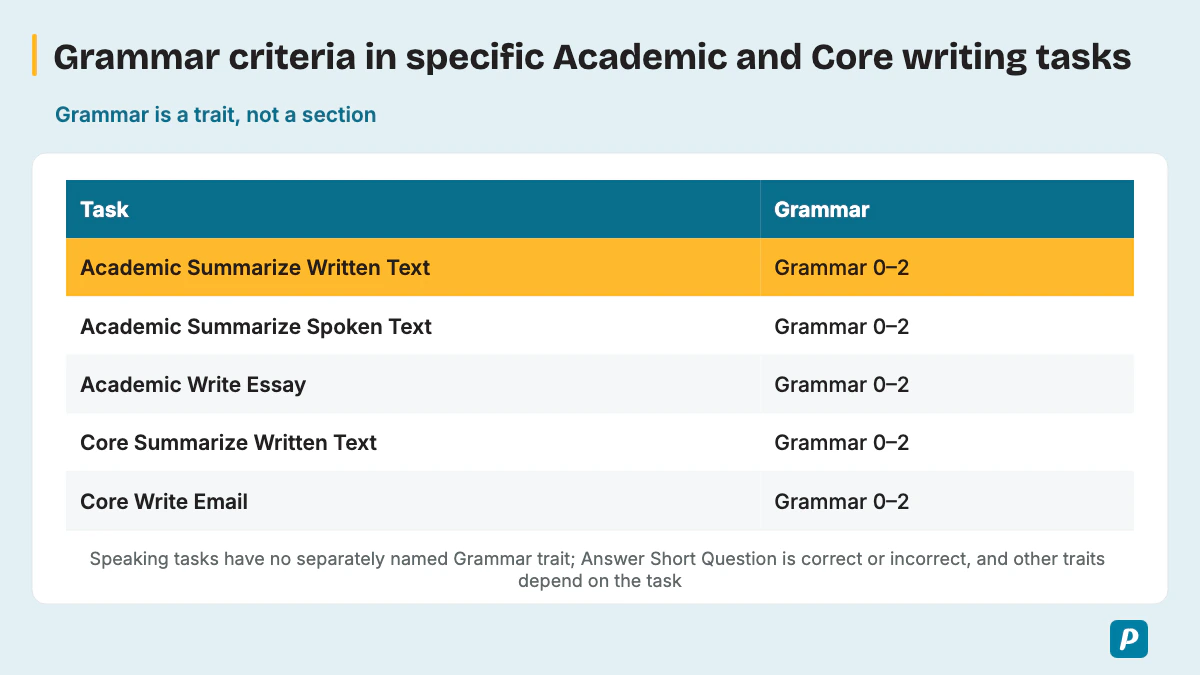
Pearson scores grammar in Summarize Written Text, Summarize Spoken Text, Write Essay and, in PTE Core, Write Email, while Speaking tasks have no grammar trait. The table maps each task to its trait, the maximum points in Pearson's PTE Academic (2025) and PTE Core (2026) Score Guides and what Pearson checks.
| Task | Test | Grammar trait | Max points | What Pearson checks |
|---|---|---|---|---|
| Summarize Written Text | PTE Academic | Grammar | 2 | Correct basic sentence structure; one sentence up to 75 words |
| Summarize Written Text | PTE Core | Grammar | 2 | Basic sentence structure; 25-50 words, one or more sentences |
| Summarize Spoken Text | PTE Academic | Grammar | 2 | Correct grammatical structures |
| Write Essay | PTE Academic | Grammar | 2 | Sentence structure, punctuation, capitalization |
| Write Email | PTE Core | Grammar | 2 | Correct complex sentences; only occasional errors |
| Speaking tasks | Both | No separately named Grammar trait | Not applicable | Scoring differs by task; content, pronunciation and fluency apply to many tasks, while Answer Short Question is correct/incorrect. Core Respond to a Situation also assesses appropriacy. |
The Score Guide sets out what each grammar score means. In both summaries, 2 points means correct grammatical structure, 1 means errors that do not hinder communication, and 0 means defective structure that could hinder it. In Write Essay, 2 points means consistent control of complex language with rare errors, 1 means a relatively high degree of control, and 0 means mainly simple structures or several basic mistakes.
In PTE Core Write Email, 2 means generally consistent control with only occasional errors, 1 means errors that cause the reader no undue effort, and 0 means mainly simple structures or frequent mistakes.
For Summarize Written Text, Pearson's task page says the best responses usually join a main clause and a subordinate clause, and its Write Essay page names this trait Grammar usage and mechanics. For Summarize Spoken Text, Pearson's tip is to save time to check subject-verb agreement, tense and word order. Some prep sites still say PTE scores grammar "indirectly" through written discourse and oral fluency, but Pearson's current trait lists name Grammar directly.
Does Grammar Count in PTE Speaking?
Not as a scored trait: the Speaking traits are Content, Pronunciation and Oral fluency, so grammar matters there only as far as clear sentences help fluency and content. A sentence you restart to fix a grammar slip costs oral fluency, so keep going. Our guide to the PTE speaking section explains each trait.
What Are the Important Grammar Rules for PTE Reading?
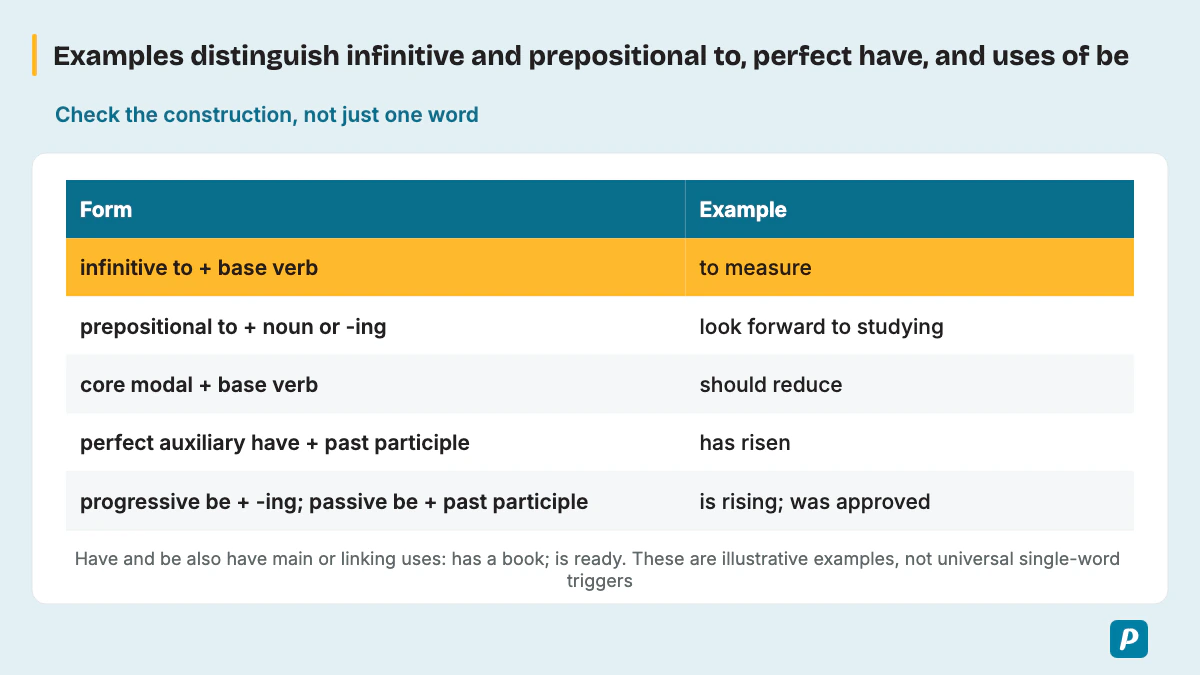
The rules that solve most Reading blanks cover verb forms, articles, plural nouns, subject-verb agreement, prepositions and parallel forms. Each rule comes with two short examples.
- Infinitive to and core modals such as should take the base verb: "to measure", "should reduce". Prepositional to takes a noun or -ing form: "look forward to studying".
- As a perfect auxiliary, have, has or had takes the past participle: "has risen", "had chosen". As a main verb, have can take a noun: "has a question".
- For a progressive form, am, is, are, was or were takes -ing: "are rising". For a passive form, be takes a past participle: "was approved". Be can also link to a noun or adjective: "is a student", "is ready".
- Be, been and being also take the past participle in the passive: "will be tested", "has been delayed".
- A or an goes before a singular countable noun, with any adjective between: "a rapid change", "an unusual result".
- Many, several and one of the take plural nouns: "several studies", "one of the causes".
- Subject-verb agreement: "it depends", "the data that support the claim", "a list that shows".
- With, of, for and about take a noun or -ing form: "a tool for measuring", "worried about losing".
- And and or join parallel forms: "cheaper and faster", "to plan or to build".
Choose a or an by sound, not spelling: "an hour", "a university". Use "the" for a noun the reader already knows or one that is unique, which is why Pearson's reading article shows "a team" in an early sentence becoming "the team" later. Pearson's Reading tips start with the part of speech: "beginning to" needs an infinitive. Collocations help too, such as "gain access" and "access to". Then choose by meaning.
Which Grammar Rules Solve Reading Fill in the Blanks?
The verb-form, article and agreement rules above solve most Reading blanks once you first decide which part of speech, or word class, the gap needs, in dropdown blanks and drag-and-drop blanks alike. Pearson advises learning whole word families, such as progress, progressive and progression, so you can pick the form that fits. Read the words on both sides of each gap, because the right word has to match the meaning and the grammar around it.
How Does Grammar Help in Reorder Paragraph?
Grammar helps you follow the links between sentences, and Pearson's own reading advice names tense, articles and pronouns as the clues, especially in Reorder Paragraph. An indefinite article usually introduces a noun first, and "the" refers back to it later. A pronoun such as "it" or "they" points back to a noun in an earlier sentence, so the sentence that names the noun comes first.
Is There an Official List of PTE Grammar Rules?
No, Pearson publishes no official list; rule counts such as 7, 10, 12 or 20 come from prep sites and general grammar guides, not from PTE. Some of those lists state the "it, which or that" rule with a plural verb, which is wrong for "it", so learn it as subject-verb agreement.
How Do You Use Grammar in PTE Writing?
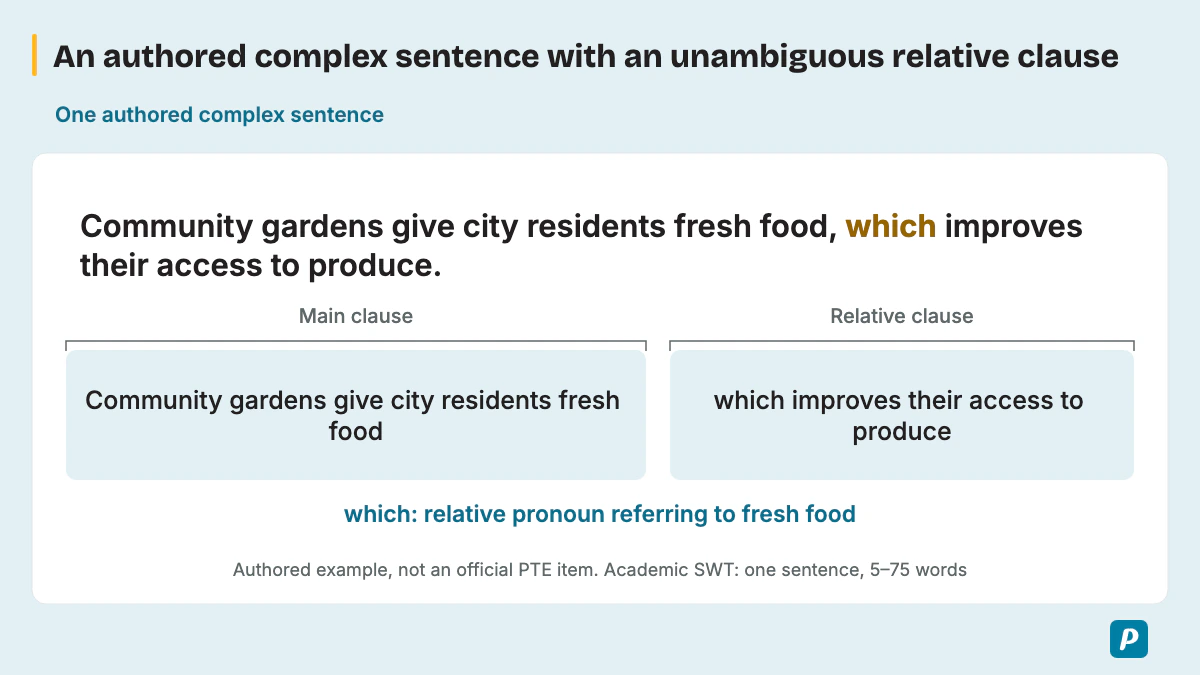
Writing grammar means one complete sentence from a main clause and a subordinate clause in Summarize Written Text, and a high share of correct complex sentences in Write Essay and Write Email. These habits cover the written tasks.
- Join the main clause and a subordinate clause with a connector, as in "Community gardens give city residents fresh food, which improves their access to produce."
- Use correct complex sentences in the essay or email, not only short simple ones.
- Check punctuation and capitalization in every sentence.
- Keep one tense through a paragraph unless the time actually changes.
- Hold one spelling convention, US, UK, Australian or Canadian, in each response.
Pearson's PTE Core tip names "which" or "and" as the connector for a summary. In PTE Core the summary may run to one or more sentences of 25-50 words, so the one-sentence limit applies to PTE Academic.
Punctuation counts in the essay and email, so keep four basics in hand:
- Put commas between items in a list and after an introductory phrase: "In many cities, rents have doubled."
- Use a semicolon between two related full clauses: "Some workers prefer offices; others work better at home."
- Show possession with an apostrophe: "the author's view" for one author, "the authors' views" for several.
- Never join two full sentences with only a comma; use a full stop, a semicolon or a connector.
How Is Grammar Scored in PTE Writing?
Pearson scores Grammar in Summarize Written Text by whether the basic sentence structure is correct, and Grammar usage and mechanics in Write Essay by sentence structure, punctuation and capitalization. Each carries up to 2 points in the PTE Academic Score Guide. In Summarize Spoken Text, Pearson's tip is to leave one to two minutes to check subject-verb agreement, tense and word order.
What Are the Most Common Grammar Mistakes in PTE?
The most common mistakes are agreement errors, tense shifts, missing articles, run-on summaries, missing capitals and the wrong word class in a blank. Each one costs points in a specific task.
- Agreement errors: writing "the results of the study shows" instead of "show" costs Grammar in Summarize Spoken Text, so check each verb's subject.
- Tense shifts: switching between past and present costs Grammar in Write Essay, so pick one time frame.
- Missing articles: dropping the "the" in "the study found" costs a word in Write from Dictation and Grammar in the essay, so read nouns back with their articles.
- A run-on sentence in Summarize Written Text can lose Grammar credit even when it contains only one full stop, so join ideas with a connector instead.
- Missing capitals and punctuation in the essay cost mechanics, so proofread the first word of every sentence.
- The wrong word class in a Reading blank: a noun where a verb belongs, so decide the part of speech first.
Each incorrect sentence below breaks one rule, and the correct version fixes only that rule.
| Incorrect | Correct | Rule |
|---|---|---|
| The number of visitors have grown. | The number of visitors has grown. | Agreement with "the number" |
| She is a engineer at a hospital. | She is an engineer at a hospital. | A or an by sound |
| Last year the council builds a new bridge. | Last year the council built a new bridge. | Past tense for a finished time |
| Trains are more faster than buses here. | Trains are faster than buses here. | No double comparative |
| Prices rose sharply, many families cut spending. | Prices rose sharply, so many families cut spending. | No comma splice |
| The plan needs careful manage. | The plan needs careful management. | Noun after an adjective |
| The report focuses in rural schools. | The report focuses on rural schools. | Preposition after "focus" |
| The companys profits fell. | The company's profits fell. | Possessive apostrophe |
How Can You Improve Your PTE Grammar Skills?
Grammar improves through a daily grammar routine: daily reading of academic English, noticing how sentences are built, timed practice and a rule check on every answer. Read one short academic article, then do a few blanks and one summary under time. A rule check on each answer shows which rule you used and which you guessed.
Add a 10-15 minute sentence-transformation drill each day: turn an active sentence into the passive, move a sentence into another tense, or rewrite it with a modal. Spread the week so every grammar skill gets time.
| Day | Focus |
|---|---|
| Three days | Sentence-transformation drills plus a few Reading blanks |
| Two days | Timed Reading Fill in the Blanks and Reorder Paragraph |
| One day | One timed summary and one essay or email |
| One day | Review the mistake log and redo the items you missed |
Keep a mistake log with three columns: your sentence, the corrected sentence and the rule. When the same rule appears three times, drill it first the next week.
How Do You Memorize Grammar Rules for PTE?
Rules stick when you meet them in real sentences: practice a rule on a few Reading blanks a day and say why each answer fits. Daily practice with a reason attached works better than trying to memorize rules from a list. Try it on PTE reading fill in the blanks items.
Do Collocations Help With PTE Grammar?
Yes, collocations such as "gain access to" carry both meaning and grammar, which is why Pearson names them as a way to solve Reading blanks. Word partners tell you the preposition as well as the noun. Build a list from our PTE collocations page.
Is There a PTE Grammar Book Worth Using?
Any good general grammar book helps, but the best practice for PTE is grammar met in timed PTE-style tasks, because that is where it is scored. Use a grammar book to look up general grammar, and run your practice writing through a grammar checker to spot repeat errors for your mistake log, since no checker is available in the test. Our guide to improve your English for PTE suggests where to start.
Practice PTE Online on EasyEnglish
Try Speaking, Writing, Reading and Listening tasks in a timed, computer-based format.
Practice scores are EasyEnglish estimates, not official Pearson scores. You can try speaking scoring without signing up.
Written by
EasyEnglish Team
The team behind EasyEnglish's PTE practice and mock tests
We build the PTE practice tasks, mock tests and scoring on EasyEnglish, and we oversee every guide on this site. We consult official test-provider and government sources where relevant. Check the sources and review date for each guide; practice examples are authored learning material. EasyEnglish is not affiliated with Pearson.
Editorial review completed .