How to Improve PTE Reading Speed and Comprehension? Tips
PTE Reading
When the PTE Reading section runs on one clock with no per-item timer, every minute your reading saves on one text goes to the next. PTE reading speed buys those minutes, and comprehension decides whether they turn into marks. Pearson's own reading article sets the benchmark: practice daily with short articles of about 300 words, aim for at least 220 words per minute and read in chunks rather than word by word.
PTE Academic Part 2 Reading runs 23-30 minutes, and PTE Core gives 27-37 minutes for the same five task types.
Table of Contents
How Fast Should You Read for PTE Reading?
Pearson's reading article suggests aiming for at least 220 words per minute, practiced daily on short 300-word articles. That figure is Pearson's practice target, not a test rule, and the test never measures your reading pace directly. Pearson asks for speed and comprehension at the same time. A faster read that loses the meaning isn't progress, because every Reading task scores understanding. For an adult test taker, reading fluency simply means reading smoothly at a steady pace while still following the argument.
What Is Meant by Reading Fluency?
Reading fluency is reading accurately, at a steady pace and with understanding, so attention goes to meaning rather than to decoding words. The term comes from school literacy teaching. In PTE, oral fluency is a different thing: it's a Speaking trait Pearson scores in tasks such as Read Aloud, so don't confuse the two.
Why Does Reading Speed Matter in the PTE Reading Section?
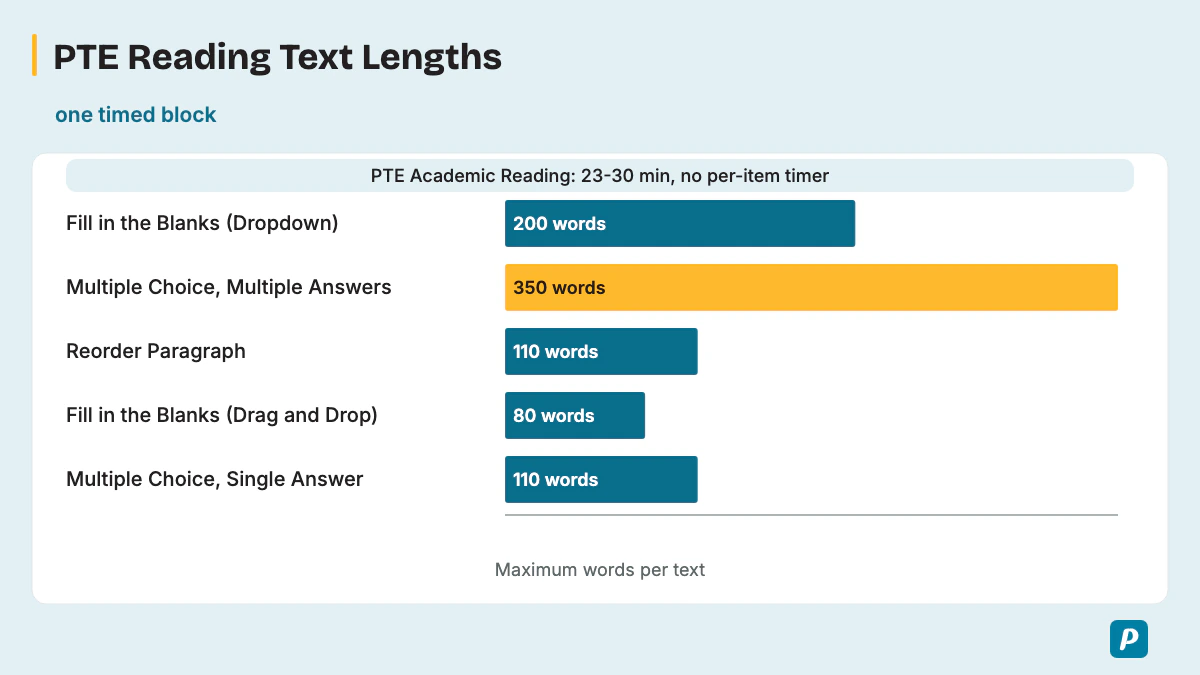
PTE Academic gives one block of 23-30 minutes for all five reading task types and no per-item timer, so slow reading on one long text takes minutes from every task after it. Text length in the PTE Reading section ranges from up to 80 words in drag-and-drop Fill in the Blanks to up to 110 in Reorder Paragraph and Multiple Choice, Single Answer. The dropdown Fill in the Blanks text runs up to 200 words, and Multiple Choice, Multiple Answers up to 350 (275 in PTE Core). Pearson notes that Multiple Choice, Multiple Answers needs more time than the single-answer task. An older Pearson India blog post still lists 29-30 minutes and texts up to 300 words; Pearson's current pages say 23-30 minutes and give the lengths above.
How Do You Measure Your Reading Speed?
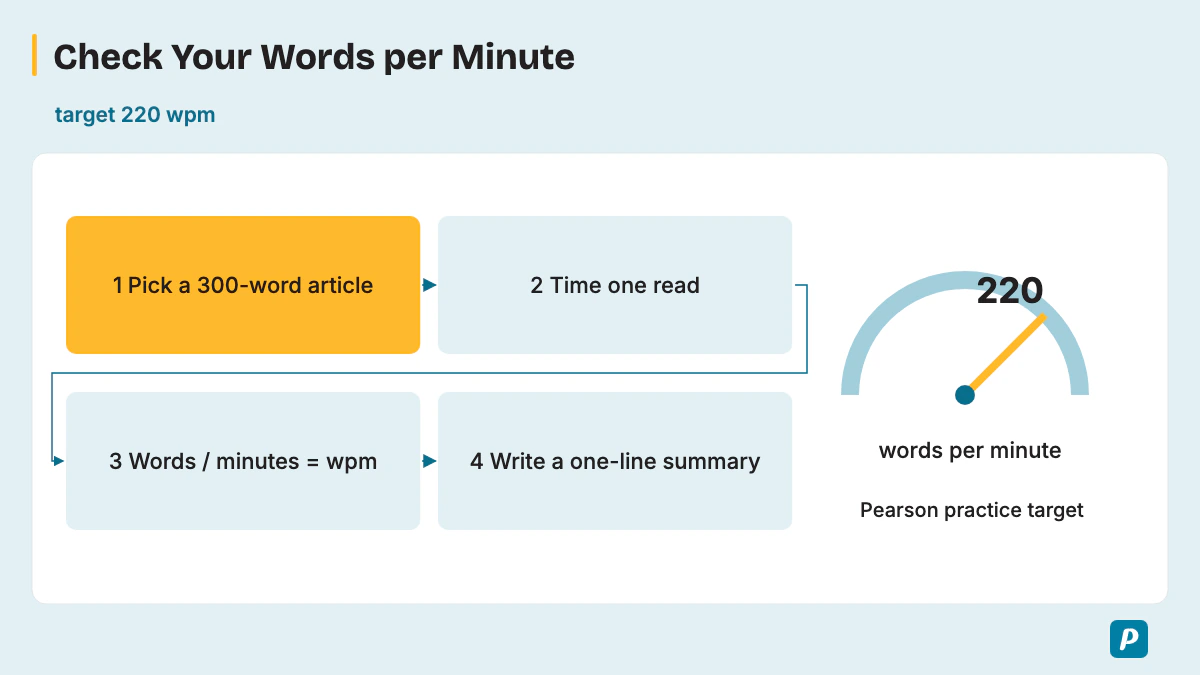
Time yourself reading a short article, count its words and divide the words by the minutes taken; then answer two questions on it to check you kept the meaning. A four-step reading speed test needs only a timer and a pen.
- Pick an article of about 300 words on an academic topic.
- Read it once at your normal pace with a timer running.
- Divide the words by the minutes, so 300 words in 2 minutes gives 150 words per minute.
- Write a one-line summary as your comprehension check.
Compare the result with the 220 wpm target from Pearson's article. At 220 words per minute, the same 300 words take about 1 minute 22 seconds instead of 2 minutes, so the gap is real time inside the block. Retest weekly on similar texts, and count a result only when the summary is still accurate.
What Are the Core Speed-Reading Techniques?
Read in chunks instead of single words, cut the silent "saying" of each word, stop translating into your first language, and keep your eyes moving forward. These five speed-reading techniques work together.
- Chunking: take in a group of words per glance instead of one word at a time. Pearson's article names this step directly.
- Phrase reading: try taking familiar phrases as groups, and retain any inner speech that helps you follow a difficult sentence.
- No mental translation: think in English as you read. Translating each sentence adds a step to every line.
- Steady eye movement: run a finger or the cursor under the line to pace yourself. It keeps the eyes from wandering.
- Selective rereading: reread when a reference, contrast or option is unclear; avoid repeating a whole passage when one sentence will answer the question.
Pearson says only "chunks (groups of words)" and sets no chunk size or skim time, so treat any fixed number as a personal setting.
Is Speed Reading a Real Skill?
Track pace together with an accurate summary and answers. Treat a higher words-per-minute figure as useful only when your comprehension holds. That's why Pearson ties speed reading to comprehension and asks you to build both together.
How Do You Increase Reading Speed and Comprehension Together?
Pearson's advice is to practice speed and comprehension at the same time: read actively, check the meaning after each paragraph, and only then push the pace and move to chunks. Four habits make active reading part of every practice text.
- Predict the topic from the first line before you read on.
- After each paragraph, jot a paragraph summary of a few words.
- Mark linkers such as "however" or "therefore" that signal contrast or result.
- Raise the pace only when your summaries stay accurate, so comprehension and retention keep up with speed.
How Does Expanding Your Vocabulary Help Reading Speed?
Every unknown word stops the eye, so a wider academic vocabulary, and knowing which words go together, lets you read at a steady pace and answer Fill in the Blanks faster. Collocations decide Pearson's dropdown example: only "access" fits "gained ... to technologies", because English says "gain access to". Keep a personal word list from every practice text, with each word in its phrase and grouped by word family and prefix (for example, stable, stability, unstable). Guess a new word from its sentence and read on: in "The bridge was so precarious that engineers closed it until new cables were fitted", precarious must mean unsafe, so the dictionary can wait.
How Do You Use Skimming and Scanning Together?
Skim first for the topic and structure, then scan for the words the question points to, and read closely only around what you find. Skimming saves time on the whole text, scanning saves it on the search, and close reading then earns the mark. Pearson warns that scan reading plus word matching is a common Multiple Choice, Single Answer mistake. Its fix is to learn synonyms and paraphrasing, because the correct answer generally does not reuse the text's words. To skim, read the title, the first sentence of each paragraph and the closing sentence; to scan, fix your target first, such as a year, a number or a name from the question.
What Is the Difference Between Skimming and Scanning?
Skimming reads for the gist of the whole text; scanning hunts for one specific detail the question names. The full method, with a task-by-task map, is in our guide to skimming and scanning in PTE Reading.
How Do You Tackle Question Types One by One?
Each reading task rewards a different reading speed: fast skimming for Reorder Paragraph and the two Fill in the Blanks tasks, slow intensive reading of the stem and options for the two Multiple Choice tasks. The table follows Pearson's task order.
| Task | Text length (Pearson) | Read fast or slow | Speed move |
|---|---|---|---|
| Fill in the Blanks (dropdown) / Reading & Writing: Fill in the Blanks | Up to 200 words | Fast, then slow at each blank | Skim the topic, then read around each gap. |
| Multiple Choice, Multiple Answers | Up to 350 words | Slow on the stem | Read stem and options closely, then scan. |
| Reorder Paragraph | Up to 110 words | Fast | Skim every box and find the topic sentence. |
| Fill in the Blanks (drag and drop) | Up to 80 words | Fast | Read once for meaning, then fit the words. |
| Multiple Choice, Single Answer | Up to 110 words | Slow on the prompt | Note the prompt key words before the text. |
Which Smart Time-Management Strategy Works in PTE Reading?
Watch the on-screen section clock, spend more of the block on the longer Multiple Choice, Multiple Answers texts, and don't let one Reorder Paragraph set eat the minutes the last tasks need. Four rules keep time management simple.
- Know your block: 23-30 minutes in PTE Academic and 27-37 minutes in PTE Core.
- Set a personal checkpoint halfway through the block.
- Move on after a best guess on any item that stalls you.
- Never leave a single-answer item blank, since a wrong pick costs nothing extra.
Pearson's current page sets no per-item timer, so any per-question split is your own plan.
How Should a Daily Training Routine Build Reading Speed?
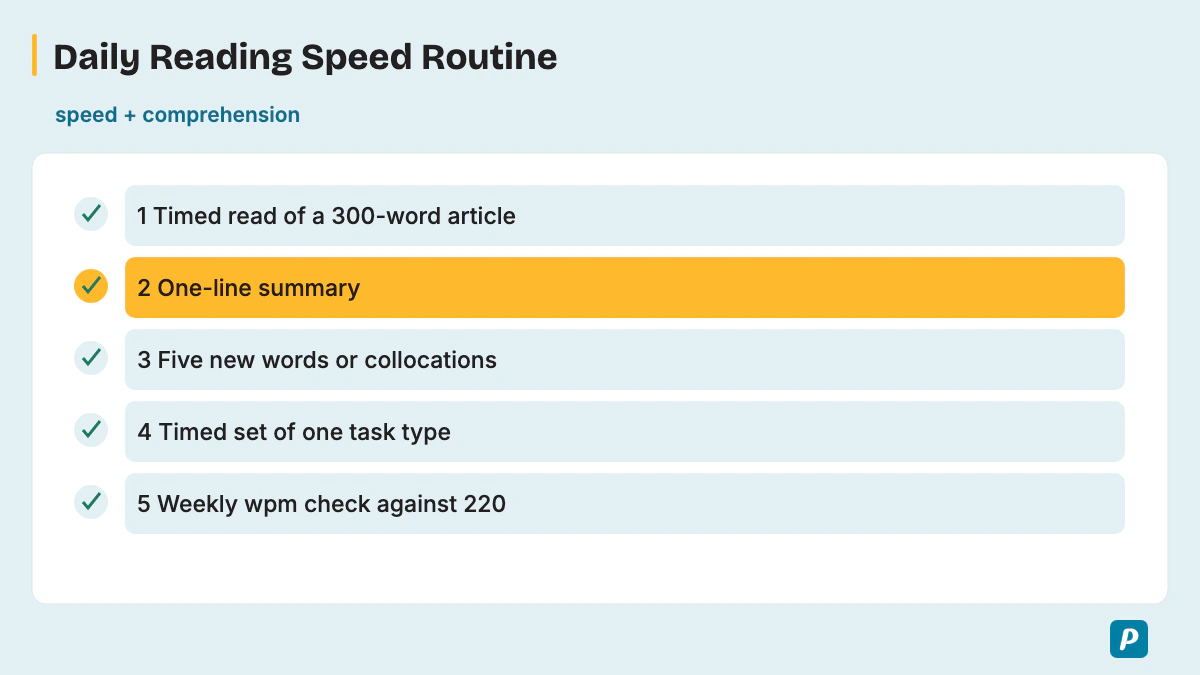
Read one or two short academic articles of about 300 words every day at a timed pace, check your comprehension, and finish with a timed set of PTE reading items. Five steps make up the daily practice.
- Do a timed reading of one 300-word article.
- Write a one-line summary of it.
- Add five new words or collocations to your list.
- Do a short timed set of one task type.
- Run a weekly words-per-minute check against 220.
Rotate the subject of the daily article, for example science on one day, history on the next and economics or the arts after that, so an unfamiliar topic doesn't slow you on test day. Pearson also suggests reading often for short periods and turning the speed target into a challenge with friends to stay motivated. Pearson publishes no 30-day plan or fixed minutes per block, so set the length of each step yourself. Once the routine feels easy, sit a full mock test under test conditions to see whether the speed holds across the whole block.
How Do You Improve Your Reading Score in PTE?
Speed only pays when it turns into correct answers, so pair the routine above with PTE reading tips for each task and task practice on the items that cost you most. A fast read still costs Reading score points if it ends in a wrong pick, so check each answer against the text before you move on.
How Is the PTE Reading Section Structured?
PTE Academic Reading gives five task types and 15-20 items in 23-30 minutes, while PTE Core gives the same five types and 13-18 items in 27-37 minutes, according to Pearson's Score Guides. Our PTE reading section overview covers every task in the Reading section.
How Do You Get 90 in PTE Reading?
90 is the top of the 10-90 scale, so the last points come from accuracy on every task, not speed alone. The full method for a score of 90 in each skill is on our page on how to score 90 in PTE.
What Are the Best PTE Reading Tips and Tricks?
Use task-specific tips to guide practice. Read before and after each blank, find the topic sentence first in Reorder Paragraph, and avoid wrong options by choosing only options you are sure of in Multiple Choice, Multiple Answers. Our full list of PTE reading tips and tricks goes task by task.
How Do You Get Faster at Reading Fill in the Blanks?
Skim the passage for its overall meaning first, then read around each blank and elsewhere in the passage when the meaning or reference needs it. Our guide to PTE reading fill in the blanks has practice sets.
How Do You Handle Multiple Choice, Multiple Answers?
Read the stem and the options closely first, note repeated words such as nouns or adjectives, then scan the up-to-350-word text for those words and read around them. Negative marking applies in Multiple Choice, Multiple Answers, so each wrong pick loses a point, although the item can't score below zero. See PTE reading multiple choice multiple answer for practice items.
Practice PTE Reading on EasyEnglish
Try Reading tasks in a timed, computer-based format like the real test.
Try speaking practice without signing up. A free account is required for full mock tests. Practice scores are estimates, not official Pearson scores.
Written by
EasyEnglish Team
The team behind EasyEnglish's PTE practice and mock tests
EasyEnglish provides independent PTE practice and estimated scores. EasyEnglish is not affiliated with or endorsed by Pearson. Contact support@inverseai.com.
Format and scoring sources checked on 26 October 2026: Academic Reading; Core Reading; Academic Score Guide; Core Score Guide (January 2026). Academic and Academic UKVI details use the format introduced on 7 August 2025; Core details use its January 2026 Score Guide. Where a task page and Score Guide differ, the distinction is identified in the text; use the Guide for scoring criteria. Practice passages, names, figures, prompts and model answers are authored examples supplied with this guide, not authentic exam items or independently verified research findings. Suggested practice schedules and time splits are coaching advice, not Pearson requirements or score guarantees.
Reading pace suggestions come from Pearson's 8 July 2021 reading advice, checked 26 October 2026. They are practice targets, not requirements for a particular score.
Editorial review completed .