PTE Essay Writing Tips: Plan, Structure and Proofread
PTE Writing
Pearson scores Write Essay on seven traits, and each of these essay writing tips protects at least one of them. Write Essay is a PTE Academic task (PTE Core has Write Email instead): you get one prompt, 20 minutes and a target of 200-300 words. Pearson's PTE Academic Test Taker Score Guide (2025) caps Content, Development, structure and coherence, and General linguistic range at 6 points each, and Form, Grammar, Vocabulary range and Spelling at 2 each.
The short answer: note the prompt's key words, plan briefly, write four paragraphs that hold one clear position, stay inside 200-300 words, use correct complex sentences joined by varied linking words, and keep time to proofread. Pearson's own rules also correct four popular claims. An essay under 200 words doesn't score zero (only under 120 does), Pearson sets no minute split, simple-only grammar caps your Grammar score, and a second spelling slip zeroes the Spelling trait, not the whole essay.
Table of Contents
How Do You Write an Essay for the PTE Exam?
You read the 2-3 sentence prompt, note its key words, pick a position, write a 200-300 word argumentative essay and proofread it, all inside 20 minutes. Pearson's essay article breaks the job into three steps: analyze the prompt and plan, write the essay, then proofread. The Write Essay page tells you to note key words in the prompt before you write anything. It names two prompt kinds: whether you agree or disagree with a statement, and how different groups of people might feel about a situation. Four common essay types are teaching labels rather than Pearson categories, so each one still needs a clear position.
Put simply, an argument prompt asks you to defend one side, and a two-views prompt asks for both sides and then your judgment. A problem-solution prompt asks for causes and fixes, while an advantages-disadvantages prompt weighs benefits against drawbacks before a verdict.
How Should You Manage the 20 Minutes in PTE Essay Writing?
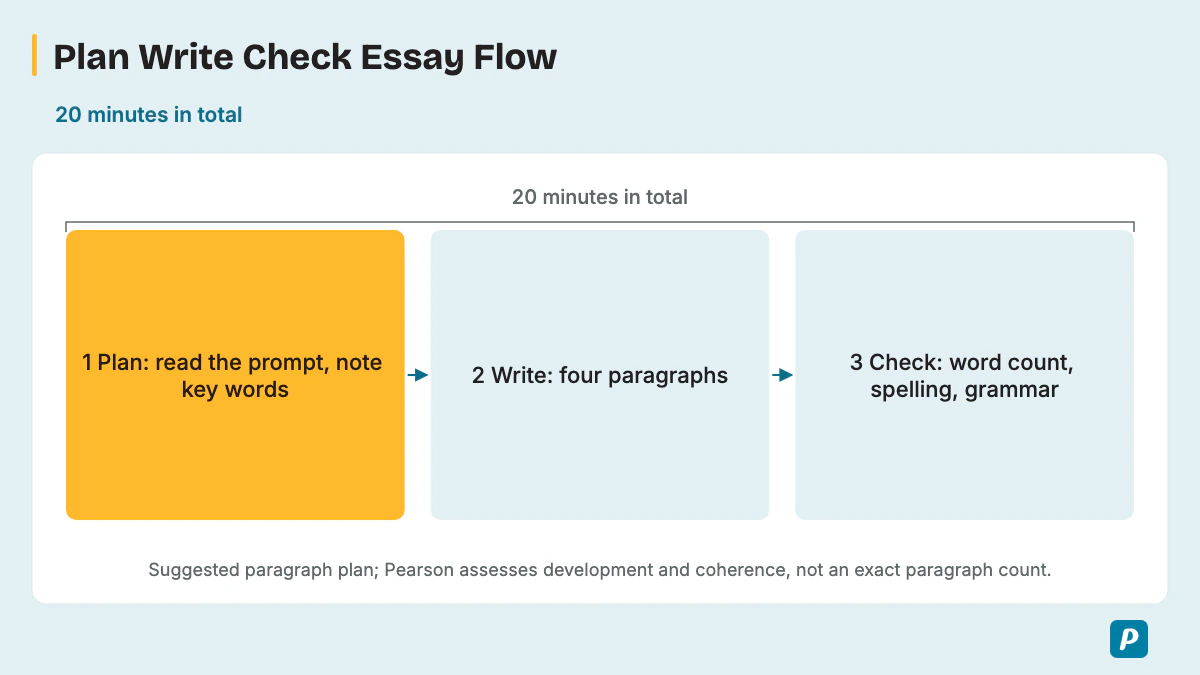
Pearson gives 20 minutes to plan, write and check, and publishes no fixed split, so use a habit you've tested in timed practice and always leave proofreading time. Good time management means treating the phases as jobs, not as timed slots.
- Plan: note the key words, choose your position and jot one idea for each body paragraph.
- Write: build the four paragraphs in order and glance at the word counter after each one.
- Check: reread for the prompt, the word range, one spelling convention and sentence-level grammar.
Some prep sites still quote a fixed split such as 2 minutes to plan, 14 to write and 4 to check; Pearson's current page gives only the 20-minute total. A split you rehearse is a personal habit, not a rule.
A quick brainstorm makes the planning phase concrete. Take this advantages-disadvantages prompt: "Wearable fitness trackers have become common among people of all ages. What are the advantages and disadvantages of relying on these devices to manage your health?"
| Advantages | Disadvantages |
|---|---|
| Records daily steps and sleep as real numbers. | Readings are estimates, not medical tests. |
| Motivates users with goals and reminders. | Constant data can make some users anxious. |
| Can flag unusual heart-rate readings to discuss with a doctor. | Personal health data may be shared with companies. |
Pick the strongest point from each column, here motivation and data privacy, and those two become your body paragraphs. An agree-disagree prompt needs only a one-line plan. "Every secondary school should teach cooking" becomes: agree; body 1 = a life skill that cuts reliance on processed food; body 2 = lessons that teach budgeting; conclusion = restate with one condition.
How Do You Structure the Essay in Four Paragraphs?
Write an introduction, two body paragraphs that each develop one idea, and a short conclusion; Pearson's essay article describes the same four parts. Under Development, structure and coherence, Pearson's Write Essay page says the best responses contain "multiple paragraphs" with "a clear introduction, body and conclusion that relate to the topic". The Score Guide's top descriptor (6 of 6) adds that "Ideas are organised cohesively into paragraphs", so each of the four paragraphs has a clear role and each body paragraph carries one main idea.
A five-paragraph school essay with three arguments is unnecessary: two developed body paragraphs fit 20 minutes and 300 words. The prompt kind decides what those two paragraphs do. For a weigh-both-sides prompt, body 1 takes one view, body 2 the other, and the conclusion gives your judgment. For a choose-one-side prompt, each body paragraph carries a separate reason for the same side.
Each paragraph has a job. The introduction paraphrases the prompt, states your position and previews the two points. A body paragraph opens with a topic sentence, explains it, then proves it with an example. The conclusion restates your position without new arguments. As a rough guide rather than a Pearson rule, that works out at 2-3 sentences for the introduction, 3-5 for each body paragraph and 2 for the conclusion.
What Is the PTE Essay Word Limit?
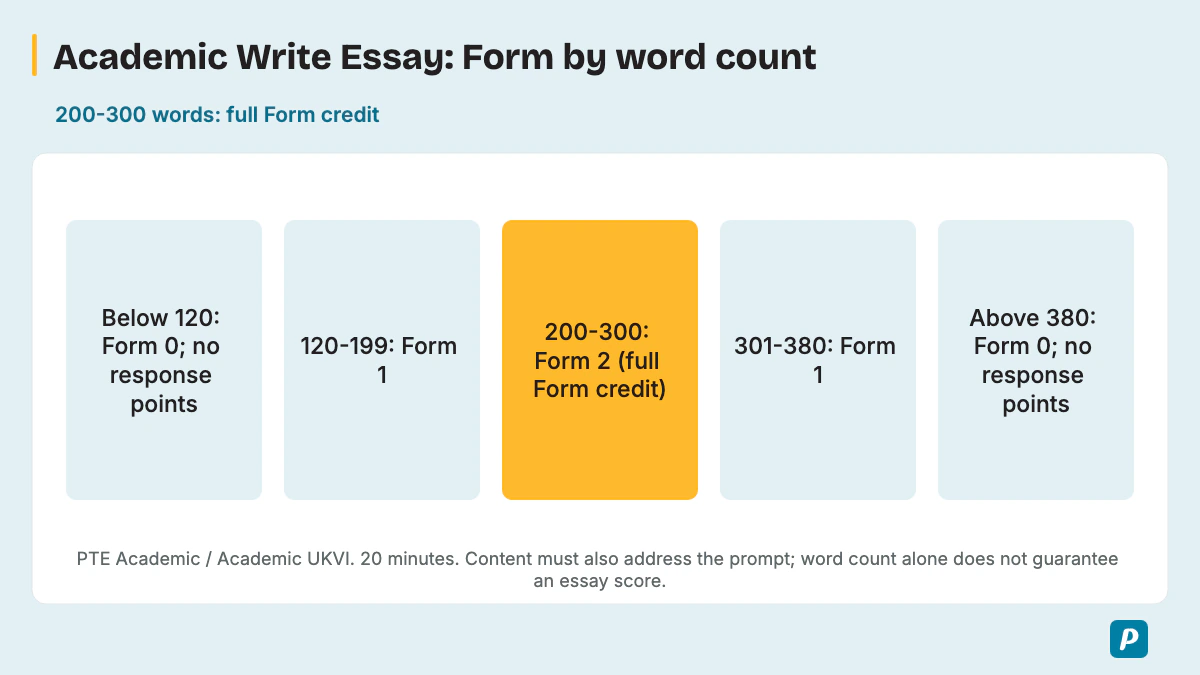
An essay of 200-300 words gets full Form credit, worth 2 points in the Score Guide. A count of 120-199 or 301-380 earns 1 point, and an essay under 120 words or over 380 words scores Form 0, which means no score points on any of the seven traits. Each word range maps to a Form score in Pearson's tables.
| Word count | Form points | What happens |
|---|---|---|
| Under 120 | 0 | No score points for the whole essay. |
| 120-199 | 1 | The essay is scored, with a lower Form score. |
| 200-300 | 2 | Full Form credit. |
| 301-380 | 1 | The essay is scored, with a lower Form score. |
| Over 380 | 0 | No score points for the whole essay. |
An older Pearson article from 2021 says that writing under 200 or over 380 words scores zero, but Pearson's current format page and the Score Guide set the zero line at 120. The task page's "How to answer" box still tells you to write a minimum of 200 words and no more than 300, so aim for 200-300 and treat 120 and 380 as the hard edges. The Word Count at the bottom of the screen tracks the word limit as you type, so check that word counter after each paragraph.
What Are the Key Scoring Strategies for the PTE Essay?
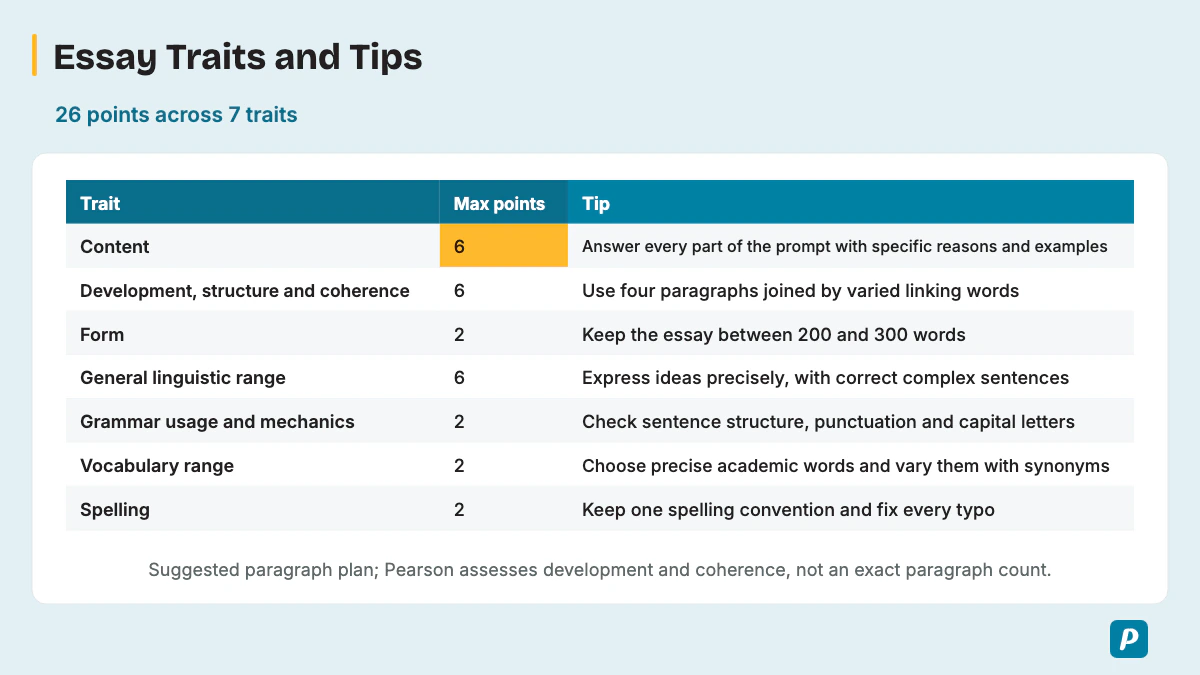
The core strategy is to aim each part of the essay at one of Pearson's seven traits, knowing that Content, Development, structure and coherence, and General linguistic range carry up to 6 points each. Form, Grammar, Vocabulary range and Spelling carry up to 2 each. Here is each trait with its maximum and the habit that protects it.
| Trait | Max points (Score Guide) | The tip that protects it |
|---|---|---|
| Content | 6 | Answer every part of the prompt with specific reasons and examples. |
| Development, structure and coherence | 6 | Use four paragraphs joined by varied linking words. |
| Form | 2 | Keep the essay between 200 and 300 words. |
| General linguistic range | 6 | Express ideas precisely, with correct complex sentences. |
| Grammar usage and mechanics | 2 | Check sentence structure, punctuation and capital letters. |
| Vocabulary range | 2 | Choose precise academic words and vary them with synonyms. |
| Spelling | 2 | Keep one spelling convention and fix every typo. |
The Score Guide states that a 0 for Content or Form means no score points for the whole response. These responses trigger that zero:
- An essay on a completely different topic from the prompt (Content 0).
- Fewer than 120 or more than 380 words (Form 0).
- An essay written in capital letters, with no punctuation, or made only of bullet points or very short sentences (Form 0).
- A response built on significant amounts of pre-prepared or memorized material (Content 0).
The task page names only the off-topic and word-count zeros; the capital-letter, punctuation and bullet-point rules come from the Score Guide's Form table.
Pearson also gives no credit for "an unoriginal response" and says "You must use your own words". It accepts US, UK, Australian and Canadian spelling if one spelling convention runs through the essay, and it scores Spelling at 2 for no errors, 1 for one error and 0 for more than one. On top of the AI score, a human expert checks Content, the structure trait and General linguistic range, so every claim needs a reason a reader can follow.
Should You Keep It Simple in PTE Essay Writing?
Keep it clear, not only simple. Pearson's General linguistic range note says you are "more likely to receive full credit if you use complex sentence structures and vocabulary correctly". The alternative it warns against is "consistently using simple sentence structures and vocabulary."
The popular "keep it simple" tip is right about clarity and wrong if it means short simple sentences only. The Score Guide's Grammar scale gives 2 for "consistent grammatical control of complex language" and 0 for "mainly simple structures and/or several basic mistakes", so grammatical accuracy and range have to come together. Complex sentences join a main clause to a dependent one, and each pair below turns choppy simple sentences into one correct complex sentence.
- Simple: Community gardens use empty land. Neighbors grow food there. They meet each other. Complex: Community gardens turn empty lots into shared plots where neighbors grow food and get to know one another.
- Simple: Street food is cheap. Many workers buy it. Hygiene can be poor. Complex: Although street food gives workers a cheap meal near their jobs, poor hygiene at some stalls makes it a health risk.
- Simple: Dogs need walks. Owners must go outside. This keeps owners active. Complex: Because dogs need walking every day, owners who might otherwise stay indoors end up taking regular exercise.
Which Grammar Mistakes Cost Marks in the PTE Essay?
The errors to hunt for are subject-verb agreement, tense shifts, run-on sentences, missing articles, comma splices and wrong word forms, because Pearson scores Grammar usage and mechanics on "sentence structure, punctuation and capitalization". The Score Guide's middle score (1 of 2) describes "a relatively high degree of grammatical control. No mistakes which would lead to misunderstandings". Six common slips appear here with a corrected version of each.
| Mistake | Wrong | Right |
|---|---|---|
| Subject-verb agreement | The number of commuters are rising. | The number of commuters is rising. |
| Tense shift | Last year the city built a bridge, and traffic falls since then. | Last year the city built a bridge, and traffic has fallen since then. |
| Run-on sentence | Prices rose sharply families cut their spending. | Prices rose sharply, so families cut their spending. |
| Missing article | Most people agree that internet has changed work. | Most people agree that the internet has changed work. |
| Comma splice | Online courses save travel time, they can feel isolating. | Online courses save travel time, but they can feel isolating. |
| Wrong word form | The policy had a strong economy effect. | The policy had a strong economic effect. |
How Do You Use Linking Words in a PTE Essay?
Use linking words to show how ideas relate: adding a point, contrasting, giving a cause or result, giving an example, conceding or concluding, with one or two per paragraph where they carry meaning. The Score Guide's top Development, structure and coherence descriptor rewards "a variety of connective devices effectively and consistently", while lower descriptors describe limited or repetitive linking. A particular set of three conjunctions does not determine the trait score by itself. Pick the connective by its job rather than by how formal it sounds.
- Contrast: "however" or "whereas" turns the essay toward the opposing view.
- Result: "as a result" or "therefore" shows that one point causes the next.
- Concession: "although" or "admittedly" grants a point before you answer it.
- Conclusion: "overall" or "on balance" opens the final paragraph.
Smooth transitions also depend on placement. Starting every sentence with "Firstly", "Secondly" or "In addition" reads mechanical, so vary the position. "The plan, however, ignores rural areas" places the connective mid-sentence and keeps the cohesion without the drumbeat.
How Do You Brush Up on Academic Vocabulary for the PTE Essay?
Use precise academic words and vary them with synonyms, because Pearson scores the variety of your words and their appropriateness in an academic environment. Pearson's best responses "use precise academic terms and avoid repetition by using synonyms and idioms where appropriate", and Vocabulary range 2 in the Score Guide needs a "Good command of a broad lexical repertoire". Pearson's 2021 article adds that idioms help only in small doses, and a precise common word beats a rare one used wrongly. Word forms (economy, economic, economical) and collocations such as "pose a risk" let you vary a sentence without changing the idea. To build academic vocabulary, read news and opinion articles and note whole phrases by theme, like the 24 in this table.
| Theme | Academic words and collocations |
|---|---|
| Technology | automate routine tasks, data privacy, digital divide, screen time |
| Environment | carbon emissions, renewable energy, habitat loss, sustainable practice |
| Education | academic achievement, critical thinking, lifelong learning, tuition fees |
| Health | preventive care, sedentary lifestyle, public health campaign, life expectancy |
| Work | job security, flexible hours, skills shortage, work-life balance |
| Cities | urban sprawl, affordable housing, traffic congestion, green space |
What Are the Do's and Don'ts of PTE Essay Writing?
Answer the exact prompt in your own words, inside 200-300 words, with clear paragraphs, and avoid memorized sentences, off-topic drift, copied prompt sentences, bullet points, capitals and mixed spelling conventions. Each habit below names the trait it protects.
Do
- Answer every part of the prompt with reasons and examples, which protects Content.
- Hold one clear position from introduction to conclusion, which protects Development, structure and coherence.
- Stay between 200 and 300 words, which protects Form.
- Write correct complex sentences alongside short ones, which protects General linguistic range and Grammar.
- Swap repeated words for precise synonyms, which protects Vocabulary range.
- Keep one spelling convention, such as "color" or "colour" but never both, which protects Spelling.
Don't
- Paste memorized sentences, since the Score Guide treats pre-prepared material as irrelevant and scores Content 0.
- Drift off-topic, since an essay on a different topic earns no score points on any trait.
- Copy whole sentences from the prompt, since low Content descriptors name "repeating language from the prompt".
- Use bullet points, because an essay made only of bullet points scores Form 0.
- Type in capital letters, because an all-capitals essay also scores Form 0.
- Leave typos unchecked, because two spelling errors drop the Spelling trait to 0.
Pearson's 2021 self-improvement article says more than one spelling mistake scores zero for the question. The Score Guide applies that 0 to the Spelling trait alone (2 for correct spelling, 1 for one error, 0 for more than one), so the other six traits are still scored.
What Does a Sample PTE Essay Answer Look Like?
This sample essay is a model answer that applies the tips: four paragraphs, a clear position, one idea per body paragraph, varied linking words, correct complex sentences and 247 words, a word count inside the 200-300 range.
Prompt: Several cities have closed their central streets to private cars. Supporters say this makes the center cleaner, quieter and safer, while critics argue that it hurts local shops and people who cannot walk far. Discuss both views and give your own opinion.
A growing number of cities now keep private cars out of their central streets. Supporters believe the change makes town centers healthier and safer, whereas critics fear that shopkeepers and less mobile residents pay the price. In my view, car-free centers bring more benefits than costs, provided that cities plan carefully for the people who rely on driving.
On the one hand, removing cars transforms the quality of urban life. Air near busy junctions becomes cleaner, which matters most for children and people with asthma, and pedestrians no longer have to compete with traffic for space. Streets that were once noisy and congested can be turned into cafés, markets and play areas, so the center becomes a place where people choose to spend time rather than simply pass through.
On the other hand, the policy can create genuine hardship. Shop owners who depend on customers parking outside may lose trade, especially in the first months after a ban. Elderly or disabled residents, for whom a short walk can be exhausting, may find the center harder to reach than before. If these groups are ignored, the scheme will seem unfair, and public support will quickly fade.
Overall, I believe car-free centers are worth introducing, but only alongside practical safeguards. Cities should run frequent shuttle buses, allow deliveries at fixed hours and issue access permits to residents with limited mobility. With these measures in place, a center can become greener without shutting out the people who need it most.
Each paragraph does a scoring job.
- Introduction: paraphrases the prompt, names both views and states the writer's position, which sets up Content.
- Body 1: develops one view with specific effects on air, space and street use, which builds Development, structure and coherence.
- Body 2: develops the opposing view through two affected groups, using a "for whom" clause that shows General linguistic range.
- Conclusion: restates the position and names three safeguards. For a clearer argument, develop those safeguards in the body rather than introducing them only in the conclusion. The model has 247 words.
How Can You Improve Essay Writing for PTE?
Write timed essays on fresh prompts, check each one against the seven traits and the word range, and fix one weak trait at a time. After each essay, score yourself trait by trait against the table above and pick the lowest trait as the focus for the next session.
Build typing speed too, because the essay is typed on screen with cut, copy and paste buttons and a word counter. Write a full timed 20-minute essay every other day so you learn your own pace.
Timed practice works only with a self-check afterwards, so keep a log of your lowest trait per essay. These six practice prompts mix both prompt kinds and four essay types.
- Many zoos now describe themselves as conservation centers rather than places of entertainment. Some people argue that keeping wild animals in captivity can no longer be justified. To what extent do you agree or disagree?
- Some schools require students to wear a uniform every day, while others let them choose their own clothes. Discuss both views and give your own opinion.
- Supermarkets throw away large amounts of edible food every year. What are the main causes of this problem, and what steps could reduce it?
- Robots are being tested in care homes to help older residents with daily tasks and companionship. What are the advantages and disadvantages of this development?
- Some governments fund schools and broadcasters to keep minority languages alive. How might native speakers, taxpayers and young people feel about this spending?
- A number of cities have removed large advertising billboards from their streets. Do you agree that other cities should follow this example? Support your view with reasons and examples.
What Is the Right Essay Format to Use?
The right format is the one Pearson describes: an argumentative essay of 200-300 words with an introduction, body paragraphs and a conclusion. The task rules, timing and essay format are set out in the PTE Write Essay guide.
What Should a PTE Essay Writing Sample Show?
A useful sample shows the four paragraph jobs filled with words that only fit its own prompt, which is why it is a model to study, not a script to copy. The PTE essay template and sample guide annotates an essay sample for each of seven essay types. It also gives the paragraph plan for each type and the full bank of linking words.
Where Can You Find PTE Essay Topics to Practice?
The linked task description gives no complete topic list, so practice with original prompts grouped by theme and written in Pearson's 2-3 sentence style. Original prompts train you to plan fast for unseen topics; a larger bank of practice prompts sorted by theme sits on the PTE essay topics page.
What Goes on a Final Checklist Before Submitting?
Before you submit, check the word count, one spelling convention, capital letters and full stops, and subject-verb agreement in your longest sentences. Run this final checklist in the minutes you saved, and use the PTE grammar rules guide to drill agreement and punctuation between practice essays.
How Do You Score 90 in PTE Writing?
No single tip guarantees 90, because the Writing score also draws on other items such as Summarize Written Text; a strong essay protects its share by meeting every trait. The Score Guide credits Write Essay to Writing only, although the task page also lists grammar, spelling, vocabulary and written discourse. The PTE score 90 guide covers what a 90 in writing takes across every task.
Practice PTE Writing on EasyEnglish
Try Writing tasks in a timed, computer-based format like the real test.
Try speaking practice without signing up. A free account is required for full mock tests. Practice scores are estimates, not official Pearson scores.
Written by
EasyEnglish Team
The team behind EasyEnglish's PTE practice and mock tests
EasyEnglish provides independent PTE practice and estimated scores. EasyEnglish is not affiliated with or endorsed by Pearson. Contact support@inverseai.com.
Format and scoring sources checked on 26 October 2026: Academic Speaking & Writing; Core Speaking & Writing; Academic Score Guide; Core Score Guide (January 2026). Academic and Academic UKVI details use the format introduced on 7 August 2025; Core details use its January 2026 Score Guide. Where a task page and Score Guide differ, the distinction is identified in the text; use the Guide for scoring criteria. Practice passages, names, figures, prompts and model answers are authored examples supplied with this guide, not authentic exam items or independently verified research findings. Suggested practice schedules and time splits are coaching advice, not Pearson requirements or score guarantees.
Editorial review completed .