PTE Essay Topics: Practice Prompts and Sample Answers
PTE Writing
The official task description does not provide a complete topic list or repeat-frequency data, so every one of the 126 practice prompts below was written from scratch, not taken from a real or predicted exam. Each one follows the 2-3 sentence style Pearson describes for the PTE Academic Write Essay task and asks you to take a position.
The 120 bank prompts each carry a short idea outline, and five model answers show how a prompt becomes a 200-300 word essay. PTE Core has Write Email instead of an essay.
Table of Contents
Are There Official or Most Repeated PTE Essay Topics?
No, Pearson publishes no official topic list and no data on repeated topics. On prompt length, its Write Essay page says only that prompts are 2-3 sentences. They may ask whether you agree or disagree with a statement, or how different groups of people might feel about a situation. Lists sold as "most repeated" topics come from coaching companies. A memorized answer to a predicted topic risks an unoriginal response, which earns no credit, or an off-topic essay, which Pearson scores zero.
What Are the Main Categories of PTE Essay Topics?
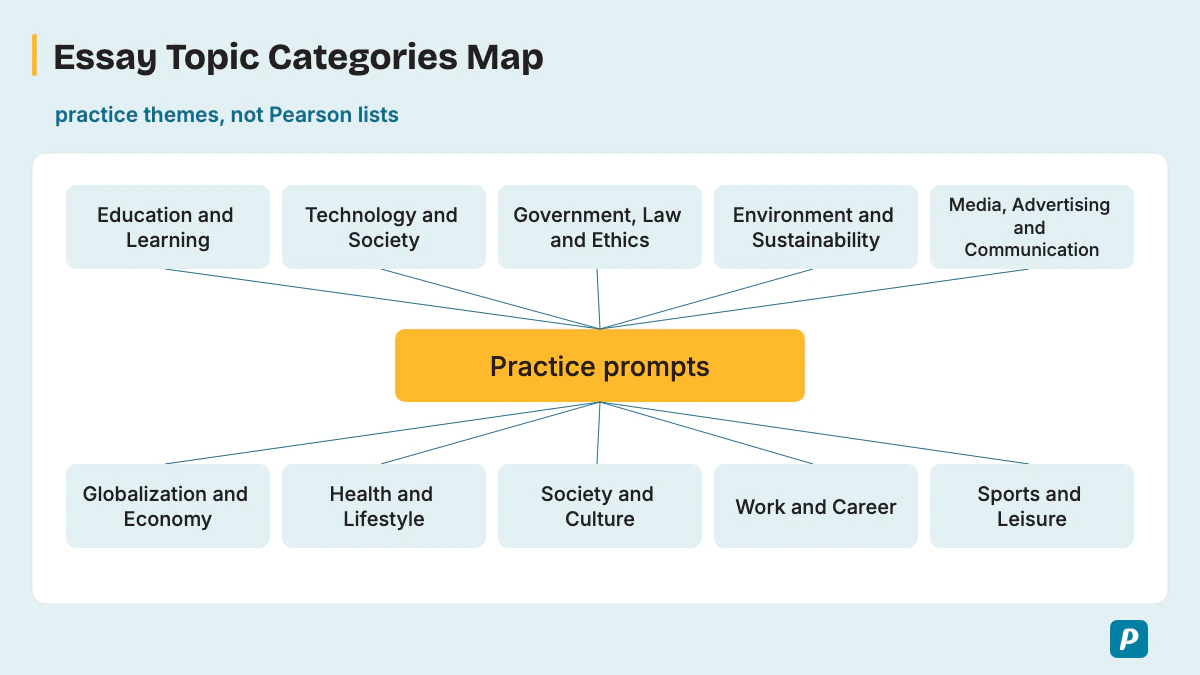
Practice prompts fall into ten broad themes, from education and technology to globalization, health and sport. Pearson sets no official categories, so these topic categories are teaching groupings used across PTE practice material, and nothing published shows how often each appears.
| Category | What prompts in it ask about |
|---|---|
| Education and Learning | Schools, universities, online study, exams and how people learn. |
| Technology and Society | How phones, the internet, AI and automation change daily life. |
| Government, Law and Ethics | Laws, punishment, privacy, public spending and what the state should control. |
| Environment and Sustainability | Pollution, waste, energy, water and how to protect the environment. |
| Media, Advertising and Communication | News, social media, influencers and the effect of advertising. |
| Globalization and Economy | Trade, international companies, tourism, inequality and migration for work. |
| Health and Lifestyle | Diet, exercise, stress, aging and public health. |
| Society and Culture | Family roles, tradition, role models and multicultural life. |
| Work and Career | Pay, job satisfaction, remote work and the changing job market. |
| Sports and Leisure | Extreme sports, school sport, big events and free time. |
What Are Some Good Topics for Writing a PTE Test Essay?
Good practice topics are debatable issues from the ten categories, written as 2-3 sentence prompts with a task line that tells you what to do. The 120 original practice prompts below are numbered by category, mix every prompt type, and each comes with three ideas you can build body paragraphs from, not a script to copy.
Education and Learning
- Some universities now let students complete entire degrees online, while others argue that a campus education cannot be replaced. To what extent do you agree or disagree that online degrees are as valuable as campus degrees?
- Ideas: online study opens degrees to working adults and rural students; campus life gives labs, networking and face-to-face feedback; example of a nurse studying part-time between shifts.
- In many countries, school students get homework every day. Some parents believe it builds discipline, while others say it takes away time for rest and play. Discuss both views and give your own opinion.
- Ideas: homework builds study habits and shows parents how a child is doing; too much cuts sleep, sport and family time; your view could favor short, focused tasks.
- Some people think university education should be free for every student and paid for through taxes. To what extent do you agree or disagree?
- Ideas: free tuition gives low-income families a fair chance; taxpayers fund courses some graduates never use; a middle path is free places in subjects with skill shortages.
- Many schools still judge students mainly through written exams. Discuss the advantages and disadvantages of relying on exams to measure learning.
- Ideas: exams are equal for everyone and hard to copy; they reward memory and last-minute cramming; projects can sit alongside one final exam.
- Some educators believe children should start formal schooling at four, while others think seven is a better age. Discuss both views and give your opinion.
- Ideas: an early start builds reading and routine; a later start leaves time for play and social skills; compare a play-based kindergarten with a formal classroom.
- Every student should be required to learn a second language at school. Do you agree or disagree?
- Ideas: a second language helps with travel, careers and other cultures; the time could go to math or coding instead; translation apps reduce the need but do not remove it.
- Schools often focus on academic subjects rather than life skills such as cooking, budgeting and basic repairs. Should schools teach more practical skills, and which ones matter most?
- Ideas: life skills prepare students for living on their own; academic subjects keep university routes open; choose two skills, such as budgeting and first aid, and defend them.
- Stress during the final years of school is a growing concern for teenagers. What causes this problem, and what can schools and families do about it?
- Ideas: causes include exam pressure, competition for places and social media comparison; solutions include counseling, spread-out assessment and realistic family expectations.
- Some people argue that teachers will matter less as students learn more from online videos and apps. To what extent do you agree or disagree?
- Ideas: apps give instant explanations and endless practice; teachers motivate, assess and adapt to each learner; example of a teacher spotting why a student repeats the same mistake.
- More students now choose to study abroad. Why do they make this choice, and how can their home countries benefit?
- Ideas: reasons include course quality, career options and independence; home countries gain returning skills and links with foreign universities; graduates abroad may also invest at home.
- Some universities reserve places for students from poorer areas. How might students from wealthy families and students from low-income families feel about this policy?
- Ideas: low-income students see a fair chance despite weaker schools; wealthy students may feel judged by background rather than grades; both groups want clear, open rules.
- Students increasingly use AI chatbots to help with assignments. What are the advantages and disadvantages of this trend for learning?
- Ideas: chatbots give quick explanations and feedback on drafts; they invite copying, weaker thinking and wrong answers; schools can set clear rules on acceptable use.
Technology and Society
- Software can now write reports and answer customer questions without human help. Some people welcome this, while others fear the loss of jobs. How might workers and employers feel about this change?
- Ideas: employers see lower costs and round-the-clock service; workers face insecurity and the need to retrain; people can still handle the complex cases.
- Smartphones make it possible to contact anyone at any time. Some argue this has weakened face-to-face relationships. To what extent do you agree or disagree?
- Ideas: phones keep distant families close through video calls; constant checking interrupts meals and conversations; the effect depends on habits, not the device.
- Social media companies collect large amounts of personal data from their users. Should governments limit what these companies can collect, and why?
- Ideas: data pays for free services through targeted ads; leaks and profiling put users at risk; limits could require clear consent and the right to delete data.
- Children now get their first smartphone at a younger age. Discuss the advantages and disadvantages of giving young children smartphones.
- Ideas: phones give safety contact and learning apps; they bring screen time, cyberbullying and lost sleep; parental controls and age limits reduce the risks.
- Some people believe technology has made life more stressful, while others say it has made life easier. Discuss both views and give your own opinion.
- Ideas: online banking, maps and remote work save time; notifications and late-night work emails add pressure; your view can depend on how people set limits.
- Online scams and fraud are increasing in many countries. What are the causes of this problem, and how can people protect themselves?
- Ideas: causes include more online payments, convincing fake messages and low awareness; protection includes two-step verification, bank alerts and public education.
- Artificial intelligence will soon make human art and music less valuable. To what extent do you agree or disagree?
- Ideas: AI produces images and songs in seconds; audiences still value personal stories and live performance; artists can use AI as a tool rather than a rival.
- Many cities now use cameras with facial recognition to fight crime. What are the advantages and disadvantages of this technology?
- Ideas: cameras help find suspects and missing people faster; they reduce privacy and can misidentify innocent people; strict rules on storage and use limit the harm.
- Some people think video games waste young people's time, while others believe they build useful skills. Discuss both views and give your opinion.
- Ideas: heavy gaming can replace exercise and sleep; games can train problem-solving and teamwork; time limits keep the benefits.
- Many people now work, shop and socialize mostly online. Do the benefits of this lifestyle outweigh the drawbacks?
- Ideas: convenience, saved travel time and wider choice; isolation, fewer local shops and more screen time; compare an online grocery order with a market visit.
- Cyberbullying has become a serious problem among teenagers. Why does it happen, and what can schools, parents and platforms do to stop it?
- Ideas: anonymity and constant access make bullying easy; reporting tools and school rules help victims; parents who talk openly hear about problems sooner.
- Some people believe the internet has made people better informed than ever before. To what extent do you agree or disagree?
- Ideas: free access to news, courses and research; misinformation spreads as fast as facts; the habit of checking where a claim comes from decides the outcome.
Government, Law and Ethics
- Some governments are considering making voting compulsory for all adult citizens. Supporters say it strengthens democracy. To what extent do you agree or disagree with compulsory voting?
- Ideas: higher turnout means every group is heard; forced voters may choose at random; a "none of the above" option keeps choice free.
- Many cities have introduced heavy fines for littering in public places. Discuss the advantages and disadvantages of using fines to change public behavior.
- Ideas: fines deter offenders and pay for cleaning; they are hard to enforce and weigh more on poorer people; more bins and education work alongside fines.
- Some people believe harsher punishments reduce crime, while others argue that education and rehabilitation work better. Discuss both views and give your opinion.
- Ideas: tough sentences deter some offenders and protect the public; training and treatment can stop people offending again; the answer can differ by type of crime.
- The death penalty still exists in some countries. Should it be abolished everywhere, and what should replace it?
- Ideas: courts can make mistakes that cannot be undone; supporters see it as justice for victims; life imprisonment protects the public without that risk.
- Governments can collect phone and internet data to prevent crime and terrorism. Is the gain in security worth the loss of privacy?
- Ideas: monitoring can stop attacks and trace criminals; mass collection can be abused against ordinary citizens; court approval and independent oversight act as safeguards.
- Some people think governments should spend more money on space exploration, while others think the money should go to problems on Earth. Discuss both views and give your opinion.
- Ideas: space research gave us satellites for weather forecasts and navigation; poverty, health and housing need funds now; a modest space budget can sit beside social spending.
- Wealthy countries have a duty to help poorer countries with food, education and health care. To what extent do you agree or disagree?
- Ideas: shared humanity and global stability support aid; aid can create dependence or be misused; help tied to local training lasts longer.
- Unpaid community service should be a compulsory part of high school. Do you agree or disagree?
- Ideas: service builds responsibility and links students to their town; compulsory work can feel like punishment; a free choice of projects keeps motivation high.
- Some countries ban smoking in all public places, including parks and outdoor cafes. What are the advantages and disadvantages of such a ban?
- Ideas: bans protect non-smokers and cut litter; they limit personal freedom and can hurt some businesses; marked smoking areas offer a compromise.
- Companies that damage the environment should face much stricter punishment. To what extent do you agree or disagree?
- Ideas: small fines become just another business cost; strict penalties protect local communities; clean-up duties can replace fines that lead to job losses.
- Many governments are writing new laws for artificial intelligence. Why do governments want to regulate AI, and what should those laws cover?
- Ideas: concerns include bias, fake content and safety; laws can require labels on AI content and data protection; important decisions can stay under human review.
- Some people think parents should be legally responsible for crimes committed by their children. How might parents and victims of crime feel about such a law?
- Ideas: victims want someone held accountable; parents may see it as unfair for a teenager's own choices; support for parents and age limits balance both sides.
Environment and Sustainability
- Plastic packaging is cheap and convenient, but much of it ends up in landfills and oceans. Some people believe governments should ban single-use plastics completely. To what extent do you agree or disagree?
- Ideas: plastic harms oceans and wildlife for generations; a sudden ban costs small businesses and low-income families; a staged ban with cheap alternatives answers both.
- Air pollution in large cities keeps rising as traffic grows. What are the main causes of this problem, and what solutions could governments and individuals adopt?
- Ideas: causes include cars, factories and building dust; governments can fund public transport and clean-air zones; individuals can cycle, walk or share rides.
- Some people think environmental problems can only be solved by governments, while others believe individuals must act. Discuss both views and give your opinion.
- Ideas: governments set laws and fund clean energy; individuals change demand through daily choices; most problems need both working together.
- Many countries are building solar and wind farms to replace coal and gas power stations. What are the advantages and disadvantages of this shift to renewable energy?
- Ideas: lower emissions and less dependence on imported fuel; storage costs, weather dependence and job losses in coal regions; a gradual switch eases the change.
- Fresh water is becoming scarce in many cities. What causes this shortage, and how can it be solved?
- Ideas: causes include population growth, leaking pipes, pollution and drought; solutions include repairing networks and recycling water; pricing very heavy use discourages waste.
- Some people believe protecting endangered species is a waste of money. To what extent do you agree or disagree?
- Ideas: species keep ecosystems working, for example bees pollinating crops; the money could meet human needs; wildlife also brings tourism income.
- Electric cars are becoming more popular. Do their advantages outweigh their disadvantages?
- Ideas: no exhaust fumes and lower running costs; high prices, limited charging and battery mining; the benefit grows as electricity becomes cleaner.
- People should fly less because air travel adds heavily to pollution. To what extent do you agree or disagree?
- Ideas: long flights produce high emissions per passenger; flights support tourism jobs and family ties; trains can replace short flights.
- Some people think we should eat less meat to protect the environment, while others say meat is an important part of a healthy diet. Discuss both views and give your opinion.
- Ideas: livestock needs land and water and adds emissions; meat provides protein and iron; smaller portions and more plant meals meet both aims.
- Large areas of forest are cut down every year for farmland and timber. Why does this happen, and what are the effects on people and wildlife?
- Ideas: demand for crops, wood and land drives clearing; effects include lost habitats, floods and a warmer climate; farmers need other incomes before clearing stops.
- Fast fashion makes clothes cheap but creates a lot of waste. How might shoppers and clothing workers feel about stricter rules on the fashion industry?
- Ideas: shoppers face higher prices but get longer-lasting clothes; workers may gain safer conditions but fear job cuts; brands and governments can share the cost.
- Some cities charge drivers a fee to enter the city center. What are the advantages and disadvantages of this policy?
- Ideas: less traffic and cleaner air, with money for public transport; a burden on low-income drivers and small businesses; exemptions and good alternatives soften it.
Media, Advertising and Communication
- Advertising aimed at children is common on television and online platforms. Some people think it should be banned entirely. To what extent do you agree or disagree?
- Ideas: young children cannot recognize persuasion; ads pay for free programs and apps; limits on junk-food and toy ads are a middle path.
- News is now shared instantly on social media, often before anyone checks it. How might journalists and ordinary readers feel about this change in the way news spreads?
- Ideas: readers enjoy speed and many voices; journalists worry about rumors beating checked reports; both groups lose when false stories spread.
- Social media companies should be responsible for stopping fake news on their platforms. Do you agree or disagree?
- Ideas: platforms profit from attention and control what users see; deciding what is false raises free speech questions; fact-check labels and fast removal of proven lies help.
- Some people say printed newspapers will soon disappear, while others believe they still have a place. Discuss both views and give your opinion.
- Ideas: online news is fast and often free; print offers depth, trust and access for older readers; print may shrink without vanishing.
- Advertising makes people buy things they do not need. To what extent do you agree or disagree?
- Ideas: ads use emotion and create new wants; ads also inform people about prices and products; shoppers still make the final choice.
- Celebrities and influencers often promote products on social media. What are the advantages and disadvantages of influencer marketing?
- Ideas: influencers reach young audiences and feel personal; hidden ads mislead followers; clear "ad" labels protect trust.
- Some people think the media should not publish details of crimes, while others say the public has a right to know. Discuss both views and give your opinion.
- Ideas: detailed reports can inspire copycats and hurt victims' families; the public needs to know about risks in their area; report facts without graphic detail.
- The media focuses heavily on bad news. Why does this happen, and what effect does it have on audiences?
- Ideas: dramatic stories attract more viewers and clicks; constant bad news raises anxiety and distrust; positive and solution-based reporting offers balance.
- Video calls and messaging apps have replaced many face-to-face meetings. Do the benefits outweigh the drawbacks?
- Ideas: calls save travel time and connect distant teams; people miss body language and casual talk; important meetings can stay in person.
- Governments sometimes block websites to protect the public from harmful content. Is internet censorship ever justified?
- Ideas: blocking can stop child abuse material and fraud; broad censorship silences criticism and free speech; narrow rules with court checks limit misuse.
- Many young people now get most of their news from short videos. What are the advantages and disadvantages of this trend?
- Ideas: short videos make news quick and engaging; they leave out context and spread errors; following trusted outlets on the same apps helps.
- Some people think publicly funded broadcasters are still necessary, while others say private media is enough. Discuss both views and give your opinion.
- Ideas: public broadcasters can serve small audiences and cover serious topics; private media competes and costs taxpayers nothing; independence rules decide the value of public funding.
Globalization and Economy
- International companies now operate in almost every country. Some say they bring jobs and investment, while others say they harm local businesses. Discuss the advantages and disadvantages of this trend.
- Ideas: global firms bring jobs, training and investment; local shops struggle to compete on price; rules that favor local suppliers balance the effect.
- More young people choose to work abroad after finishing their studies. Some see this as a loss for their home countries. To what extent do you agree or disagree?
- Ideas: home countries lose trained workers; migrants send money home and may return with skills; better local pay keeps more graduates.
- Many everyday products now travel long distances before they reach shops. Do the advantages of this global trade outweigh the disadvantages?
- Ideas: trade lowers prices and widens choice; transport adds pollution and local producers suffer; buying local for some goods reduces the cost.
- The gap between rich and poor is growing in many countries. What causes this, and what should governments do about it?
- Ideas: causes include unequal education and high housing costs; governments can fund schools and training; fair taxes pay for public services.
- International tourism brings money to many places but can damage local culture and the environment. Discuss both effects and give your opinion.
- Ideas: tourism creates jobs and funds heritage sites; crowds raise prices and harm fragile places; visitor limits and local ownership spread the benefit.
- Some people think foreign visitors should pay more than local residents to enter museums and historic sites. To what extent do you agree or disagree?
- Ideas: residents already pay through taxes; higher prices may feel unfair to guests; a small difference that funds upkeep seems reasonable.
- Large shopping malls are replacing small local shops in many towns. How might shop owners and shoppers feel about this change?
- Ideas: shoppers like choice, parking and lower prices; owners of small shops lose customers and income; town centers lose character.
- Some people believe economic growth is the best way to reduce poverty, while others say growth damages the environment. Discuss both views and give your opinion.
- Ideas: growth creates jobs and pays for services; growth based on fossil fuels harms the planet; clean industries allow growth with less damage.
- Some economists support a basic income paid to every adult by the government. What are the advantages and disadvantages of this idea?
- Ideas: a basic income gives security and simplifies welfare; it costs a great deal and may reduce the wish to work; small trials show whether it works.
- More people buy from online stores instead of local shops. What are the advantages and disadvantages of online shopping for local communities?
- Ideas: residents save time and find lower prices; local shops close and high streets empty; local shops can sell online too.
- Governments should raise taxes on the wealthy to pay for public services. To what extent do you agree or disagree?
- Ideas: wealthy people can afford more and benefit from public systems; high taxes may push investors away; a fair, simple system matters more than high rates.
- Some people think workers should be free to move and work in any country. To what extent do you agree or disagree?
- Ideas: free movement fills labor shortages and helps families; it can lower wages and strain services in some areas; managed visa systems are a middle path.
Health and Lifestyle
- Fast food is cheaper and quicker to buy than ever before. Some people believe governments should tax unhealthy food to protect public health. To what extent do you agree or disagree?
- Ideas: a tax can push people toward healthier choices and fund health care; it hits low-income families hardest; pairing the tax with cheaper fruit and vegetables is fairer.
- Many office workers spend most of the day sitting at a desk. What problems does this cause, and what can employers and employees do to solve them?
- Ideas: back pain, weight gain and tiredness; standing desks and short breaks at work; walking at lunch and taking the stairs.
- Stress is now a common problem in many countries. What factors in modern life cause stress, and how can people reduce it?
- Ideas: long hours, money worries and constant connection; exercise, sleep and time offline; employers and governments can support mental health.
- Some people think a healthy diet matters most for good health, while others believe regular exercise is more important. Discuss both views and give your opinion.
- Ideas: diet controls weight and many diseases; exercise strengthens the heart and mood; both work best together.
- Childhood obesity is rising in many countries. What are the causes, and what can parents and schools do?
- Ideas: causes include sugary snacks, screen time and less outdoor play; schools can serve healthy meals and daily sport; parents can cook at home and limit screens.
- People are living longer in many countries, so populations are aging. What problems does this create, and how can they be solved?
- Ideas: pension and health costs rise while the workforce shrinks; flexible retirement and immigration can help; community care keeps older people active.
- Health care should be free for everyone and paid for by the government. To what extent do you agree or disagree?
- Ideas: free care protects poor families from debt; it needs high taxes and can mean long waits; a public system with optional private care balances both.
- Many adults do not exercise regularly. Why is this, and what can be done to encourage them?
- Ideas: lack of time, cost and few safe places; free parks, cycle lanes and workplace programs help; small goals such as a daily walk build the habit.
- Online doctor appointments by video call are becoming more common. What are the advantages and disadvantages of this kind of health care?
- Ideas: video calls save travel and reach rural patients; doctors cannot examine patients physically; video works for follow-ups, not emergencies.
- Mental health should be taught as a subject in schools. Do you agree or disagree?
- Ideas: lessons help students spot problems early and reduce stigma; the timetable is already full; short weekly sessions can fit in.
- Energy drinks are popular among teenagers. Should their sale to young people be restricted, and why?
- Ideas: high caffeine can affect sleep and heart rate; restrictions limit choice and are hard to enforce; clear labels and age limits protect young buyers.
- Some people work long hours to earn more, while others accept less pay for more free time. Discuss both views and give your own opinion.
- Ideas: higher income brings security and opportunities; free time protects health and family life; the right balance changes with life stage.
Society and Culture
- Many people move from rural areas to large cities every year. What are the reasons for this, and what problems can it cause?
- Ideas: jobs, higher wages and better services draw people; cities face crowded housing and transport; villages lose young workers.
- Some people think men and women should share household tasks equally, while others prefer traditional roles. Discuss both views and give your opinion.
- Ideas: equal sharing is fair when both partners work; some families choose traditional roles freely; the key is agreement, not custom.
- Celebrities are often seen as role models for young people. To what extent do you agree or disagree that this is a good thing?
- Ideas: some stars inspire hard work and charity; others promote wealth and risky behavior; teachers and parents remain closer role models.
- Many traditional festivals and customs are disappearing. Why is this happening, and should people try to preserve them?
- Ideas: city life, global media and busy schedules weaken customs; traditions carry identity and community spirit; schools and local events can keep them alive.
- Global brands of food, fashion and films are found in almost every country. Is this causing local cultures to lose their identity?
- Ideas: global brands spread the same tastes everywhere; local culture adapts and mixes rather than vanishing; support for local arts protects variety.
- Many cities are now home to people from dozens of cultures. Do the benefits of a multicultural society outweigh the challenges?
- Ideas: new food, ideas and skills enrich a city; language barriers and tension can appear; shared public spaces and language classes build trust.
- Some people think young adults should live with their parents until they marry, while others think they should leave home early. Discuss both views and give your opinion.
- Ideas: living at home saves money and keeps family support; leaving early builds independence; housing costs often decide for people.
- In many families, grandparents now care for children while parents work. What are the advantages and disadvantages of this arrangement?
- Ideas: children get trusted care and family values; grandparents may become tired or isolated; paid childcare for part of the week shares the load.
- Some people believe history lessons have little value for modern life. To what extent do you agree or disagree?
- Ideas: history explains present conflicts and institutions; students may prefer job-related subjects; local history and field trips make lessons useful.
- Fewer people volunteer in some communities than before. Why might this be, and how can more people be encouraged to help?
- Ideas: long hours and family duties leave little time; short, flexible tasks fit busy lives; employers can give paid volunteering days.
- Some people prefer living in a big city, while others prefer the countryside. Discuss both views and give your opinion.
- Ideas: cities offer jobs, culture and services; the countryside offers space, quiet and cleaner air; remote work changes the choice for many families.
- Some people believe people today are less polite than in the past. To what extent do you agree or disagree?
- Ideas: rude comments online and crowded cities support the claim; manners have changed rather than disappeared; examples of new courtesy such as messaging before a call.
Work and Career
- Some people think job satisfaction is more important than a high salary. To what extent do you agree or disagree?
- Ideas: enjoyable work protects health and motivation; a good salary pays for housing and family needs; most people need a minimum income before satisfaction matters.
- Many employees now work from home for part of the week. What are the advantages and disadvantages of remote work for employees and companies?
- Ideas: no commute and flexible hours for staff; smaller offices and wider hiring for companies; weaker teamwork and blurred work-home limits.
- Some people think a four-day working week would be better, while others say five days are needed. Discuss both views and give your opinion.
- Ideas: a shorter week can improve health and focus; some services need full coverage; trials in one sector show whether it works.
- Part-time jobs alongside university study are now common. Is this a positive or negative development?
- Ideas: jobs build experience, money skills and confidence; long shifts cut study time and sleep; a limit on weekly hours keeps the balance.
- Gig work through delivery and ride apps is growing. What are the advantages and disadvantages of this work for the people who do it?
- Ideas: workers choose their hours and start quickly; income is unstable and benefits are missing; basic protections can apply to app workers.
- Many university graduates struggle to find jobs in their field. Why does this happen, and how can it be solved?
- Ideas: skills taught do not match employers' needs; internships and career guidance close the gap; universities can work with local industry.
- It is no longer realistic to expect one job for life. To what extent do you agree or disagree?
- Ideas: technology and company changes end many roles; some public jobs stay stable; lifelong learning prepares workers for change.
- Some countries make it illegal to reject job applicants because of their age. How might younger and older job seekers feel about such a law?
- Ideas: older seekers gain a fair chance; younger seekers may worry about competition with experience; both benefit when hiring is based on skills.
- Many jobs have become more stressful because of long hours and constant emails. What causes this, and how can employers help?
- Ideas: tight deadlines, small teams and always-on phones; clear limits on after-hours messages; fair workloads and real breaks.
- Some people think companies should hire for skills rather than university degrees. To what extent do you agree or disagree?
- Ideas: skills tests open jobs to talented people without degrees; degrees show long-term effort and knowledge; some fields, such as medicine, need formal training.
- Some people prefer working for large corporations, while others prefer small businesses. Discuss both views and give your opinion.
- Ideas: large firms offer training, structure and stable pay; small firms offer variety and quick responsibility; the right choice depends on career stage.
- Automation is replacing many factory and warehouse jobs. What problems does this cause, and what can governments do?
- Ideas: job losses hit workers with few other options; whole towns can decline; retraining funds and new local industries soften the change.
Sports and Leisure
- Extreme sports such as skydiving and mountain climbing are growing in popularity. Are the benefits of these sports worth the risks?
- Ideas: they build confidence and fitness; injuries can be serious and rescues costly; training and safety rules reduce the danger.
- Sport should be a compulsory subject at every school. To what extent do you agree or disagree?
- Ideas: sport improves health, teamwork and focus; students who dislike sport may feel humiliated; a wide choice of activities keeps everyone moving.
- Many countries spend large sums to host major international sporting events. Do the advantages of hosting outweigh the disadvantages?
- Ideas: events bring tourism, global attention and new transport; stadiums can sit empty and debts remain; reusing existing venues lowers the cost.
- Some people think professional athletes are paid too much, while others say they deserve their salaries. Discuss both views and give your opinion.
- Ideas: nurses and teachers earn far less for vital work; athletes have short careers and bring in huge revenue; the market sets pay, but tax can share it.
- Governments should invest more in public sports facilities. Do you agree or disagree?
- Ideas: free facilities improve public health and keep young people busy; the money could go to hospitals or schools; shared school grounds stretch budgets.
- Some people say watching sport is as valuable as playing it. To what extent do you agree or disagree?
- Ideas: watching brings people together and inspires; playing builds fitness that watching cannot; watching can lead children to start playing.
- Esports competitions are now streamed to large online audiences. Should esports be treated as real sports, and why?
- Ideas: players train hard and compete at high levels; physical effort is central to most definitions of sport; esports can be recognized as a separate category.
- Adventure tourism such as rafting and trekking brings money to remote areas. What are the advantages and disadvantages for local communities?
- Ideas: guiding jobs and income for small businesses; damage to trails, rivers and local customs; local control and visitor limits protect the area.
- Many people feel they have less free time than before. Why is this, and how does it affect their health and relationships?
- Ideas: long commutes, extra jobs and screen use fill spare hours; tiredness and less time with family follow; planning screen-free time helps.
- Doping scandals keep appearing in professional sport. Why do some athletes use banned drugs, and how can sport stop it?
- Ideas: pressure to win and money from sponsors; regular testing and long bans deter cheats; education starts with young athletes.
- Some people think children should spend their free time on organized activities, while others believe free play is better. Discuss both views and give your opinion.
- Ideas: clubs teach skills and discipline; free play builds creativity and independence; a mix of both suits most children.
- Companies should encourage employees to take part in sport during working hours. To what extent do you agree or disagree?
- Ideas: exercise can lift mood, health and team spirit; it takes time from work and not everyone enjoys sport; short optional sessions respect choice.
What Are PTE Essay Topics by Type?
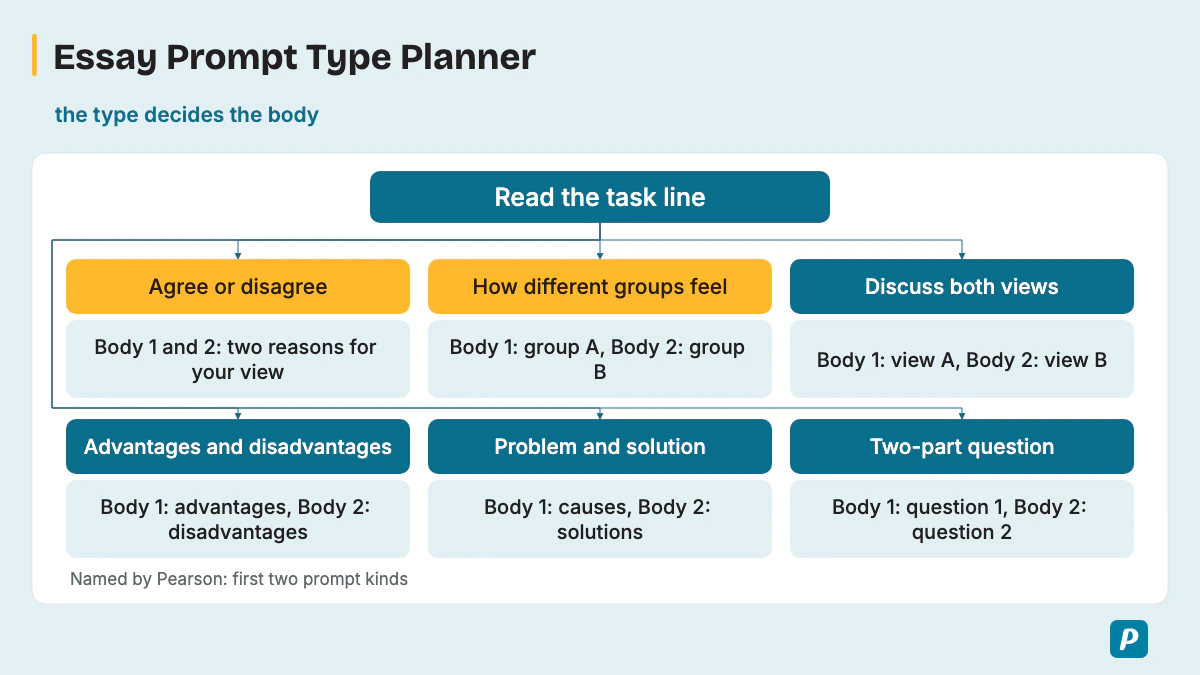
The same theme can arrive as different prompt types, and the type sets what your two body paragraphs do. Each prompt type in the table has a fresh original practice prompt, which brings the total to 126 prompts.
| Prompt type | One original practice prompt | What the body paragraphs do |
|---|---|---|
| Agree or disagree with a statement | Zoos no longer have a place in modern society because wildlife films can teach people about animals. To what extent do you agree or disagree? | Body 1 gives your main reason; body 2 adds a second reason or answers the other side. |
| How different groups of people might feel | Some airports plan to ban night flights to reduce noise for nearby homes. How might local residents and airline workers feel about this? | Each body paragraph explains one group's view and why it holds it. |
| Discuss both views | Some people prefer printed books, while others say e-books are better. Discuss both views and give your opinion. | Body 1 explains one view; body 2 explains the other, and your opinion goes in the conclusion or body 2. |
| Advantages and disadvantages | More students now take a gap year before university. Discuss the advantages and disadvantages. | Body 1 covers the advantages; body 2 covers the disadvantages and weighs them. |
| Problem and solution | Many young people struggle to afford housing in big cities. What causes this problem, and how can it be solved? | Body 1 explains the causes; body 2 proposes solutions. |
| Two-part question | Many adults return to study in their thirties or forties. Why do they do this, and how can employers support them? | Body 1 answers the first question; body 2 answers the second. |
Pearson names only the first two types: agree or disagree, and how different groups of people might feel. Discuss both views, advantages and disadvantages, problem and solution, and two-part questions are labels coaching material uses for common prompt shapes.
What Do PTE Essay Topics With Answers Look Like?
Topics with answers look like a practice prompt from the bank, answered with a 200-300 word four-paragraph essay in original wording. Model answers 1-5 cover five prompt types, and each states its real word count. Study how each one stays on-topic and answers the task line, then write your own; Pearson gives no credit for an unoriginal response.
Model answer 1: agree or disagree (prompt 37, single-use plastics)
Single-use plastics such as bags, straws and food containers have become a symbol of waste, and many governments are now debating whether to remove them from shops altogether. I largely agree that a complete ban on single-use plastics is justified, although it needs to be introduced in stages.
The main reason to support a ban is the scale of the damage these products cause. Most single-use plastic is used for a few minutes and then thrown away, yet it can remain in landfills and oceans for generations. Marine animals swallow plastic fragments, and the same fragments can return to people through the food chain. Voluntary measures, such as asking shoppers to bring bags, have changed habits slowly, so a legal ban sends a clearer signal.
Opponents argue that a sudden ban would hurt small businesses and people on low incomes, who depend on cheap packaging. This concern deserves attention, but it supports careful timing rather than inaction. Governments could phase out the most common items first, give companies time to switch to paper or reusable options, and offer support to small traders during the change.
Overall, the harm caused by single-use plastics outweighs their convenience. A gradual but complete ban would protect the environment while giving businesses and households time to adapt.
Word count: 212 words. The introduction keeps the prompt's key words single-use plastics and ban but rewrites the prompt's sentences in new words ("remove them from shops altogether") instead of copying them. "I largely agree" answers the task line "To what extent do you agree or disagree?" directly.
Model answer 2: discuss both views (prompt 2, daily homework)
Daily homework is a familiar part of school life in many countries, yet parents disagree about whether it helps or harms their children. While both sides make fair points, I believe homework is useful only when it is short and has a clear purpose.
Supporters of daily homework argue that it builds discipline and good study habits. When students review a lesson at home, they remember it better and arrive at the next class ready to build on it. Homework also lets parents see what their children are learning and notice early when they are falling behind, for example in reading or basic arithmetic.
Critics, however, point out that children need time for rest, sport and family life. A student who spends three hours on worksheets every evening may sleep less, exercise less and start to see learning as a burden. Young children in particular learn a great deal through play, conversation and hobbies that homework can crowd out.
In my view, the answer lies in the amount and type of homework rather than in a simple yes or no. Schools should set brief, focused tasks, such as reading for twenty minutes or practicing one new skill, and avoid repetitive exercises. This approach keeps the benefits of homework while protecting the free time that children need to grow.
Word count: 218 words. Each body paragraph explains one view, and the final paragraph gives the opinion the task line asks for.
Model answer 3: advantages and disadvantages (prompt 98, remote work)
A growing number of companies now let employees work from home for part of the week. This arrangement brings clear benefits for both staff and employers, but it also creates problems that need careful management.
The main advantage for employees is flexibility. Without a daily commute, workers save time and money, and they can arrange their day around family duties such as school pick-ups. Companies gain as well, because they can rent smaller offices and hire talented people who live far from the city. A quiet room at home can also suit focused tasks such as writing reports or analyzing data.
On the other hand, remote work can weaken teamwork and learning. New employees miss the informal advice they would pick up by sitting near experienced colleagues, and managers find it harder to notice when someone is struggling. Some workers also find that the line between work and home disappears, so they answer emails late at night and feel unable to switch off.
Overall, the advantages of remote work outweigh the disadvantages when companies plan it well. Regular office days for meetings and training, together with clear limits on after-hours messages, allow organizations to keep the flexibility that employees value without losing the teamwork that makes them successful.
Word count: 208 words. Body 1 covers employees and companies, so both groups named in the prompt get an answer.
Model answer 4: problem and solution (prompt 74, sitting at a desk)
Many office workers now spend most of their working day at a desk, often followed by an evening on the sofa. This inactive routine causes real health problems, but both employers and employees can take simple steps to reduce them.
The most obvious problems are physical. Sitting for long periods with poor posture can lead to back and neck pain, and a lack of movement makes weight gain and heart disease more likely over time. There is also a mental cost, because a day without breaks or fresh air often leaves people tired and less able to concentrate by the afternoon.
Employers can solve part of the problem by changing the workplace. Adjustable desks that let staff stand for part of the day, walking meetings and short scheduled breaks all add movement at little cost. Companies can also offer gym discounts or cycle-to-work schemes that encourage exercise outside office hours. Employees, for their part, can stand up every hour, take the stairs and walk during their lunch break.
Overall, long hours at a desk are a modern health risk, but they need not be harmful. When companies design active workplaces and individuals build movement into their routines, office work can become far healthier. Small daily habits, repeated over years, make the biggest difference.
Word count: 213 words. The prompt asks two things, problems and solutions, and the essay gives each its own paragraph and names both employers and employees.
Model answer 5: two-part question (prompt 85, moving to cities)
Every year, large numbers of people leave villages and small towns to settle in big cities. This movement has several clear causes, and it creates problems for both the cities that receive newcomers and the rural areas they leave behind.
The main reason for this migration is economic. Cities offer a wider range of jobs and usually higher wages, so young people in particular move in search of a better income. Better access to universities, hospitals and entertainment also attracts families who want more opportunities for their children. In many rural regions, by contrast, farming provides an unstable income and few other careers exist.
However, rapid migration causes serious difficulties. In cities, housing becomes expensive and crowded, public transport struggles to cope and some newcomers end up in poor-quality settlements without basic services. Traffic and air pollution also grow as more cars fill the roads. Meanwhile, rural communities lose their young workers, so schools and shops close and older residents are left with fewer people to support them.
Overall, people move to cities mainly for work and services, but the trend puts pressure on both urban and rural areas. Governments can reduce these problems by investing in rural jobs and infrastructure while planning affordable housing in growing cities.
Word count: 208 words. Body 1 answers "what are the reasons", body 2 answers "what problems can it cause", and the conclusion restates both.
To open an essay, paraphrase the prompt in your first sentence instead of copying its wording, as in these opening lines.
- Prompt 1, online degrees: "Distance learning has moved from a niche option to a mainstream route into higher education, raising the question of whether it matches the value of studying on campus."
- Prompt 14, smartphones: "Mobile phones have made people reachable at every hour, and many now ask whether this constant contact has come at the cost of time spent together in person."
- Prompt 25, compulsory voting: "Low turnout at elections has led some governments to consider requiring every adult to cast a ballot."
- Prompt 40, renewable energy: "The shift from coal, oil and gas toward solar and wind power is one of the largest economic changes of this century, and it brings both gains and costs."
- Prompt 49, children's advertising: "Young viewers now meet commercial messages on television, in games and on video apps, which has led to calls for a complete ban."
- Prompt 64, inequality: "In many nations, the distance between the highest and lowest incomes keeps widening, and its causes are as debated as its cures."
- Prompt 79, free health care: "Whether medical treatment should cost patients nothing at the point of use is one of the most contested questions in public policy."
- Prompt 109, extreme sports: "Activities such as skydiving and climbing attract more people every year, even though a single mistake can be fatal."
What Are the PTE Essay Word Count and Time Rules?
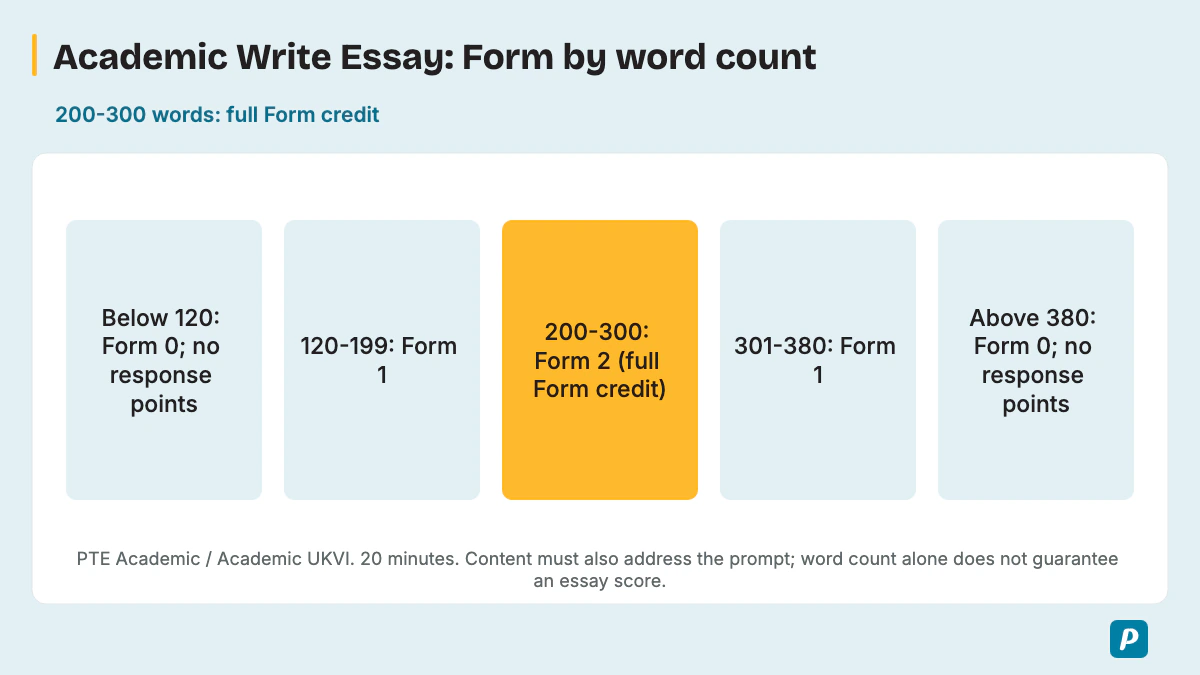
Write 200-300 words in 20 minutes; fewer than 200 or more than 300 lowers the score, and fewer than 120 or more than 380 gets no score points on any of the seven factors. Pearson sets one Write Essay task per test, according to its Score Guide.
| Rule | What Pearson says |
|---|---|
| Length for full credit | 200-300 words. |
| Reduced score | Under 200 words or over 300 words lowers the score. |
| Zero score | Under 120 words or over 380 words gets no score points on any of the seven factors. |
| Form scored 0 | The essay is in capital letters, has no punctuation, or consists only of bullet points or very short sentences (Score Guide). |
| Time | 20 minutes to plan, write and check. |
| Off-topic essay | An essay that does not address the topic is scored zero. |
| Unoriginal response | No credit; "You must use your own words." |
Pearson's Score Guide gives Form 2 points for 200-300 words and 1 point for 120-199 or 301-380 words, so an essay of 120-199 words loses one Form point; below 120 words, Form is zero and the response earns no points. The word count shows on screen while you type, so you can check it without counting by hand.
The split below is a practice guideline for using the 20 minutes, not a Pearson rule.
| Stage | Words | Minutes |
|---|---|---|
| Read the prompt and plan | - | 2-3 |
| Introduction | 40-50 | 2-3 |
| Body paragraph 1 | 70-80 | 5 |
| Body paragraph 2 | 70-80 | 5 |
| Conclusion | 30-40 | 2 |
| Proofread | - | 2 |
| Total | 210-250 | 18-20 |
What Common Mistakes Should You Avoid With Essay Topics?
The costly mistakes are writing about the theme instead of the exact prompt, reusing a memorized answer and ignoring the task line.
- Drifting to the general theme: an essay about "technology" when the prompt asks about smartphones and relationships goes off-topic and costs Content.
- Pasting a prepared answer: a memorized answer reads as an unoriginal response, which earns no credit.
- Answering half of a two-part prompt: a prompt that asks for causes and solutions needs both, or Content drops.
- Missing the word range: 120-199 or 301-380 words earns 1 of 2 Form points, and under 120 or over 380 scores zero.
- Writing in bullet points: the Score Guide gives Form 0 to an essay of only bullet points or very short sentences, or one in capital letters or without punctuation.
- Repeating the prompt's words: copying its phrasing without synonyms limits Vocabulary range.
- Mixing spelling conventions: Pearson accepts US, UK, Australian and Canadian spelling but asks for one convention throughout, so writing "color" and "colour" in one essay breaks that one-convention rule.
- Writing in a chatty register: slang lowers the academic appropriateness that Vocabulary range checks.
- Reusing one linking word: opening every paragraph with "However" weakens the smooth transitions that Development, structure and coherence rewards, so rotate linkers such as "In contrast", "As a result" and "For example".
How Do You Use This List Before Your Exam?
Pick an unseen prompt, write a timed 20-minute essay, check the word count and the seven traits, then move to a different category.
- Choose a prompt you haven't read before, so the practice matches test conditions.
- Underline the key words and the task line before you plan.
- Plan the four paragraphs in a few lines of notes.
- Write against a 20-minute timer and stop when it ends.
- Review the essay against the seven traits and the 200-300 word range, then switch category.
Pearson scores Write Essay on seven traits: Content; Development, structure and coherence; Form; General linguistic range; Grammar usage and mechanics; Vocabulary range; and Spelling. All seven are AI-scored, and a human expert also reviews Content, Development, structure and coherence, and General linguistic range before the task score is confirmed.
Pearson's Score Guide scores Content, Development, structure and coherence, and General linguistic range out of 6 each, and Form, Grammar, Vocabulary range and Spelling out of 2 each. Spelling drops to 1 point with one error and to 0 with more than one.
When a prompt leaves you without ideas, try one of three quick methods during timed practice. List every related point you can think of in one minute, then keep the two strongest. Freewrite for two minutes without stopping, then pick the clearest argument, or draw a mind map with the issue in the middle and causes, effects and groups of people around it. If one category keeps producing thin body paragraphs, that's the category to repeat before the test.
How Do You Write an Essay on Any PTE Topic?
Read the key words, choose one clear position, plan four paragraphs and write every sentence for that prompt. Pearson's essay article frames this as three steps: analyze the prompt and plan, write the essay, then proofread. The plan stays the same across topics, and each new prompt sets the ideas and wording.
What Are the PTE Essay Task Requirements?
Write Essay asks for a 200-300 word argumentative essay in 20 minutes on a 2-3 sentence prompt, and it appears only in PTE Academic. The full task requirements, including every scoring trait, are in the PTE Write Essay task guide.
Which PTE Essay Template Works for Every Topic?
A four-paragraph plan works for every topic as long as you fill it with your own words, because Pearson gives no credit for an unoriginal response. An essay template that fixes the structure, not the sentences, is set out in PTE essay template and structure.
What Are the Tips and Tricks for Writing PTE Essays?
The tips that matter most protect a trait: stay on the exact prompt, stay in the word range, and write correct complex sentences. More essay tips, each tied to the trait it covers, are in PTE essay writing tips.
Where Can You Find PTE Essay Topics With Answers in PDF?
The linked official task page is a format guide, not a complete topic bank. Check a PDF's publisher and rights rather than assuming a coaching list is official. The 126 prompts and five model answers above stay online and free to use. The PTE writing section guide covers the other writing tasks.
Practice PTE Writing on EasyEnglish
Try Writing tasks in a timed, computer-based format like the real test.
Try speaking practice without signing up. A free account is required for full mock tests. Practice scores are estimates, not official Pearson scores.
Written by
EasyEnglish Team
The team behind EasyEnglish's PTE practice and mock tests
EasyEnglish provides independent PTE practice and estimated scores. EasyEnglish is not affiliated with or endorsed by Pearson. Contact support@inverseai.com.
Format and scoring sources checked on 26 October 2026: Academic Speaking & Writing; Core Speaking & Writing; Academic Score Guide; Core Score Guide (January 2026). Academic and Academic UKVI details use the format introduced on 7 August 2025; Core details use its January 2026 Score Guide. Where a task page and Score Guide differ, the distinction is identified in the text; use the Guide for scoring criteria. Practice passages, names, figures, prompts and model answers are authored examples supplied with this guide, not authentic exam items or independently verified research findings. Suggested practice schedules and time splits are coaching advice, not Pearson requirements or score guarantees.
Editorial review completed .