PTE Speaking Format: Sections, Question Types and Answers for 2026
PTE Speaking
The PTE Speaking format sets the order of the speaking items in Part 1, Speaking & Writing, fixes how long you prepare and speak for each, and decides which traits each answer earns. Pearson times Speaking and Writing together in both PTE Academic and PTE Core, so the clock for each item matters more than any section total.
Table of Contents
What Is the PTE Speaking Module?
The PTE Speaking module is the speaking half of Part 1, Speaking & Writing: seven scored speaking question types plus an unscored Personal Introduction in PTE Academic, and five plus the Personal Introduction in PTE Core. Each item is answered once into a microphone on a fixed clock. "Module" and "section" mean the same thing here, since Pearson's pages simply say Part 1: Speaking & Writing. Speaking and writing share one timed part, so Pearson publishes no speaking-only duration. Speaking-only figures such as 30-44 minutes don't appear on Pearson's pages.
How Is the PTE Speaking Section Structured?
In the section structure, speaking opens Part 1, Speaking & Writing, which runs 76-84 minutes with 9 scored question types in PTE Academic and 50-65 minutes with 7 scored question types in PTE Core, plus an unscored Personal Introduction in each. The writing tasks follow in the same part.
| Feature | PTE Academic | PTE Core |
|---|---|---|
| Part of the test | Part 1, Speaking & Writing | Part 1, Speaking & Writing |
| Time for the whole part | 76-84 minutes | 50-65 minutes |
| Scored question types in the part | 9 | 7 |
| Scored speaking types | 7 | 5 |
| Unscored item | Personal Introduction | Personal Introduction |
| Writing tasks in the same part | Summarize Written Text, Write Essay | Summarize Written Text, Write Email |
Pearson's Score Guides do publish an item count for each speaking type, from 2-3 Retell Lecture items to 10-12 Repeat Sentence items; the full count sits in the items table in the next section.
What Are the PTE Speaking Question Types?
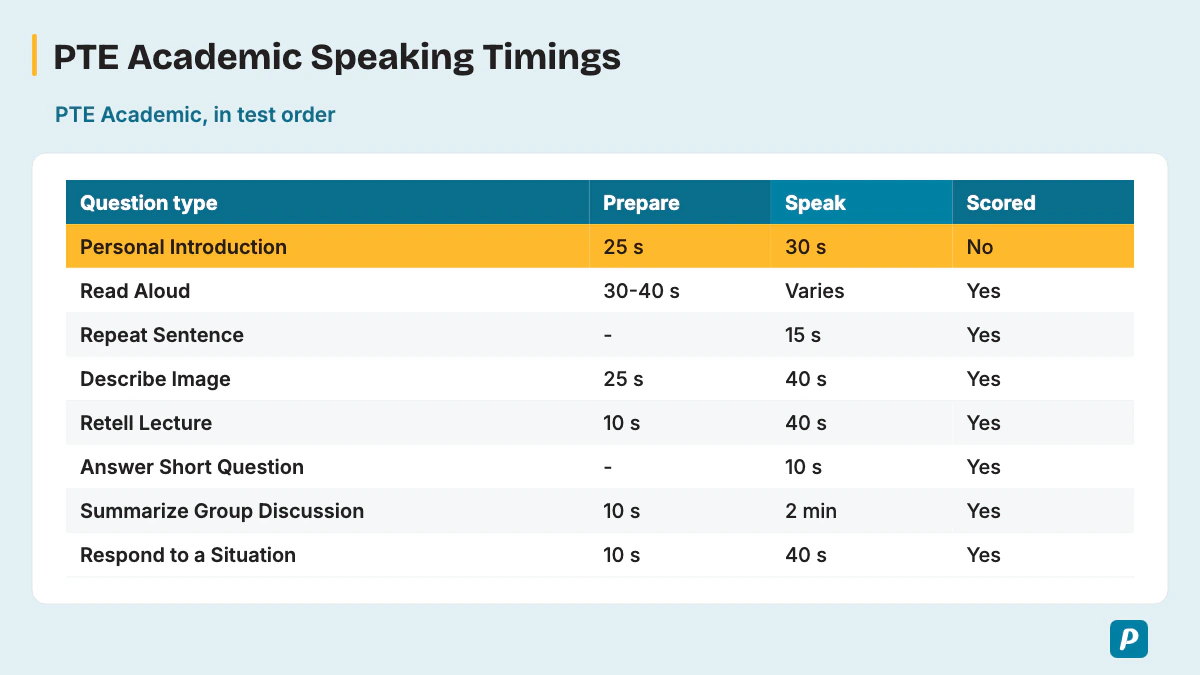
In test order, PTE Academic runs Personal Introduction (unscored), Read Aloud, Repeat Sentence, Describe Image, Retell Lecture, Answer Short Question, Summarize Group Discussion and Respond to a Situation. The table sets out the prompt length, preparation time and time to answer for each, in Pearson's order.
| Question type | Prompt | Preparation time | Time to answer | Scored on |
|---|---|---|---|---|
| Personal Introduction | Written prompt | 25 s | 30 s | Not scored |
| Read Aloud | Text up to 60 words | 30-40 s | Varies by item | Content, Pronunciation, Oral Fluency |
| Repeat Sentence | Audio, 3-9 s | - | 15 s | Content, Pronunciation, Oral Fluency |
| Describe Image | Image | 25 s | 40 s | Content, Pronunciation, Oral Fluency |
| Retell Lecture | Lecture up to 90 s | 10 s after it ends | 40 s | Content, Pronunciation, Oral Fluency |
| Answer Short Question | Audio, 3-9 s | - | 10 s | Correct or incorrect |
| Summarize Group Discussion | Discussion up to 3 minutes | 10 s | 2 minutes | Content, Pronunciation, Oral Fluency |
| Respond to a Situation | Situation up to 60 words | 10 s | 40 s | Content, Pronunciation, Oral Fluency |
Shorter prompt lengths quoted elsewhere, such as 3-7 seconds for Repeat Sentence or a one-minute lecture, are out of date; Pearson's PTE Academic page says 3-9 seconds and up to 90 seconds. A dash means Pearson gives no preparation time for that item. Retell Lecture can be audio or video and may show an image, and in Respond to a Situation the text appears and the audio plays before the preparation countdown starts.
Pearson's PTE Academic Score Guide sets the number of items and the skills scored for each of the speaking question types.
| Question type | Items per test | Skills scored |
|---|---|---|
| Read Aloud | 6-7 | Speaking (Pearson's task notes also mention reading) |
| Repeat Sentence | 10-12 | Listening and Speaking |
| Describe Image | 5-6 | Speaking |
| Retell Lecture | 2-3 | Listening and Speaking |
| Answer Short Question | 5-6 | Listening |
| Summarize Group Discussion | 2-3 | Listening and Speaking |
| Respond to a Situation | 2-3 | Speaking |
The Personal Introduction has no score, so it feeds no skill. Integrated items such as Repeat Sentence count toward both skills they assess.
What Is the PTE Core Speaking Format?
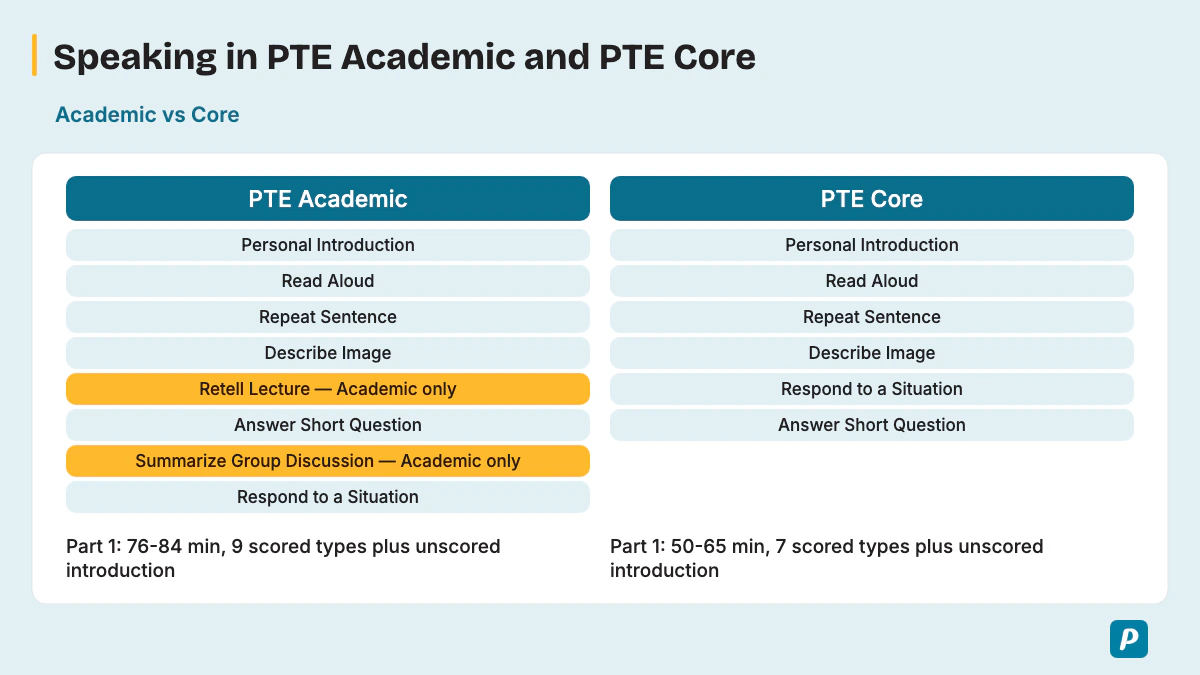
PTE Core keeps Personal Introduction, Read Aloud, Repeat Sentence, Describe Image, Respond to a Situation and Answer Short Question, and drops Retell Lecture and Summarize Group Discussion. The rows below show only where PTE Core differs from PTE Academic.
| Question type | PTE Academic | PTE Core |
|---|---|---|
| Retell Lecture | Yes | No |
| Summarize Group Discussion | Yes | No |
| Respond to a Situation preparation | 10 s | 20 s |
| Respond to a Situation traits | Content, Pronunciation, Oral Fluency | Appropriacy, Pronunciation, Oral Fluency |
| Answer Short Question skills | Listening | Listening and Speaking |
| Read Aloud skills | Speaking | Reading and Speaking |
| Describe Image items | 5-6 | 3-4 |
| Respond to a Situation items | 2-3 | 2-4 |
| Repeat Sentence answer time | 15 s, after a short tone | 40 s shown, no short tone |
Pearson's PTE Core page prints its Repeat Sentence 40 seconds under a second "Prompt length" label, so read it as the answer window and start speaking the moment the microphone opens.
The Core page also says Answer Short Question affects vocabulary scoring. Some prep sites say the situation task replaces Retell Lecture only in PTE Core; Pearson lists Respond to a Situation in both tests. On the writing side of the same part, PTE Core uses Write Email where PTE Academic uses Write Essay.
How Is Speaking Scored in PTE?
Most speaking items are scored on three traits, Content, Pronunciation and Oral Fluency, with partial credit, while Answer Short Question is scored correct or incorrect; scores are reported on the 10-90 scale.
| Trait | What Pearson checks |
|---|---|
| Content | The right words, or all the main parts of the image, lecture or discussion. |
| Pronunciation | Speech most regular speakers understand easily, with correct word and phrase stress. |
| Oral Fluency | Smooth rhythm, phrasing and stress at a constant, natural rate; hesitations, repetitions and false starts lower it. |
| Appropriacy | Used for PTE Core Respond to a Situation only. |
Oral Fluency is scored in 6 PTE Academic speaking tasks and 4 PTE Core speaking tasks, never in Answer Short Question. The Score Guides rate Pronunciation and Oral Fluency from 0 to 5 on every open task. Content runs 0-6 on Describe Image, Retell Lecture, Summarize Group Discussion and Respond to a Situation in PTE Academic, and 0-3 on Repeat Sentence.
Read Aloud Content counts each replaced, omitted or inserted word as an error, and Answer Short Question scores 1 or 0 with a Vocabulary trait. In PTE Core, Describe Image Content runs 0-5 and Appropriacy 0-3.
Pearson says AI scoring covers Content, Pronunciation and Oral Fluency. In PTE Academic, a human expert also reviews Content for Describe Image, Retell Lecture, Summarize Group Discussion and Respond to a Situation.
Pearson gives no credit for an unoriginal response and tells you, "You must use your own words." It also recognizes regional and national accents that most regular speakers understand.
What Are the PTE Speaking Test Rules?
Pearson's rules are start speaking after the short tone, finish before the progress bar ends, and expect each answer to be recorded only once.
- Speak when Recording appears, after the tone where one is provided; earlier speech is not recorded.
- Finish before the progress bar reaches the end, when "Recording" changes to "Completed".
- Expect one recording per item, with no second attempt.
- Answer Short Question has no short tone, so answer as soon as the question ends.
- Pearson's three-second wording reads: "If you wait for more than three seconds, the recording will stop and the item status will change to completed."
- Pearson's second sentence covers pauses: "If you stop for three seconds whilst speaking, the recording status will change to completed even if you haven't finished."
- Speak clearly at a steady, normal volume; Pearson's instruction is "There is no need to rush."
- Set the headset during the microphone check and keep the microphone at the same distance throughout.
- Others test in the same room, and Pearson says the microphones won't pick up what they say.
Pearson writes that three-second wording in the Answer Short Question block. It then adds: "This also applies to speaking item types Read aloud, Repeat Sentence, Describe Image and Re-tell Lecture." It names no such rule for Summarize Group Discussion or Respond to a Situation.
What Are the New PTE Speaking Formats for 2026?
The 2026 format for PTE Academic speaking includes two task types Pearson added in August 2025, Summarize Group Discussion and Respond to a Situation, alongside the earlier five scored types. Older guides still list only Read Aloud, Repeat Sentence, Describe Image, Retell Lecture and Answer Short Question; Pearson's current page lists seven scored types.
- Summarize Group Discussion: a three-person discussion of up to 3 minutes, with 2 minutes to speak.
- Respond to a Situation: a situation task of up to 60 words, with 40 seconds to speak.
Summarize Group Discussion is PTE Academic only, while Respond to a Situation also appears in PTE Core.
How Do You Answer Each PTE Speaking Question Type?
Each speaking type needs its own answer method, from reading in meaning chunks to giving a one-word answer, so practice every question type under its own timer. Record every practice answer and replay it against its own timer, so a 10-second answer and a 2-minute answer each get the pace they need. Open each task page for the full method and samples.
How Do You Answer Personal Introduction Speaking Questions?
Personal Introduction gives you 25 seconds to prepare and 30 seconds to talk about yourself, and it does not count toward your score. This unscored item works as a warm-up and a microphone check. See PTE personal introduction for what to say.
How Do You Answer Read Aloud Speaking Questions?
Read Aloud rewards reading every word as written, in meaning chunks at a natural pace, because replaced, added or missed words lower Content. Use the 30-40 seconds of preparation to mark where each chunk ends. Our PTE read aloud guide shows the method.
How Do You Answer Repeat Sentence Speaking Questions?
Repeat Sentence plays a 3-9 second sentence once, and Content counts the correct word sequences you say back. Since it's played once only, listen for the meaning and keep the word order. More drills are on the PTE repeat sentence page.
How Do You Answer Describe Image Speaking Questions?
Describe Image gives you 25 seconds to study an image and 40 seconds to cover its main point, details and a conclusion in your own words. Pearson warns that memorized responses or templated sentences can lead to a score of 0 for Content. The PTE describe image page covers every image type.
How Do You Answer Retell Lecture Speaking Questions?
Retell Lecture (PTE Academic only) plays a lecture of up to 90 seconds, then gives you 10 seconds to prepare and 40 seconds to retell it in your own words. The lecture can be audio or video and may show an image; Pearson suggests using the 3 seconds before the audio to look at it and predict the topic. Note key words on the erasable noteboard while you listen. Our PTE retell lecture guide explains the note method.
How Do You Answer Short Speaking Questions?
Answer Short Question, the shortest speaking item, needs one or a few words within 10 seconds, scored only correct or incorrect, with no extra marks for extra words. Asked "What instrument do we use to measure body temperature?", you say "a thermometer" and stop; a short answer is all it takes. The PTE answer short question page has practice questions.
How Do You Answer Group Discussion Speaking Questions?
Summarize Group Discussion (PTE Academic only) asks you to paraphrase what each of three speakers said and how their views relate, in 2 minutes. Track who said what, where the speakers agree or disagree and any outcome, because Pearson says retelling the discussion without paraphrasing lowers your score. See PTE summarize group discussion for a structure.
How Do You Answer Respond to a Situation Speaking Questions?
Respond to a Situation gives you a short situation to read and hear, then 40 seconds to answer it in a fitting formal or informal register. Choose a formal register for a manager or a stranger, and an informal one for a friend. Our PTE respond to a situation guide covers this situation task in full.
How Do You Get 76 in PTE Speaking?
A 76 needs all three traits to hold up together: few hesitations, clear stress and answers that cover what each task asks. The Speaking overview gathers the scoring, question types and tips in one place. Pearson publishes no task-by-task route to a target score such as 76, so no page can promise one. Start with our PTE speaking guide.
Practice PTE Speaking on EasyEnglish
Try Speaking tasks in a timed, computer-based format like the real test.
Try speaking practice without signing up. A free account is required for full mock tests. Practice scores are estimates, not official Pearson scores.
Written by
EasyEnglish Team
The team behind EasyEnglish's PTE practice and mock tests
EasyEnglish provides PTE practice and independent preparation guides. Official test rules are checked against the sources identified in each guide; practice examples are illustrative, not real exam questions. Practice scores are estimates. Questions or corrections: support@inverseai.com. EasyEnglish is not affiliated with or endorsed by Pearson.
Editorial review completed .