PTE Eligibility: Age Limit, Qualifications and ID Rules
Understanding PTE
Before you pay for a seat, you want to know nothing will stop you on the day. PTE eligibility comes down to what Pearson checks: an accepted ID whose details match your booking and parent or guardian consent if you are under 18. PTE Core adds a minimum age of 16, and PTE Home is for over-18s. For PTE Academic and PTE Core, a valid passport decides most cases.
Pearson owns and runs PTE and checks these rules through its identification policy. The ID rules differ by test: PTE Core adds the Canadian PR Card in Canada, and PTE Academic UKVI and PTE Home accept a wider UK list.
Table of Contents
What Is PTE Eligibility Criteria?
PTE eligibility criteria are the conditions Pearson checks before and on test day: an acceptable ID that matches your booking, parent or guardian consent under 18, and the age rules for PTE Core and PTE Home. For most test takers the acceptable ID is a valid physical passport. Every PTE test, PTE Home included, is taken at a secure Pearson test center; there is no at-home PTE test.
Pearson publishes no separate eligibility page, so these rules sit across its ID policy, booking help center and test FAQs. The score you need is not an eligibility rule at all: the receiving body sets it.
What Is the PTE Age Limit?
The PTE age limit is short: Pearson states a minimum age 16 for PTE Core, says PTE Home is only for test takers over 18, and requires under-18 consent from a parent or guardian; follow the instructions Pearson provides during booking to confirm that consent. Pearson's PTE Academic FAQ and booking help center give no minimum age for PTE Academic and no upper age limit. Some prep sites quote a "recommended" minimum age of 16 for PTE Academic, but Pearson's own pages do not.
People also ask about "PTE eligibility for female" test takers: Pearson sets no gender-based rule, and the only gender point is that the gender you enter at booking must match your ID. For a 16- or 17-year-old, obtain parent or guardian consent before booking. Follow the instructions Pearson provides during the booking process to confirm that consent.
Is Any Academic Qualification Required for PTE?
No: Pearson's ID policy, booking help center and PTE Core FAQ list no academic qualification or English qualification as a condition for booking PTE. Pearson sets no secondary school requirement and no prerequisite course. You also don't need IELTS or any other test before you book PTE. The course or visa you apply to may set education rules of its own, and those sit with that body, separate from the test.
What Are the PTE ID and Identification Requirements?
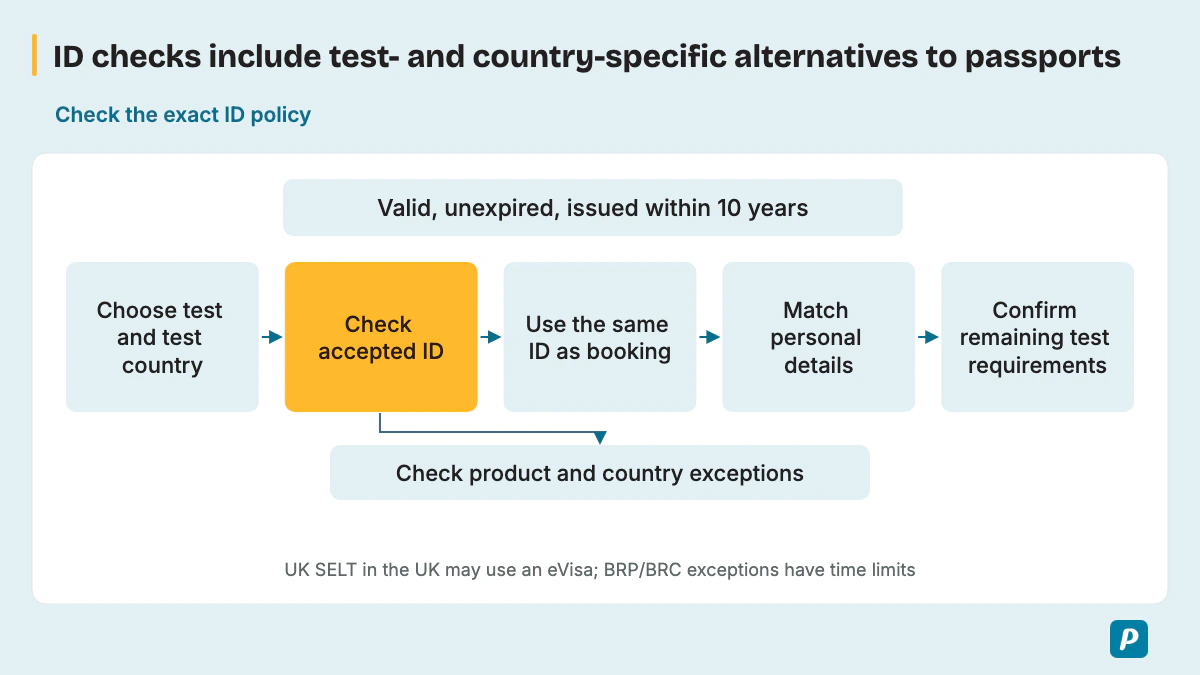
Pearson's identification policy asks for a physical ID that is unexpired, issued no more than 10 years ago and the same one you chose at booking. For PTE Academic and PTE Core that ID is normally a valid physical passport, and the name, date of birth, citizenship and gender on it must match your booking details exactly. These rules from that policy decide whether you get through check-in.
- Digital IDs, photocopies and temporary IDs are refused, except the UK eVisa for UKVI and PTE Home tests taken in the UK.
- Booking details that differ from the ID mean no test, and the fee is lost.
- Outside your country of citizenship, PTE Academic accepts only a passport.
- PTE Core also accepts the Canadian Permanent Resident Card, but only in Canada.
- PTE Academic UKVI and PTE Home accept a UK eVisa share code, entered at booking and usable in the UK only.
- PTE Academic UKVI and PTE Home also accept a BRP or BRC, usable up to 24 months after expiry or until 31 December 2026, whichever is sooner.
- PTE Academic UKVI and PTE Home accept Convention and stateless persons travel documents, inside and outside the UK.
- PTE Academic UKVI and PTE Home accept an EEA ID card in the UK or in its issuing country.
- PTE Academic UKVI and PTE Home accept a photographic national ID card in its issuing country, outside the UK.
- For PTE Academic UKVI and PTE Home, emergency travel documents are refused.
Inside your own country of citizenship, PTE Academic accepts an alternative ID only if it appears on Pearson's exceptions list, so check that list before you rely on anything other than a passport. Write your name in Roman characters exactly as printed, with all given and middle names in "Given name(s)".
Timing matters too. If your passport is held for a visa application, ask for it back before test day. If you are renewing it or replacing a lost one, wait until the new passport arrives before you book, because the booking has to match the passport you'll show.
Immigrant, refugee and stateless test takers who cannot provide any of Pearson's accepted IDs have a separate route. Complete Pearson's Immigrant, Refugee and Stateless Person application form before scheduling the test. Pearson's current ID policy states that Customer Support will respond in 3-5 working days with guidance on the next steps; this is a response window, not approval or a guaranteed test date. Build that time into your plan if a deadline is close.
Who Can Take the PTE Exam?
Anyone who meets the ID and age rules can book PTE, whether they are a school student, a college student, a graduate, a working professional or a migrant. The purpose behind the booking changes from group to group.
- Students applying abroad take PTE Academic for university and college admission.
- Working professionals use PTE Academic for work visas in Australia and New Zealand, or PTE Academic UKVI for UK work visas.
- Skilled migration applicants use PTE Academic for Australia and New Zealand or PTE Core for Canada.
- Nurses use PTE Academic for US nursing registration with HRSA and state Boards of Nursing.
- Family and settlement applicants in the UK use PTE Home, which is open only to adults over 18.
Students under 18 still need parent or guardian consent. Follow Pearson's booking instructions to confirm it. If you have a disability or medical condition, tick the test accommodations option when you create your myPTE account.
Then send Pearson's form with a dated, signed letter from a licensed medical practitioner at least six weeks before the test. Approved arrangements include 25% extra time, a 10-minute break (not for PTE Home) and a separate room. Nothing in Pearson's rules depends on your job or degree, only on your ID, your age and, for minors, that consent.
Which PTE Test Should You Take?
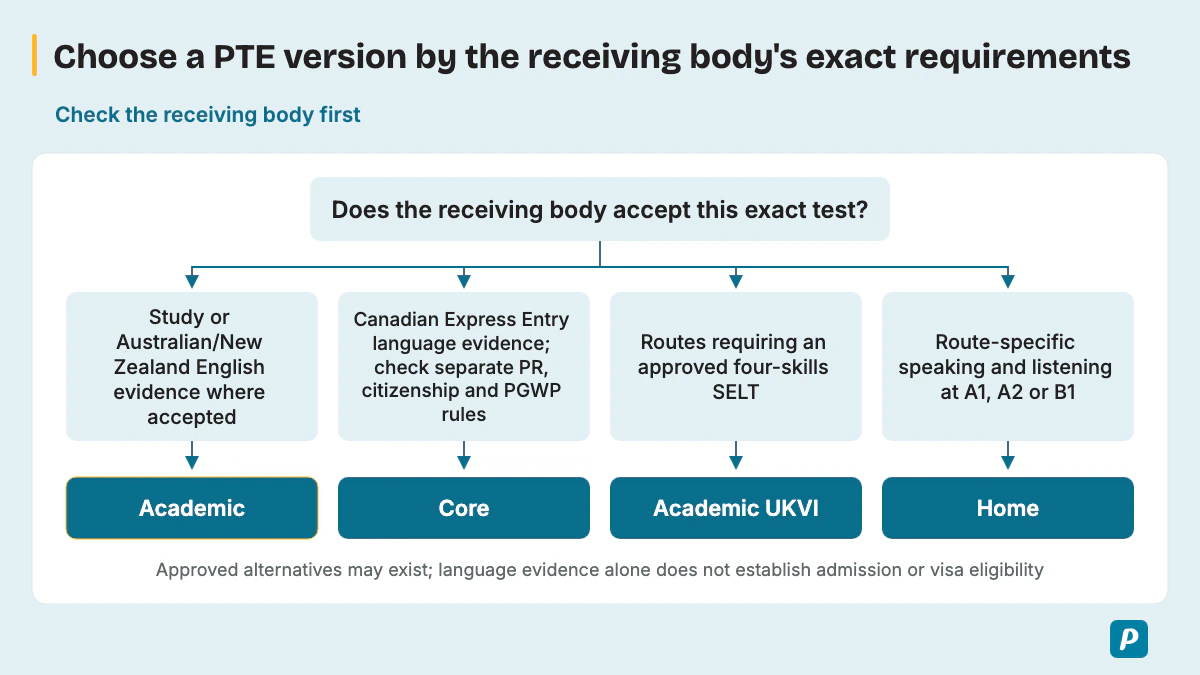
Take PTE Academic for study abroad, Australian and New Zealand work and migration visas, and US nursing registration; take PTE Core for Canadian permanent residency, citizenship and the PGWP. For the UK, Pearson's two approved tests are PTE Academic UKVI and PTE Home. The table matches each goal to its test.
| Goal | PTE test to take |
|---|---|
| Study abroad | PTE Academic, accepted by 4,000+ universities and colleges. |
| Australia or New Zealand work and migration visa | PTE Academic. |
| US nursing registration (HRSA and state Boards of Nursing) | PTE Academic. |
| Canadian permanent residency, citizenship or PGWP | PTE Core. |
| Study in Canada | PTE Academic, not PTE Core. |
| UK work visa or study below degree level | PTE Academic UKVI. |
| UK family visa, extension, settlement or citizenship | PTE Home A1, A2 or B1, a speaking and listening test for over-18s. |
The Canada rows trip people up: PTE Core is for Canadian immigration, and a Canadian university or college asks for PTE Academic. In the UK, the family route asks for A1 at first application and A2 at extension, while settlement and citizenship ask for B1.
Is There a Minimum PTE Score Requirement?
No, PTE has no pass or fail mark: the score requirement comes from the university, employer or visa authority you apply to, on Pearson's 10-90 scale. Any minimum score you see belongs to that body, not to Pearson, which reports your English on the 10-90 scale graded against the Global Scale of English.
Many bodies set a minimum for each communicative skill as well as the overall score, plus academic entry rules of their own. Check both figures on the body's own requirements page before you book. PTE Academic and PTE Core scores have a two-year validity from the test date.
What Are Common PTE Eligibility Mistakes to Avoid?
The mistakes that stop people testing are an ID mismatch, an expired passport, booking while the passport is away, an under-18 booking without guardian consent, and arriving late. Each one breaks a Pearson rule, and most end with the fee lost.
- An ID mismatch between booking and passport breaks the identification policy, so you can't test and the fee is lost.
- An expired passport, or one issued more than 10 years ago, fails Pearson's ID check at check-in.
- Booking while your passport sits with an embassy leaves you with no accepted ID on test day.
- Booking with an old passport you are about to renew means the new one won't match the booking.
- An under-18 booking without guardian consent breaks the booking help center rule for minors.
- Arriving less than 30 minutes before your appointment can mean no test and a lost fee, under Pearson's test taker handbook.
The first one is the easiest to prevent. Pearson requires the details to match exactly, so read your name back from the passport letter by letter before you pay, including every middle name. If a long name will not fit the form, enter as much as fits and send Pearson's support form at least three working days before the test.
How Do You Check Your PTE Eligibility Before Booking?
A quick eligibility check before booking takes four steps: match your passport details to the booking, confirm the PTE variant your goal needs, confirm the score your institution or visa asks for, then book. Pearson lets you book up to six months ahead, so you can run this check well before a deadline.
How Many Attempts Are Allowed for the PTE Exam?
Pearson allows up to 12 tests in a 12-month window, with one test booked at a time. Under the retake policy, a new test can be booked only after the scores from the last test arrive, so attempts follow one another rather than overlap. See how to retake the PTE exam for the timing.
Is PTE Valid for 2 Years or 3 Years?
Two years: Pearson states that PTE Academic and PTE Core scores are valid for two years from the test date. A receiving body can accept older scores under its own rules, which is why "3 years" appears in some answers. Our PTE score validity guide explains how each receiving body sets its own window.
What Is the PTE Exam Fee?
The fee depends on the test country, and Pearson's fee finder shows the current price. In India, PTE Academic, PTE Academic UKVI and PTE Core cost INR 18,900 and PTE Home costs INR 15,300. Elsewhere the fee is AUD 499 in Australia, CAD 360 in Canada, GBP 230 in the UK and USD 275 in the US. You pay in the currency of the country where you test. Our PTE exam fees page lists more countries.
How Do You Register for the PTE Exam?
You register by booking a test on pearsonpte.com, where you create your myPTE account with your passport details. PTE registration and booking are one booking flow, and under-18s need parent or guardian consent and should follow the confirmation instructions Pearson provides during booking. Pearson allows one account per user, so merge any duplicate before you book; our guide on how to book the PTE exam walks through each step.
Practice PTE Online on EasyEnglish
Try Speaking, Writing, Reading and Listening tasks in a timed, computer-based format.
Create a free account to see your practice scores. Scores are our own estimates, not official Pearson scores.
Written by
EasyEnglish Team
The team behind EasyEnglish's PTE practice and mock tests
We build the PTE practice tasks, mock tests and scoring on EasyEnglish, and we oversee every guide on this site. We use official test and government guidance where available, identify authored practice examples and review consequential claims before publication. EasyEnglish is not affiliated with Pearson.
Editorial review completed .